

Netflix critics see mountains of debt and bleeding free cash flow. Opportunists see a company with the world’s best track record for beating the odds in disrupting traditional media.
For investors, it could be a costly mistake to be on the wrong side of that debate, as Netflix stock’s 52-week low is $231 and the high is $385, a sizable spread for a $125 billion market-cap company. In the two weeks that followed the streaming company’s second-quarter earnings release in July, Netflix shed $24 billion in market value. The Los Gatos, Calif.-based company releases third-quarter results Oct. 16.
Investors are on edge with over-the-top (OTT) stocks, with whipsaw reactions to news of any kind that a new entrant has emerged. (An OTT media service offers TV shows and movies directly to viewers via the internet.) And with more than 190 OTT providers in the U.S., there are plenty to keep track of. These days, competition is becoming a daily threat. We’ve seen new services by Apple AAPL, -0.23%, NBCUniversal and Disney DIS, +0.05% challenge investors’ conviction on Netflix.
Second-quarter earnings results added to the debate, as Netflix said the net number of subscribers declined in its home market for the first time. The company also reported fewer-than-expected new international subscribers. Never mind the fact that Netflix is the top streaming service by a wide margin, with 87% of OTT households in the U.S. subscribing to the service.
The OTT growth opportunity is global. Cable companies are primarily holding on to subscribers with live sports and news, suggesting there’s an opportunity for OTT live content. For subscription video on demand (SVOD) content, such as Netflix’s, the domestic market is mature — the company has 60.1 million subscribers, compared with 128 million households. What remains is global.
The international opportunity is clearly indicated in earnings and subscriber growth, and Netflix is primarily in the red with free cash flow due to producing content for various regions. However, the market is myopic with this particular stock, overlooking the simple facts around broadband penetration rates and the lack of viable competitors on a global scale.
Global OTT market
According to Digital TV Research, the global over-the-top market will grow from $68 billion in 2018 to $159 billion in 2024. Subscription services will climb by $51 billion between 2018 and 2024, reaching a total of $87 billion.
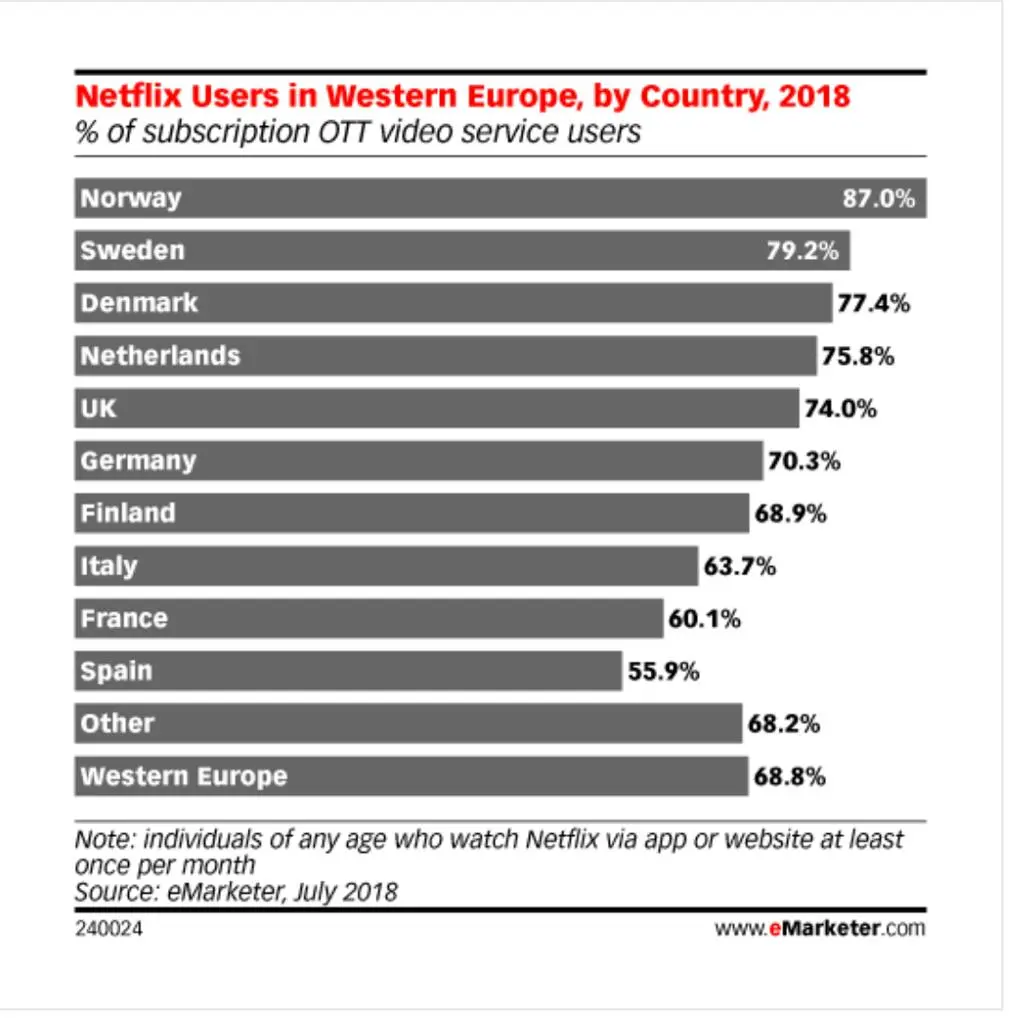
Netflix is the clear leader globally. The streaming service has done an excellent job penetrating Western Europe, which has fast broadband speeds. English-speaking countries represent 70%-87% of Netflix subscribers, while non-English-speaking countries, such as Italy, France and Spain, stand at between 55%-64%.
Asia-Pacific offers growth opportunities as the OTT market is complicated for rivals, yet early in the maturation phase. Some challenges are outside of Netflix’s control, such as in India, where only 1% of the population watches Netflix due to the cost of the service and low broadband speeds. In that country, where 61% of Indians watch pirated content, an ad-supported service is more likely to succeed than a subscription service.
As Asia’s population represents the majority of the world’s, gains of 2%-3% can be more impactful than double-digit increases in North America. According to eMarketer, Netflix’s penetration of Asia-Pacific will advance from 11.8% in 2018 to 14.3% in 2020.
Regions such as China have high barriers to entry for stand-alone services, yet Netflix has secured a promising licensing deal with iQiyi IQ, +2.41%, which is owned by Baidu BIDU, +1.65%. Netflix’s share in Japan remains at 17%, despite launching in 2015, as the country has an older population that is averse to new technologies.
International markets such as Central and Eastern Europe, the Middle East and Africa have upside for acquired titles, an area of strength for Netflix.
If Netflix continues to dominate globally, then the company could be serving 50%-70% of developed countries and 20% of the developing world. With the limitations of broadcast and linear television, it’s unprecedented to have a truly global media company. We will see the full effects of this long after the United States is saturated.
See: Beth Kindig’s premium service for entries and exits on technology stocks
Broadband penetration
The OTT market in the U.S. took a decade to surpass pay TV, with Hulu launching in 2007, popular set-top boxes starting circa 2008 and Netflix’s streaming service beginning in 2010. (Netflix was founded in 1997 as a DVD-rental service.) This growth has been assisted with the wide availability of high-speed broadband.
The global market will take twice, or maybe three times, that long. Broadband is slow to non-existent in many countries, although progress is being made. Brazil, for instance, reports a 20% annual improvement in households with 4 Mbps (megabits per second) or more. (Netflix requires at least 3 Mbps.)
Japan and South Korea have nearly 50 million people with speeds of 100 Mbps or higher. Fiber technology and broadband are prominent in Japan and South Korea, along with Australia, Hong Kong, Malaysia, Singapore, Taiwan and Vietnam. There is room for growth once higher broadband rates are achieved in New Zealand, Indonesia, Thailand, India and the Philippines.


