Nvidia Fiscal Q2: The AI Giant Answers to Losing Market Share
Written by
Beth Kindig
Lead Tech Analyst
Published: August 27, 2026
Last Updated: August 27, 2026
On this page
Nvidia reported another impeccable quarter, yet the more important story came from the earnings call. As the I/O Fund has covered in the past, Nvidia’s share of the AI accelerator market is expected to decline from roughly 90% during the Hopper-Blackwell generations to around 70% by the end of 2026, according to some industry researchers. This is primarily due to competition from hyperscalers deploying their own custom chips.
But Nvidia effectively pulled a rabbit out of a hat this quarter by showing investors they may be asking the wrong question. Rather than be concerned with the exact percentage of its dominant market share, Nvidia demonstrated that it may not need hyperscalers to the degree the market thinks.
According to management, “There is sovereign AI, there are regional AIs, there are neoclouds, there are AI startups at enterprises […] which represents about half of our business, and that is growing 100% a year.”
This growing customer list helped lead to an even bigger surprise than the current quarter’s beat, which is that Nvidia broke their typical guidance cadence by providing a guide for FY28, stating they will report 70% growth, or about $691 billion, compared to analyst estimates for $570 billion.
Below, we discuss the main takeaway from Nvidia’s earnings report, which is that the AI infrastructure buildout is finally broadening beyond Big Tech.
ACIE Segment Drives $40 Billion Revenue at 138% Growth Rate
Last quarter, Nvidia separated hyperscalers from AI Clouds, Industrial and Enterprise customers (ACIE) for the first time. The new disclosure is increasingly important because it proves that Nvidia can be more resilient than feared should more Big Tech capex be redirected to custom silicon.
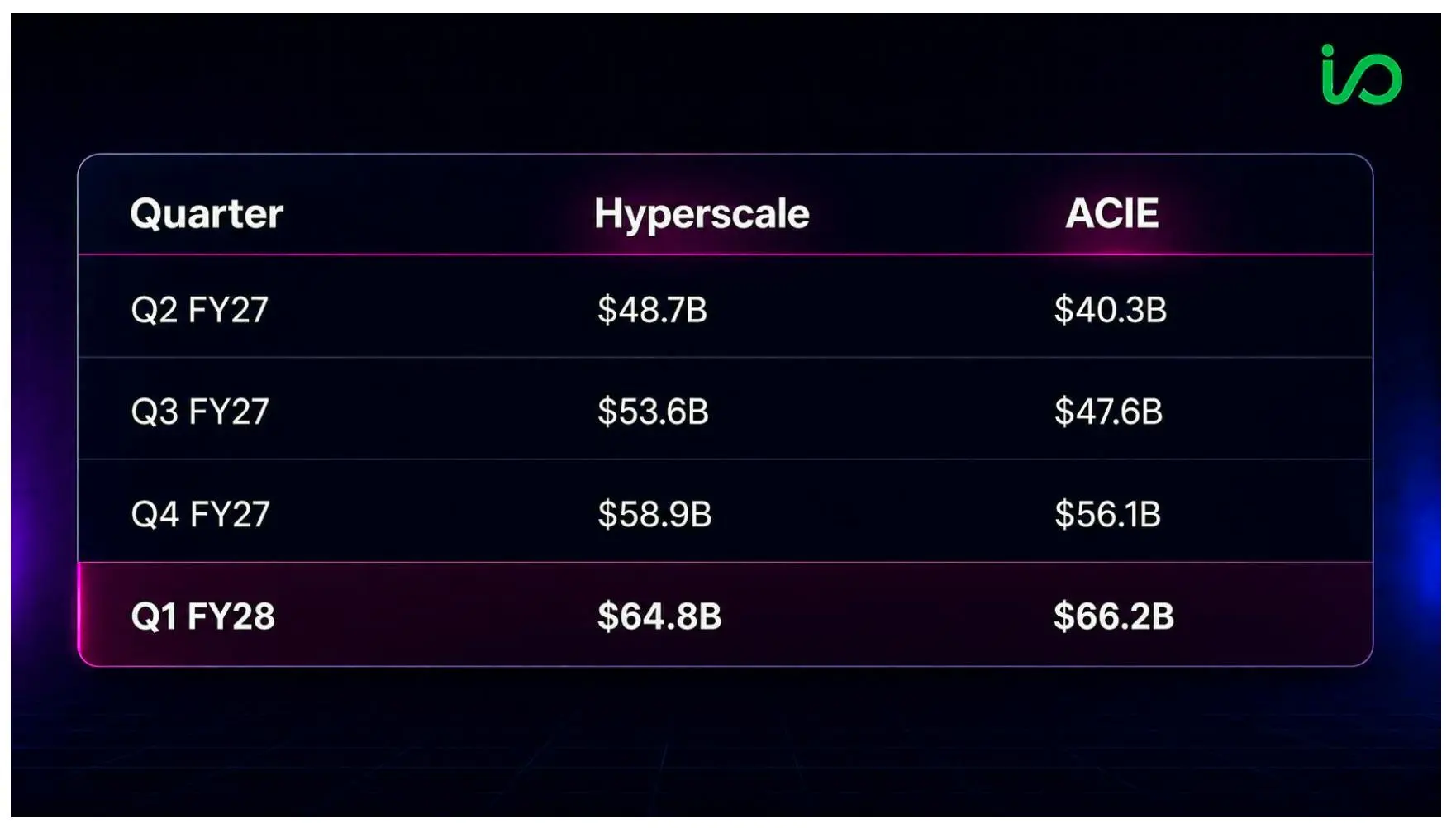
This quarter, hyperscalers represented revenue of $48.7 billion compared to ACIE revenue of $40.3 billion, yet ACIE had a stronger growth rate of 138.5% compared to the hyperscaler segment at 101.2%. After reclassifying one company, the QoQ growth for ACIE was 25% compared to hyperscalers at 13%. Within this, sovereign AI revenue and regional neoclouds reported growth of 35% QoQ and tripled YoY.
Depending on how you model the two-quarter lumpiness, ACIE can conservatively overtake hyperscalers in 5-6 quarters at a 14% QoQ growth rate versus 10% QoQ growth rate for hyperscalers, or as soon as 2 quarters if the Q2 pace continues.
This table compares projected Nvidia revenue from hyperscale customers and the AI Cloud, Industrial and Enterprise (ACIE) segment from Q2 FY27 through Q1 FY28. Starting from Q2 FY27, hyperscaler revenue stands at $48.7 billion versus $40.3 billion for ACIE. Assuming higher growth rates for ACIE, the gap steadily closes over subsequent quarters, with ACIE projected to reach $66.2 billion in Q1 FY28, surpassing hyperscaler revenue of $64.8 billion. The projections highlight how data center growth is increasingly being driven by a broader mix of AI customers beyond hyperscalers.
Perhaps Nvidia is in no hurry for ACIE to surpass hyperscalers, as having both grow at a strong rate is, of course, the better outcome. Following Q2 reports, Big Tech’s spending remains exceptionally strong, with Microsoft, Meta, Amazon and Google currently expected to deploy $432 billion in the second half of 2026 alone. Including Oracle, capex at the top five hyperscalers is closing in on $800 billion this year, nearly doubling YoY, assuming no further raises.
Currently, consensus estimates are pointing to combined capex approaching as much as $1.1 trillion, a more than 4X increase in just three years. Yet, Nvidia offered a welcome surprise on the capex front this quarter, with CFO Collette Kress stating: “With cloud industry backlog now greater than $2 trillion, CapEx by the top five hyperscalers is expected to reach nearly $800 billion in 2026 and $1.3 trillion in 2027.”
That view sits $200 billion above consensus estimates, or more than 18%. The weight of Nvidia’s words should not be discounted as it arguably has the best visibility in the world into hyperscaler spending trends through its demand pipeline.
However, given that hyperscalers represent roughly half of Nvidia’s data center revenue, seeing a rising tide in two customer groups is an ideal setup.
Lifetime Token Output Help Justify Price Increases
At the heart of every Nvidia’s earnings report is the question – how will the world’s most valuable company continue to grow? The economics around lifetime token output increasingly matters for inference as it brings to the forefront that it’s less about what the systems cost, and it’s more about how many tokens a rack can generate.
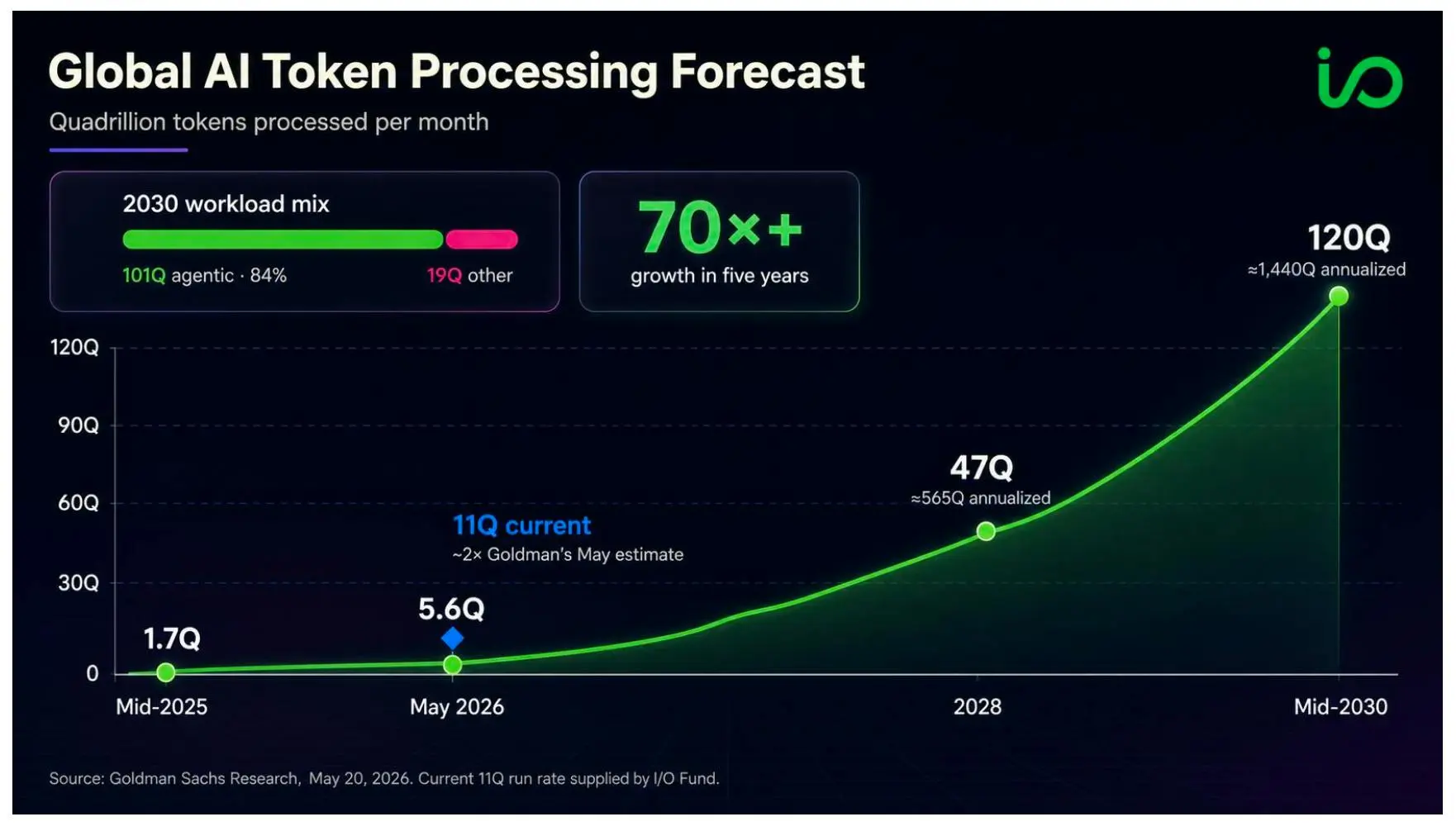
We covered this topic in our previous free newsletter “AI Token Demand is Shattering Forecasts” when we pointed out that: “Goldman Sachs’ forecasts from May 2026 estimate that token processing will hit 47 quadrillion per month in 2028. That is approximately 565Q tokens per year, or about 10X Dell’s forecast. The firm sees monthly token processing rising from 1.7Q in mid-2025 to nearly 120Q in mid-2030 (1,440 quadrillion annually) a more than 70X increase in five years. Of this, Goldman estimates that around 101Q tokens will come from agentic workloads, or over 80% of the total.”
This chart projects global AI token processing growth from mid-2025 through mid-2030. Monthly token processing is forecast to increase from 1.7 quadrillion tokens in mid-2025 to 47 quadrillion in 2028 and 120 quadrillion by mid-2030, representing more than 70x growth in five years. The chart also shows a current run rate of 11 quadrillion monthly tokens, nearly double Goldman Sachs’ May 2026 estimate of 5.6 quadrillion, while agentic AI is expected to account for 101 quadrillion monthly tokens, or 84% of workloads, by 2030.
As token forecasts explode higher, it provides an opportunity for Nvidia to drive down costs while simultaneously raising prices. To illustrate, one reason token usage is surging is that users are asking models to complete more complex tasks, which increases the input and output for each request. On the Q2 earnings call, Kress stated: “Meanwhile, because NVIDIA’s compute is so productive, the tokens they are generating, the GPU hours they are renting out is insanely profitable as you know. Their margins are fantastic.”
This helps justify Nvidia’s price increases – even as more competition enters the market. Ahead of the earnings call this week, Reuters reported that Nvidia planned to raise server prices by 15%, however, this does not necessarily lead to 15% in the cost if Rubin can generate substantially more tokens.
Nvidia has stated the upcoming generation Vera Rubin can deliver 50X more throughput per megawatt and 35X lower token cost relative to Blackwell Ultra. In the event that higher throughput can rise faster than total cost of ownership, then hyperscalers and ACIE customers will be more willing to pay higher prices if the systems lower the cost of every token produced.
From Hopper to Rubin, Revenue per Gigawatt Keeps Climbing
Another one of the more overlooked comments from Nvidia’s earnings call centered around how much revenue the company now expects to generate from every gigawatt of deployed AI infrastructure.
On the earnings call, CEO Jensen Huang stated: “The other part of it is, and this is the reason why we mapped it out for you. In the case of Hopper, we were at about $18 billion per gigawatt. For Grace Blackwell, we are about $25 billion per gigawatt. For Vera Rubin, it is about $40 billion per gigawatt.”
Moving from $18 billion per GW with Hopper to $40 billion with Rubin represents more than a 2.2X increase in revenue density from essentially the same amount of infrastructure. Management is becoming more focused on tokens per watt because Nvidia’s customers won’t be able to secure infinite power, so the goal for Nvidia will be to double the revenue generated from every gigawatt deployed.
Get Our Free Weekly Stock Newsletter
Get weekly stock insights, market analysis, and technology updates straight to your inbox.
Weekly stock insights
Market analysis
Technology updates
Nvidia’s Strong Financials Enable Circular Investing at Scale
There was little fault within Nvidia’s growth metrics in Q2. Revenue accelerated more than 20 points to 105.9% YoY, its first triple-digit growth quarter in two years despite its revenue base being 3X larger at $96.2 billion. Q3 guidance pointed to 89.5% YoY growth to $108 billion, marking Nvidia’s first $100 billion-plus quarter.
Most importantly, Nvidia raised guidance for FY28, stating revenue would grow 70%. Assuming 12% QoQ growth in FQ4, roughly matching FQ3’s guide, this would project FY28 revenue out to $691 billion, a year ahead of consensus estimates, which sat at $570 billion in FY28 and $695 billion in FY29 heading into the report.
To put the size of this raise in perspective with Nvidia’s cumulative $1 trillion in Blackwell and Rubin visibility, analysts implied this would be about a $200 billion raise: “The 70% growth in fiscal 2028, which I guess is sort of calendar 2027, that is something like, I don’t know, a $200 billion uptick versus the prior outlook if I back it out. The prior outlook was $1 trillion over the 3 years, so this is probably $200 billion more.”
The strength of Nvidia’s financials, evident in its accelerated growth guide and margin strength in the face of memory cost headwinds, is allowing it to take a more front-and-center stance in circular financing. This includes providing financial guarantees on Open AI’s mega-campus and AI cloud agreements with third-party customers.
This quarter, Nvidia laid its cards on the table in the circular financing arena, stating it currently has $164.5 billion in land, power and shell guarantees, and AI cloud agreements. The majority of this, $105 billion, is a guarantee to provide credit support for OpenAI to lease capacity at SB Energy’s mega-scale Ohio campus, with an initial 4.25GW plus an option for an additional 3.75GW.
Overall, these guarantees are relatively spaced out. For OpenAI, the guarantee obligations will be phased as capacity comes online, with the first expected in fiscal 2029; for the AI cloud agreements, Nvidia’s guarantees range between $6 to $8 billion annually from fiscal 2028 through fiscal 2031.
Considering the revenue ramp into FY28 and strong gross margin profile, a reasonable assumption to maintain a mid-40% free cash flow margin next year could see Nvidia generate north of $310 billion in FCF – or enough to cover the current obligations by nearly 2X.
Neoclouds Seeing 10X more Tokens Per GW with Rubin
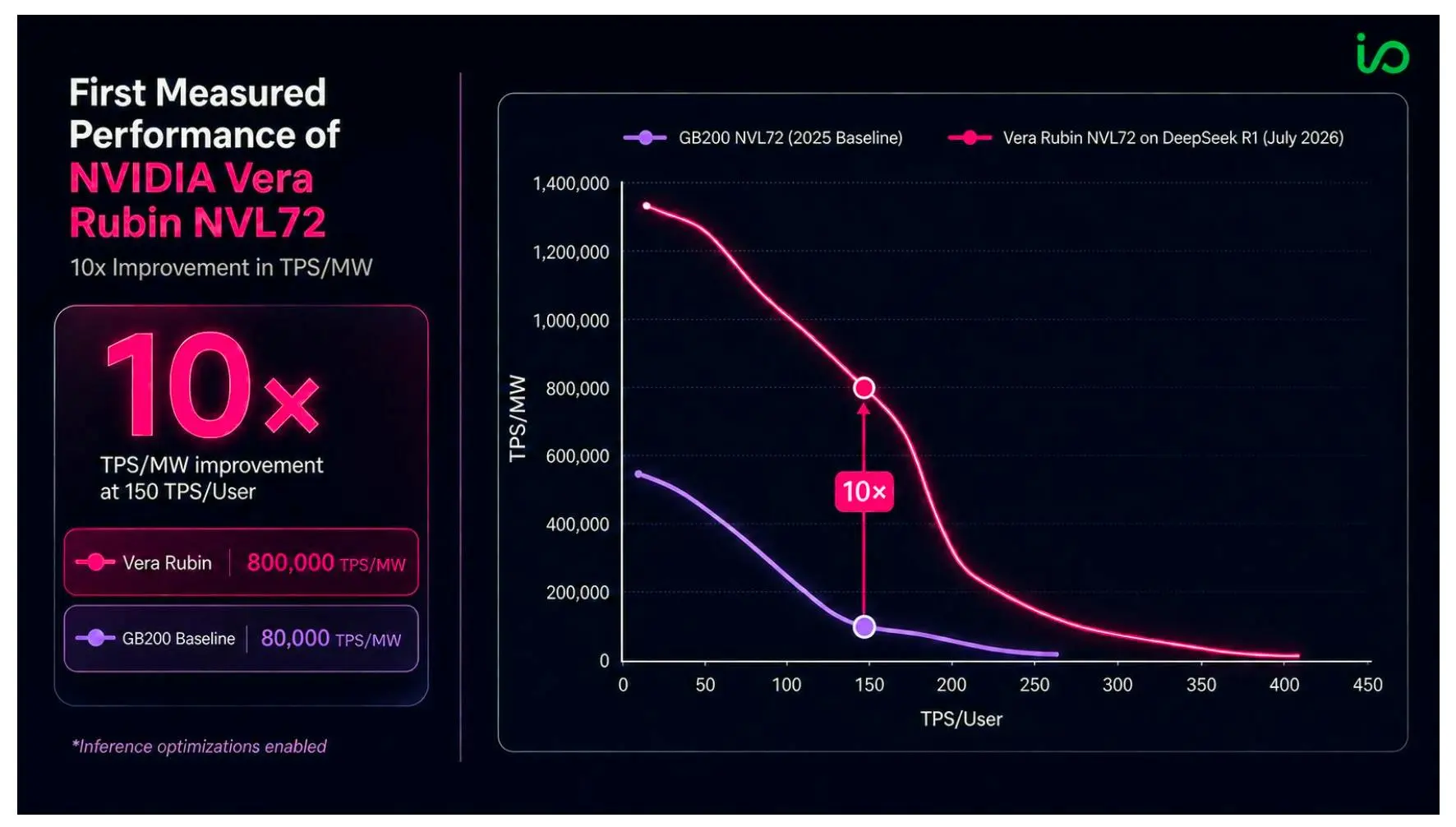
While Vera Rubin carries quite the price tag premium compared to Hopper and Blackwell systems, the new generation is showing significant performance improvements in terms of throughput per MW. CoreWeave offered the first look at Vera Rubin NVL72’s performance on DeepSeek R1 in July, finding up to a 10X increase in tokens per MW compared to the GB200.
Simple back-of-napkin math shows revenue implications remain substantial – even assuming an 80% decrease in token prices from a theoretical $5 per million to $1 per million, a 10X increase in TPS per MW could see revenue rise 2X, using CoreWeave’s example below.
This chart compares inference performance between Nvidia’s GB200 NVL72 and Vera Rubin NVL72 running DeepSeek R1. At approximately 150 TPS per user, Vera Rubin achieves roughly 800,000 TPS per MW, compared to about 80,000 TPS per MW for the GB200, representing a 10x improvement in throughput per megawatt.
Once a data center maxes-out its available megawatts, additional compute cannot be added without new energy infrastructure, which can take years. Nvidia’s approach is to give customers another path to growth by producing more AI output from the same facility.
We touched on this in our 90-page I/O Fund’s Top 20 Stocks Report published in July, stating, the subtle hint from Nvidia’s March GTC is that the core KPI is no longer simply FLOPs, but tokens per watt. In other words, if a data center has 100MW of power, the winning architecture will be the one that can produce more inference within that same power envelope […] Vera Rubin therefore allows substantially more inference in the same facility power envelope, which is critical for hyperscalers constrained by power availability.”
Conclusion:
If I were to describe this earnings report in just a few words, it would “AI is broadening beyond just the hyperscalers.” Funny enough, customer concentration was the market’s major concern, and yet even while clearly illustrating that demand is broadening, the stock is only up a few points after hours. The disconnect may be that ACIE revenue growth is being discounted for its creative financing structure, as it would make sense for this revenue to be assigned a lower multiple.
If only stock investing were as easy as finding a company that reports strong financials and has a clear runway for growth. Instead, Nvidia continues to battle with an important resistance zone of $236.55. If I were to guess, the catalyst that pushes the stock past this level can be described in two words – and it arrives in the January quarter: Vera Rubin.
Nvidia remains one of the most important companies in AI, but the biggest winners over the next several years won’t necessarily be the largest companies. Find out which AI stocks we currently rank ahead of Nvidia inside the I/O Fund’s Top 20 Stocks Report, including real-time trade alerts, weekly webinars and an audited portfolio with an industry-leading annualized return.
Subscribe to access the I/O Fund’s Top 20 Stocks report: Learn more here
Please note: The I/O Fund conducts research and draws conclusions for the company’s portfolio. We then share that information with our readers and offer real-time trade notifications. This is not a guarantee of a stock’s performance and it is not financial advice. Please consult your personal financial advisor before buying any stock in the companies mentioned in this analysis. Beth Kindig and the I/O Fund own shares in NVDA at the time of writing and may own stocks pictured in the charts.
I/O Fund will soon migrate to a newly redesigned website. Our official domain will remain io-fund.com. If you experience any issues during the transition, please contact support@io-fund.com.
Beth Kindig is the lead tech analyst for the I/O Fund with audited results that beat Ark in 2020 and returns of up to 1700% on her premium site in two years and 1150% in her free newsletter in three years on individual stocks and assets.