Digital Ads

Is TV Advertising Dead? Ad Revenues Suggest Otherwise

Written by

Beth Kindig

Founder, CEO and Lead Technology Analyst

Published: June 12, 2018

Last Updated: June 12, 2018

Ideally, advertisers experience the same brand recall from TV combined with the audience-based targeting advertisers use in digital. By combining the best qualities of television with the addressability of digital, advertisers could have targeted, dynamic video ads in TV-quality streaming environments.

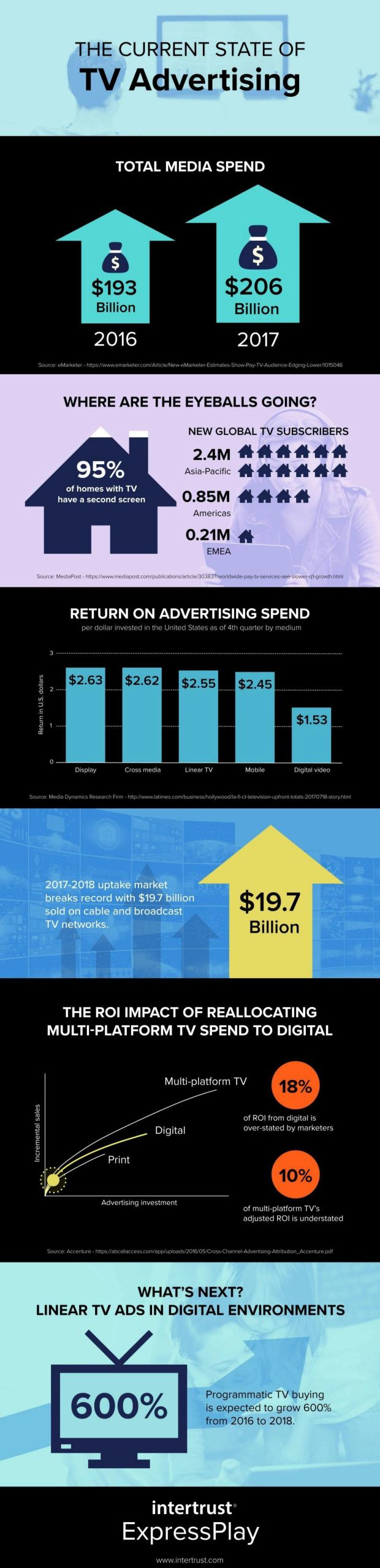
Cord cutters are getting a lot of attention these days. Perhaps justified considering 95% of homes with TV have access to services that can be viewed on another screen, contributing to the lowest growth rate ever for worldwide pay TV subscribers. Globally, Asia-Pacific saw the biggest gains adding 2.4 million homes compared to the Americas which added 850,000 homes and EMEA adding 210,000 homes[1].

However, while eyeballs may be shifting, many advertisers report TV ads delivering better ROI than digital. Coca-Cola’s global chief marketing officer famously declared to conference attendees they see $2.13 returned for every dollar spent on TV compared to $1.25 for dollars spent on digital.

Beth Kindig, founder and lead tech analyst of I/O Fund

Get Our Free Weekly Stock Newsletter

Get weekly stock insights, market analysis, and technology updates straight to your inbox.

  • Weekly stock insights
  • Market analysis
  • Technology updates

A recent study by Accenture found that marketers over-state ROI from digital at almost 18% when seen as a standalone channel by failing to track and measure the halo effect from multi-platform television. Conversely, multi-platform TV’s adjusted ROI is understated by 10% according to the study by being mistakenly credited to single channels which analyzed $12 billion in anonymized marketing spend. In addition, while ROI from search, display and short-form video is high at initial spend levels, returns diminish as spend increases.

This infographic on The Current State of TV Advertising illustrates key points on the importance of TV Advertising today:

About the author

Beth Kindig

Beth Kindig

Profile

Beth Kindig is the Founder, CEO and Lead Technology Analyst at I/O Fund, with more than 15 years of experience covering private and public technology companies. Known for her early Nvidia research beginning in 2018 and bold, high-conviction calls on emerging technology trends, Beth also manages I/O Fund's audited technology portfolio, which has returned 326% since May 2020, or 29.2% annualized. She is a regular guest on Fox Business and Bloomberg and has appeared on Real Vision, CNBC, Yahoo Finance, BBC, MarketWatch, Forbes, and more.

Curation

Expand your knowledge

View all posts
AMD Stock: Two-Catalyst Punch Leads to 80% Growth Next Year
SEMICONDUCTOR STOCKS

AMD Stock: Two-Catalyst Punch Leads to 80% Growth Next Year

In August, our premium article "Venice Meets Helios" pointed to two strategic product releases that were arriving soon - AMD’s Venice CPUs and the highly anticipated Helios MI400 Series. At the time, management expected server CPU revenue to grow more than 70% in 2027, while total Data Center revenue would grow “well over 100%,” driven by the Helios ramp. Three months later, AMD has raised its outlook considerably, and the two product ramps are now exceeding the I/O Fund’s original expectations. Server CPU revenue is now expected to more than double in 2027, up from the previous outlook for 70%+ growth. Meanwhile, Data Center AI revenue (GPUs) is expected to significantly more than double.

SEMICONDUCTOR STOCKSNOV 13, 2026
Nvidia Says Capacity Is the Constraint: 3 Bottlenecks Holding Back the AI Buildout
AI STOCKS

Nvidia Says Capacity Is the Constraint: 3 Bottlenecks Holding Back the AI Buildout

Nvidia has signed capacity agreements with six key suppliers for chip parts and has a new design to build AI data centers, even as CEO Jensen Huang points out extraordinary demand amid capacity constraints. However, grid power remains the limit Nvidia can’t fix on its own.

AI STOCKSNOV 13, 2026
Data Centers in Space: Google Runs AI on 1 kW in Orbit as SpaceX Bets on Orbital Compute
DATA CENTER

Data Centers in Space: Google Runs AI on 1 kW in Orbit as SpaceX Bets on Orbital Compute

Google ran AI in orbit on about 1 kW. SpaceX plans 250 kW satellites. A 1 GW campus on Earth uses 1,000,000 kW. We take a deep dive into what it takes to put data centers in space.

DATA CENTERNOV 12, 2026