
This week, AMD reached a $1 trillion market cap – an incredible victory given the company was on the brink of bankruptcy in 2014. When Lisa Su became CEO of the company, she inherited a company with margins that were deep in the red, operating at a loss from 2012-2017. The huge bets the company made under her leadership with the Zen architecture were bold, and saved AMD from going under.
Six years ago, I dubbed AMD the “Dark Horse” for my premium research members as the company had a mere 4% share in the CPU-data center and was up against the near-monopoly of Intel. The term “Dark Horse” refers to a competitor that unexpectedly achieves victory, as in March of 2020, I began publishing my prediction that AMD would eventually overtake Intel.
That prediction has played out extraordinarily well as Intel is closing-in on first place on x86 server CPU market share. At AI Investor Day 2025, Lisa Su stated that AMD has a “clear path to capturing more than 50% of server revenue market share,” up from roughly 40%, combined with a 60% data-center CAGR.
That’s certainly exciting – but I’m not here to talk about Intel.
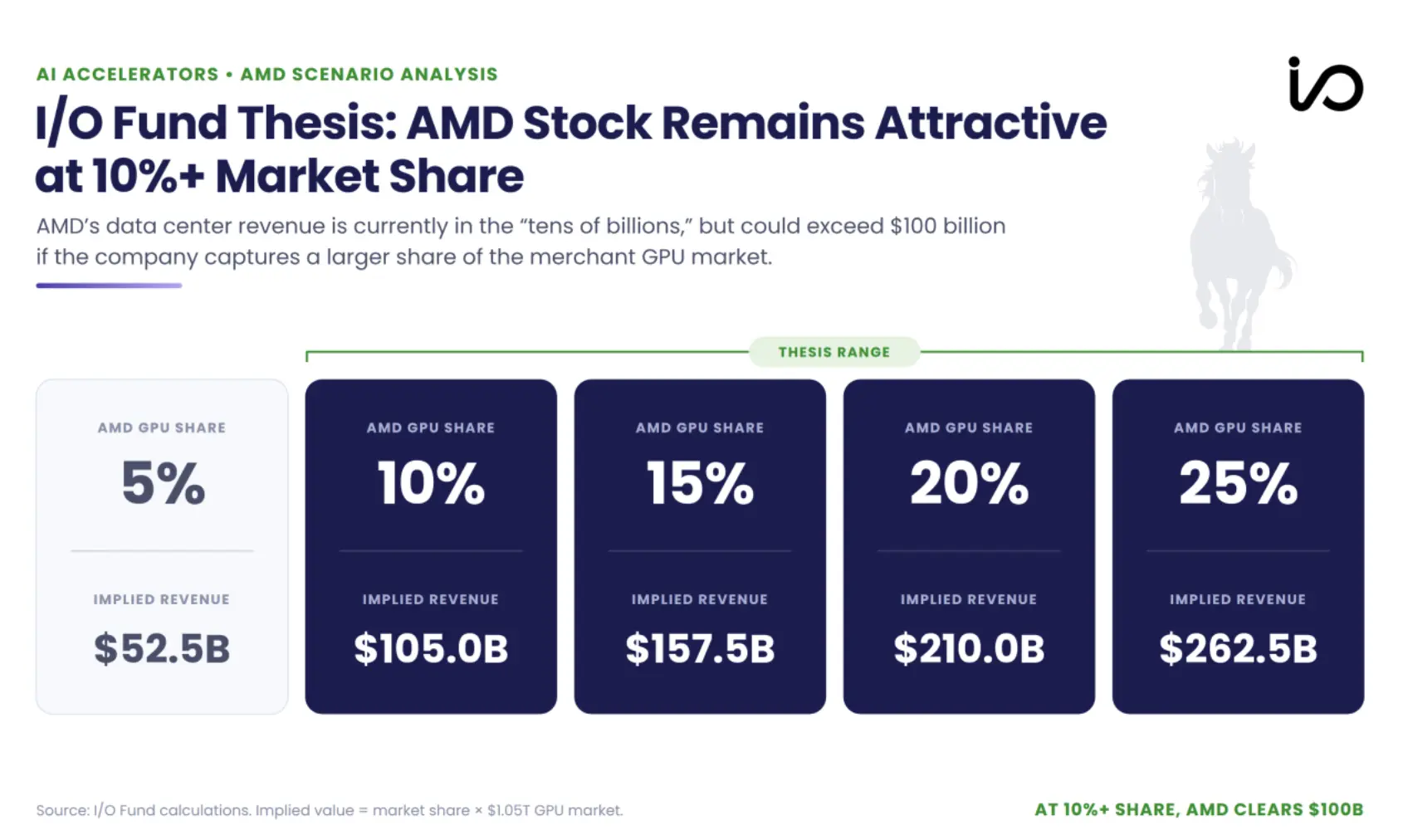
I’m here to talk about Nvidia. If we examine Nvidia’s GPU server market share compared to AMD’s GPU server market share, eerily enough, we are in a similar place of trailing on market share. AMD has an estimated 5%-7% of the GPU server market compared to Nvidia’s 85%+.
The market perception is also nearly identical, as AMD is once again entering a battle against a dominant incumbent that few believe it can meaningfully challenge. Nvidia has built the most valuable semiconductor company in history; it will not concede as easily as Intel.
This leads back to another prediction that I published in July of 2024 – not that AMD would surpass Nvidia in GPU market share, but that AMD stock would surpass Nvidia in returns over a five-year period. We are now halfway through that prediction, and so far, so good.
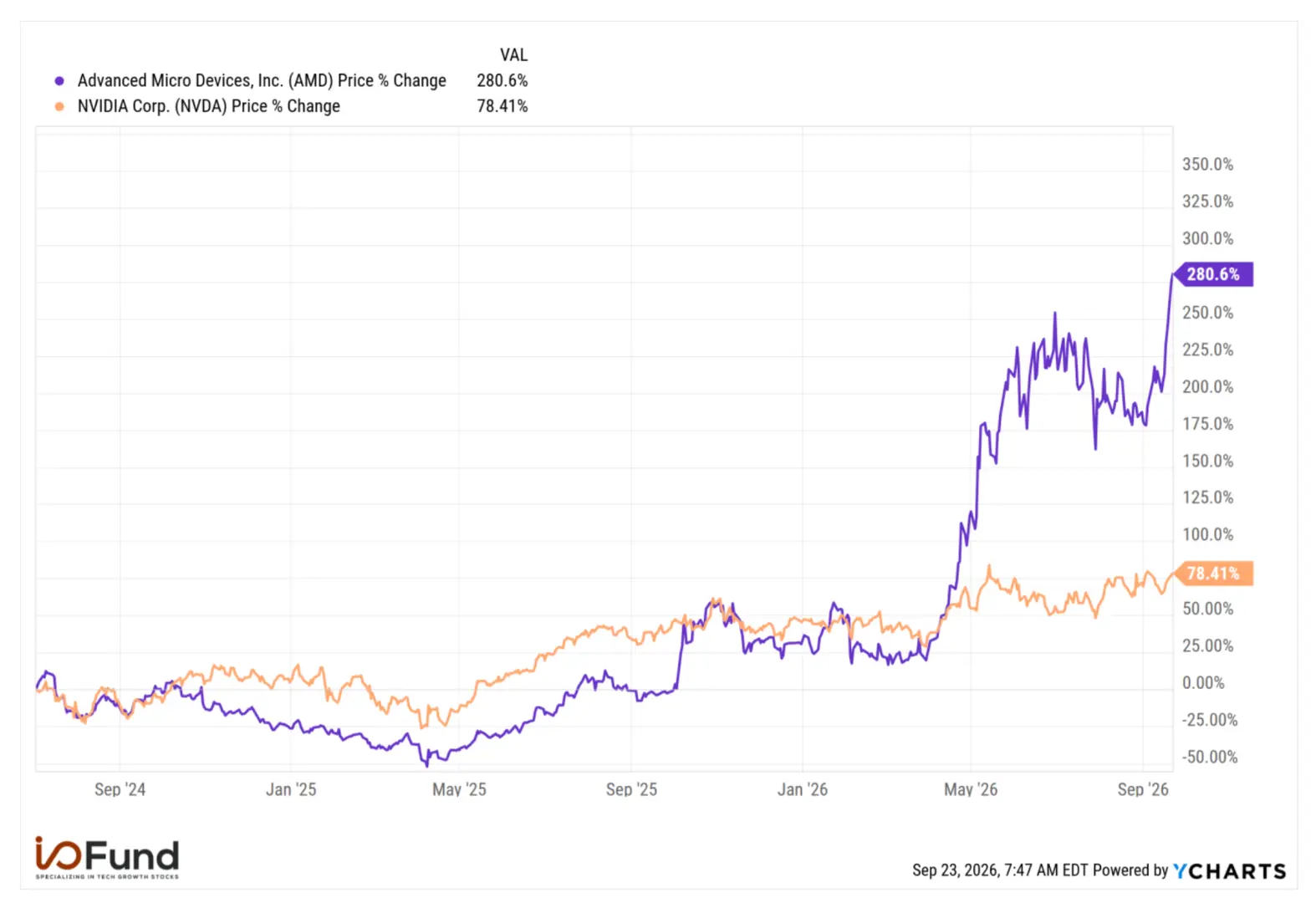
Below, I examine why AMD’s next-generation GPU roadmap could continue to support higher returns than Nvidia through 2028, and why crossing $1 trillion does not mark the end of AMD’s Dark Horse era.
Although AMD is no longer the deeply underestimated company it was a decade ago, the next chapter could prove just as consequential, as AMD transitions from fighting for relevance to fighting for meaningful share in what has become the largest growth opportunity in history.
Venice CPUs “Demand Stronger than any Prior EPYC Generation”
Before substantiating the claim that AMD returns can outpace Nvidia’s over the next few years, we should revisit the core business that got the company here in the first place.
As previously discussed on the I/O Fund’s premium research site, the headline above are important words as AMD’s EPYC generations are responsible for crushing Intel on the company’s home turf. Whether it was Rome, Milan, Genoa or Turin, the Zen architecture has an enviable, historic growth record. Yet, management stated Venice CPU demand is the strongest they’ve seen yet:
“Customer demand for Venice is stronger than for any prior EPYC generation and we expect to continue growing market share across cloud and enterprise in the coming quarters.”
Built on the new Zen 6 architecture and 2nm process technology, Venice is said to deliver 2x the performance per watt as leading x86 CPUs and up to 3.3x the performance per watt as leading Arm-based CPUs. Here is what was stated about the strong positioning of Venice:
“What we’re seeing is when we go into Venice, the workloads actually expand. So there are more workloads that are going to be run on the next generation of EPYC than are run on the previous generation. And that’s what gives us the confidence to say that we can grow substantially ahead of the market, given the product positioning.”
It was also stated that higher core counts will support higher ASPs: “We’re seeing just very strong demand from an overall market standpoint on the ASP growth. We have ASP growth as we go to higher core counts. But as we go forward, you should expect both unit and ASP growth.”
We covered in April in a free article on Arm that: “For investors, what matters is that CPUs account for 50% to 90% of total latency in workflows, which means the CPU-to-GPU ratio in AI clusters will need to increase. Earlier this year, both AMD and Intel saw analyst upgrades based on the outstripped supply of CPUs leading to higher average sales prices of roughly 10% to 15%. Reuters also reported that Intel’s unfulfilled orders are reaching longer than six months while AMD delivery times are believed to be eight to 10 weeks.”
In just seven months, AMD doubled its server CPU TAM estimate from $60 billion to $120 billion by 2030, lifting its CAGR from 18% to 35%, then raised it again to $220 billion by 2030, just two months later at its Advancing AI event in July. This is a market that has historically experienced single-digit annual growth rates, which led to shortages escalating from a supply chain that wasn’t prepared.
Net-net, investors can expect AMD’s CPU growth to perform well in the near-term especially given management’s strong commentary on Venice. With that said, AMD’s competitors reach far beyond Intel and Arm, given hyperscalers are now aggressively pursuing custom CPU standalone systems, such as Amazon’s Graviton, Google’s Axion, Microsoft’s Cobalt, and of course, Nvidia’s Vera CPUs, and eventually Arm’s AGI CPU (2027-2028).
This leads us back to general-purpose GPUs, of which there is effectively only one competitor.
The Dark Horse Saddles Up: Helios Set to Ramp Through 2027
Helios combines Venice CPUs, MI450 GPUs, and Pensando networking with ROCm software to attack Nvidia’s margins (if we’re being blunt about it). The more spec-driven explanation is that Helios will deliver up to 15% more throughput at the same rack power and up to 30% more tokens per dollar than competing systems.
The best nugget on the last earnings call was the clear indication that GPUs will overtake CPU growth rates next year.
Management stated the following:
“The Helios ramp is just starting at the end of Q3 and it’ll be much more substantial in Q4. So that should give you the picture of we think Q3 is certainly a strong quarter as we look at the strong, very strong double digit growth going into data-center segment and in Q4 it will be higher than that.”
From there, it’s expected Helios will sharply ramp in 2027:
“And we believe the overall segment will grow by over 100%. So we’ll more than double due to the data-center AI ramping. So we do see a very significant ramp into 2027.”
When pressed, the CEO acquiesced that data center will “be well over 100%” – with it well understood that Helios will carry the growth above the 70% expected from CPUs:
“And we do expect the overall data center business to be well over 100%. And the well over 100% comes because the data-center AI business is going to be well over 100% just given the strength of our strategic customers, the ramp of Helios and all of the things that we’ve talked about.”
Personally, I cannot wait for the day that Lisa Su begins her opening remarks with commentary on GPUs instead of CPUs. I think that day is coming, if not with the MI400 Series then with the MI500s.
AMD’s Customers Broaden; Weakening the Bear Argument
The predominant risk to Instinct customer wins was it was based on hyperscalers wanting negotiating leverage against Nvidia. However, a widening customer base weakens the argument that lower prices is the only reason to adopt Instinct, suggesting that performance and TCO are contributing to increasing adoption. In fact, quite the opposite is at play, with AMD reportedly set to raise AI accelerator and other chip prices by ~10% in Q4 as TSMC hikes prices.
Management stated in August that Helios is running ahead of AMD’s own expectations: “customer pull for Helios is very strong and tracking ahead of our initial forecasts.”
OpenAI and Meta have signed up for a combined 12 GWs (!), while Anthropic will deploy up to 2GW of MI450 Series GPUs in Helios racks, with the first gigawatt beginning in the first half of 2027. Microsoft will also deploy Helios at scale on Azure for frontier model inference across Microsoft, its AI customers and Azure AI Services. Shipments to Microsoft, Meta, and OpenAI are expected to commence in 2H 2026.
This broadening of the customer base aligns with management’s strategy for scaling the Instinct platform – market share expansion being the priority, followed by gross margins. The early ramp stage through late 2026 and early 2027 is likely to present some gross margin headwinds as GPU mix increases, as management has stated that GPU gross margins currently sit slightly below corporate average but are expected to rise as the business scales. CFO Jean Hu explained at Citi’s TMT conference earlier this month that “the way to think about it is when we ramp MI450 in Q4 and 2027, the gross margin will be slightly lower than what we guided Q3. Q3, we actually guided our gross margin at 56%.”
The Inference Opportunity Strengthens AMD’s Bull Case
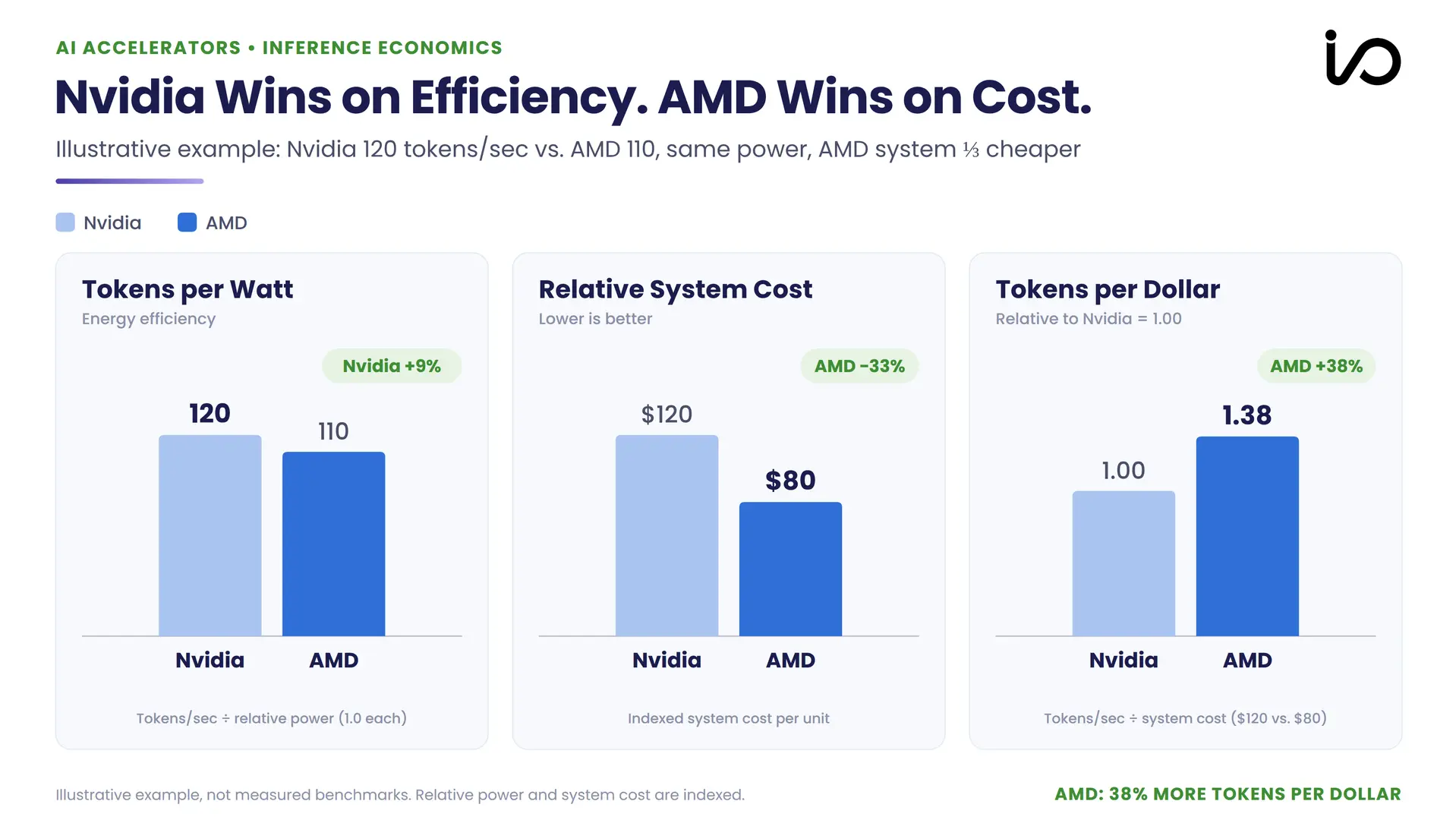
As inference scales, the GPU problem is becoming an economics problem rather than simply a compute problem. The goal moving forward, will be for hyperscalers to maximize how many tokens they can generate from every dollar and every watt deployed.
This is due to AI demand shattering early estimates for token processing. We highlighted in “AI Token Demand is Shattering Forecasts” that Dell raised its 2028 token-processing estimate by 57X, yet actual token processing has already moved far beyond that sharply revised forecast. Google, for example, saw surface-wide token processing rise by 330X from May 2024 to May 2026.
Nvidia has increasingly focused on tokens per watt because its customers cannot secure infinite power. As we detailed in “Why Nvidia’s Next AI Battle Is About Tokens per Watt,” increasing tokens per watt is key to hyperscalers growing inference revenue despite power constraints, while also expanding inference margins.
AMD is approaching the same problem from a slightly different angle, to where the constraint is the economics of exploding token growth. Recently, management has repeatedly been emphasizing tokens per dollar and total cost of ownership as their go-to-market strategy for Helios.
Recently, in technology conferences, such as Citi’s 2026 TMT Conference, it was stated:
“[…] But as you think about things in market today and what we’re going to be ramping significantly over the next number of quarters, we feel like there’s a — our customers are great, great partners with us, but they do expect us to generate economic — differentiated economic returns for them in terms of tokens per dollar, and that’s what the market is demanding of us, and that’s what we think the product delivers.”