Why Nvidia’s SK Hynix Deal Leaves Little AI Memory for Everyone Else
Written by
I/O Fund Team
Research Team
Published: October 2, 2026
Last Updated: October 2, 2026
On this page
The memory bottleneck is one of the most pressing issues weighing on the global AI race. Even as AI adoption accelerates, the AI hardware market is experiencing a structural shift driven by global shortages in high-bandwidth memory (HBM) supply. AI accelerators cannot ship at scale without adequate HBM supply.
In July 2026, Nvidia signed a partnership valued at over $500 billion with SK Hynix and its parent company SK Group. Though it was widely interpreted as a $500 billion purchase agreement for HBM, the partnership is essentially a letter-of-intent agreement across SK Group, including an SK Telecom AI factory of up to 2GW in addition to priority access to memory.
For Nvidia, even this priority access to SK Hynix’s HBM is a significant development. Morgan Stanley’s estimates as of September 2026 place Nvidia as the market leader cornering 37% of HBM capacity in 2027. The global HBM shortage has split the market into two tiers, haves and have-nots. And the Nvidia deal that secures priority HBM access from SK Hynix squarely establishes Nvidia as the leading buyer in the first tier.
What Nvidia Secured on HBM From the $500B SK Hynix Agreement
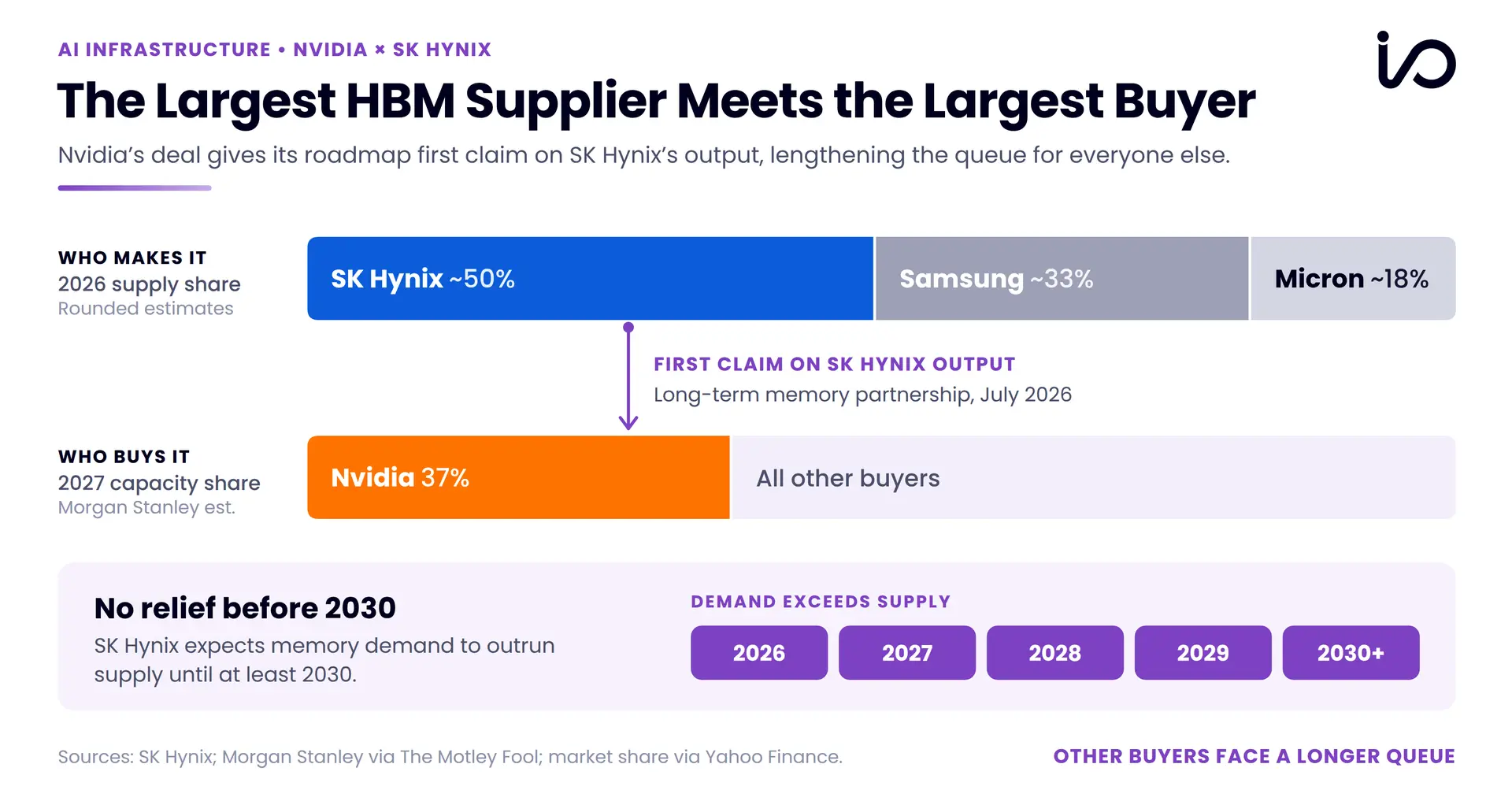
Illustrative comparison of 2026 HBM supplier market share and projected 2027 HBM capacity allocation. The chart highlights SK Hynix’s estimated 50% HBM market share, Nvidia’s projected 37% share of 2027 HBM capacity, and SK Hynix’s expectation that memory demand will exceed supply through at least 2030.
In 2026, SK Hynix is the largest global supplier of HBM, accounting for around 50% of market share. Samsung and Micron come a distant second and third, with 33% and 18% share respectively. Nvidia’s agreement helps the company’s roadmap secure a first claim on SK Hynix’s HBM output.
The agreement comes at a crucial time even as SK Hynix foresees the imbalance between global demand and supply of memory to extend at least until 2030. When the leading supplier producing 50% of global HBM in the market signs an agreement with the world’s leading consumer that could account for 37% of global HBM capacity in 2027, the queue for everyone else waiting to access memory gets longer.
Nvidia, Alphabet, and AMD Could Account for 85% of 2027 HBM Capacity
Morgan Stanley estimates that Nvidia will corner 37% of HBM capacity in 2027, followed by Alphabet at 36% and AMD at around 12%. Together, the three largest names will consume 85% of global HBM capacity in 2027. However, HBM supply cannot catch up fast enough to accommodate the rising demand. This is because HBM production needs around 4x the cleanroom capacity per gigabyte compared with standard DRAM.
Faced with such tight supply constraints, even Nvidia, the largest buyer, is paying up to secure access to HBM. The company’s CFO, Colette Kress, described “extreme pricing conditions in memory” and said prices are “headed even higher into next year.” In its most recent guidance, Nvidia expects gross margins to come in at 71-72%. If the best-placed buyer is paying up, buyers without contracts face even steeper costs down the line.
Micron’s Q3 earnings reveal a similar theme. It has already finalized agreements for most of its 2027 HBM supply, at significantly higher prices than a year earlier.
The Three Ways Buyers Are Securing Memory Supply
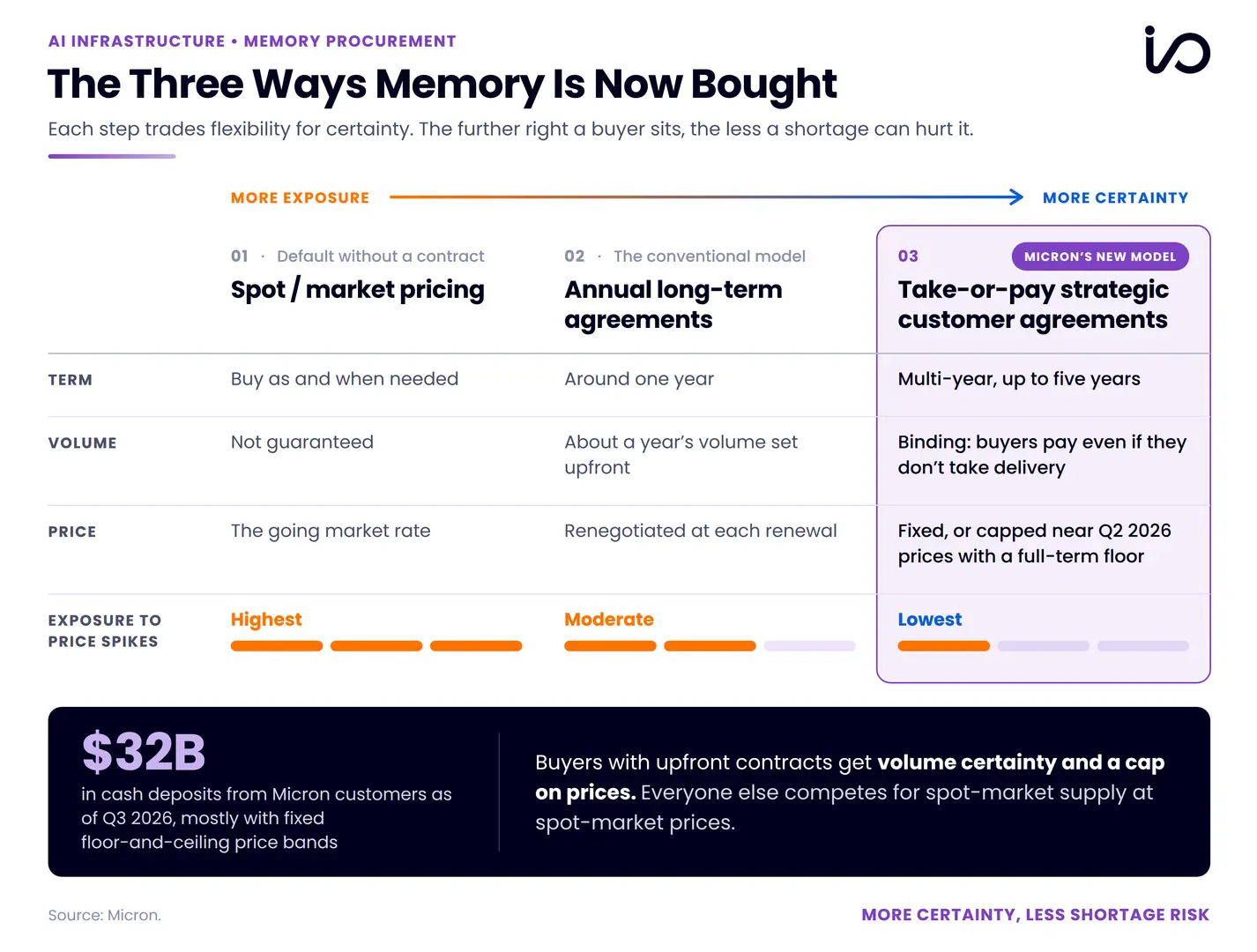
Chart comparing three memory procurement models: spot or market pricing, annual long-term agreements, and take-or-pay strategic customer agreements. It compares contract duration, volume commitments, pricing mechanisms, and exposure to price spikes, showing how buyers trade flexibility for greater supply certainty. It also highlights Micron’s take-or-pay model, under which customers had provided approximately $32 billion in cash deposits as of Q3 2026, largely tied to agreements with fixed floor-and-ceiling price bands that offer volume certainty and capped pricing.
Get Our Free Weekly Stock Newsletter
Get weekly stock insights, market analysis, and technology updates straight to your inbox.
Weekly stock insights
Market analysis
Technology updates
HBM buyers have one of three ways to procure memory. The first is spot or market pricing, which lets them buy as and when needed, paying the going rate in the market. This is the default option for HBM buyers who have not worked out any contracts in advance. This set of buyers faces the highest exposure to price spikes and shortages in memory availability.
Another option is through the use of annual long-term agreements, which is the old and conventional model of buying memory. Such a contract accounts for around one year of volume upfront, and prices get renegotiated when the contract comes up for renewal at the end of each cycle.
And then there are take-or-pay strategic customer agreements, which is Micron’s new model of choice. In such a model, buyers sign multi-year contracts, now running into 2031, and pay for the agreed upon memory even if they do not take delivery. Micron has signed 26 of such agreements, which it estimates will account for 35% of its revenue through 2030. 75% of that revenue has a defined pricing framework, mostly bands with fixed floor and ceiling prices. Its customers have committed $32 billion as of September 30, 2026, with the vast majority in the form of cash deposits.
Buyers with upfront contracts enjoy certainty in terms of volume and a cap on prices for memory. All other buyers must vie for spot market volume and pricing to fulfil their requirements. Latecomers pay more: Micron has stated that any new agreement will be negotiated at higher prices based on current market conditions.
JOIN I/O FUND AND BE THE FIRST TO GET SUCH INSIGHTS
HBM supply is becoming a factor in AI chip launches. I/O Fund members receive our ongoing semiconductor research and real-time trade alerts as the story develops.
Every other AI chip program shares around 15% of 2027’s HBM supply, per Morgan Stanley’s estimates. This includes hyperscalers’ in-house chips beyond Alphabet and AI chip startups. Chip designers form the core buyers of HBM. For neoclouds and tier-2 CSPs, their HBM is already provided within their Nvidia and AMD GPUs.
Data centers are projected to account for around 70% of all memory produced this year. Capacity moving to HBM tightens the supply of DRAM that powers phones, PCs and cars. Among these, phone makers are further split into two similar tiers.
In the first tier, Apple and Samsung are protected by long-term supply agreements and sufficient cash balances to buy 12-24 months ahead. The second tier of phone makers with thinner margins, including Xiaomi, Transsion, Oppo, and Lenovo have no choice but to pass on the higher memory costs to their buyers. Research by CSIS anticipates a 14% increase in smartphone selling prices, driven by the global memory shortage.
At the same time, new automotive DRAM contract prices have also increased by 70-100%. The two-tier pattern is no longer limited to AI chips. Long-term contracts appear to be the new way to access memory, whether the buyers are hyperscalers or budget phone makers.
Memory Is Now Allocated Before It Is Priced
The Nvidia-SK Hynix partnership and Morgan Stanley’s 2027 estimates point to the same conclusion: about 15% of HBM is left for every other AI chip program beyond Nvidia, Alphabet, and AMD. At the same time, phone, PC and car makers compete for conventional DRAM as capacity moves to AI. The split in how memory is bought shows that access, not price, now decides who gets memory.
The same multi-year contracts that lock in supply for the top tier give memory suppliers such as SK Hynix and Micron earnings visibility for years to come. Buyers outside that tier have no such protection, leaving them exposed to price spikes, margin pressure and supply risk.
Want the analysis behind the trades? Get more than 100 premium AI stock articles a year, real-time trade alerts and weekly webinars with I/O Fund Premium.
Please note: The I/O Fund conducts research and draws conclusions for the company’s portfolio. We then share that information with our readers and offer real-time trade notifications. This is not a guarantee of a stock’s performance and it is not financial advice. Please consult your personal financial advisor before buying any stock in the companies mentioned in this analysis. Beth Kindig and the I/O Fund own shares in NVDA and MU at the time of writing and may own stocks pictured in the charts.
Aiswarya Gopan, AI and Semiconductor Investment Writer at I/O Fund, contributed to this analysis.