Micron Stock: Why the AI Memory Cycle Is Different This Time
Beth Kindig·SEP 18, 2026·12 min read
On this page
The AI memory boom is one of the most controversial debates in the market, as investors weigh if the historical cyclical nature of memory means that Micron, SK Hynix and other memory stocks have put in a top.
It’s no secret memory stocks have soared with both SK Hynix and Micron up 400% and 500% in a 1-year time frame. This follows high bandwidth memory (HBM) growing from a roughly $4 billion market in 2023, to a $34.6 billion market in 2025, with Micron now expecting the market to reach $100 billion in 2027.
Looking further out, the dynamics of inference workloads requiring enormous amounts of memory, and increased KV cache requirements, means the supply constraints are moving beyond HBM to conventional DRAM and NAND. Memory suppliers are signaling that new capacity may not arrive until 2028.
This is beginning to change the typical memory-cycle pattern. Historically, memory cycles peak as supply catches up to higher prices and demand, whereas currently, some of the industry’s largest suppliers are expecting demand to remain above available capacity for years.
However, an area where we excel at the I/O Fund is not getting swept away by bullish exuberance. Although memory may be far from topping in the AI cycle, there is material evidence that revenue growth is cooling off as many memory companies become subject to various forms of long-term agreements.
As discussed below, this creates an unusual setup, as the memory cycle is expected to remain very tight even as reported growth rates decelerate.
Why AI Memory Demand Could Remain Elevated Through 2028
AI systems are requiring substantially more memory, as we discussed in-depth in our analysis “Micron is up 900% – Here’s Why the Memory Trade May Have More Room to Run.” Model complexity and the KV cache are two primary drivers, especially for inference workloads requiring increasingly large context windows.
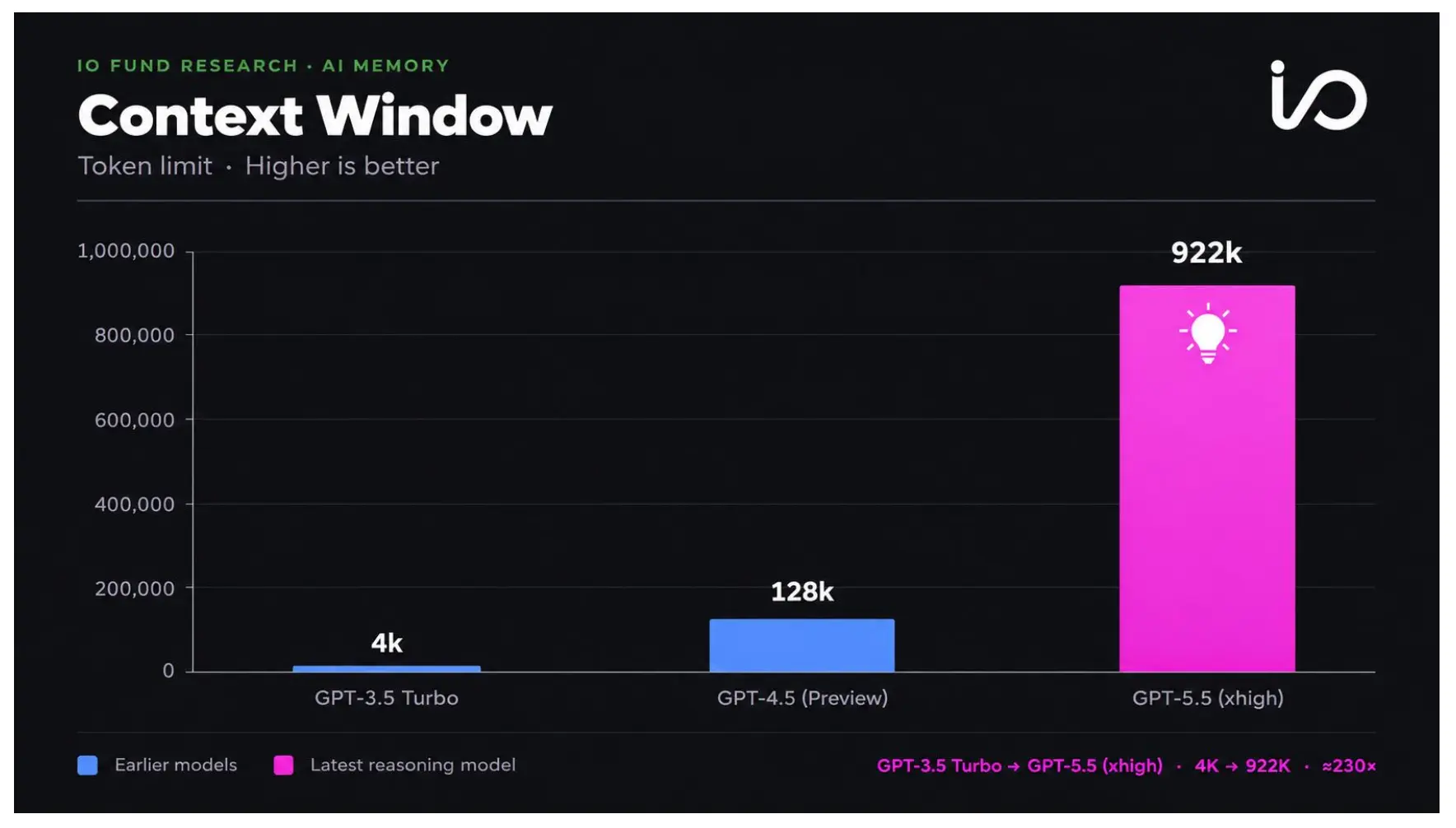
According to Artificial Analysis, OpenAI’s GPT-3.5 Turbo, released in 2023, had a context window of just 4k tokens. This increased to 128k tokens in GPT-4.5 Preview in early 2025, while OpenAI’s latest model, GPT-5.5 (xhigh), has a context window of 922k tokens, a 230X increase in the span of three years.
Context windows continue to increase with OpenAI’s latest models, with the new GPT 5.6 Sol and GPT 6 Astra said to have context windows of 1.05 million tokens. However, Meta’s Llama 4 Scout offers the largest context window in the industry at 10 million tokens, nearly 10X larger than OpenAI’s newest models.
Chart showing the context windows of three OpenAI models. GPT-3.5 Turbo’s context window is 4k tokens, increased to 128k tokens in GPT-4.5 Preview, while OpenAI’s latest model, GPT-5.5 (xhigh), has a context window of 922k tokens. Source: Artificial Analysis
With longer context windows adding to already intense memory demand, management commentary suggests the memory shortage could extend well beyond 2027. Micron’s VP of Marketing, Christopher Moore, said in a January interview that “you’re not really gonna see real output, meaningful output” until 2028, given the time required for qualification, customer acceptance and equipment installation.
Micron CEO Sanjay Mehrotra echoed this in May, saying, “we see that meaningful new supply in the industry doesn’t really start ramping until 2028 timeframe.” In its latest earnings report, Micron went a step further, stating, “Even as we expect industry supply to improve gradually in 2028, we currently do not have line of sight as to when memory supply will be able to catch up with increasing demand.”
Here is the bombshell quote on how long this constraint could last from SK Hynix CEO Kwak Noh-jung. “We forecast that next year will be the worst year in the industry’s history from the supply perspective. We still forecast that customer demand will remain higher than our supply capacity even beyond 2030.”
NAND is facing similar constraints. Kioxia is planning to double its 2024 NAND capacity, but this will not be achieved until 2029, with equipment spending remaining below 2023 levels as NAND manufacturers remain cautious on spending to prevent oversupply.
In an interview with Charles Payne on Fox Business News, Beth Kindig of the I/O Fund discusses why it’s highly inprobable that memory has topped.
Memory Pricing Outlook for the Second Half of 2026
If you follow me on X, you’ll see that from time to time we publish pricing estimates for memory suppliers. Our most recent estimates show just how extraordinary the current pricing environment has become.
In April, conventional DRAM contract prices were expected to rise 58% to 63% QoQ in Q2 2026, while NAND Flash contract prices were expected to jump 70% to 75% QoQ, according to TrendForce. Final numbers published in July showed DRAM coming in at the expected 58% to 63% range, with NAND pricing lower, but still impressive, at 55% to 60% QoQ.
Micron continues to show strength, as its fiscal quarter ending in May reported DRAM ASPs rising in the low-60% range and NAND in the mid-80% range, likely benefiting from stronger pricing in March given the off-quarter reporting.
Looking ahead, year-end pricing estimates disagree by more than 25 points.
Supporting another strong quarter of pricing, ADATA Chairman Chen Li-bai recently stated that memory manufacturers have indicated DRAM contract prices will rise another 20% to 30% in Q3, while NAND Flash prices are expected to increase 35% to 40%, according to Commercial Times.
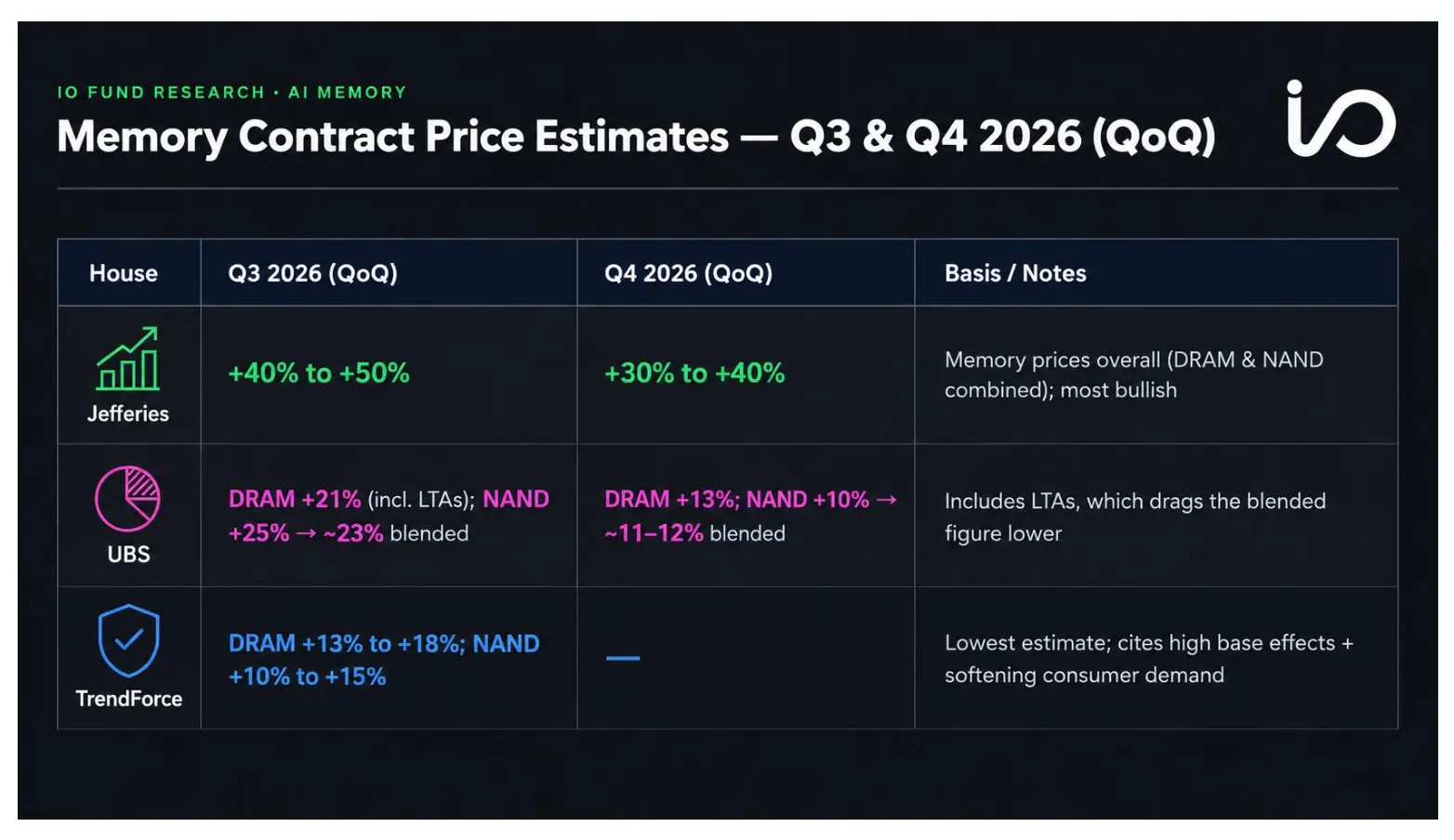
UBS is considerably lower, modeling DRAM ASPs including LTAs up 21% QoQ in Q3 and 13% in Q4. For NAND, UBS models ASPs up 25% QoQ in Q3 and 10% in Q4. Overall, this puts UBS at roughly 23% QoQ in Q3 and 11% to 12% in Q4, much lower than Jefferies’ estimates above.
The spread is partly a disagreement about mix. AI-server-driven demand is seeing the strongest pricing power, while the consumer and commodity side is facing affordability ceilings and higher comparison bases. UBS also folds LTAs into its estimates, which weighs on the blended figures.
Forecasts from Jefferies, UBS, and TrendForce highlight differing expectations for DRAM and NAND pricing in H2 2026, with ongoing AI infrastructure demand and memory supply constraints expected to support elevated pricing across the market.
How Micron’s 5-Year Agreements Could Reshape the Memory Cycle
Get Our Free Weekly Stock Newsletter
Get weekly stock insights, market analysis, and technology updates straight to your inbox.
Weekly stock insights
Market analysis
Technology updates
Last March, Micron first discussed shifting from long-term agreements to strategic customer agreements (SCAs): “We continue to work with customers on strategic customer agreements — or SCAs — that are different from prior LTAs (long-term agreements) and have specific commitments over a multi-year time horizon for improved visibility and stability in our business model […] We are excited to have signed our first five-year SCA.”
The read-through is that SCAs could lead to a cap in pricing during a surge, putting a limit on the surging prices we are seeing now in DRAM and NAND. The upside to SCAs is that they lock-in supply and volume to smooth out lumpiness in a cyclical industry, yet they could also limit upside in exchange for multi-year visibility.
Importantly, where long-term agreements used to be 1-year in length, these agreements are now extending to 5 years. This brings up an interesting counterpoint to the typical cyclicality concern, as Micron has essentially alleviated that concern by locking in 5-year terms. Yet this now creates the opposite concern that Micron may not fully benefit from the boom-like nature of this cycle.
How Memory Suppliers Are Protecting Their Pricing Upside
SK Hynix has reportedly removed price caps from its long-term memory supply agreements, with the new structure reportedly allowing spot market increases to be fully reflected in contract pricing when supply shortages push prices higher. According to Global Economy News, SK Hynix is the only major memory supplier not applying a price cap in its long-term agreements.
In contrast, Micron has disclosed SCAs that set a price floor and ceiling, with the cap tied to market levels from April to June. As management stated, “The price gets negotiated every quarter based on market conditions, the price cannot exceed the ceiling no matter what, cannot go below the floor no matter what. And consequently, the value of these agreements can be readily determined.”
However, one key detail is that the cap does not apply to newer generations of HBM, DDR6 and LPDDR6, which will be priced separately at higher levels. This helps preserve the upside from AI while locking in attractive pricing and margins on current generations as they become commoditized. This helps explain why the stock reacted positively following the earnings report despite the mention of a ceiling. Here was the key statement, “Transitions like LP5 to LP6, DDR5 to DDR6 and newer generations of HBM all come with rising bit costs… Our customer SCAs provide for appropriate price premiums for such new products to be negotiated in the future.”
Micron also stated that its customers would like to lock up more supply, but the company is “unwilling to do so right now.” As a result, these SCAs contain less volume than customers would actually like to secure. As management explained, “In fact, in a lot of these negotiations, we spend a lot of time helping customers understand that this is all we can do in this time frame.”
Why Memory Growth May Slow Even as Profitability Remains Strong
However, the second point is that Micron’s fundamentals could see a cooling off in the immediate term. During the late June earnings call, analysts attempted to nail down management on where margins and SCA pricing could ultimately land. The discussion pointed to the potential for normalized gross margins above Micron’s prior peak in the low-60% range, while one analyst estimated SCA pricing could range from roughly $10 to $12 per GB at the floor to the mid-$20s per GB at the ceiling.
It’s clear that growth is being driven by higher ASPs. However, management also stated that price growth will “moderate” as Micron continues shifting bits toward data center, edge and other higher-performance applications.
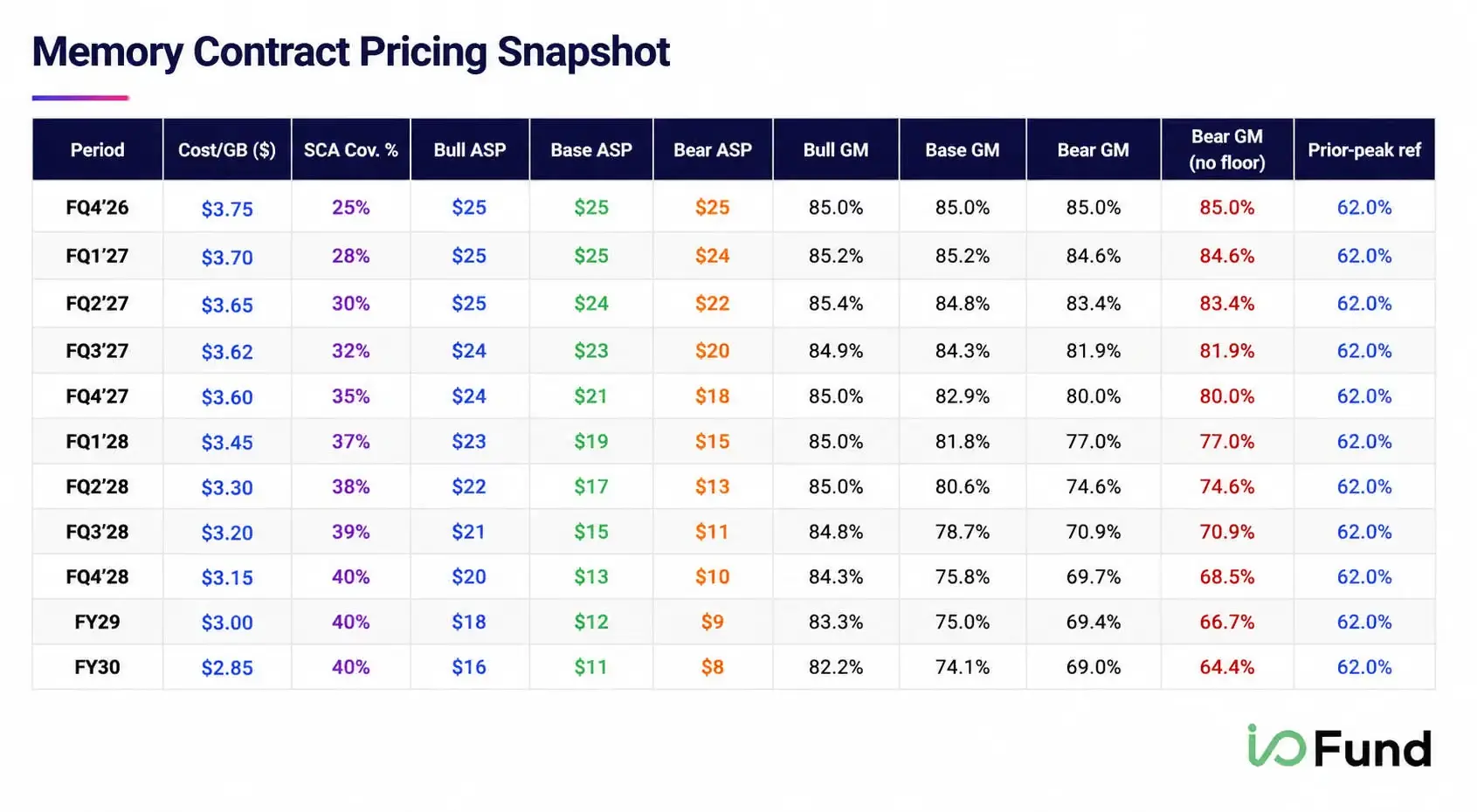
When you take all of the above commentary and combine it with SCAs potentially locking in pricing around the mid-$20s per GB at the ceiling, based on the analyst’s estimate, you get a fairly strong margin profile.
Memory contract pricing snapshot from FY26 to FY30 comparing bull, base, and bear ASP scenarios. SCA coverage rises from 25% to 40%, while gross margins remain above prior peak levels across most scenarios despite moderating prices.
It’s important to note that Micron is shifting toward a bottom-line story, as capping pricing on roughly 40% of revenue around CYQ2 2026 market levels is going to weigh on top-line growth if memory prices continue to rise. In all likelihood, the 343% YoY growth rate recently reported is in the rearview mirror.
Analysts are currently expecting revenue growth of approximately 88% in FY27 ending in August, followed by 13% in FY28 and 10% in FY29. From there, consensus expects growth to turn flat, and then sharply negative.
This could create an opportunity if investors can identify the inflection point when the remaining 60% of uncapped revenue begins to benefit from next-generation products rolling out. In my opinion, these estimates do not fully capture the pricing power memory suppliers could have over the next few years, particularly as newer generations of HBM, DDR and LPDDR remain outside the existing SCA ceilings.
Third, outside of AI systems loaded with HBM, memory architectures are also going through frequent iteration right now. Instead of CPUs relying primarily on DDR5, customers are planning to increase their use of low-power DRAM (LPDRAM), originally a phone technology, through a new form factor called SOCAMM. LPDRAM can substantially reduce power requirements compared to DDR5.
The longer-term drivers for Micron include automotive and humanoid robots, which are worth keeping an eye on toward the close of the decade.
Conclusion:
Although long-term agreements could cause memory stocks to go through an adjustment period, newer generations of HBM, DDR6 and LPDDR6 are not subject to existing price caps, helping preserve AI upside while locking in attractive pricing and margins on current generations.
Whether it’s Micron’s SCAs, SK Hynix removing price caps or widespread wafer tightness across HBM, there is a stark difference from past cycles, which is that supply is being built against contracted demand rather than speculatively.
The 10,000-foot view is that memory companies have shifted from a commoditized, boom-bust business where oversupply could threaten pricing within a few quarters to a contracted runway of many years with stronger earnings visibility.
Our portfolio has also identified AI winners such as Bloom Energy, up 1580% since our April 2025 entry, and lesser-known AI networking stocks up 390% since our November 2025 entry.
We publish more than 100 paywalled articles each year on AI stocks, hold weekly 1-hour webinars, and offer an actively managed portfolio with real-time trade alerts.
Please note: The I/O Fund conducts research and draws conclusions for the company’s portfolio. We then share that information with our readers and offer real-time trade notifications. This is not a guarantee of a stock’s performance and it is not financial advice. Please consult your personal financial advisor before buying any stock in the companies mentioned in this analysis. Beth Kindig and the I/O Fund own shares in MU at the time of writing and may own stocks pictured in the charts.