Data Center Stocks Face a New Bottleneck: What Project Jupiter Reveals for Bloom, Oracle and Applied Digital
Written by
I/O Fund Team
Research Team
Published: October 2, 2026
Last Updated: October 2, 2026
On this page
On September 24, 2026, Oracle issued a force majeure notice to Blue Owl, owner of STACK Infrastructure, in order to protect itself contractually in case Project Jupiter fails to launch as planned by 2028. The notice lets Oracle delay payments or avoid incurring additional costs in case of any delays in launch. Following this, Oracle’s Vice President of Global Communications, Michael Egbert, clarified that the notices “do not, by themselves, establish a project delay.”
Project Jupiter is a flagship site that forms part of Stargate, aimed at building AI infrastructure in the US under a $500 billion investment committed by OpenAI, SoftBank Group, and other partners. The 2.45 GW campus spans 1,400 acres in Doña Ana County, New Mexico and secured $18 billion in loans from a consortium of banks.
In this case, it’s not demand that’s holding back Project Jupiter. The new bottleneck is permission, which is why investors may want to pay closer attention to “permissioned megawatts.”
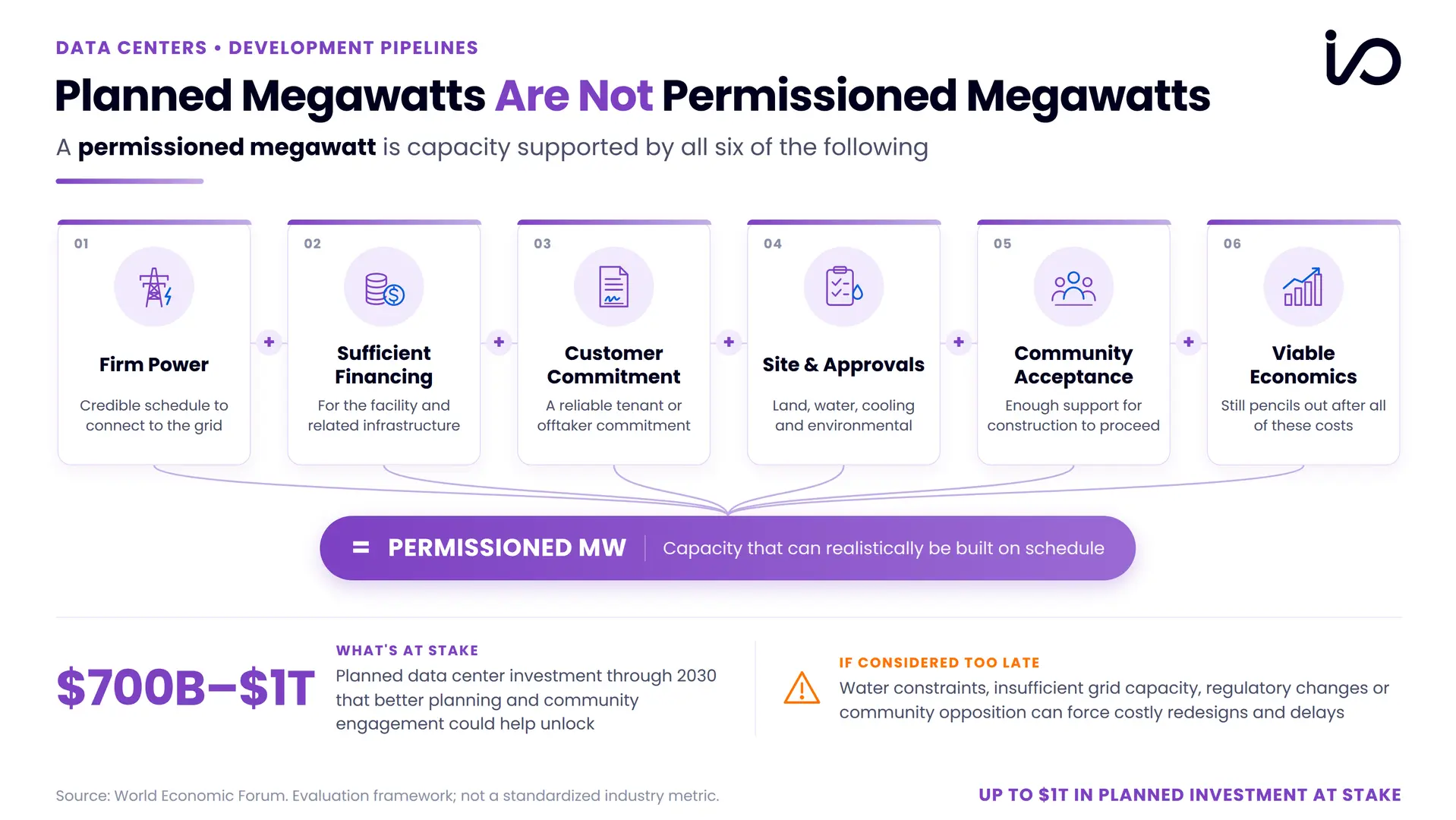
Illustration of six requirements for permissioned data center capacity: firm power, sufficient financing, customer commitment, site and approvals, community acceptance, and viable economics. The graphic also references $700 billion to $1 trillion in planned data center investment through 2030.
What’s Delaying Project Jupiter’s 2028 Launch?
In August 2025, Energy Transfer announced its 500+ mile Desert Southwest pipeline, running from Waha, Texas to Phoenix. In March 2026, the New Mexico State Land Office denied Energy Transfer’s request for a pipeline right-of-way across state trust land, then rejected a request to reconsider in July.
On April 27, Oracle and BorderPlex replaced the gas turbines and diesel generators in the campus’s original 2.2 GW design with an off-grid Bloom Energy fuel-cell microgrid.
But gas still needs to reach this site. Transwestern and Energy Transfer’s Green Chile 17.77-mile, 24-inch pipeline to Project Jupiter, initially estimated to cost around $60 million, has had its in-service date pushed from August 2026 to February 1, 2027 as of writing.
Meanwhile, the New Mexico Environment Department’s deadline on the permit for the Bloom 2.46 GW microgrid is November 23, 2026. This microgrid is not yet built.
Three separate approvals, for land, pipeline, and air, now stand between a signed tenant and its 2028 launch.
Bloom Solves the Wait for Grid Power, but Not the Gas Question
Oracle and Bloom Energy finalized a partnership in July 2025, with Bloom committing to power a full data center within 90 days of signing. In April 2026, the companies announced an expansion of capacity to 2.45 GW, alongside Oracle receiving a $400 million warrant from Bloom.
Bloom’s fuel cells run on natural gas and depend on the delayed gas pipeline. They bring down projected emissions from over 14 million tons a year under the turbine plan to around 10 million tons, a nearly 30% reduction. The partnership helped the project site get out of the grid queue for power, but the other two problems of gas supply and air permit still weigh on it.
Power, not demand, is becoming the bottleneck for AI data centers, and the I/O Fund positioned early. Our Bloom Energy position is up over 1,500% since our April 2025 entry. Get real-time trade alerts, portfolio commentary and weekly webinars as we track the next beneficiaries of the AI power buildout. Get Premium Access→
What Is the Price of Permission for Oracle?
Oracle has already confirmed that it will fund its own electricity and energy infrastructure on its New Mexico campus, instead of increasing local electricity rates. In addition, Oracle has outlined its commitments to Doña Ana County:
$50 million for local water system improvements.
$360 million in direct support for schools, infrastructure, and local services.
$6.9 million for workforce development, the Boys & Girls Club, and habitat restoration.
Oracle has also agreed to not use public drinking water for its data center cooling needs, with projected ongoing water consumption of about two U.S. households’ worth a year. Project Jupiter’s social commitment also includes creating over 4,000 jobs in construction and 1,500 ongoing jobs for the local community.
The rising uncertainty surrounding such projects is also evident in the financing market. Banks, including Santander and Jefferies, have quoted around $18 billion of loans associated with Oracle’s leased campus at 89-91 cents on the dollar. According to Financial Times, efforts to distribute these loans to a wider pool of investors have stalled owing to the company’s borrowing and local opposition surrounding air and water quality. Additionally, Oracle’s credit took a hit after S&P’s downgrade to one notch above junk in July.
Get Our Free Weekly Stock Newsletter
Get weekly stock insights, market analysis, and technology updates straight to your inbox.
Weekly stock insights
Market analysis
Technology updates
Community approvals for projects come with a clear price tag, and lenders have started pricing the risk even before the site begins to generate any revenue.
Project Jupiter Reflects a Broader Industry Challenge
On September 16, the Ratepayer Protection Act passed the House with an overwhelming 417-3 vote. The bill would require state regulators to consider making new data centers that consume at least 100 MW cover the incremental cost of power generation, transmission, and distribution infrastructure built to support their operations. It would also protect ratepayers in the event of a developer cancelling or relocating a project after a utility commits capital. The bill will not restrict construction of new data centers.
A day later, Senator Martin Heinrich of New Mexico blocked a unanimous consent request to pass the bill, arguing that it did not go far enough. His competing GRID Savings Act asks the Federal Energy Regulatory Commission to enforce clearer rules to determine which upgrades large electricity users must fund and how to calculate these upgrade costs. Analysts don’t expect either of the bills to pass the Senate before the midterm elections in November.
The pressure isn’t felt by one campus alone. The World Economic Forum has also revealed that 75 U.S. projects, accounting for around $130 billion worth of investment, experienced blockages and delays in Q1 2026. The demand for AI infrastructure is still exceptional, but turning it into operational capacity now depends on permissioned megawatts, meaning capacity with secured power, financing, local and environmental approvals, including water and cooling, and a committed customer.
Applied Digital Highlights the Gap Between Contracts and Revenue
As of May 31, 2026, Applied Digital had 1,410 MW of contracted critical IT load across five campuses, accounting for around $36.2 billion of initial contracted revenue. Yet only $99.8 million of its $611.3 million fiscal 2026 revenue came from AI data center base rent, and less than $2 billion of its contracted lease revenue is scheduled through fiscal 2028.
Signs of execution are already underway. At Polaris Forge 1 in North Dakota, Applied Digital’s first 100 MW facility reached full operational status in fiscal 2026. The company also delivered a second building in July, and its campus could supply 400 MW of critical IT load once it is fully built.
However, the remaining capacity still needs significant financing before it can start receiving rent from leasing. The fourth Polaris Forge 1 building has been financed by $1.59 billion in senior secured notes. By the end of fiscal 2026, Applied Digital’s reported cash and debt position stood at around $4.2 billion in cash, cash equivalents, and restricted cash holdings, and around $5 billion in debt.
Long-term take-or-pay leases protect against utilization risk after a building is delivered, but not against construction delays, interest costs, permit risks, or cost overruns. For Applied Digital, the question is how much of its contracted portfolio generates rent on schedule and within its original financial estimates.
The November 23 permit decision is the next test for Project Jupiter, and for the data center stocks tied to it. Get I/O Fund’s free weekly newsletter for our analysis of AI infrastructure, power and the stocks driving the buildout, straight to your inbox.
Bloom’s procurement agreements, Applied Digital’s long-term leases and Oracle’s record backlog all point to rising demand for AI computing. What has changed is the number of conditions that must be met before that demand becomes operating capacity. For Project Jupiter, the next test is the November 23 permit decision.
The next stage of the data center buildout may be measured less by planned megawatts than by permissioned megawatts: capacity that is powered, financed, contracted, approved and ready to generate revenue.
Please note: The I/O Fund conducts research and draws conclusions for the company’s portfolio. We then share that information with our readers and offer real-time trade notifications. This is not a guarantee of a stock’s performance and it is not financial advice. Please consult your personal financial advisor before buying any stock in the companies mentioned in this analysis. Beth Kindig and the I/O Fund own shares in BE at the time of writing and may own stocks pictured in the charts.
Aiswarya Gopan, AI and Semiconductor Investment Writer at I/O Fund, contributed to this analysis.