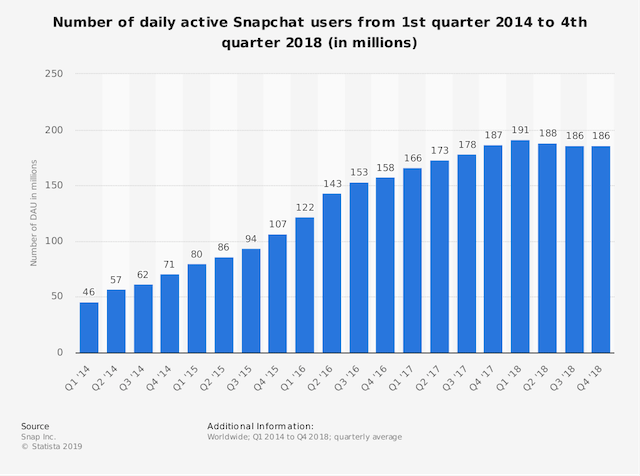


Social media companies today are using smoke and mirrors to hide an important key metric. I’m going to pick on Pinterest first because the social media company recently revealed these issues in its S-1 Filing, and meanwhile, Pinterest stock saw a 25% pop on the day of its public debut. To be fair, this 25% IPO pop pales in comparison to Snap’s 135% stock price increase from December lows.
My best guess is that investors are hoping for the next Facebook, or perhaps they aren’t reading beyond the financials, which are on page 13 of the prospectus, compared to the social media metrics located on page 70. This is one reason I recommend following an unbiased tech analyst, such as myself, to avoid reading long S-1 filings
As important as the financials are to the value of the stock, they can be misleading when not accompanied by scrutiny of the underlying business. For example, there are a couple of terms that are important to social media growth. I italicized growth because I presume investors will demand growth at both Pinterest and Snap’s outsized valuations. The first is monthly active users (MAU) or daily active users (DAU). The second is average revenue per user (ARPU). On the surface, Pinterest has healthy MAU numbers with 265 million monthly active users in the most recent quarter. For comparison, Snapchat has about 300 million MAU and Twitter has just over 325 million as of Q4 2018.
In regards to ARPU, a company with a healthy metric would be Twitter, for example, which has an average revenue per user (ARPU) of $9.48 and the revenue is split roughly 50/50 between international users and domestic users in the United States. For instance, in the most recent quarter Q1 2019, Twitter generated $317 million globally and $363 million in the United States. Contrast this with Pinterest and Snap with ARPU in the $2-$3 range. Investors in both Pinterest and Snap are speculating these social sites can increase ARPU significantly – meanwhile, there are issues of attrition in Pinterest’s and Snap’s user base.
(See more on Snap below, which reports earnings today.)
PINTEREST – CAN’T MONETIZE GLOBALLY
One issue with looking at ARPU holistically is that not all regions are created equal. This is especially true for monetizing on mobile. The United States spends a lot of money on social media compared to other regions, while Europe spends a reasonable amount of money. Other regions, such as India, spend very little money and can actually cause a social media company to lose money as providing a free service to users who do not monetize well – by advertising or purchases – creates low to negative operating margins. (You may be able to tell that I am foreshadowing here.)
Pinterest has monetized the United States beautifully. The 80 million or so users in the United States generate $9 average revenue per user. We see evidence this is saturated, however, as the user growth has been stagnant for many quarters.
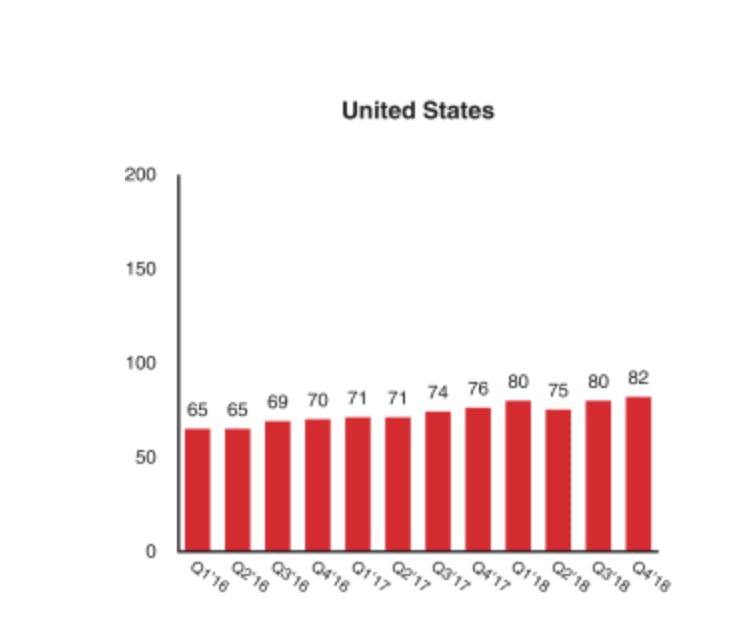
Venture capitalists like to see 10% month-over-month growth with mobile application users or website users. (Actually, the prefer to see 30% month-over-month growth). Pinterest has struggled to achieve 10% year-over-year growth in the United States with some declining quarters.
However, Pinterest has achieved a 10% QoQ benchmark globally – and this graph looks much better. But there’s a catch …
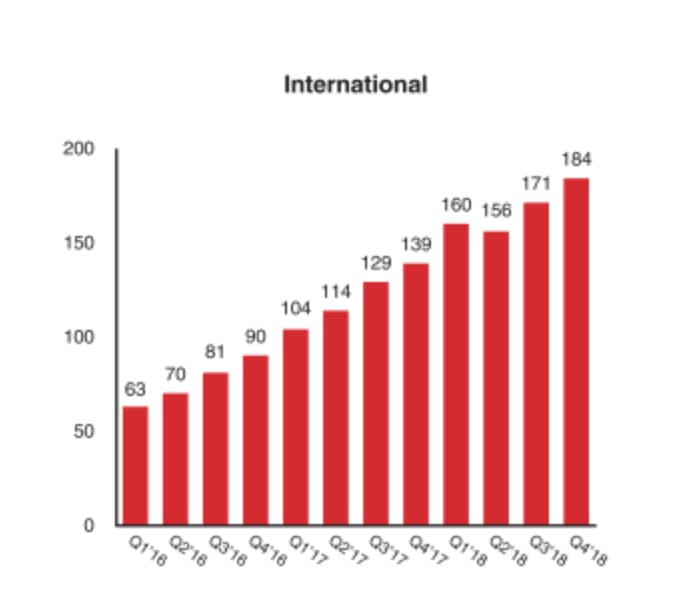
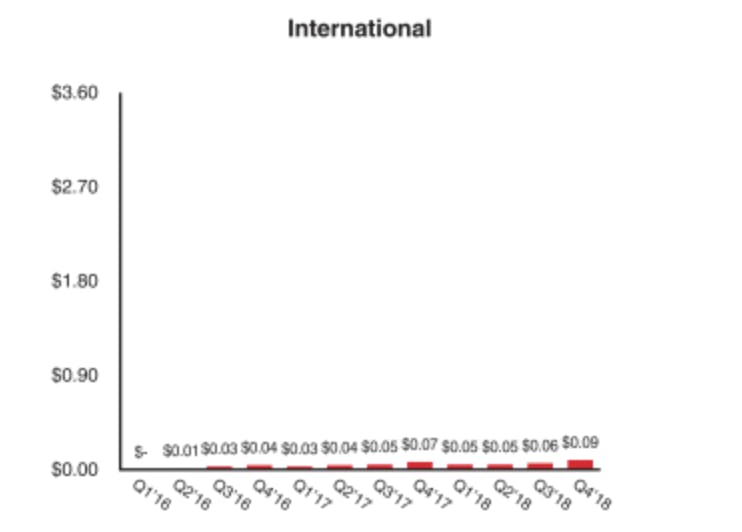
Here’s the problem. The international audience doesn’t monetize. The regions where Pinterest is growing are only monetizing at 25 cents per user annually, which is not enough for a profit margin let alone an operating margin. Compare this to the $9 average revenue per user in the United States, and you can see why the average ARPU for Pinterest drops significantly to $2-$3 annually.