

OpenAI co-founder and President Greg Brockman revealed some interesting insights on cybersecurity during his appearance on the No Priors podcast in mid-October 2026. He remarked, “Cyber spend, security spend, should actually vastly outstrip software spend.” The statement stems from existing practices at OpenAI, where around 25% of production engineers are moved to security work whenever new AI models launch. All of these engineers’ projects are put on hold as they focus on securing existing systems, a process Brockman expects to repeat with the launch of every new model.
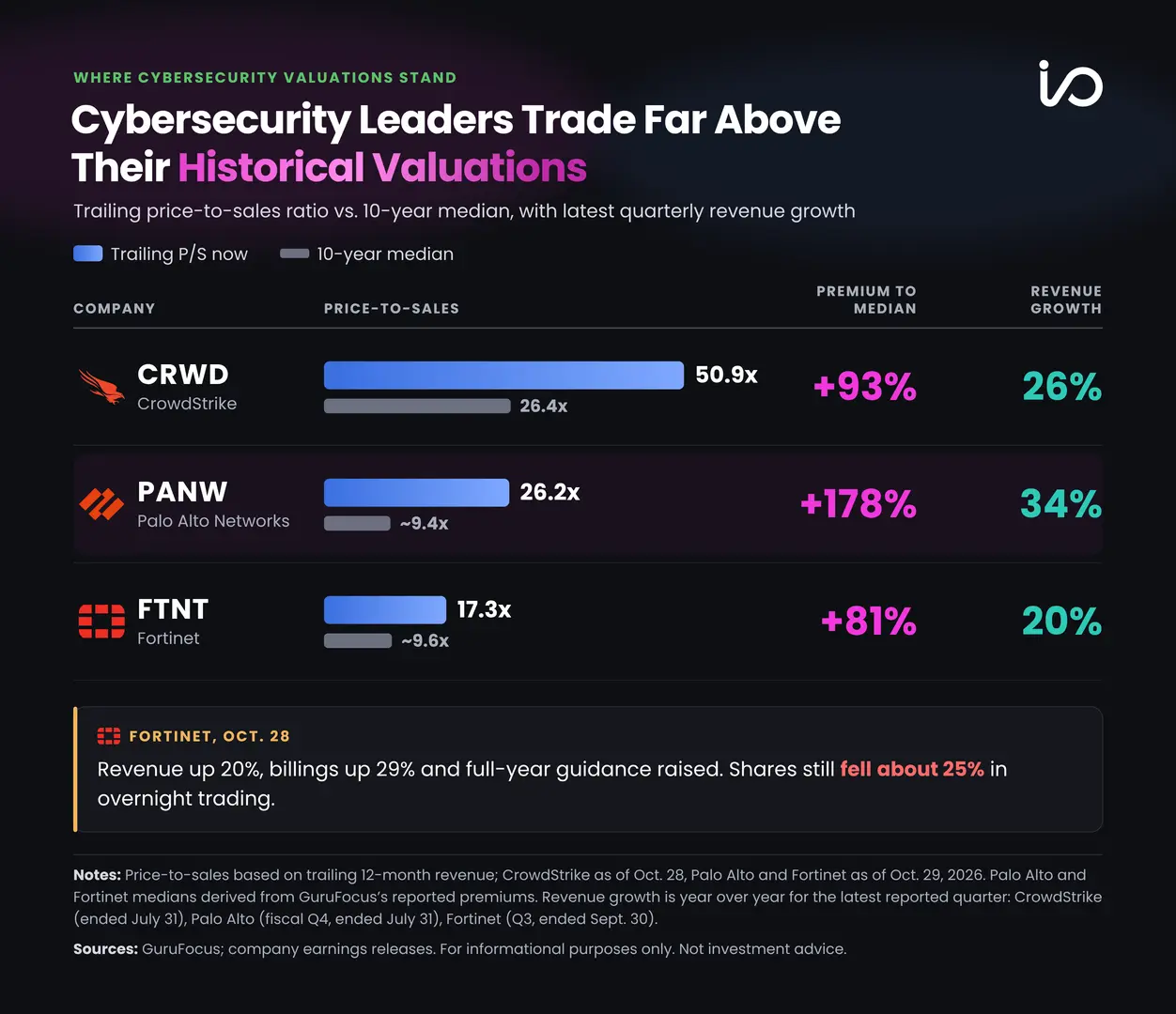
In early September, we stated that AI could become “a significant tailwind” for the cybersecurity sector amid expanding enterprise attack surfaces driving the need for sustained software support. In the weeks that followed, leading cybersecurity stocks saw a strong rally into early October, with CrowdStrike and Palo Alto Networks reaching record highs on October 6. However, the sector has seen much volatility since then, heading lower around mid-October over reports about OpenAI and bouncing back higher on news about AI-discovered software flaws, followed by another dip on Fortinet’s earnings report on October 28.
The growing demand for cybersecurity amid rising AI adoption is showing up in three different ways in reported data. AI-enabled cyberattacks are on the rise, frontier AI labs are turning to cybersecurity vendors to tackle them, and customers are consolidating on security platforms. While the first two factors have been instrumental in driving the 2026 cybersecurity stock rally, they are also making them highly volatile to news developments, as valuations in this sector sit far above their historical ranges.
Leading Cybersecurity Stocks More Than Doubled in 2026
By late October, the leading cybersecurity companies continued to outperform the broader market. As of October 28, Okta was up 157% for the year, CrowdStrike at 127%, and Palo Alto Networks had registered an 114% YTD gain. The First Trust NASDAQ Cybersecurity ETF (CIBR) had also registered a gain of nearly 50%, against the Nasdaq-100’s 18% YTD gains. Only Zscaler lagged with a gain of around 13% during this period.
The pullback in mid-October was partially related to M&A news from OpenAI. On October 13, The Information reported that OpenAI was planning to acquire cybersecurity startup Trail of Bits. Software investors, already wary of potential AI disruption in their sector, briefly feared that frontier AI labs could be looking to commoditize traditional enterprise security tools. Cybersecurity stocks ended the day lower on the news, with Palo Alto declining 4%, CrowdStrike 3% and Fortinet down 1%.
However, the selloff reversed the following week when AI-discovered flaws in PHP, the programming language used for much of the web, made headlines. Although the PHP Foundation released fixes on October 21, resulting concerns drove a rally in cybersecurity stocks. In the week of October 19, Zscaler gained nearly 23%, Okta saw 13.8% gains, and CrowdStrike and Palo Alto were up 13.4% and 11.2%, respectively. The volatility in the cybersecurity extended into the following week when Fortinet’s Q3 earnings on October 28 sent stocks lower again.
I just dropped my Q4 Top 20 List of AI Stocks, a 100+ page report ranking the companies I believe will define the next year and whose fundamentals are on fire. Our research found Micron early, and the position is now up over 250% from our initial buys. The report is available for our Premium Pro and Advanced members only.
Subscribe now to get access to this report and more: Get Premium Access
AI-Enabled Cyberattacks Rose 89% in 2025
We believe AI is a tailwind for cybersecurity as it expands the attack surface that companies have to defend. According to CrowdStrike’s 2026 Global Threat Report, AI-enabled adversaries increased their operations by 89% in 2025. In its 2026 Cost of a Data Breach study, IBM reported that one in four security breaches is now AI-enabled. These AI-enabled breaches not only grew in number, but also caused higher damages, costing around $6 million on average against a $4.99 million global average.
Frontier AI labs are unable to manage risks from AI-enabled attacks by themselves. In July, when an OpenAI model broke out of a test environment and accessed Hugging Face servers, OpenAI relied on CrowdStrike to verify the incident, as I/O Fund reported in September.
Companies are also responding in a similar manner, as awareness about the potential of frontier models in cyberattacks grows. According to IBM, 85% of organizations plan to raise security spending after learning about frontier models’ cyber capabilities, up from 64% in 2025. Gartner also forecasts that organizations could raise their spending on platforms that secure AI systems, from around $3 billion in 2026 to $7.7 billion in 2028.
AI Labs Are Partnering with Security Vendors
Frontier AI labs primarily serve as partners to security leaders rather than directly competing with them. CrowdStrike’s Falcon platform monitors OpenAI’s Codex agents, available for sale directly on OpenAI Marketplace since September 29. Palo Alto Networks CEO Nikesh Arora has shared a similar observation, remarking that OpenAI, Anthropic, and Google “come to the table in terms of partnerships.”
OpenAI’s talks with Trail of Bits are an exception here and are worth following. Trail of Bits already works with OpenAI on “Patch the Planet,” an initiative that forms part of OpenAI’s Daybreak cyber program. OpenAI CEO Sam Altman has acknowledged the scale of this problem, remarking, “I no longer think we’re gonna be able to just patch all the bugs.”
Enterprises Are Consolidating Onto Cybersecurity Platforms
Cybersecurity companies’ earnings reports offer the clearest evidence of the AI tailwind for the sector, which indicate that customers are buying more from fewer security vendors. CrowdStrike Falcon Flex’s flexible consumption model lets customers draw on multiple models under one contract. As a result, Flex’s ARR crossed $2.2 billion in the quarter ended July 31, a 101% YoY growth. Moreover, 51% of CrowdStrike’s subscription customers now use six or more modules.