Google’s $250 Billion AI Chip Opportunity Takes Aim at Nvidia
Written by
Beth Kindig
Lead Tech Analyst
Published: October 23, 2026
Last Updated: October 23, 2026
On this page
In April, there was a major shift in the AI accelerator market, and for once, it didn’t come from Nvidia. Six months later, merchant TPUs are moving from announcement to commercial execution, with Google recognizing its first revenue from TPU systems in Q2 (from a small base). Last quarter, Cloud revenue growth accelerated to 82% for $24.8 billion, compared to $22.5 billion expected. In addition, new details around the TPU 8t show that Google’s threat to Nvidia is not limited to inference.
At the time, we pointed out that Google may be one of Nvidia’s strongest AI challengers, as Big Tech is closest to the problems that accelerators must solve. The problem that Google is prioritizing is lower cost per token, with token economics becoming a predominant concern as AI spending is pushing Big Tech’s free cash flows into the red.
Below, we discuss two reasons why Google’s AI story is about to change, not from advancements in AI software, but by going after one of the most profitable hardware businesses the tech industry has ever seen.
Two Financial Benefits to Custom Silicon and What TPU 8i Aims to Achieve
With Google reporting Q3 earnings next week, its TPU strategy could become a central focus of the earnings call, as merchant custom silicon addresses two major investor concerns. First, by lowering its cost per token, each dollar of capex stretches further. Secondly, selling TPUs to third-party customers creates an additional revenue stream for Google outside of monetizing capacity via cloud rentals.
Google’s newest TPU 8t and 8i both claim significant performance-per-dollar improvements over the prior generation, TPU v7 (Ironwood). This stems from increased HBM bandwidth, with 8t and 8i packing 216GB and 288GB respectively, up from Ironwood’s 192GB, as well as increased scale-up bandwidth, with 8i doubling Ironwood’s to 19.2 Tb/s.
With the TPU 8i, Google is addressing the problem of high costs (and consequently weak cash flows) through coherent shared memory, which plays a critical role in improving inference efficiency.
Arguably, the most critical point to understand about Google’s design advantage with the 8i is that the 331.8 TB of memory is shared across the entire pod over Google’s inter-chip interconnect (ICI). In our previous article, Google TPU v8 vs Nvidia: How Inference is Rewriting the AI Market we discussed that SRAM capacity and Boardfly topology also contribute to latency improvements.
Per our article, “Google noted that TPU 8i delivers up to an 80% performance-per-dollar improvement over the Ironwood TPU, particularly at low-latency targets for large MoE models.” This performance gain is not limited to 8i, as 8t offers up to 2.7X better performance-per-dollar on training.
To put this in different terms, this will allow customers to serve almost twice the volume at the same cost.
My updated Q4 Top 20 AI Stocks report hit inboxes this week. The report runs over 100 pages and identifies the 20 stocks I believe will lead the AI market this quarter. The report is built on the same investment discipline that drove our YTD outperformance and surfaced some of the biggestAI winners of 2026.
TPUs Help Gemini Deliver Competitive Cost per Intelligence Tasks
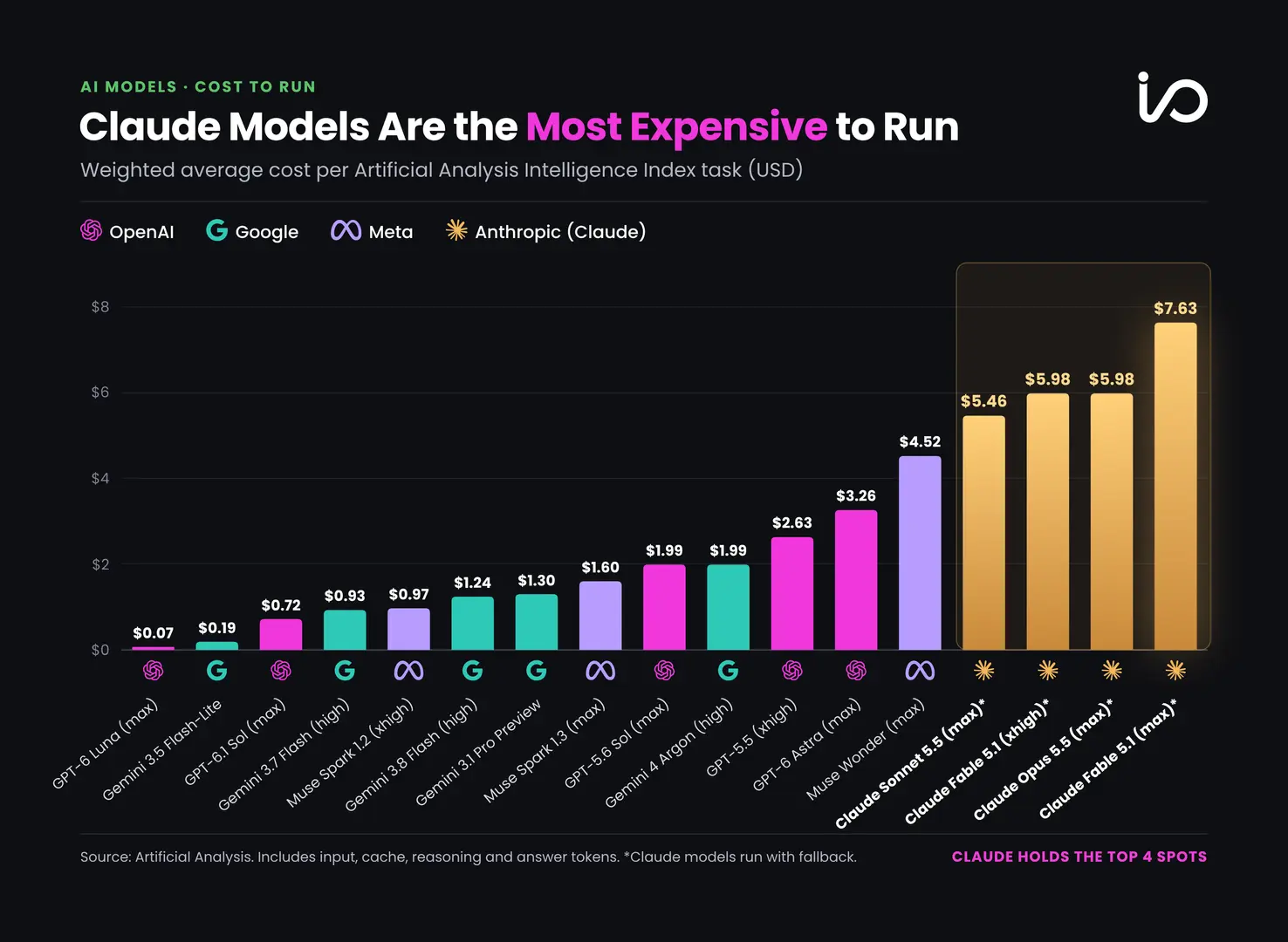
The benefit from this improved performance-per-dollar is evident in lower token costs, where Google offers among the lowest “cost per intelligence task.”
According to Artificial Analysis, cost per intelligence task reflects average prices for real-world evaluation scenarios, rather than just a simple per-million token price via APIs. In the evaluations, Gemini ranked among the lowest cost per intelligence compared to leading models from OpenAI, Anthropic and Meta.
For example, Gemini 3.1 Pro Preview costs an average of $1.30, or 51% cheaper than GPT 5.5 (high) and 76% cheaper than Claude Sonnet 5.5. However, lightweight models such as GPT 6 Luna provide stiffer cost competition, with an average cost of $0.07 versus Gemini 3.8 Flash Lite’s $0.19.
Claude models rank as the most expensive to run, occupying the four highest-cost positions. Gemini 3.1 Pro Preview averages $1.30 per intelligence task versus $5.46 for Claude Sonnet 5.5 and $7.63 for Claude Fable 5.1.
The 8i’s deployment would compound the already significant serving cost reductions Google achieved in 2025. Last Q4, Google’s CEO stated there was a 78% reduction in Gemini serving unit costs throughout 2025, with this occurring prior to the optimized v8 generation and the significant performance improvements it delivers.
As inference workloads shift from Ironwood to the new generation, that 80% reduction in performance-per-dollar can allow Google to continue lowering serving costs and help broaden Gemini adoption.
Third-Party TPU Sales Could Become Google’s Next Major Revenue Driver
Second, selling TPUs to third-party customers creates an additional revenue stream for Google outside of monetizing capacity via rentals. Google first made the shift to selling TPUs to third-party customers in April, recognizing the first TPU-related revenue in Q2 at a small scale.
Despite being quite early in this endeavor, its TPU customer list is notable. According to Broadcom’s update in Q3, Anthropic is deploying 1GW of Ironwood TPUs in 2026, 5GWs of TPU 8i in 2027 and an incremental 10GW in 2028.
Meta signed a multibillion-dollar TPU deal in February and was rumored to explore third-party TPU deployments, while Google’s joint venture with Blackstone aims to bring its first 0.5 GW of TPU capacity online in 2027.
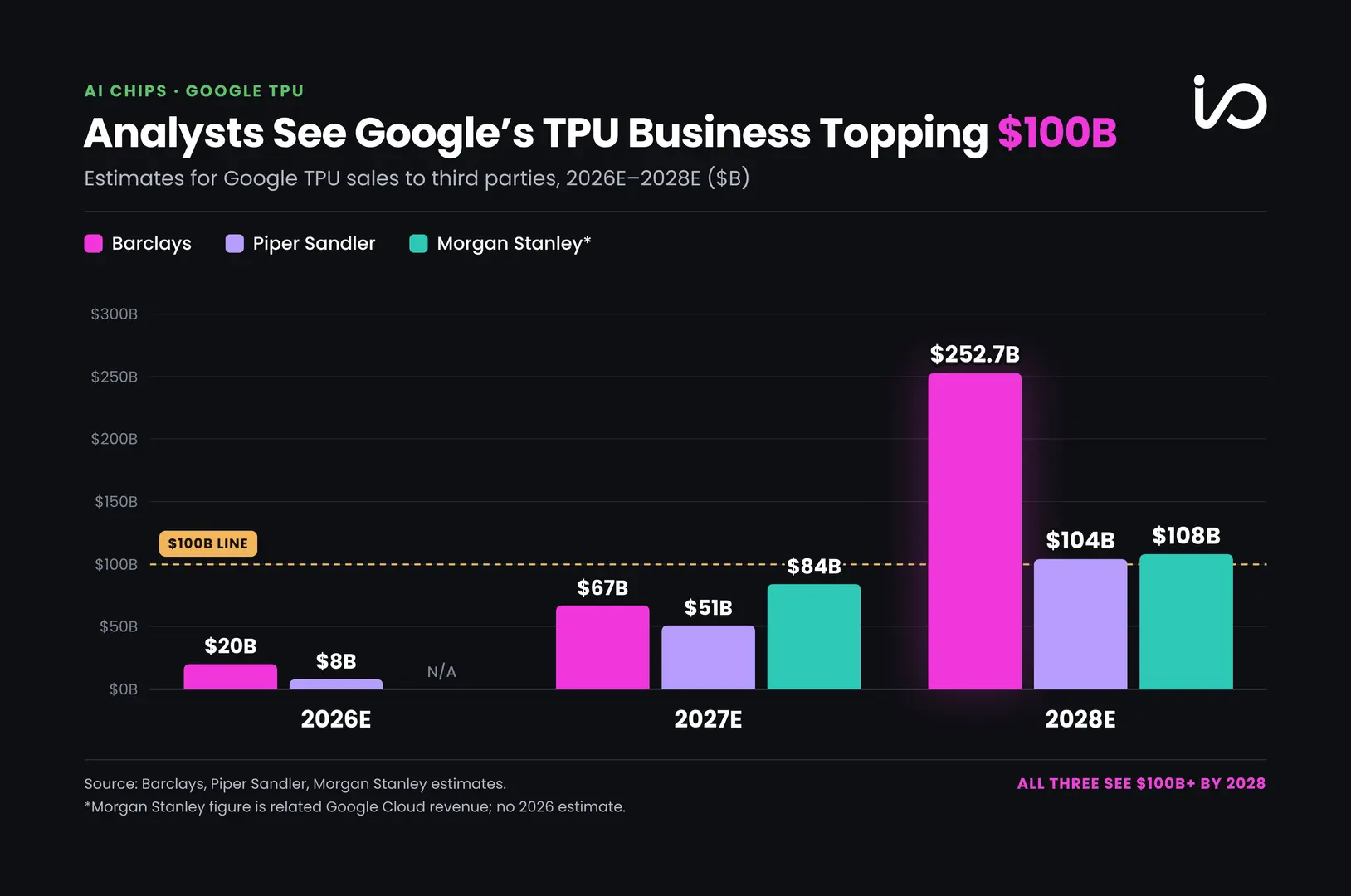
This rapid multi-GW ramp is expected to create a significant revenue stream for Google, with the majority of shipments starting to land in 2027 and beyond. Barclays projects third-party TPU sales could generate roughly $20 billion in revenue in 2026, more than triple to $67 billion in 2027 and more than triple again to $252.7 billion by 2028. This is one of the most aggressive ramps expected, with Piper Sandler and Morgan Stanley projecting just over $100 billion by 2028.
To put this in perspective, that 2028 projection from Barclays would imply that third-party TPU sales would ramp to the current run rate of Google’s Search business in just two and a half years.
Analysts project rapid growth in Google’s third-party TPU business through 2028. Barclays forecasts TPU sales reaching $252.7 billion by 2028, while Piper Sandler and Morgan Stanley estimate approximately $104 billion and $108 billion, respectively.
However, this secondary revenue stream currently comes with a fair degree of risk. At the moment, Anthropic accounts for the majority of expected third-party shipments, creating customer concentration and financing risk for TPU shipments.
Merchant TPU Sales Shift the Capex Burden to Customers
This secondary revenue stream from selling TPUs also shifts the capex burden away from Google to its third-party customers. With $200 billion earmarked towards capex this year, any incremental revenue that doesn’t require Google to build the data center first is unusually valuable.
For Google to deploy TPUs through Google Cloud and rent them to customers, it must first pay upfront for the data center, the power, the cooling and the chips, reflected in its 2026 capex bill at $195-205 billion. Once TPUs are installed and energized, Google can then recover its capex by renting these chips out in the cloud across several years.
However, merchant TPU sales to third-party customers flip that equation around. Under this sales model, customers would fund the data center and the hardware purchases, with Google’s revenue coming at chip delivery instead of those multi-year rental terms. Thus, that estimated $253 billion revenue stream would appear in financials as systems are shipped.
One major drawback to shifting capex to its customers is that R&D labs such as Anthropic, who accounts for the majority of projected shipments, do not enjoy the same balance sheet strength as hyperscalers. While Anthropic says it was cash flow positive in Q3, it does not have the same strength in terms of cash as the hyperscalers do. If Google plays a larger role in helping finance chip purchases (where Broadcom currently is active with its AI XPV platform), some of the cash benefit shifts back onto Google’s balance sheet or into contingent obligations.
Get Our Free Weekly Stock Newsletter
Get weekly stock insights, market analysis, and technology updates straight to your inbox.
Weekly stock insights
Market analysis
Technology updates
Third-Party TPU Sales Come With Margin Trade-Offs
One caveat to external TPU revenue is that it could weigh on Google’s margins, as TPU system sales will carry a far lower margin than cloud revenue.
For context, Google Cloud reported an operating margin of 35.6% as of Q2, expanding roughly 15 points YoY as operating income more than tripled to $8.8 billion as AI services ramped.
However, by shifting to selling full TPU racks, revenue will now include HBM, networking components, cooling and power, much of which will pass through at little markup. Broadcom offers a clear example for this, noting that as “TPUs continue to accelerate, there’ll be pressure overall on margins” as these lower-margin systems contribute a higher proportion of AI semiconductor revenue.
My updated Q4 Top 20 AI Stocks report hit inboxes this week. The report runs over 100 pages and identifies the 20 stocks I believe will lead the AI market this quarter. The report is built on the same investment discipline that drove our YTD outperformance and surfaced some of the biggestAI winners of 2026.
For Google, margin impacts could be more pronounced, as it’s expected that third-party TPU sales will carry far lower margins than even what Broadcom realizes. Even with the higher mix of lower-margin XPU projects, Broadcom is maintaining a mid-70% gross margin, though Morgan Stanley estimates that Google’s third-party TPU sales could carry a gross margin of just 30%.
Impacts in the near-term are likely to be relatively minimal as TPU revenue should be easily absorbed by its broader cloud suite, but come later in 2027 and especially 2028, the higher mix of TPU-driven revenue (potentially outpacing broader Cloud services) could weigh on segment margins.
Google’s Challenge to Nvidia Extends Beyond Inference
While the 8i targets inference workloads, new details on the training-focused TPU 8t show how far Google is pushing scale.
At Hot Chips in August, Google outlined an 8t ‘superpod’ of 9,600 chips with access to 2PB of shared HBM and 121 exaflops of FP4 compute, offering roughly twice the performance-per-watt of Ironwood. The scale is made possible by Google’s optical circuit switches, which can dynamically carve slices out of a 9,600-chip pod. Compare this to Nvidia’s current rack-scale systems, where the scale-up domain tops out at 72 GPUs.
Google is also taking this scale a step further with the introduction of its dedicated Virgo Network fabric. With Virgo, Google can link together fourteen of the ‘superpods’ in a single fabric, capable of supporting 134,400 TPUs in a single domain with 47 PB/s of bandwidth. This cluster size offers 1.6 yottaflops of compute (or 1.6 million exaflops) for massive, large-scale frontier model training.
According to AMD at CES 2026, “Reaching yottascale AI compute would require the equivalent of millions of today’s Frontier exaflop-class supercomputers operating together.”
Nvidia Delay Could Help Google; But it’s Not Necessary
As we’ve said in the past, Nvidia’s product roadmap has consistently pushed the limits across the supply chain. This led to a delay in 2024 on Blackwell, due to the systems overheating.
In May, we discussed a reported one-quarter delay in Nvidia’s Rubin ramp, stating:
“Lastly, the reported one-quarter delay of Nvidia’s Rubin ramp, officially scheduled for Q3 2026, could offer a strong argument for diversification across AI accelerators. Notably, TrendForce revised its estimate of Rubin’s contribution to Nvidia’s total high-end GPU shipments for 2026 down from 29% to 22% to account for such a delay.
Factors contributing to the reported delay and TrendForce’s revision include “the time required to validate the newer HBM4 memory used by the chips, challenges with the migration to Nvidia’s faster ConnectX-9 NICs, the system’s higher overall power consumption, and the more advanced liquid cooling requirements.”
Since then, another report has surfaced. In July, CNBC reported that SemiAnalysis found Nvidia’s Kyber rack architecture had been delayed by more than 12 months to 2028, citing a PCB midplane manufacturing issue, though Nvidia has publicly disputed the report.
If these reports prove accurate on the Kyber rack delay, or even if Nvidia shifts the Rubin Ultra architecture from its original planned four-die design to a “2+2” design as rumored, the impacts would be larger than just timing. Kyber marks the system that expands Nvidia’s scale-up domain from 72 GPUs to 576 GPU dies per rack.
A delay to 2028 would mean Nvidia’s largest coherent domain stays in the 72-GPU class through 2027, the same year Google’s merchant TPU revenue is set to ramp with pods of 1,152 chips for inference and 9,600 chips for training (slightly larger than the 9,216-chip pod with Ironwood).
Google is also quickly catching up to Nvidia in terms of unit volume, although a majority of these will be used internally to serve Gemini. However, any potential delay on Nvidia’s roadmap could open the door for further market share gains, as estimated TPU volumes range from 8.8 to 10 million in 2027, above UBS’ estimate for 8.8 million Rubin chips next year.
HBM Supply Constraints Remain the Largest Bottleneck
HBM is the leading constraint the AI industry faces, and commentary from industry executives suggests that the shortage is only worsening with little relief expected in 2027 or even 2028.
In our recent newsletter, Why Nvidia’s SK Hynix Deal Leaves Little AI Memory Supply, we explained that based on industry estimates, Nvidia and Alphabet are expected to demand roughly three-quarters of global HBM supply in 2027. When factoring in AMD’s Helios ramp and numerous custom silicon projects at other hyperscalers, there is little chance for meaningful HBM supply relief or allocation increase.
Faced with such tight supply constraints, even Nvidia, the largest buyer, is paying up to secure access to HBM, and Google likely is having to do the same given its allocation is nearly on par with Nvidia’s, and far ahead of AMD’s.
With the memory market recently shifting in favor of long-term agreements with substantial prepayments, it means cash goes out the door long before TPU revenue is recognized. Customer deposits for third-party TPU capacity can offset this, but it’s a timing drag during a ramp, which is exactly what 2027 will be.
Conclusion
Google’s greatest competitive advantage may not be building a faster chip than Nvidia, but rather in building AI infrastructure at a lower cost. The company has spent years designing accelerators around the demands of its own AI workloads, giving it an advantage that traditional chip companies cannot easily replace.
Selling TPUs to third-party customers opens up a new revenue stream for Google, with analysts forecasting a wide range of revenue from $100 billion to $250 billion as soon as 2028. The higher-end of those forecasts represents what took Search decades to achieve.
The one caveat? HBM constraints and customer financing could limit how quickly the sales translate to improved cash flow. Read more here.
My updated Q4 Top 20 AI Stocks report hit inboxes this week. The report runs over 100 pages and identifies the 20 stocks I believe will lead the AI market this quarter. The report is built on the same investment discipline that drove our YTD outperformance and surfaced some of the biggest AI winners of 2025.
Please note: The I/O Fund conducts research and draws conclusions for the company’s portfolio. We then share that information with our readers and offer real-time trade notifications. This is not a guarantee of a stock’s performance and it is not financial advice. Please consult your personal financial advisor before buying any stock in the companies mentioned in this analysis. Beth Kindig and the I/O Fund own shares in NVDA at the time of writing and may own stocks pictured in the charts.
Beth Kindig is the lead tech analyst for the I/O Fund with audited results that beat Ark in 2020 and returns of up to 1700% on her premium site in two years and 1150% in her free newsletter in three years on individual stocks and assets.