

Since 2022, Big Tech capex has been the clearest barometer of AI demand. But the market’s reaction to Google’s latest earnings shows investors are questioning how long that spending can last. While the market frets over hyperscalers’ cash flows, a second wave of AI infrastructure spending has quietly emerged, driven by enterprises and neocloud customers.
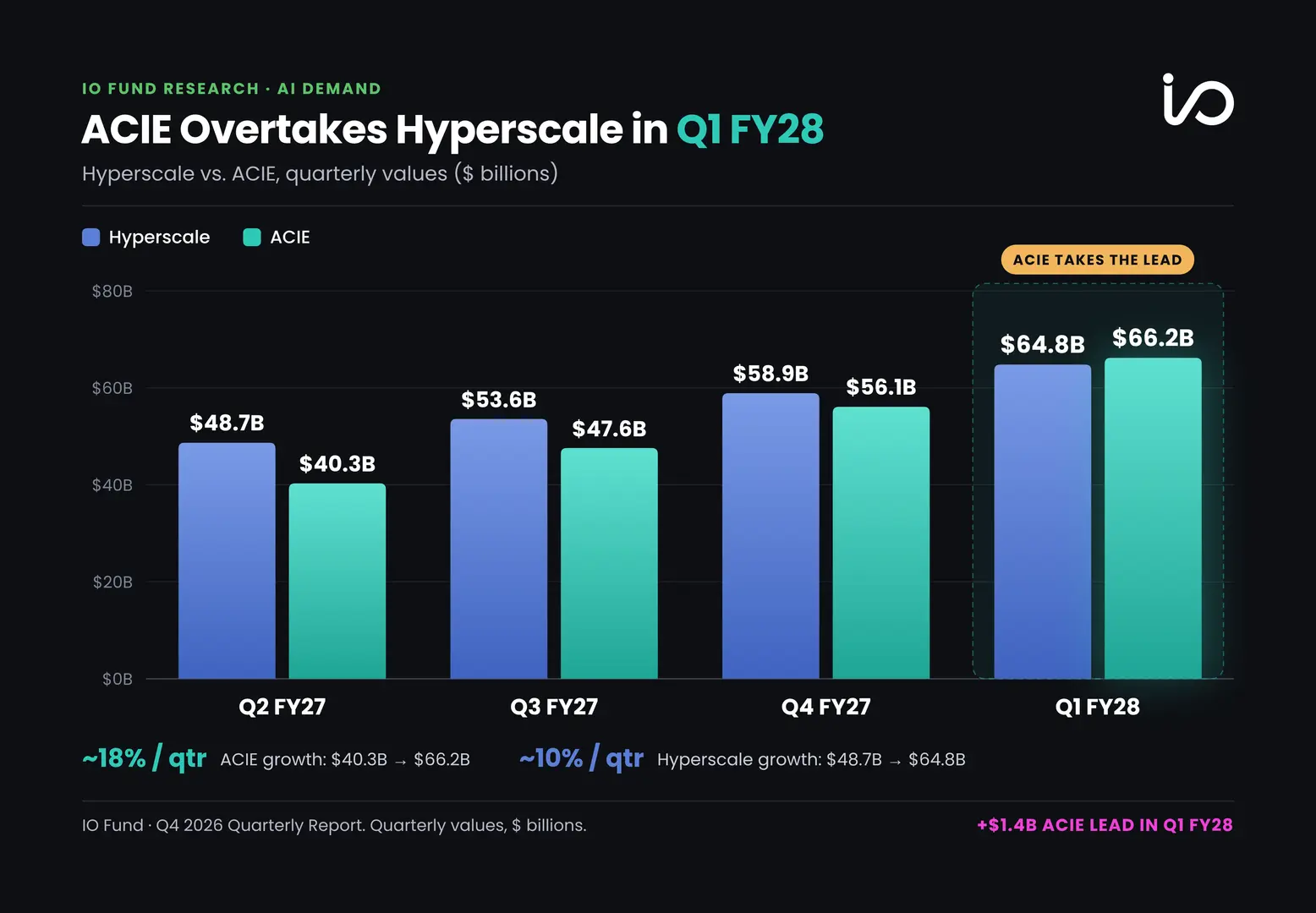
The strength in non-hyperscaler revenue is quite visible in Nvidia’s earnings reports over the past two quarters, which was the topic of our recent free newsletter Nvidia Fiscal Q2: The AI Giant Answers to Losing Market Share, when we stated: “This quarter, hyperscalers represented revenue of $48.7 billion compared to AI Clouds, Industrial and Enterprise customers (ACIE) revenue of $40.3 billion, yet ACIE had a stronger growth rate of 138.5% compared to the hyperscaler segment at 101.2%.”
Importantly, this trend is not limited to Nvidia’s report. AI server OEMs, such as Dell, Super Micro and HPE are echoing that enterprises and neoclouds are contributing to their results. Dell, in particular, laid out a forecast for 200 GW of AI data center growth through 2030, with enterprise and neoclouds expected to drive half of that growth, or 100 GW. Dell estimates this could create a $1 trillion AI infrastructure opportunity over the next four years.
On the heels of Google’s cash flows turning deeply negative, we map out the upcoming tailwinds for AI servers, and why a new growth phase in 2027 could lead to both higher shipment volumes and more revenue per deployment.
Enterprise and Neocloud Customers Could Help Drive a $1 Trillion AI Infrastructure Opportunity
Our firm’s back of the napkin math shows that Nvidia’s ACIE segment could potentially overtake hyperscalers in two to six quarters. This is an important development as it results in Nvidia’s revenue being more resilient as hyperscalers shift capex toward designing and deploying their own custom chips.
As discussed above, ACIE revenue grew faster than hyperscaler revenue last quarter at 138.5% compared to 101.2%, respectively. After reclassifying one company, the QoQ growth for ACIE was 25% compared to hyperscalers at 13%. Within this, sovereign AI revenue and regional neoclouds reported growth of 35% QoQ and tripled YoY.
Depending on how you model the two-quarter lumpiness, ACIE can conservatively overtake hyperscalers in 5-6 quarters at a 14% QoQ growth rate versus 10% QoQ growth rate for hyperscalers, or as soon as 2 quarters if the Q2 pace continues.
In early September, Dell was in agreement with Nvidia’s results, stating that enterprises and neoclouds could contribute half of AI data center capacity growth through 2030, creating a $1 trillion total addressable market (TAM):
“We’re expecting AI to be 75% of all data center demand by 2030, adding 200 gigawatts of power over that same time frame. And half of that, we believe, is right in our sweet spot with our customers, the Neoclouds, sovereigns and enterprises. And if you look at that math, we think the opportunity in front of us is more than $1 trillion over that time frame.”
Dell’s extensive presence with 6,500 enterprise and neocloud customers (with more than half those added in the last three quarters), and expectations for enterprise agentic AI to be the “single largest workload by 2028” also suggest this $1 trillion TAM will primarily be driven by enterprise and neocloud growth.
Although it may seem counterintuitive for Nvidia, Dell or Super Micro to emphasize enterprise and neocloud customers over the hyperscalers and their $1 trillion capex next year, the reason is simple.
Unlike the hyperscalers, these customers do not have those budgets to splurge tens of billions on custom chips. Instead, demand is more concentrated in ready-to-deploy servers that can immediately be brought online to generate revenue for immediate ROI, which Dell and Super Micro can do in as little as six hours to one day.
Enterprise AI Deployments Increase Revenue per Server Deployment
Enterprise offers another avenue for Dell and Super Micro to increase their value-add due to more rack complexity and increased density. The spend comes with strong attach rates in higher-margin storage, networking and, especially for Dell, services contracts.
According to Dell:
“The momentum with enterprise, best measured by number of customers, the number of customers that are buying repeatedly is all up and the indicators are strong. And they tend to buy more storage, and they tend to buy more networking when they engage with us, a more complete solution.”
Increasing attach rates, particularly within storage, are a big value proposition for AI server companies, as higher attach rates mean Dell and Super Micro are able to capture a much larger revenue opportunity per deployment. For example, analysts last quarter suggested Dell’s storage attach opportunities ranged from $2-3 per $1 of servers. This can then flow down the line and aid operating margins.
Agentic AI is also a multiplier to storage attach, as agentic workflows inherently are much more intensive than simple chatbot query workloads. Autonomous agents will continuously call tools, retrieve data, invoke models, evaluate intermediate outputs, and repeat those steps into dozens of operations. This is expected to drive a 15X increase in tokens per user, per Arm, while also increasing the size of KV cache data needing to be stored to maintain model context.
This increase in storage intensity from multi-step inference or KV cache requirements also presents an opportunity for server OEMs to differentiate themselves with storage offerings. For example, Dell is leveraging its storage IP portfolio to create a ‘persistent’ KV cache storage tier, which it says can offer up to a 19x faster time‑to‑first‑token and 5.3x higher tokens-per-second.
AI’s “safe” bets like $NVDA and Big Tech are underperforming the $QQQ YTD. Meanwhile, some of 2026’s biggest triple-digit winners are hiding deeper in the AI stack. My Q4 Top 20 AI Stocks report, released this week, breaks down the lesser-known companies leading the charge. Previous reports identified an energy stock up more than 1,230% since our initial entry last year, an optical networking stock up 173%, and two of our largest AI positions up 153% and 138% year to date.
Subscribe to access the 100+-page Q4 Top 20 AI Stocks report: GET PREMIUM ACCESS
Rack-Scale CPUs Expand AI Infrastructure Beyond Traditional GPU Systems
Up until this point, the AI server industry has only faced two high-volume platforms in a 72-GPU scale-up system, Blackwell and Blackwell Ultra. As we head into the end of 2026 and into 2027, rack-scale solutions are broadening, across both GPU and now CPU roadmaps.
Over the past year, an important development is that standalone CPUs are beginning to migrate to rack-scale solutions with releases from major CPU players AMD, Arm and Nvidia. This expansion offers a bullish readthrough for AI server manufacturers as rack-scale CPUs introduce a new category of high-value systems beyond GPU deployments. The revenue per deployment increases as rack-scale systems require greater compute density and additional networking and power and cooling requirements.
AMD earlier this month unveiled its new ‘Helion’ platform, marking its first CPU-only racks for agentic AI deployments. AMD is launching Helion in two configurations, the hyperscale-oriented CPU-only rack offering up to 32,768 Venice CPU cores, and an enterprise configuration featuring up to 16 MI355X GPUs alongside CPUs. Although the announcement is relatively fresh, AMD appears to be moving quite quickly, with the first Helion platforms already under development for a November launch.
AMD’s release also follows Arm, who made the entry into physical chip development and rack-scale CPU systems earlier this year in March with its AGI CPU. As we outlined in our newsletter, Arm Stock Could Win as Agentic AI Shifts the Bottleneck to CPUs, Arm’s new chip will ship in both air-cooled and fully liquid-cooled racks to meet customers where their data center infrastructure lies.
In an air-cooled rack, Arm can pack 30 blades (or 60 CPUs) for a total of 8,160 cores in a 36kW power envelope, saying this configuration can deliver up to 2X the performance per rack versus x86 chips based on its internal estimates. The fully liquid-cooled rack, in partnership with Super Micro, consumes 200kW and packs 336 CPUs, delivering a total of up to 45,696 cores.
In fiscal Q1 earnings in July, Arm continued to maintain its view for $1 billion in AGI CPU revenue across FY27 and FY28, with supply in place to hit that target. Arm says the demand pipeline still exceeds $2 billion.
Nvidia Vera Could Become a $40 Billion Rack-Scale CPU Opportunity
Nvidia explained in Q2 that it expects Vera CPUs to be “deployed by every major hyperscaler, neocloud, AI lab, and system OEM with shipments already underway to our lead partners, including OCI, SpaceXAI and starting this quarter, AWS.”
Nvidia sees $20 billion in server CPU demand in FY27 with the potential to double to $40 billion in FY28; for comparison, this is roughly two-thirds of Intel’s total revenue this year. Arm is also entering hardware for the first time with its AGI CPU racks, featuring 152 or 336 CPUs in liquid cooled racks.