
Tech Stocks

Highlights from Bitcoin Conference 2019

Written by

Beth Kindig

Founder, CEO and Lead Technology Analyst

Published: July 3, 2019

Last Updated: July 3, 2019

Last week, the world’s largest bitcoin conference took place in San Francisco. Despite bitcoin holding a $200 billion market cap in Q2 2019, cryptocurrency conferences receive less press than tech conferences from companies with comparable market caps, such as Oracle World, Dream Force or even Oktane, a conference by a company with a fraction of the market cap that receives ample press coverage. 

Despite naysayers, Bitcoin has proven to be a revolutionary, digital asset. Worst case scenario, if you had invested in bitcoin as a long-term investment at the height of each bubble and sold at the bottom of the crash (due to terrible luck and timing), you would have seen 82-fold returns from $39 to $3,200 over the last decade or 3-fold returns from $1,151 to $3,200. There are those who bought at $19,000 who are still licking their wounds, but these were not long-term investors.
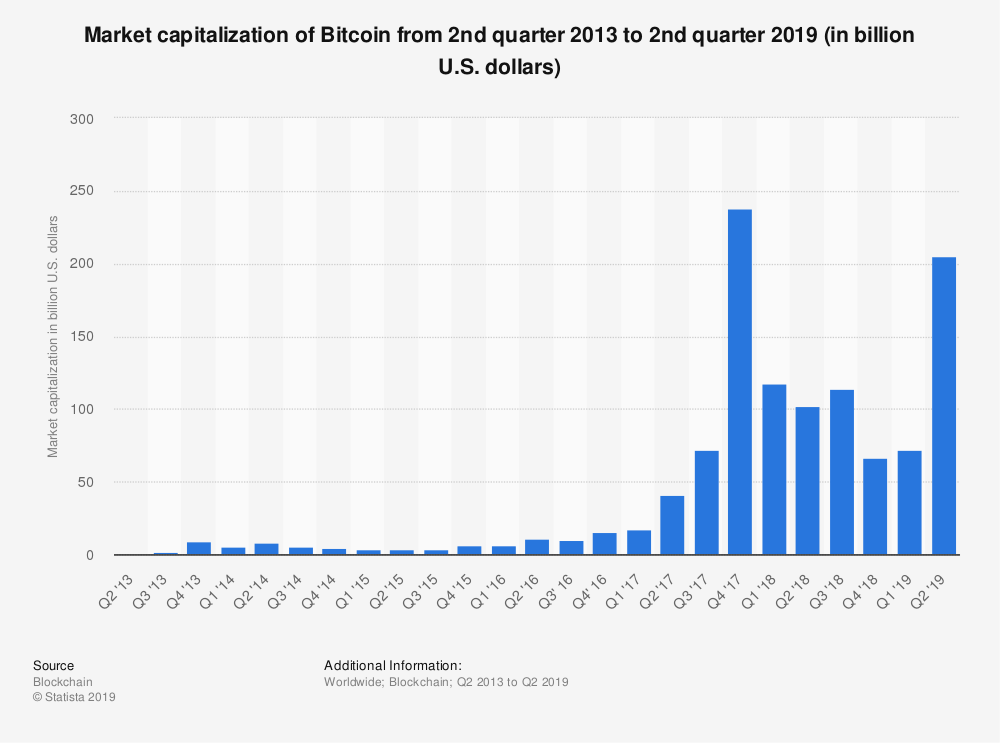
Quite a few of the speakers at the conference have been holding bitcoin since its early days as a long-term investment. There are key reasons as to why bitcoin will make a solid long-term asset over the next five years and may reach its peak as a new technology with mass adoption in seven to ten years. Follow me for a three-part series entitled: “Is Bitcoin a Good Investment” with analysis on three important phases to the bitcoin tech cycle: institutional adoption, global economic uncertainty and digital payments.

Privacy and Bitcoin

One of the highlights at the Bitcoin Conference 2019 was a fireside chat with Edward Snowden (yes, that Edward Snowden), who dialed into the conference for a thirty-minute webcast on privacy. The crowd was ecstatic to say the least, as technologists and privacy advocates are usually one and the same. When you work in the industry, you see too much and know too much to be complacent over privacy, and bitcoin technologists are no exception.

Hackers endorsing bitcoin can be a double-edged sword, however, as institutions circle the cryptocurrency with no official adoption just yet (i.e. SEC regulated platform). The cryptocurrency is well adopted in the hacker community and will now require broader adoption to see its full potential.

Onion routing is one method of concealing location and online activity from network surveillance or traffic analysis. Tor Project is a group of developers who offers onion routing to reduce the likelihood of sites tracing actions and data back to a user. Going beyond a Virtual Private Network, onion routing conceals IP addresses although the use of Tor can be traced. 

Isabela Bagueros of Tor Project spoke at the Bitcoin Conference 2019 and her message was clear – that VPNs are centralized and not to be trusted for anonymity. The proliferation of bitcoin and concerns around financial privacy will likely draw more attention in the years to come as Bitcoin has an inherent, anonymity issue as every transaction is public data. Meanwhile, specific solutions that combine full anonymity over a computer network and the use of blockchain and/or bitcoin have not been developed at this time. Bitcoin is a step direction towards financial privacy, but as many of the panelists pointed out, there’s still more to be done.

Beth Kindig, founder and lead tech analyst of I/O Fund

Get Our Free Weekly Stock Newsletter

Get weekly stock insights, market analysis, and technology updates straight to your inbox.

  • Weekly stock insights
  • Market analysis
  • Technology updates

Bitcoin Vs. Libra

Tim Draper is well-known in the startup scene and is a founding partner of Draper Fisher Jurvetson. He has been an early advocate of bitcoin and one of the more publicized spokespeople on the topic, especially around his first prediction that bitcoin would hit $10,000 (this came true), a second prediction that it will hit $100,000 and his current prediction that bitcoin will hit $250,000 by 2023.

When Draper was asked about the effects of Facebook’s Libra coin, he pointed out that two drawbacks is the coin relies on fiat currencies and is also controlled by Facebook, and therefore, goes against the ideals of decentralized cryptocurrencies.

During a panel that included Max Keiser of the Keiser Report, Bill Barhydt of Abra and Anthony Pompliano of Morgan Creek Digital, Libra was seen as potentially a positive thing for introducing crypto wallets to the 2+ billion users across Facebooks apps. At the very least, Libra will normalize the concept of carrying crypto and transacting in crypto even if there is little success with the Libra currency. 

Dovey Wan, the founding partner of Primitive, expressed on a separate panel that Libra is not much different than AliPay, a digital payments platform used in China that does not require cash or credit cards to transact.

Facebook is not the only company placing large bets on the future of crypto. During the same week as the conference, Hotels.com announced a partnership with Lolli to reward Hotel.com customers with micro units of Bitcoin. Moneygram also recently announced that Ripple will be its main partner for cross-border transactions that use digital assets.

In my upcoming three-part series entitled “Is Bitcoin a Good Investment,” I cover three important phases to the bitcoin tech cycle: adoption by institutions, global economic uncertainty and digital payments.

Recommended Reading:

Will Bitcoin Make a Good Investment? Part 1: Institutional Adoption Will Facebook’s Cryptocurrency Have a Long-Term Impact?Uber IPO

About the author

Beth Kindig

Beth Kindig

Profile

Beth Kindig is the Founder, CEO and Lead Technology Analyst at I/O Fund, with more than 15 years of experience covering private and public technology companies. Known for her early Nvidia research beginning in 2018 and bold, high-conviction calls on emerging technology trends, Beth also manages I/O Fund's audited technology portfolio, which has returned 326% since May 2020, or 29.2% annualized. She is a regular guest on Fox Business and Bloomberg and has appeared on Real Vision, CNBC, Yahoo Finance, BBC, MarketWatch, Forbes, and more.

Curation

Expand your knowledge

View all posts
Amazon’s AI Data Center Expansion Faces a New Roadblock Ahead of November 17 Vote
DATA CENTER

Amazon’s AI Data Center Expansion Faces a New Roadblock Ahead of November 17 Vote

Amazon dropped data centers on its $427 million Ashburn campus after local pushback. Loudoun votes November 17 on a 12-month pause for data center approvals. Is permission the new bottleneck for the AI buildout?

DATA CENTERNOV 16, 2026
AMD Stock: Two-Catalyst Punch Leads to 80% Growth Next Year
SEMICONDUCTOR STOCKS

AMD Stock: Two-Catalyst Punch Leads to 80% Growth Next Year

In August, our premium article "Venice Meets Helios" pointed to two strategic product releases that were arriving soon - AMD’s Venice CPUs and the highly anticipated Helios MI400 Series. At the time, management expected server CPU revenue to grow more than 70% in 2027, while total Data Center revenue would grow “well over 100%,” driven by the Helios ramp. Three months later, AMD has raised its outlook considerably, and the two product ramps are now exceeding the I/O Fund’s original expectations. Server CPU revenue is now expected to more than double in 2027, up from the previous outlook for 70%+ growth. Meanwhile, Data Center AI revenue (GPUs) is expected to significantly more than double.

SEMICONDUCTOR STOCKSNOV 13, 2026
Nvidia Says Capacity Is the Constraint: 3 Bottlenecks Holding Back the AI Buildout
AI STOCKS

Nvidia Says Capacity Is the Constraint: 3 Bottlenecks Holding Back the AI Buildout

Nvidia has signed capacity agreements with six key suppliers for chip parts and has a new design to build AI data centers, even as CEO Jensen Huang points out extraordinary demand amid capacity constraints. However, grid power remains the limit Nvidia can’t fix on its own.

AI STOCKSNOV 13, 2026