AMD Stock: Two-Catalyst Punch Leads to 80% Growth Next Year
Written by
I/O Fund Team
Research Team
Published: November 13, 2026
Last Updated: November 13, 2026
On this page
After an eventful week for Jensen Huang, we revisit the most epic battle in AI: AMD versus Nvidia.
Despite CPUs taking center stage for AMD this past year, the primary thesis for AMD stock remains its ability to challenge Nvidia in GPUs.
But then again, why choose if you don’t have to?
For investors, there is only one thing better than an incoming catalyst, and that’s two catalysts arriving at the same time.
In August, our premium article “Venice Meets Helios” pointed to two strategic product releases that were arriving soon – AMD’s Venice CPUs and the highly anticipated Helios MI400 Series. At the time, management expected server CPU revenue to grow more than 70% in 2027, while total Data Center revenue would grow “well over 100%,” driven by the Helios ramp.
Three months later, AMD has raised its outlook considerably, and the two product ramps are now exceeding the I/O Fund’s original expectations. Server CPU revenue is now expected to more than double in 2027, up from the previous outlook for 70%+ growth. Meanwhile, Data Center AI revenue (GPUs) is expected to significantly more than double.
AMD guided for companywide revenue to increase more than 80% next year, which is more than twice the company’s long-term growth model outlined in November 2025’s Analyst Day.
Perhaps the most important milestone is that AMD’s Data Center AI business is expected to surpass its server CPU business in revenue for the first time in Q4, as Helios enters a multi-gigawatt cycle with Anthropic, Meta, Microsoft, OpenAI and Oracle deploying its new racks.
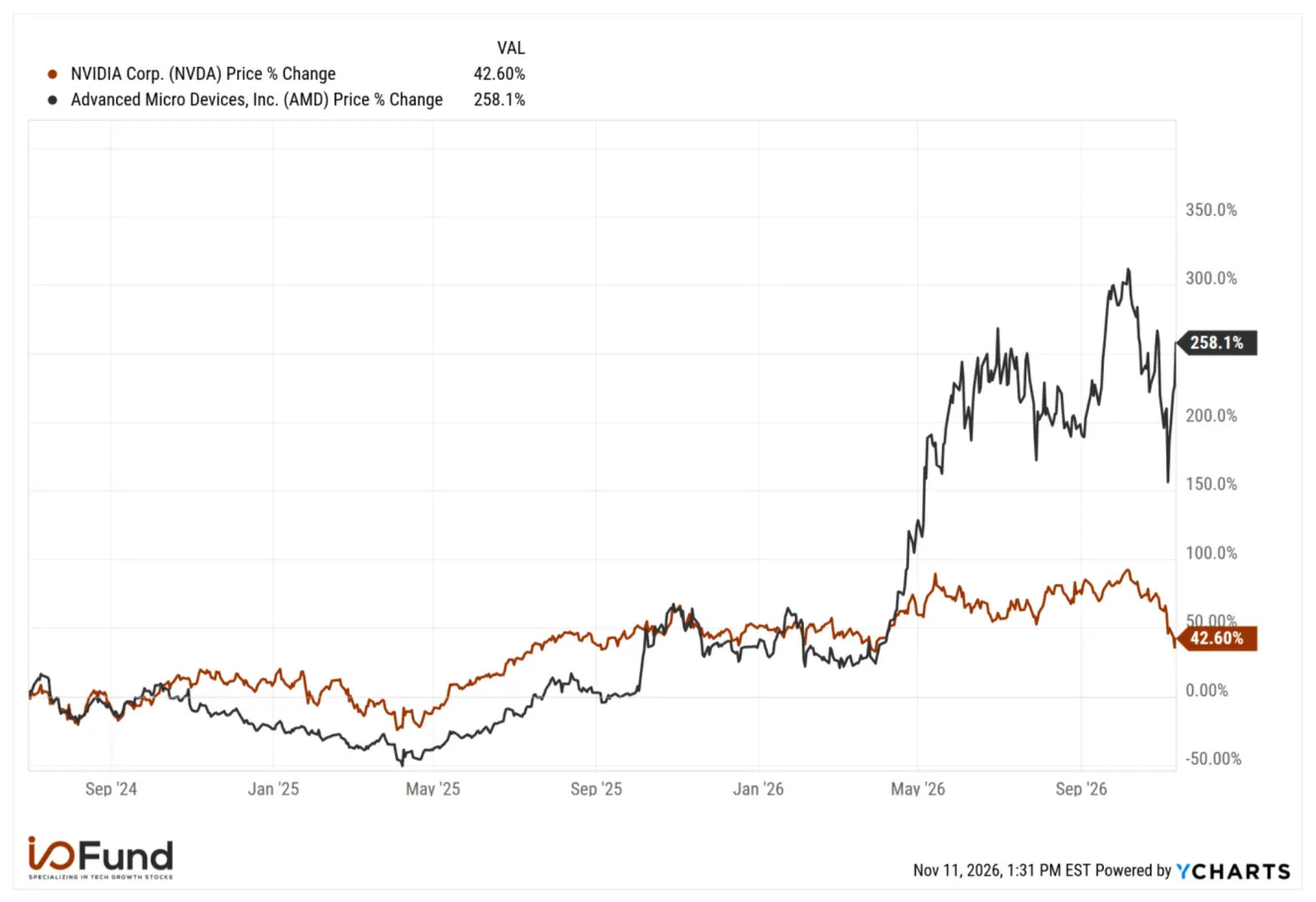
Below, we revisit my July 2024 prediction that AMD’s returns would surpass Nvidia – a call that I made when Nvidia was the market darling. Since then, AMD has gained more than 250% compared to Nvidia’s 51% outperforming by about 5X – and I have a hunch that gap could get wider.
Revisiting the I/O Fund’s 2024 Prediction: AMD Stock to Surpass Nvidia’s Returns
In July of 2024, when Nvidia was the market darling following it’s extraordinary AI-driven rally, I published a prediction that was unheard of at the time, which is that AMD stock would outperform Nvidia in percentage returns over the next five years. Importantly, this did not require AMD to overtake Nvidia in GPU market share.
So far, that prediction is playing out. Since July of 2024, AMD stock has gained more than 250% compared to Nvidia’s 51% as the inference opportunity that I identified 2.5 years ago is beginning to unfold.
AMD has substantially outperformed Nvidia since July 2024, with AMD shares rising 258.1% compared with Nvidia’s 42.6% gain. The chart shows how I/O Fund’s July 2024 prediction that AMD would outperform Nvidia in stock returns has tracked to date. Source: YCharts
The July 2024 video below, which is 30 minutes long, helps solidify the I/O Fund’s long track record of prescient calls. Similar to when I said Nvidia would become the world’s most valuable company in 2019, and later stated it would surpass Apple in 2021, the thesis on AMD is characteristically straightforward compared to what you’ll find elsewhere.
My thesis for the Dark Horse is this: At 10%+ GPU market share, AMD remains an attractive stock. At 15%+, the underdog story changes considerably.
Consider that in 2024, the growing role CPUs would play in orchestrating workloads for AI inference was unaccounted for industry-wide. This brings us back to the current moment, with two product cycles converging at the same time.
Let’s start with Venice.
Server CPUs: Venice Drives Higher Unit Shipments and Core Counts
AMD began revenue shipments of 6th Gen EPYC Venice processors in Q3 with initial OEM systems expected in Q4. As stated last quarter, management prepped investors by stating it was Venice was seeing “demand stronger than any prior EPYC generation.”
According to the earnings call, more than 240 Venice platforms have been committed, or 20% more than the previous generation Turin. It was also explicitly stated that Venice outperforms all x86 CPUs and Arm CPUs on performance per watt, per core and per dollar:
“Venice builds on that leadership with significantly better performance per watt, performance per core, and performance per dollar than any other x86 or ARM server CPU, positioning us to gain share and significantly grow our server business as the TAM grows to approximately $220 billion by 2030.”
According to AMD, Venice can offer up to 3.3X the rack-level performance within a 100kW power budget versus Nvidia’s Vera CPU, across a variety of workloads including general-purpose compute, KV and in-memory caching, web serving and more.
While TAM was stated to grow around 50% per year to $220 billion by 2030, it’s clear with AMD’s 100% CPU server growth forecast that the company has every intention of taking outsized market share.
According to management, the 100% growth is mainly driven by unit and core counts: “The growth in revenue is mostly in units and core counts, and less so in ASPs, although there is an ASP uplift as we increase core count”
Helios Enters a Multi-GW Deployment Cycle
Next quarter will mark the first quarter that AMD’s GPU business is expected to surpass its CPU server business: “In Q4, we are guiding sequentially revenue growing 50% for Data Center business. It is actually going to be the quarter Data Center AI business surpass server business.”
Later, during the Q&A, it was confirmed that this referred to dollars and not only revenue growth – an important milestone for AMD.
Management confirmed that Anthropic, Meta, Microsoft, OpenA and Oracle have brought their first Helios racks online, with deployments expected to increase substantially in Q4 as production continues to ramp.
The scale of 3 GWs was addressed during the Q&A when an analyst stated the following: “What is the level of confidence that AMD has that your anchor customers have the financing and the physical infrastructure to support, I think it is roughly 3 GW or so of planned AMD deployments into 2027?”
At a previously estimated $15 billion to $20 billion per GW, that represents $45B to $60B in revenue if the full 3 GWs is deployed. Although not formal guidance, it provides a benchmark.
However, investors should note this exchange is a bit loaded as it’s bringing up the fact that Nvidia has a strategic advantage in financing its customers with a much healthier balance sheet. The question for 2028 is if AMD will have to give into the peer pressure and start financing it’s customers, as well. This is a tougher proposition given the company’s debt increased from $3.3B to a whopping $7.1B as the company secures supply.
This sets up Helios well for inference tasks, such as reasoning and agentic workloads, where longer contexts, KV cache requirements, and greater concurrency require more memory.
As discussed in our previous article, tokens per watt measures how much inference can be produced within a fixed power envelope, such as 1GW. However, tokens per dollar measures how much inference can be produced relative to the total cost of operating a system.
Tokens per dollar incorporates many factors that determine tokens per watt, with power efficiency being one input into the broader economics rather than a separate consideration.
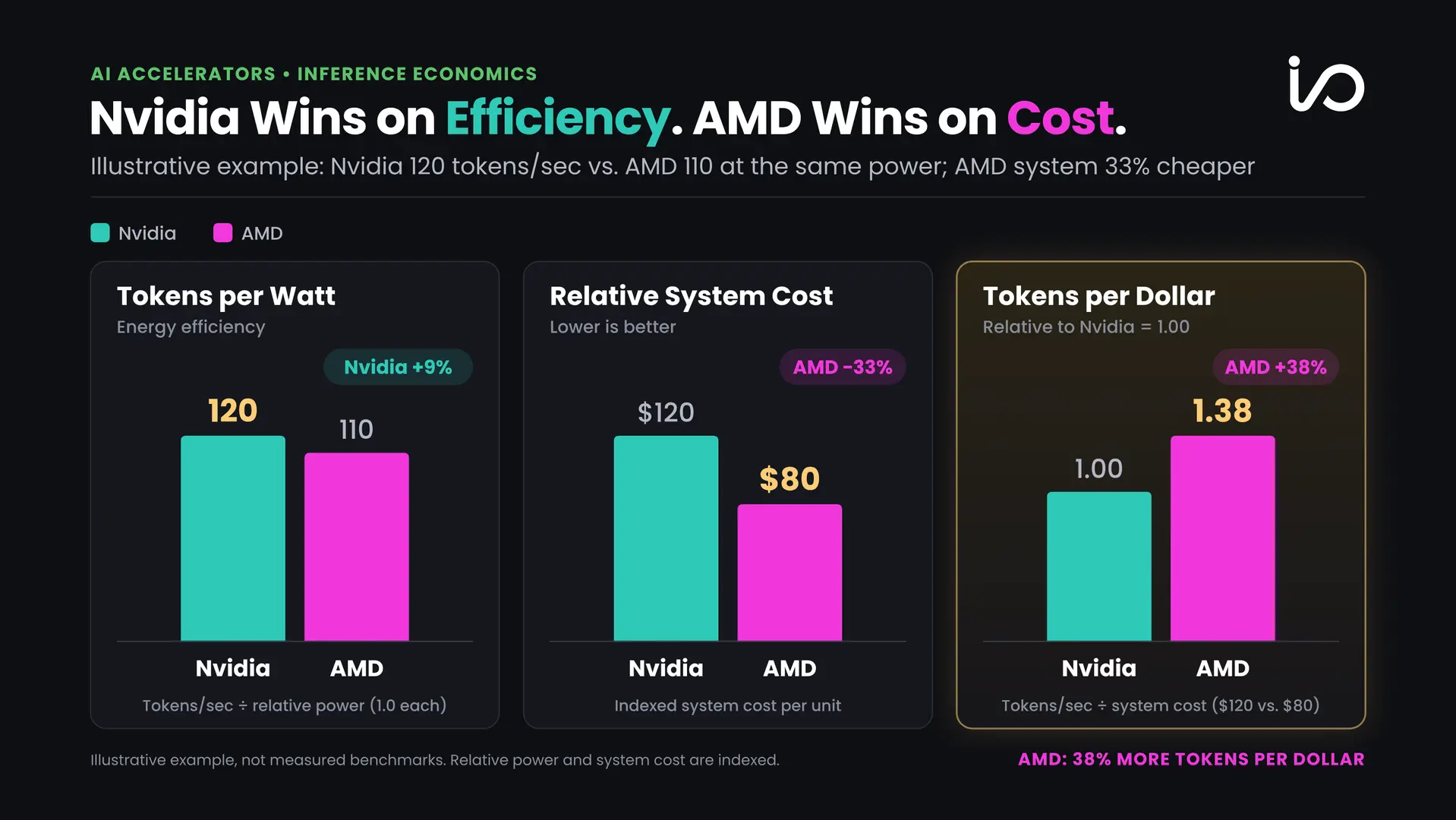
This is what it looks like side-by-side, to help illustrate that Nvidia could theoretically generate more tokens from the same amount of power, while AMD can generate more tokens per dollar if the cost of the Helios system is lower.
This illustrative example highlights the trade-off between AI efficiency and cost. Nvidia generates more tokens per watt at the same power level, while AMD produces 38% more tokens per dollar because the example assumes a lower relative system cost.
What makes Helios particularly interesting is that AMD is claiming it will not have to sacrifice one metric to win on the other. Management has stated that Helios delivers up to 15% more throughput at the same rack power and up to 30% more tokens per dollar than the competition.
If these economics hold as Helios moves into large-scale deployments, AMD does not need to compete with Nvidia head-on with performance. Instead, Helios seeks to offer strong enough performance at a low enough total cost that hyperscalers can generate more tokens for every dollar invested.
Get Our Free Weekly Stock Newsletter
Get weekly stock insights, market analysis, and technology updates straight to your inbox.
Weekly stock insights
Market analysis
Technology updates
That’s a mouthful, but the reality is that AI capex is putting more pressure on Big Tech free cash flow than we’ve seen in a very, very long time. Not only Big Tech, but R&D labs are set to go public soon, and their cash flow will be an eyesore. Therefore, having a second supplier that can help offset Nvidia’s extreme pricing power is what AMD is aptly proposing.
Helion Targets the Agentic AI Opportunity
Up until this point, the AI server industry has only faced two high-volume platforms in a 72-GPU scale-up system, Blackwell and Blackwell Ultra. As we head into the end of 2026 and into 2027, rack-scale solutions are broadening, across both GPU and now CPU roadmaps. The readthrough as CPUs move from standalone servers into much larger 72-CPU configurations is that AMD is increasing its CPU content in AI infrastructure, independent of which company supplies the GPUs.
Last month, AMD unveiled its new ‘Helion’ platform, marking its first CPU-only racks for agentic AI deployments. AMD is launching Helion in two configurations, the hyperscale-oriented CPU-only rack offering up to 32,768 Venice CPU cores, and an enterprise configuration featuring up to 16 MI355X GPUs alongside CPUs. Although the announcement is relatively fresh, AMD appears to be moving quite quickly, with the first Helion platforms already under development for a November launch.
Rather than supplying a relatively small number of CPUs alongside dozens of GPUs, AMD and other CPU players are now targeting entire racks dedicated to CPU-intensive workloads. With up to 32,768 Venice cores in a single rack, Helion considerably expands the potential CPU content that AMD can capture.
During the earnings call, management confirmed that Helion will see systems ship starting in Q4 with every major server OEM and ODM planning to offer the platform. Management pointed to Meta’s Muse and OpenAI’s Dots as personal agents driving more demand for rack-scale CPU systems: “These agents work continuously and in parallel across applications and enterprise systems, adding to accelerator demand while creating a substantial increase in CPU demand.”
Given AMD pointed to higher unit shipments and core counts rather than ASPs as the primary reason for raising its 2027 CPU revenue outlook from 70% to 100%, it’s not a stretch to think Helion is contributing quite a bit to the higher growth number.
HBM Supply Constraints Remain a Key Risk
The memory bottleneck is one of the most pressing issues weighing on the global AI race, and AMD is not immune to this risk. It goes without saying that HBM is perhaps the most squeezed component in the industry as we head into 2027, with a ripple affect also impacting DRAM as more capacity is shifted from DRAM to HBM.
As it stands, Nvidia and Google are expected to corner roughly three-quarters of HBM supply in 2027, with Nvidia’s demand expected to account for approximately 37% of HBM capacity followed by Alphabet at 36%, per Morgan Stanley. As a result, AMD is estimated to account for just around 12% of global capacity.
The shift to HBM4 could further constrain DRAM output, as the trade ratio will worsen with HBM4. With HBM3, the trade ratio sat at around 3:1, per Micron, meaning that for every 100 bits of HBM produced, DRAM supply was reduced by 300 bits. With HBM4 and HBM4e, the trade ratio is expected to approach 4:1, requiring roughly 33% more conventional DRAM-equivalent capacity per HBM bit produced compared to HBM3.
However, there are a few signals in favor of AMD as it prepares to ramp Helios. For one, Samsung is reportedly AMD’s leading HBM4 supplier for the MI450, and is expected to increase overall HBM capacity by 40% in 2027 to ~250K wafers per month. HBM4 and HBM4e are expected to account for 80% of that, or 200K per month, up nearly 190% from an estimated 70K monthly in 2026.
Additionally, AMD likely has already secured substantial memory supply to support its planned platform ramps in 2027, with purchase commitments having moved significantly higher over the past two quarters. As of Q3, AMD’s future purchase commitments totaled nearly $48.8 billion, up more than 61% from $30.3 billion in Q2 and nearly double the $25.7 billion as of Q1.
Looking Ahead: Q4 Could Deliver AMD’s Fastest QoQ Growth in Six Years
AMD reported Q3 revenue of $13.38 billion, up 44.7% YoY and 16% QoQ, beating the $13.09 billion consensus estimate by just 2.2%. The Q4 guide was the brighter spot of the report, with AMD projecting revenue to be $17 billion, +/- 3%, beating estimates for $16.15 billion. This would mark a 21 point acceleration to 65.5% YoY, while sequential growth would see a strong acceleration to 27.1% QoQ, the fastest QoQ growth pace in six years as Helios and Venice ramp.
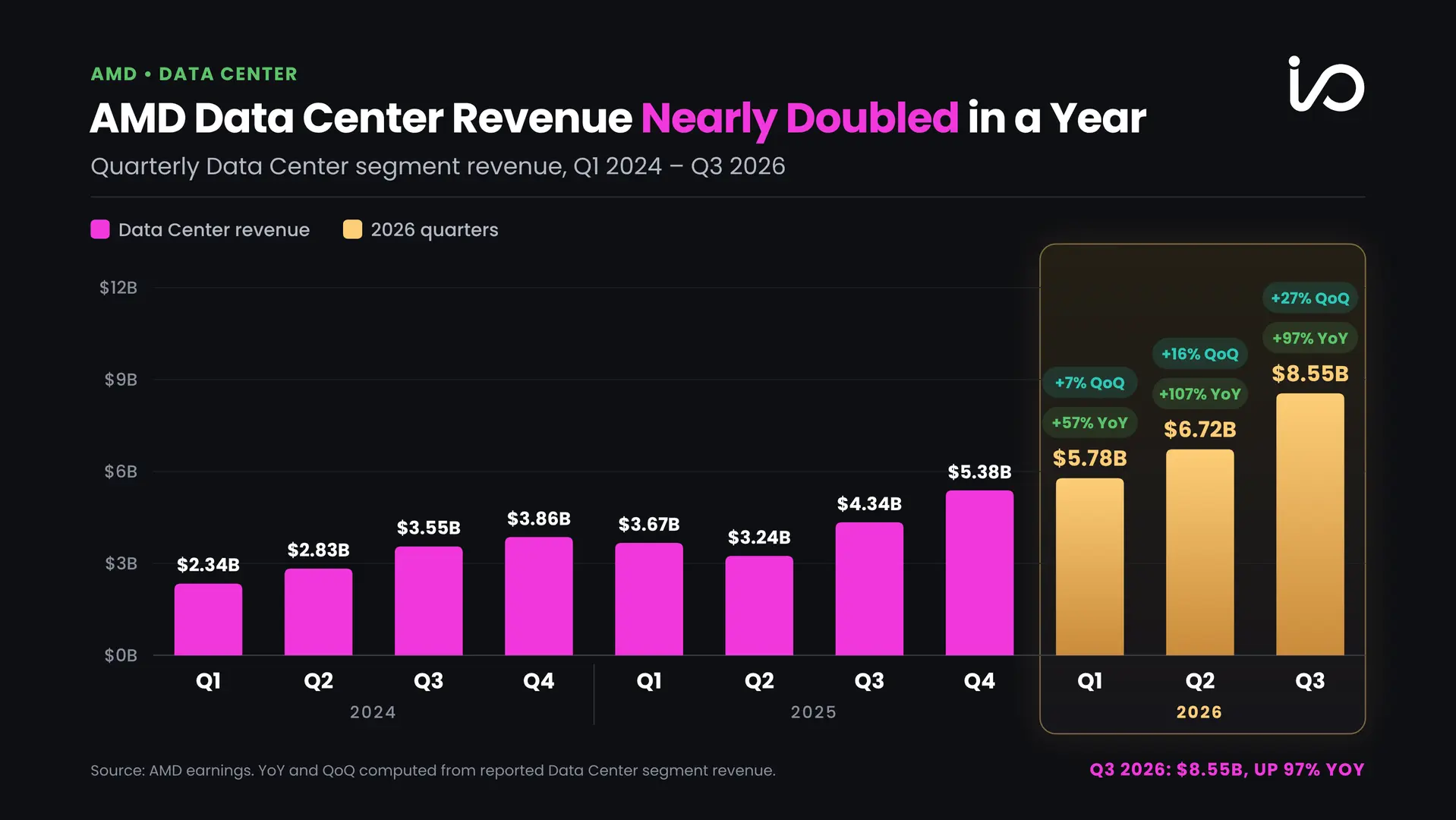
Data Center revenue reached a record $8.55 billion, up 96.9% YoY and 27.2% QoQ, ahead of the roughly $8.2 billion Street estimate on strong demand for EPYC CPUs and the ramp of its MI450 GPUs. Data Center was 63.9% of revenue, up from 58.2% in Q2 and 47.0% a year ago.
AMD’s Data Center segment reached a record $8.55 billion in Q3 2026, driven by growing demand for EPYC CPUs and AI accelerators. Revenue increased 97% year over year and 27% quarter over quarter, extending the segment’s strong growth trajectory.
AMD reported solid operating margin expansion despite softness in gross margins. Adjusted operating margin was 29.3%, up more than 5 points YoY and 2 points QoQ. For Q4, AMD’s opex guide implies adjusted operating margin near 32.9%, up 5 points YoY and more than 3 points QoQ.
Management expects operating leverage to continue into 2027 with operating expenses growing at less than half the rate of revenue growth. Given AMD’s outlook for more than 80% growth next year, that implies operating expenses could increase less than 40%. This operating leverage is key as the rapid growth of AMD’s GPU business will likely introduce pressure on gross margins. CFO Jean Hu acknowledged that Data Center AI carries a lower gross margin than the corporate average.
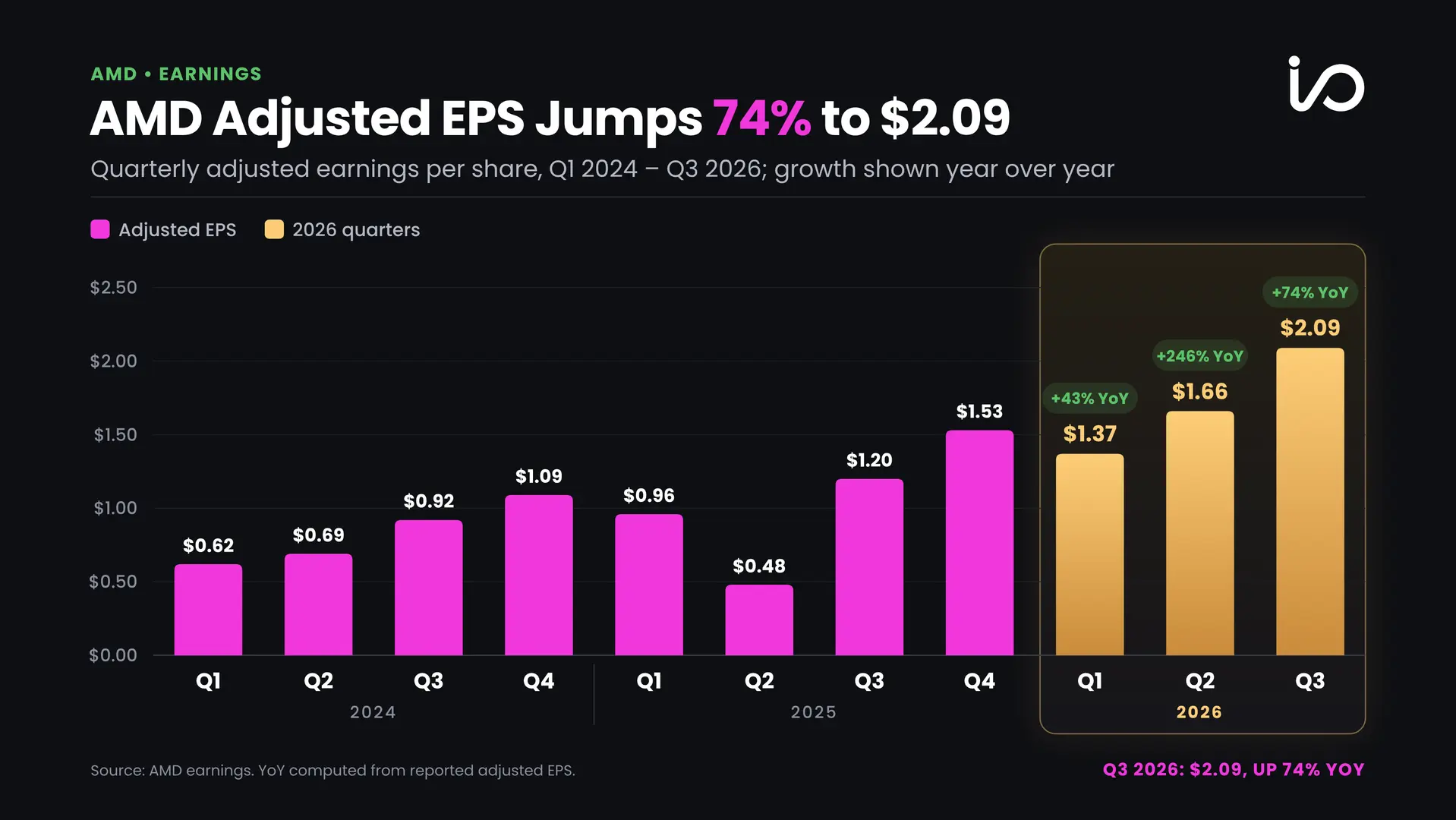
Adjusted EPS was $2.09, up 74% YoY and beating the $1.94 consensus by 7.7%. Based on Q4’s guidance for tax rates and share counts, adjusted EPS is expected to be roughly $2.92, up 91% YoY.
AMD reported adjusted EPS of $2.09 in Q3 2026, representing 74% year-over-year growth. The chart shows earnings per share recovering from a mid-2025 slowdown and accelerating through 2026 as AI and data center revenue continued to expand.
Cash flow was the clear weak spot of the quarter, with operating and free cash flow margins dropping into single-digit territory and reaching the lowest levels since the end of 2023 due to a sharp working capital build. Operating cash flow was $1.2 billion for a 9% margin, down from 21% in Q2 and 19% a year ago. Free cash flow was $554 million for a 4% margin, down from 14% in Q2 and 17% a year ago.
Inventories reached nearly $11.5 billion, up roughly $3 billion from Q2, its sharpest sequential build in inventory dollars in its history, likely to support the dual ramps of Helios and Venice, along with its new Helion racks.
Conclusion
What a week for Nvidia. Or should I say, what a week for AMD? By now, it should be clear that AMD does not need to dethrone Nvidia entirely. Rather, Lisa Su and her team only need to strike when their rival is most vulnerable. This past week offered precisely that opening, to put it kindly.
Those who have followed the I/O Fund over the years know well that I call this stock The Dark Horse, which refers to AMD’s outsized potential relative to the market’s narrative. However, it’s not a company without risks, and instead, has a “no pain, no gain” type of stock profile.
AMD will surprise you with incredible growth, then equally thin margins the next quarter, then low cash or high debt, and then a two-catalyst punch that wildly delivers.
There are certainly easier stocks to own, but I dare say, probably none more rewarding as we look to the second half of the decade.
After raising >25% cash in late Sept based on our cycle work, we went on our biggest buying spree yet with 20 buys Oct 30–Nov 5, with six on Thursday alone. That is nearly double our prior record of 11 buys (April 4–7, 2025).
See what we bought and get our next trade alert. Access Advanced Market Signals Now →UNLOCK FULL ACCESS
Please note: The I/O Fund conducts research and draws conclusions for the company’s portfolio. We then share that information with our readers and offer real-time trade notifications. This is not a guarantee of a stock’s performance and it is not financial advice. Please consult your personal financial advisor before buying any stock in the companies mentioned in this analysis. Beth Kindig and the I/O Fund own shares in NVDA at the time of writing and may own stocks pictured in the charts.