Nvidia Says Capacity Is the Constraint: 3 Bottlenecks Holding Back the AI Buildout
Written by
I/O Fund Editorial Team
Research Team
Published: November 13, 2026
Last Updated: November 13, 2026
Key Points
At GTC Berlin on October 21, Jensen Huang said demand is "extraordinary" and capacity is the constraint. Nvidia is entering capacity agreements with six suppliers, including IBIDEN, Unimicron and KYEC, to reserve substrate, testing and optics capacity.
Nvidia is targeting a 2.5x increase in substrate capacity for its own products, outpacing the roughly 2x industry-wide growth Unimicron projects through 2028.
Nvidia's DSX POD reference design cuts AI factory deployment from six months to as little as 14 days at a prepared site, with deliveries through 17 manufacturing partners starting in early 2027.
Most new supplier capacity arrives between 2027 and 2028, but grid power stays the hard limit. Nvidia estimates that over 200 GW of projects are waiting in U.S. interconnection queues.
On this page
Speaking at GTC Berlin keynote on October 21, Nvidia CEO Jensen Huang summarized the state of the AI buildout, “Demand is extraordinary. Capacity is the constraint.” To address Nvidia’s supply constraints, the company is lining up capacity agreements with six key suppliers for the substrates, packaging, testing and optics that its GPUs need, including releasing advance payments to two of them. At the same time, its new DSX POD design puts a modular spin on AI data center assembly, taking it out of the field and into the factory.
With these two simultaneous moves, Nvidia is trying to fix different problems on different timelines. Nvidia expects to start delivering DSX POD in early 2027, while substrate and packaging capacity could see a boost a bit later, around late 2027 to 2028. However, neither of these moves will increase grid capacity, the third bottlebeck and the one Nvidia can’t fix on its own.
These recent developments show how capacity is being reserved well before it is built in AI hardware. For Nvidia, this means prepaying as a way to become the first in line to receive supply.
Bottleneck 1: Is AI Infrastructure Growth Limited By Demand or Supply?
Huang claims that supply, in the form of capacity, and not demand is the constraint holding back AI infrastructure growth. The primary bottleneck now extends deeper into the supply chain, in advanced node capacity, back-end packaging, chipmaking equipment and specialized IC substrates. These intermediate components are all essential to complete AI accelerators before they are ready for deployment.
A day before Huang’s keynote, Unimicron Chairman S.C. Chien cautioned on October 20 that lead times for some key substrate tools have stretched at around 30 months even as critical materials, such as low-CTE glass cloth and ABF, face around 20% shortages in 2027. Chien also expects CoWoS packaging capacity to grow 6.8x between 2024 and 2028, while substrates could see only a 2x growth.
Chein added that the slower growth in substrate multiples “do not necessarily signal supply shortages” as each segment starts from a different base. However, it is indicative of a broader trend at play where intermediate steps in the process and critical components are facing extended lead times with little avenues to quickly relieve constraints.
Nvidia’s Capacity Agreements Aim to Secure AI Chip Capacity in Tight Supply Chain Conditions
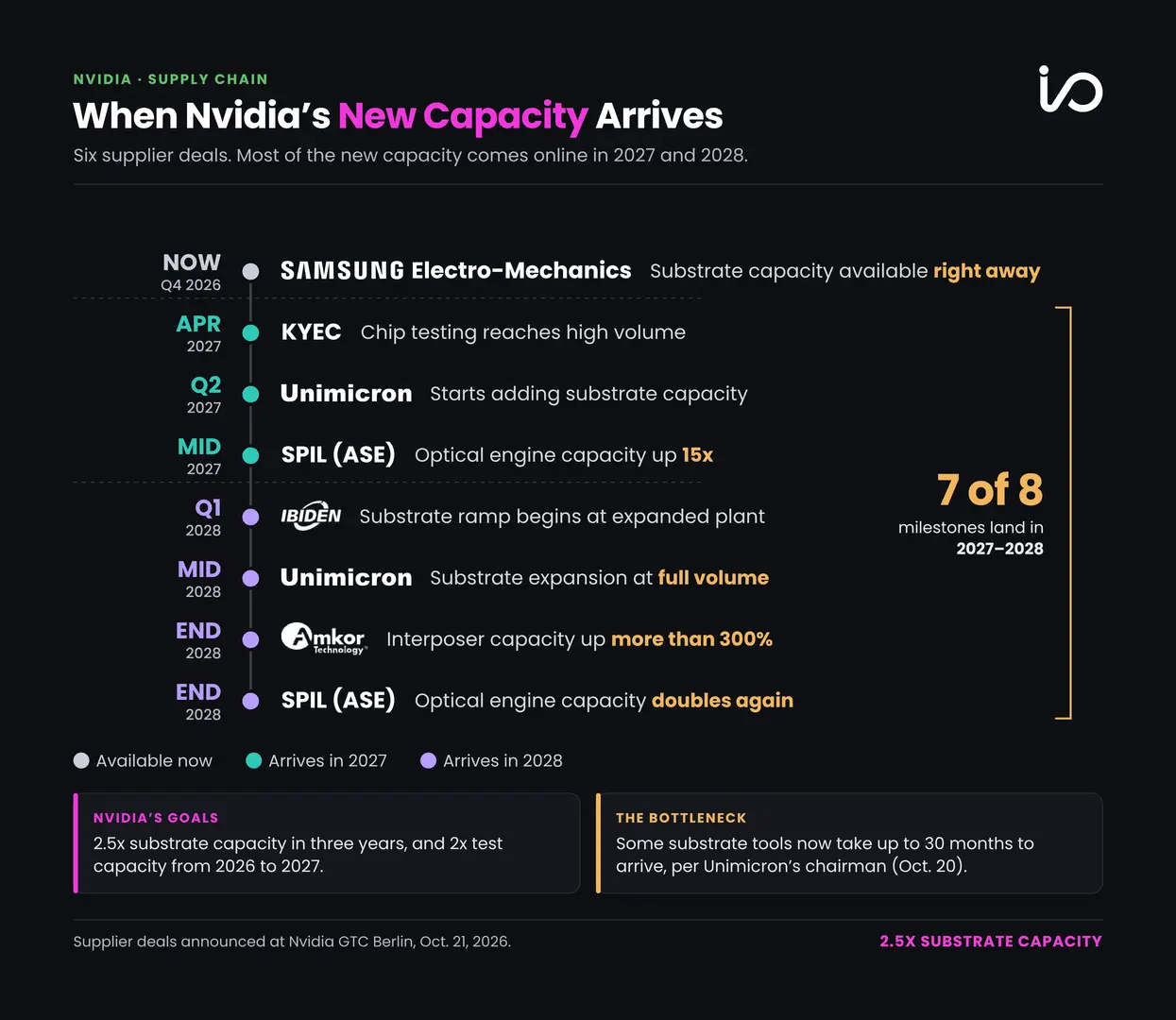
On the day Huang addressed GTC Berlin, Nvidia announced capacity agreements with six key supply chain partners in a bid to counter the slow 2x growth in industry-wide substrate capacity through 2028. With this move, Nvidia hopes to target a 2.5x capacity increase for its own chips over the next three years.
Nvidia’s six supplier agreements are expected to bring most new substrate, testing, interposer, and optical-engine capacity online between 2027 and 2028. While Samsung Electro-Mechanics provides immediate substrate capacity, major milestones such as KYEC’s U.S. testing ramp, Unimicron’s expansion, IBIDEN’s Ono plant ramp, and SPIL’s optics growth occur over the following two years, illustrating why Nvidia’s supply-chain investments are unlikely to significantly increase near-term capacity.
In substrates, it re-announced a multibillion-dollar advance to IBIDEN, signed earlier this year, to triple capacity at its Ono plant in Japan, with production ramping from Q1 2028. A capacity reservation agreement backs Unimicron’s substrate expansion in Taiwan, adding output from Q2 2027 and reaching full capacity by mid-2028. Samsung Electro-Mechanics joins as Nvidia’s new supplier, bringing immediate capacity from its existing South Korean operations as well as upgrades and new facilities in Sejong and Busan.
In testing, King Yuan Electronics receives a $1.1 billion advance to build U.S. testing facilities, with high-volume production starting in April 2027. With this, Nvidia expects its total test capacity to double from 2026 to 2027 across the U.S., Taiwan and Singapore. Amkor is targeting more than 300% growth in interposer capacity by the end of 2028, and ASE’s SPIL unit is aiming for a 15x increase in optical-engine capacity for co-packaged optics by mid-2027, and another doubling expected by the end of 2028.
Nvidia’s plans for capacity agreements with its key suppliers aims for a target growth rate of 2.5x for its own products, reaching for a larger share of the 2x substrate capacity growth that Chien projects. Such a move could leave less room for other buyers of advanced substrates, including the custom chip programs at Microsoft, Google, and Amazon. Google’s push to sell TPUs, which we covered in our October analysis, could also come up against this very same constraint.
In addition to the math, timing also plays a key role in these deals. A tool ordered today with a 30-month lead time would only arrive around April 2029, after Unimicron’s expectations to reach full-capacity around mid-2028.
Bloom Energy is up over 1,200% from our initial buys as of November 2026, and we highlighted it in our prior Top 20 reports before power became one of AI’s biggest bottlenecks. In her 100+ page report on theTop 20 AI Stocks for Q4 2026, Beth Kindig ranks 20 stocks leading the most powerful trends in AI. Many are lesser-known names, and not one Big Tech company made the list. Learn more here.
Bottleneck 2: Nvidia DSX POD Can Speed Up AI Data Centers, But Only at Prepared Sites
Get Our Free Weekly Stock Newsletter
Get weekly stock insights, market analysis, and technology updates straight to your inbox.
Weekly stock insights
Market analysis
Technology updates
Introduced on October 21, Nvidia’s new DSX POD is a reference design for complete Vera Rubin AI factories that can cut deployment from six months to as little as 14 days at a prepared site. Manufacturing partners use the design to assemble, cable and test liquid-cooled racks inside modular containers before shipping them out. Each pod holds seven Vera Rubin NVL72 racks, or 504 GPUs.
Nvidia DSX POD’s 14-day deployment time assumes the site is already prepared, where power, water, cooling, and network connections are already in place. The company has stated that its design “does not eliminate onsite work,” but partners have started reporting early gains. As a “foundational first step toward” DSX POD, Schneider Electric conducted a white-space study for its RapidScale design, bringing down onsite installation labor per pod from 75.5 hours to 15 hours. Similarly, Vertiv highlighted Polar Data Center’s 41 MW campus in Herøya, Norway as an example of factory-built deployment, which can scale to 100 MW.
Nvidia hopes to start initial DSX POD deliveries as soon as early 2027 through 17 manufacturing partners, including server makers, power and cooling suppliers, data center developers, and AI cloud providers. The goal is to deliver revenue faster, as Huang estimates a 1 GW AI factory could earn around $40 billion a year, and a three-month delay could cost a customer around $10 billion. Nvidia aims to bring down the time taken to go from installed hardware to producing tokens from four to five months today to about one month.
Bottleneck 3: 200 GW Is Stuck in Power Grid Queues, But Can Nvidia Solve This Bottleneck?
Although DSX POD can shorten installation, its fastest timelines depend on power that is already connected, a key constraint that Nvidia can’t solve on its own. Futurum analyst Nick Patience observed, “the binding constraint on AI factories in Europe is access to grid power, and DSX POD doesn’t address that.”
Nvidia stated that “over 200 gigawatts of projects are waiting in U.S. interconnection queues.” Data from Lawrence Berkeley National Laboratory (LBNL) reveals that power projects take over three years just to secure an interconnection agreement, and over five years to reach commercial operation.
Going off-grid doesn’t remove the wait, as our recent analysis of Project Jupiter and AI data center stocks from October 2026. In April 2026, Oracle and BorderPlex replaced planned gas turbines at their 2.45 GW New Mexico campus with a 2,462 MW Bloom Energy fuel-cell microgrid. However, off-grid projects encounter their own set of challenges. For instance, the Desert Southwest gas pipeline was denied state land right-of-way, while the 17.77-mile Green Chile gas pipeline’s in-service date got pushed to February 1, 2027. Oracle issued a force majeure notice to Blue Owl even as debt tied to the leased campus traded at 89-91 cents on the dollar.
Nvidia is attempting to tackle this with software tools. In a trial with EPRI, Nebius and National Grid, its DSX Flex software cut cluster power load by up to 40% during simulated grid stress events. While such software could help AI factories get more out of the megawatts they already have, Nvidia cannot build grid infrastructure or speed up utility interconnection timelines, and software cannot replace missing physical power.
Capacity Is Now Reserved Before It Is Built
The key takeaway from GTC Berlin is that Nvidia no longer treats supply constraints as someone else’s problem. Its capacity agreements with substrate, testing and optic suppliers help Nvidia stay at the front of the line at the key bottlenecks in the AI supply chain. In addition, moving assembly into the factory with DSX POD helps Nvidia bring down the time from delivery to the first token generation.
However, Nvidia’s plans still face limitations. This ranges from equipment lead-time slippage from the 30-month tool lead times, material shortages through 2027-2028, and challenges in adding power to the grid, all key factors that could decide how quickly this capacity turns into operating AI factories.
Watch for updates on all three bottlenecks when Nvidia reports its fiscal Q3 2027 earnings, along with general availability of Google Cloud’s Vera Rubin instances in November and the first DSX POD deliveries in early 2027.
AI’s most crowded trades aren’t where most of the gains are. Not one Big Tech company made Beth Kindig’sTop 20 AI Stocks for Q4 2026report. The 100+ page report ranks the 20 stocks leading AI’s most powerful trends, many of them lesser-known names further down the supply chain.
Please note: The I/O Fund conducts research and draws conclusions for the company’s portfolio. We then share that information with our readers and offer real-time trade notifications. This is not a guarantee of a stock’s performance and it is not financial advice. Please consult your personal financial advisor before buying any stock in the companies mentioned in this analysis.
Aiswarya Gopan, AI and Semiconductor Investment Writer at I/O Fund, contributed to this analysis.
The I/O Fund Editorial Team writes educational guides that explain investing concepts, market terms, and the technology behind today's markets. All content is researched from trusted sources, fact-checked, and reviewed by an I/O Fund analyst before it is published. This content is for educational purposes only and is not investment advice or a stock recommendation.