Uncategorized

Amazon’s AI Data Center Expansion Faces a New Roadblock Ahead of November 17 Vote

Written by

I/O Fund Editorial Team

Research Team

Published: November 16, 2026

Last Updated: November 16, 2026

Key Points

  • Under an October 20 deal with Loudoun County, Amazon agreed to withdraw its plan for four data center buildings totaling more than 800,000 sq ft on Ashburn, the former George Washington University campus. It will convey about 25 acres to the county and seek to rezone the rest for housing.
  • On November 17, supervisors will vote on pausing new legislative data center applications for up to 12 months, the maximum Virginia law allows. The county hosts about 233 data center buildings, which generated $1.2 billion in tax revenue in FY2026, 39% of its budget.
  • Business Insider reported that some AWS sites had space for Nvidia (NVDA) GB300 racks but not enough power to run them, so finished racks were held in warehouses. Amazon called staging equipment “best business practice.”
  • AWS reported a $578 billion backlog and $46 billion in Q3 sales, and Amazon's spending plans haven't slowed. Amazon’s leases signed but not yet started rose to $164.9 billion in Q3, and it plans to spend “meaningfully more” in 2027 than the roughly $220 billion planned for 2026.

On November 17, Loudoun County, Virginia, is set to take a final vote on pausing new legislative data center applications for up to 12 months. The vote comes four weeks after Amazon agreed on October 20 to drop its plans to build four data centers on its 122-acre Ashburn campus, which it had purchased for around $427 million.  

The same week Amazon changed its plans for Ashburn, Business Insider reported that some AWS sites had room for new Nvidia server racks but lacked adequate power to run them. As the world’s largest data center market, Loudoun County earned $1.2 billion in taxes in fiscal 2026, accounting for 39% of the county’s budget. If the vote to pause passes on November 17, new rezoning and special exception requests for data centers could take up to 12 months longer in the market. Such a delay could further affect AWS’s $578 billion backlog that is already partly unserved due to capacity constraints highlighted by Amazon CEO Andy Jassy. AWS CEO Matt Garman has cautioned that over 100 data center moratoriums are being considered across the U.S., making Loudoun County one of several instances of data center pushback. 

Why Amazon Dropped Its Ashburn Data Center Plan

Amazon originally purchased the Ashburn campus for around $427.3 million in March 2026, and four months later in July the company filed a site plan called Bridgefield Tech Center, which included four two-story data center buildings spanning over 800,000 square feet in total alongside three parking garages. Amazon sought a “by-right” approval for this plan, an administrative process with no Planning Commission, public hearing or Board vote.  

Two days later, on July 30, Loudon County’s Board of Supervisors’ Supervisor Juli Briskman vowed to “fight it every step of the way.” In early October, county staff told supervisors that Amazon would need additional county approval before building, citing a zoning determination that data centers were not a permitted primary use on the property. 
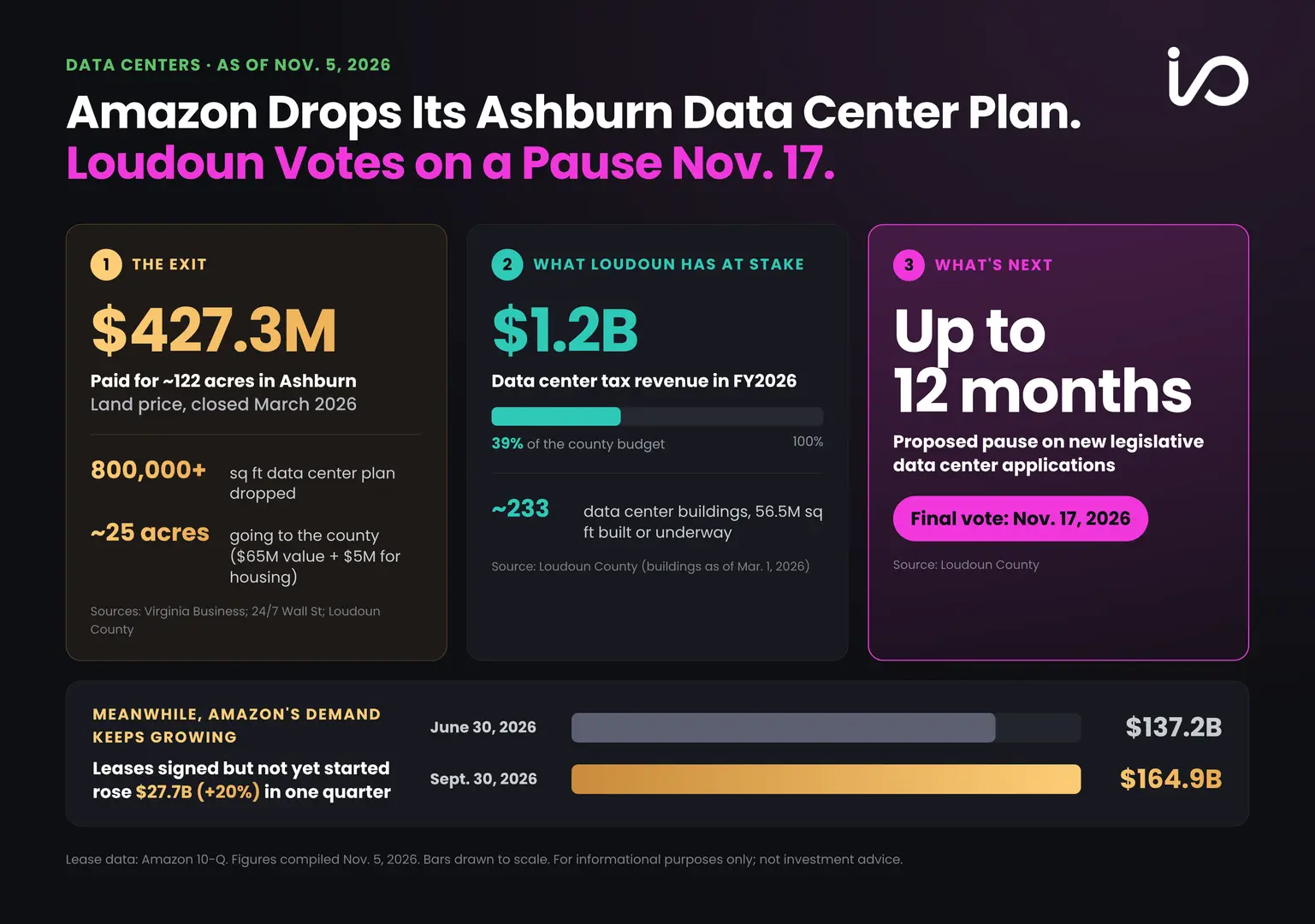
Infographic showing Amazon's Ashburn data center exit, Loudoun's proposed 12-month approval pause, and leases rising to $164.9B.
Amazon abandoned its planned 800,000+ sq ft Ashburn data center development after reaching an agreement with Loudoun County. As the county prepares to vote on a possible 12-month pause on new legislative data center applications, Amazon’s infrastructure commitments continue to grow, with leases not yet commenced increasing from $137.2 billion to $164.9 billion in one quarter.

Board Chair Phyllis Randall later announced an agreement, “Project Potomac Promise,” on October 20. Under the county’s terms, Amazon cannot construct data centers or host their supporting infrastructure on the Ashburn campus.  

Finally, Amazon gave in to opposition from residents and Loudoun County supervisors, agreeing to withdraw its application to build data centers on its Ashburn campus. As part of an October 20 deal with the county, Amazon will not build data centers on the former George Washington University campus nor sue to do so. Instead, the company will seek permission to rezone the land, mainly for housing.  

Neither Amazon nor Randall cited power supply as the reason for calling off the planned data center construction. For Randall, the campus was “just the wrong location for a data center,” owing to the infrastructure it would need and residents’ opposition. According to Amazon’s Josh Weissman, the company had “heard the community’s pointed concerns,” and it “took them seriously.” He added that while Amazon and the county have differing views on the site’s legal potential, it chose “a shared vision” over “costly litigation.” 

Ashburn and Loudoun County’s Data Center Advantage

According to Loudoun County, it has the highest concentration of data centers worldwide, home to around 233 data center buildings and 56.5 million square feet built or under construction as of March 1, 2026, plus 35.7 million square feet approved but not yet built. In 2025, the county issued permits for the construction of over 10 million square feet of data center space, the highest in a year.  

Part of the reason behind this is a 2000 zoning ruling that assigned data centers as office buildings, letting companies build them by right in office-zoned areas. Since March 2025, new data centers have required a special exception approved by a Board vote. However, projects grandfathered under the old rules can still proceed administratively.  

These data centers have helped Loudoun County generate $1.2 billion in real and personal property tax revenue in fiscal 2026, contributing to 39% of its total budget. For fiscal 2027, estimated budget projects hold around 40%, at $1.3 billion.  

Loudoun County Weighs a 12-Month Pause on Data Center Approvals

On September 15, Loudoun County supervisors voted 7-1-1 to pause Board consideration of certain legislative applications for data centers and electrical substations, meaning rezonings and special exceptions. The written resolution got deferred from October 20 to November 17 to give staff more time to gather additional information before the final vote. According to the county attorney, a moratorium on data center approvals would not be legal, so the county is considering a pause of up to 12 months, the longest gap Virginia law permits.  

However, this pause does not cover administrative applications, including at least 17 grandfathered applications totaling over 11 million square feet. Despite the final decision, the Board can continue to consider “grid reliability” substations during the period. According to Governor Abigail Spanberger, the decision on approving or blocking data center projects should rest with the community and not the state. State Senator Russet Perry has separately drafted a three-year statewide moratorium on data center approvals. 

Dominion Energy, the utility provider for Northern Virginia’s data center cluster, stated on its Q3 earnings call that it has more than 54 GW of data center capacity in various stages of contracting, including over 12 GW under electric service agreements. The company also told CBS 6 that new data centers sign 14-year contracts with minimum demand charges and post collateral of $1.5 million per MW, so residential customers don’t pay for stranded infrastructure in the event of a project falling through.  

Even as Amazon Waits on Data Center Approvals, Its Nvidia Racks Wait on Power

While Amazon tackles the uncertainty after withdrawing its plans to build data centers in Ashburn, Business Insider reported that AWS has started taking ownership of Nvidia GB300 server racks under an “Early Rack Receipt Process,” even before they reach a data center. The story broke on October 20 but is based on internal emails from August.   

According to this report, one email projected around $5 billion of GB300 racks in August, followed by around $3 billion a month for the foreseeable future. Some AWS sites located in the U.S. had floor spaces to store these racks but not enough available power to run them, so the finished racks were being held in intermediary warehouses. However, the report failed to provide more detail on how many racks were being stored, at which sites, and for how long.  

Beth Kindig, founder and lead tech analyst of I/O Fund

Get Our Free Weekly Stock Newsletter

Get weekly stock insights, market analysis, and technology updates straight to your inbox.

  • Weekly stock insights
  • Market analysis
  • Technology updates

Amazon responded to the Business Insider report, stating that it is “best practice” to stage finished equipment near deployment sites. It also disputed that it lacked a path to bring these racks into its data centers. In August, AWS and Nvidia had shared a joint announcement, detailing plans to deploy over 2 million more Nvidia GPUs on AWS in 2027 and 2028. 

AWS’s power constraints have been highlighted several times so far this year. In Amazon’s shareholder letter from April, CEO Andy Jassy stated that AWS added 3.9 GW of power capacity in 2025 and expected to double this capacity by the end of 2027. However, he also added, “we still have capacity constraints that yield unserved demand.” 

Power isn’t the only bottleneck, with  memory supply  becoming one of the tightest constraints in AI hardware. My updated Q4 Top 20 AI Stocks report runs over 100 pages and identifies the 20 stocks I believe will lead the AI market this quarter, from chips to the power and infrastructure behind them. 

Subscribe to access the Q4 Top 20 AI Stocks report → Get Premium Access 

Amazon Data Center Leases Worth $165 Billion Yet to Start

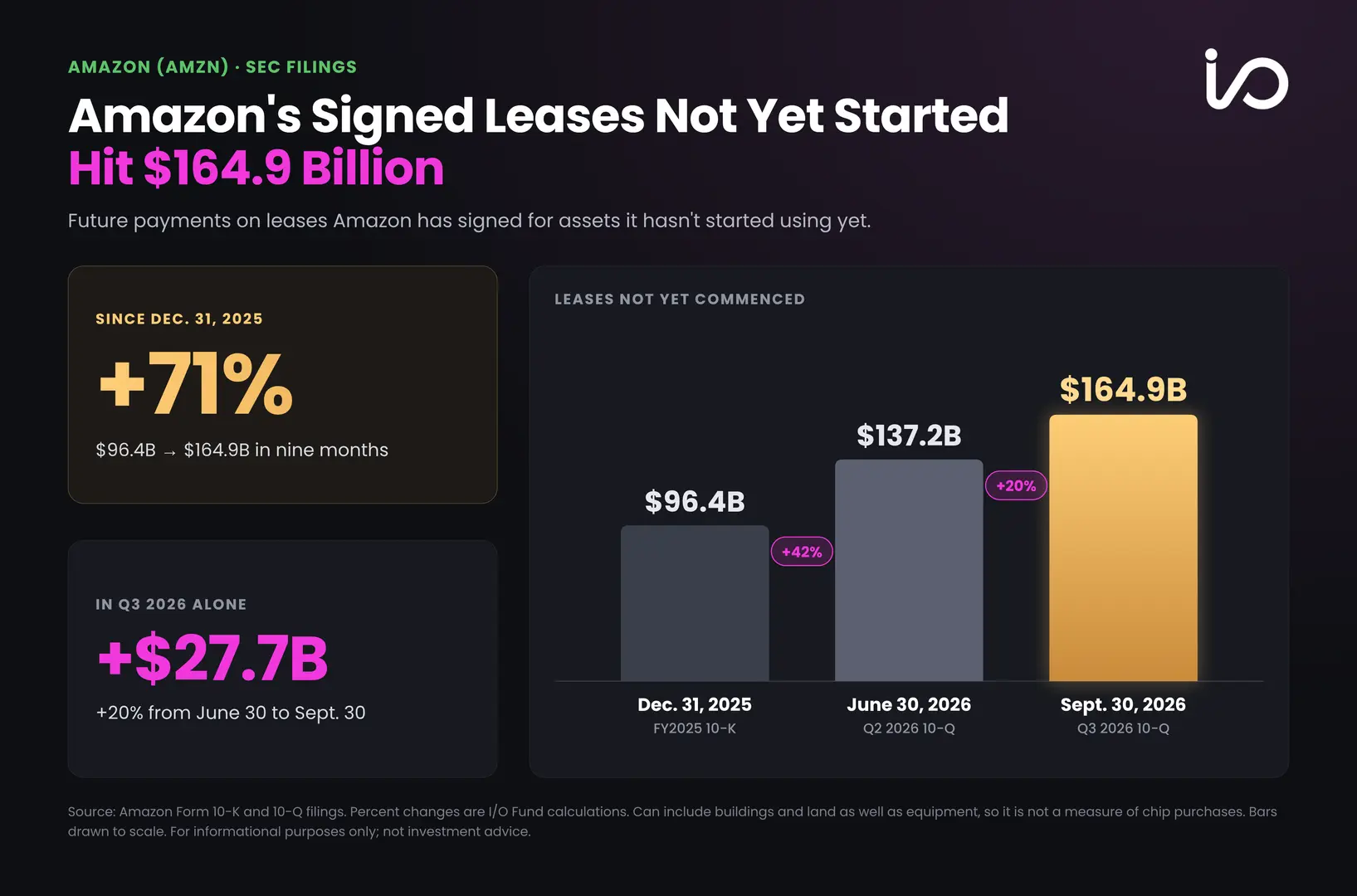
In Amazon’s quarterly filings, the company highlights leases it has signed for assets it has not yet started using under a line called “leases not yet commenced.” This figure stood at $164.9 billion at the end of Q3 2026, up from $137.2 billion in Q2 and up 71% from $96.4 billion at the end of 2025.  

Infographic showing Amazon's Ashburn data center exit, Loudoun's proposed 12-month approval pause, and leases rising to $164.9B.
Amazon abandoned its planned 800,000+ sq ft Ashburn data center development after reaching an agreement with Loudoun County. As the county prepares to vote on a possible 12-month pause on new legislative data center applications, Amazon’s infrastructure commitments continue to grow, with leases not yet commenced increasing from $137.2 billion to $164.9 billion in one quarter.

Although Amazon doesn’t break the line down by asset, it can include buildings, land, and equipment, so it is not a measure of chip purchases. Amazon’s Q3 filing also lists $159.6 billion of property and equipment commitments, separate from the leases.  

The timing affects AWS sales, which were up 39% in Q3 to $46 billion as per Amazon’s Q3 earnings release, while Amazon purchased $77.3 billion of property and equipment. Despite this, Jassy remarked in April that AWS faced “capacity constraints that yield unserved demand.” For now, AWS can only sell the capacity it has online, and its future revenue depends not only on several of these leases but only on sites and power.  

Amazon is also attempting to ease the local pushback affecting capacity. On October 2, AWS CEO Matt Garman pledged more than $1 billion to support communities near its data centers over five years. He also confirmed that Amazon would stop using NDAs with government agencies, cautioning that over 100 data center moratoriums were being considered around the U.S. 

Amazon and Oracle Face the Same Data Center Power and Permitting Bottleneck

Amazon is not alone in facing opposition to its data center buildout plans. On September 24, Oracle issued a force majeure notice to Blue Owl Capital, owner of STACK Infrastructure, over Project Jupiter, its 2.45 GW Stargate campus in Doña Ana County, New Mexico, with planned investment of up to $165 billion. Previously, the state land office denied a gas pipeline route while a delay in the Green Chile pipeline’s in-service date to February 1, 2027 also caused delays in Project Jupiter. A state air-permit decision on Project Jupiter’s Bloom Energy fuel-cell microgrid is due on November 23. For now, Oracle maintains that the project “remains on our planned schedule.” 

Amazon’s Ashburn data center withdrawal, the Business Insider report on Nvidia GB300 racks being stored, and Oracle’s Project Jupiter notice all point to the same bottleneck in the AI buildout, of getting sites approved and powered. The challenge in the AI race is no longer about demand, as AWS’s reported backlog of $578 billion and its $46 billion quarterly revenue show. The final vote on November 17 will offer more clarity on whether Loudoun County plans to pause data center approvals for up to 12 months in the world’s largest data center market. The November 23 air-permit decision in New Mexico will also reveal the next stage for Project Jupiter. 

Beth Kindig recently spoiled I/O Fund Members with a 100+ page report on the Top 20 AI Stocks for Q4 2026. This in-depth report ranks 20 key stocks that are leading the most powerful trends in AI with many lesser-known names – and not one Big Tech name made the list. Prior reports highlighted Bloom Energy, a stock up over 1,110% from our initial buys.  Learn more here. 

Please note: The I/O Fund conducts research and draws conclusions for the company’s portfolio. We then share that information with our readers and offer real-time trade notifications. This is not a guarantee of a stock’s performance and it is not financial advice. Please consult your personal financial advisor before buying any stock in the companies mentioned in this analysis.  

Aiswarya Gopan, AI and Semiconductor Investment Writer at I/O Fund, contributed to this analysis.

👉🏻 Share with a Fellow Investor
Help someone else benefit from this insight.

Recommended Reading:

About the author

I/O Fund Editorial Team

I/O Fund Editorial Team

The I/O Fund Editorial Team writes educational guides that explain investing concepts, market terms, and the technology behind today's markets. All content is researched from trusted sources, fact-checked, and reviewed by an I/O Fund analyst before it is published. This content is for educational purposes only and is not investment advice or a stock recommendation.

Curation

Expand your knowledge

View all posts
AMD Stock: Two-Catalyst Punch Leads to 80% Growth Next Year
SEMICONDUCTOR STOCKS

AMD Stock: Two-Catalyst Punch Leads to 80% Growth Next Year

In August, our premium article "Venice Meets Helios" pointed to two strategic product releases that were arriving soon - AMD’s Venice CPUs and the highly anticipated Helios MI400 Series. At the time, management expected server CPU revenue to grow more than 70% in 2027, while total Data Center revenue would grow “well over 100%,” driven by the Helios ramp. Three months later, AMD has raised its outlook considerably, and the two product ramps are now exceeding the I/O Fund’s original expectations. Server CPU revenue is now expected to more than double in 2027, up from the previous outlook for 70%+ growth. Meanwhile, Data Center AI revenue (GPUs) is expected to significantly more than double.

SEMICONDUCTOR STOCKSNOV 13, 2026
Nvidia Says Capacity Is the Constraint: 3 Bottlenecks Holding Back the AI Buildout
AI STOCKS

Nvidia Says Capacity Is the Constraint: 3 Bottlenecks Holding Back the AI Buildout

Nvidia has signed capacity agreements with six key suppliers for chip parts and has a new design to build AI data centers, even as CEO Jensen Huang points out extraordinary demand amid capacity constraints. However, grid power remains the limit Nvidia can’t fix on its own.

AI STOCKSNOV 13, 2026
Data Centers in Space: Google Runs AI on 1 kW in Orbit as SpaceX Bets on Orbital Compute
DATA CENTER

Data Centers in Space: Google Runs AI on 1 kW in Orbit as SpaceX Bets on Orbital Compute

Google ran AI in orbit on about 1 kW. SpaceX plans 250 kW satellites. A 1 GW campus on Earth uses 1,000,000 kW. We take a deep dive into what it takes to put data centers in space.

DATA CENTERNOV 12, 2026