

This article was originally published on Forbes on Oct 29, 2020,11:49pm EDTForbes on Oct 29, 2020,11:49pm EDT
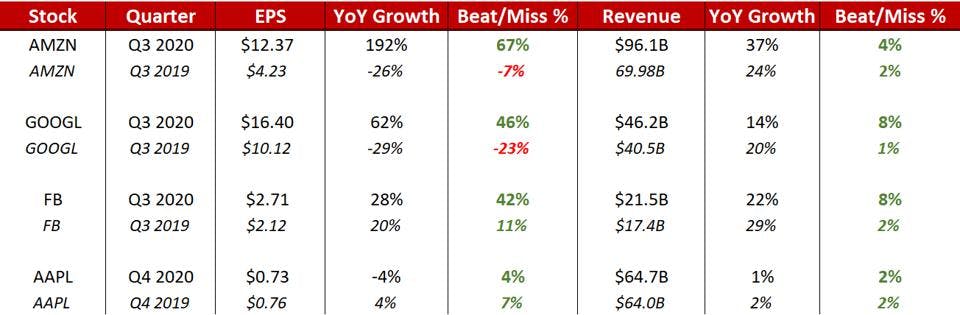
Before breaking out the earnings reports from the high-growth universe, here are the results from Big Tech earnings today. Each company beat on both the top and bottom lines. Other than Alphabet, they are all trading down after-hours following these results as the market digests the magnitude of the beats, and in Apple's case, the lack of guidance.
Snap:
Snap reported Q3 results on October 20th, beating both the top and bottom lines. The ongoing recovery of advertising budgets helped to boost Snap's revenue growth to 52% YoY in Q3, which now sits just below the 58% pre-COVID growth rate the company recorded during Q1.
Notably, the reacceleration that Snapchat reported is the highest Q3 growth rates since 2017. According to management, some of the user growth highlights from this quarter include Lens Studio, which saw creative applications to use AR as a way to try-on products from brands including Sally Hansen for nail polish and Champs for sneakers.
Other product features released contributing to this quarter's beat include Brand Profiles, Minis, Places on the Map, Dynamic Ads, Bidded AR Lenses, Dynamic Lenses, Camera Kit, Snap ML Lenses including the Anime Lense.
The company also attributes the growth to linear TV and sports being featured on the social media platform at a time when content is seeing a surge.
Here is what the company said about Dynamic Ads and AR Ads on the earnings call:
For example, last quarter we launched Dynamic Ads globally, which combine product catalogs with our optimization capabilities to reward advertisers who invest in our platform with ROI at scale, and we are already seeing strong adoption rates from Retail, CPG, Restaurant, and Gaming verticals, among others.
While Dynamic Ads recommend items to Snapchatters based on their interests, AR try-on takes this a step further and allows Snapchatters to visualize the item in real life. For example, Clearly, an eyewear retailer, leveraged our sponsored AR Lenses to enable our community to try on different pairs of glasses, which resulted in 33 seconds of average playtime and a 5.3% share rate. Clearly was able to drive a full-funnel impact for their brand, achieving a 7-point lift in brand awareness and a 5-point lift in brand consideration while also driving a 46% lift in unique page viewers on their site and a 3.3% lift in purchases.
Daily active users rose 18% to 249M, topping the consensus of 243M. For user base demographics, Snapchat reaches over 90% of Gen Z and 75% of Gen Z and Millennials in the United States, the UK and France. This is one reason the company believes its augmented reality platform is seeing early success with brands as this demographic is more likely to engage with AR advertisements. Snapchat also has a gaming platform with new releases every quarter.
The majority of Snap’s growth came from the Rest of World category, at 43% growth. North America grew 7% and Europe by 10%. Meanwhile, North America and Europe carried the majority of the revenue growth at 56% year-over-year and 49% year-over-year, respectively.
Snap also recorded its most successful quarter ever in terms of monetizing its user base with a global ARPU of $2.73, coming in well ahead of the $2.23 consensus estimate.
Even though the company did not offer guidance for Q4 due to COVID uncertainties, SNAP stock surged over 20% following the results. Kids being schooled virtually, especially college-aged, is likely contributing to the company’s record Q3 usage and monetization.
Pinterest:
Pinterest rose with Snap following Q3 results as investors anticipated a similar recovery in ad spend for the social media company. The company delivered outstanding Q3 results that easily cleared consensus expectations.
Total revenue rose 58% YoY in Q3 with 49% growth in the US and 145% growth internationally. Monthly active users jumped 37% overall to 442M and ARPU rose 15% (US +31% and international +66%) to $1.03.
Perhaps most impressive was management’s 60% YoY growth guidance for Q4:
Additionally, we expect our business to maintain its momentum in Q4, with revenue growing around 60% year-over-year.
And then finally, this brand safety concept, especially post-July and the boycotts that we saw, I would imagine that we're seeing a sustained benefit just due to the election season. But I think it's a secular trend where advertisers want to be around positivity as they build their brands, and that that's contributing to our growth as well. That's what we're hearing.
Management did state there is a level of uncertainty with this guidance due to Covid and tailwinds the company saw from being “brand safe” during the election (i.e. attracting ad spend typically given to Facebook).
Here is what the company said when asked if the beat came from factors inherent to the product or due to the macro conditions of ad spend being thin in Q2.
Sign up for I/O Fund's free newsletter with gains of up to 403% - Click hereSign up for I/O Fund's free newsletter with gains of up to 403% - Click hereClick here
Yes, I mean, Ross, it's really hard to parse. I mean, I would love to be able to disaggregate that and say, we're getting X amounts from the technology investments we've made. We're getting Y amounts on demand returning from a macro perspective, or insights give us a certain amount and the brand safety equates to the remainder, in reality, it's the combination of all the above. Ads are working. I think we went through this a little bit on Brian's question, but making it easier for especially medium-sized advertisers to on-board and automate spending their budgets effectively against their desired online conversion and sales objectives has been a big driver for us …. [some parts omitted here for brevity]
So it's a mix of product and technology, macro recovery, the insights that we're able to deliver, and the brand safety and positivity that Pinterest uniquely brings and the world of social media.
Twilio:
Twilio pre-announced Q3 revenue would come in ahead of previously issued guidance from the company of $401 million to $406 million, with analyst consensus at $404M. Expectations were already high going into the earnings report and Twilio went on to beat revenue estimates by 10% for revenue of $448 million and growth of 52% year-over-year. This was the largest beat by dollar in Twilio’s history, as referenced by analyst Khozema on the earnings call.
Twilio also handily beat on earnings at $0.04 EPS compared to analyst consensus of -$0.03 EPS.
For Q4, Twilio expects revenue of $450M-$455M (37% YoY growth) vs. consensus of $432.1M. The net retention rate came in at 137% for TWLO in Q3. The guidance the company provided for earnings next quarter did not match expectations with an operating loss ranging between $10 to $15 million.
Twilio is on an expansion streak fueled by acquisitions. The company completed the acquisition of SendGrid in early 2019, launched the Flex platform, and has now acquired Segment to “enable developers and companies to unify customer data from every touchpoint.” The guidance provided does not include Segment which is expected to close in the current quarter and will modestly impact the top and bottom line.
On the earnings call, the company highlighted the importance of health care with Twilio’s products:
In healthcare, the innovative solutions that have been built on top of Twilio to address the COVID-19 crisis, provide an opportunity for the industry to advance the use of technology to better deliver outcomes for patients and create tools that fit seamlessly within a physician's workflow. This has always been the vision, but the coronavirus crisis highlighted the urgency, immediacy, and magnitude of that need.