Micron Is Up 900%. Here’s Why the AI Memory Trade May Still Have Room to Run
Written by
Beth Kindig
Lead Tech Analyst
Published: June 26, 2026
Last Updated: June 26, 2026
On this page
In less than a year’s time, memory stocks have gone from just another way to play the AI trade to arguably its biggest beneficiaries from a return perspective.
Micron, Samsung and SK Hynix now rank among the world’s top 20 most valuable stocks, each with market capitalizations well above $1 trillion.
Widespread shortages across HBM, conventional DRAM, LPDDR5 and NAND SSDs are affecting the industry, putting immense pricing power in the hands of memory companies.
The top AI processor companies have greatly increased memory content across their systems to meet the changing needs of frontier model developers.
While memory makers are pointing to a prolonged shortage, there are multiple key risks to stay aware of as it relates to the memory trade.
Over the past 10 months, memory chip stocks have gone from being solid beneficiaries of the AI boom to capturing a massively outsized piece of the return pie.
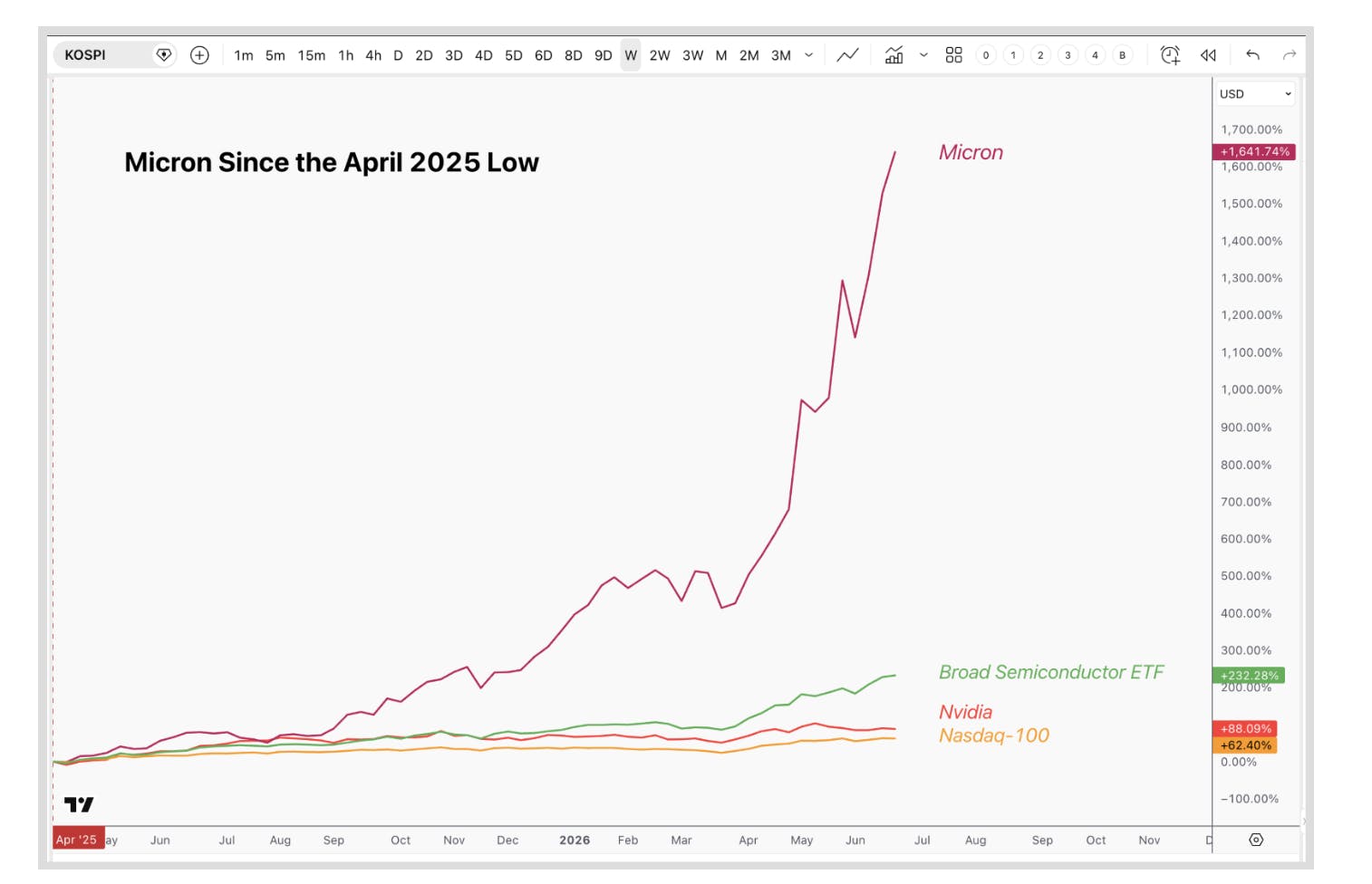
The inflection in Micron’s performance demonstrates this. From the beginning of 2025 to the end of August 2025, Micron added around $36 billion to its market capitalization, rising to $133 billion for a strong 37% gain. Since then, returns have exploded, with Micron (MU) soaring more than 900% from August 2025, and up over 1600% since the April 2025 low.
Perhaps the most striking figure is that over these 10 months, Micron added more than $1 trillion to its market capitalization, which now sits near $1.35 trillion. Along with this, industry watchers expect the memory market to far exceed $1 trillion in revenue by 2027.
This chart is a comparison of Micron’s stock performance since the April 2025 low, showing a gain of over 1,600%, far outpacing Nvidia, the semiconductor ETF, and the Nasdaq-100, highlighting the strength of the AI memory-driven rally.
The sheer velocity of the move reflects how quickly investors have repriced memory’s role in AI infrastructure. What was once viewed as a cyclical, commoditized segment of semiconductors is now becoming one of AI’s most drastic bottlenecks, as shortages spread across HBM, conventional DRAM, LPDDR5X and NAND SSDs.
The I/O Fund has been covering this dynamic for nearly three years. We first explored it in our deep dives on AMD’s AI acceleration strategy and Lam Research’s leadership in HBM and DRAM equipment in the summer of 2023. In December 2023, we expanded on this theme in our analysis of the 2024 memory and PC rebound, highlighting the shift from cyclical demand to AI-driven secular growth “that is strong enough to transform commoditized hardware into a secular trend,” with HBM and high-performance DRAM “in the early stages of a multiyear growth cycle.”
This thesis led us to make memory stocks some of our highest allocations of 10%+ in 2026, even as many market participants feared memory had topped for good.
The question now is whether the memory trade has already run too far, or whether shortages and the upside in memory pricing support more upside. Below, you’ll see pricing power is still intact, with meaningful new supply not arriving until 2028, or later, with the only overhang being how pricing power flows to memory suppliers under long-term agreements.
The discussion is data-driven, but also nuanced, because there may be no bigger debate in the market today than whether memory can continue its historic run.
What Triggered the AI Memory Supply Crunch?
First off, it is worth taking a step back to understand what brought about the shortages seen today. Traditionally, memory demand has been very cyclical, with much of the market driven by consumer spending on mobile phones and PCs. H2 2022 saw the memory market enter its worst cyclical downturn since the Great Financial Crisis. Sales and earnings plummeted from pandemic highs, with Samsung’s operating profit falling by 95% YoY in Q1 2023.
This led to significant production cuts, with Micron and SK Hynix announcing reductions of 15%–25% and cutting capex by 40%–50%. Samsung also implemented meaningful cuts to conventional DRAM and NAND output in 2023. At the same time, both Samsung and SK Hynix began aggressively expanding HBM capacity for 2024, albeit from a relatively small base—with estimates placing HBM at just 8% of total DRAM sales in 2023.
Amid this, the AI market had its watershed moment: the release of ChatGPT in November 2022. Nvidia’s data center revenue would go on to soar 217% in its fiscal year 2024 (roughly calendar year 2023), its fastest growth rate during the AI era.
This helped memory demand improve, but companies supported this demand by drawing down inventory from extremely high levels. Notably, at the beginning of 2023, Micron’s days of inventory outstanding, excluding write-downs, were 235. Without adjusting for impairments, it would have taken the company nearly eight months to sell its inventory. By the beginning of 2024, that figure had fallen drastically to 160.
The decisions to cut capacity, reduce capex, and allow inventory levels to drop were logical, considering that these firms were fresh off their worst decline in a decade and a half. However, as data center demand continued to explode and HBM capacity remained relatively low, those decisions set the stage for the drastic supply shortages we are seeing today.
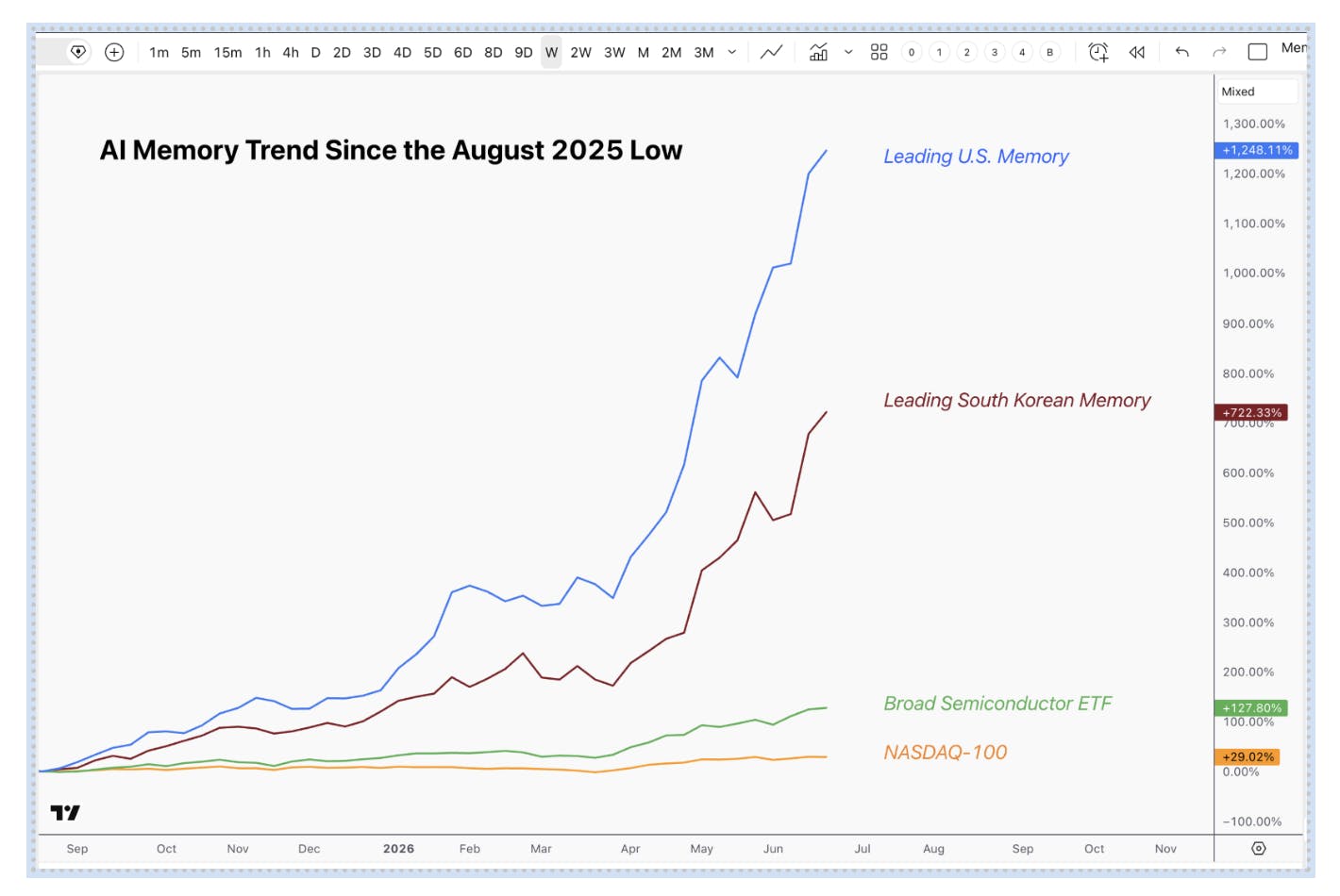
This chart is a comparison of AI memory stock performance since the August 2025 low, showing U.S. memory up over 1,200% and South Korean memory over 700%, significantly outperforming the semiconductor ETF and Nasdaq-100.
HBM Shortage: AI Infrastructure’s Core Memory Bottleneck
Memory shortages are surfacing across essentially all product types. However, perhaps the most easily identifiable shortage is in high-bandwidth memory (HBM). This comes as HBM is the type of memory packaged directly alongside AI accelerators, from NVIDIA and AMD GPUs to Google TPUs. HBM, a DRAM form factor, uses advanced packaging to stack up to 12 (and soon 16) DRAM chips, offering higher bandwidth, capacity, performance, and power efficiency compared to conventional DRAM.
Micron, Samsung, and SK Hynix are the three companies that control the HBM market. Due to massive hyperscaler demand, all three are sold out of their HBM capacity for 2026.
Rapid Market Growth Outpaces Supply Increases
Looking back a few years, we can see how fast the HBM market has grown. Bloomberg Intelligence placed the size of the HBM market at $4 billion in 2023. Meanwhile, at the beginning of 2026, SK Hynix cited data from Bank of America placing the HBM market at $34.6 billion in 2025. Taking the $3.9 billion 2023 estimate, the HBM market grew by an astounding 198% CAGR from 2023-2025. Notably, BofA forecasts additional growth of 58% YOY to $54.6 billion in 2026.
Considering this growth rate, making capacity investments at the scale required for supply and demand to balance was antithetical to the position of memory suppliers in 2023. Even if they wanted to, actually achieving this would not have been feasible, given that increasing production capacity is a lengthy and expensive process. Notably, these three companies combined for free cash flow of -$18.5 billion in 2023. Looking at conventional DRAM, a knock-on effect from HBM imbalances is exacerbating shortages there.
HBM Reallocation Is Tightening DRAM Supply
In conventional DRAM, which centers around double-data rate 5 DRAM (DDR5), the situation is somewhat similar but has different mechanics. DDR5, and increasingly low-power DDR5 (LPDDR5), are high-performance memory chips paired with AI CPUs. Nvidia uses 480 GB of LPDDR5X per Grace CPU, and will more than triple that figure to 1.5 TB in its Vera CPU.
Meanwhile, AMD uses standard DDR5 in its current generation EPYC Turin CPUs. The company plans to first support LPDDR5X in its next generation EPYC server CPU “Verano,” which is expected to become available in 2027.
DRAM Pricing Surges
Related to this, SK Hynix noted all the way back in October 2025 that its conventional DRAM, NAND, and HBM capacity was all sold out for 2026. Micron and Samsung have not said their conventional DRAM capacity is sold out, but we can see based on price increases that the shortage is very significant. As commodity products, conventional DRAM sales take place at monthly/quarterly contract prices or spot prices, while memory suppliers are allocating HBM capacity through long-term contracts.
One of the key factors contributing to conventional DRAM tightness is memory makers relocating capacity away from these products and toward higher-margin HBM. Importantly, this move from conventional DRAM to HBM does not translate into a 1:1 shift in bit supply.
Why HBM Production Reduces DRAM Supply
Current generation HBM3E requires approximately 3X the wafer capacity per GB compared to DDR5. This makes the strain on conventional DRAM exponentially worse, as reallocating wafer capacity toward HBM disproportionately reduces the wafer supply available for conventional DRAM production.
Furthermore, Micron noted in May 2026 that this ratio will continue to grow as suppliers transition from HBM3E to future generations in HBM4 and HBM4E. Notably, Nvidia’s upcoming Rubin generation and AMD’s upcoming Instinct MI450 accelerators will use HBM4, while Google’s TPU v8 will use HBM3E.
SSD Shortages Add to the AI Memory Crunch
NAND flash SSDs, which store large amounts of data beyond what DRAM can store at a given time, are also facing a supply crunch. Kioxia has a joint venture with SanDisk in operating SSD fabs. Near the beginning of 2026, Shunsuke Nakato, Managing Director of Kioxia’s Memory Business Unit, said that the company’s capacity was sold out for the year. Notably, 60% of the capacity from the joint venture goes to Kioxia. Furthermore, while interviewing SanDisk’s CEO, Bernstein analyst Mark Newman estimated that the company’s ASP per GB increased by 140% QoQ in Q1.
Perhaps even more striking are statements made by Everpure (formerly known as Pure Storage) CEO Charles Giancarlo in an open letter to customers. Everpure, which makes NAND-based storage systems, says its “input costs of many high-volume semiconductor components have surged between 300 percent and 900 percent (4x to 10x) since mid-2025.” Additionally, HDD makers Seagate and Western Digital have said their capacity is sold out for 2026.
How Long Will the Memory Shortage Last?
Looking ahead, memory suppliers are all saying that shortages will continue but are providing differing statements about how long.
SK Hynix Signals Prolonged AI Memory Shortage Into the Next Decade
SK Hynix has outlined a particularly long path to normalization. At Computex in June, Chairman Chey Tae-won reiterated his stance that shortages would persist into 2030. This comes even as the firm plans to nearly double its monthly DRAM wafer capacity from 550,000 today to 1 million by 2030. By 2034, the company expects to triple DRAM capacity, a timeline that is 10 years ahead of its previous plan.
Pursuant to its investment plans, SK Hynix is said to be in the final stages of listing its American Depository Receipts (ADRs) on the NASDAQ. The current expectation is that the offering will represent around 2.5% of the firm’s outstanding shares. This would imply a gross proceeds value near $26 billion based on recent prices and exchange rates. That would be very significant, potentially increasing its cash by 72% from $36.1 billion last quarter to around $62 billion.
Micron, Samsung, and SanDisk Expect Tight Supply Through 2027+
Micron is also adding fabs, with initial wafers expected at its Idaho 1 facility in mid-2027, and with several others to follow. Related to this, Micron’s VP of Marketing, Christopher Moore, said in a January interview, “you’re not really gonna see real output, meaningful output by the time we get all the qualification done and customers are accepting it and you get the tools, everything up and running until 2028.”
Get Our Free Weekly Stock Newsletter
Get weekly stock insights, market analysis, and technology updates straight to your inbox.
Weekly stock insights
Market analysis
Technology updates
In a May interview with Bloomberg, Micron CEO Sanjay Mehrotra echoed this, saying, “we see that meaningful new supply in the industry doesn’t really start ramping until 2028 timeframe.” In its latest earnings report, Micron added “Even as we expect industry supply to improve gradually in 2028, we currently do not have line of sight as to when memory supply will be able to catch up with increasing demand.”
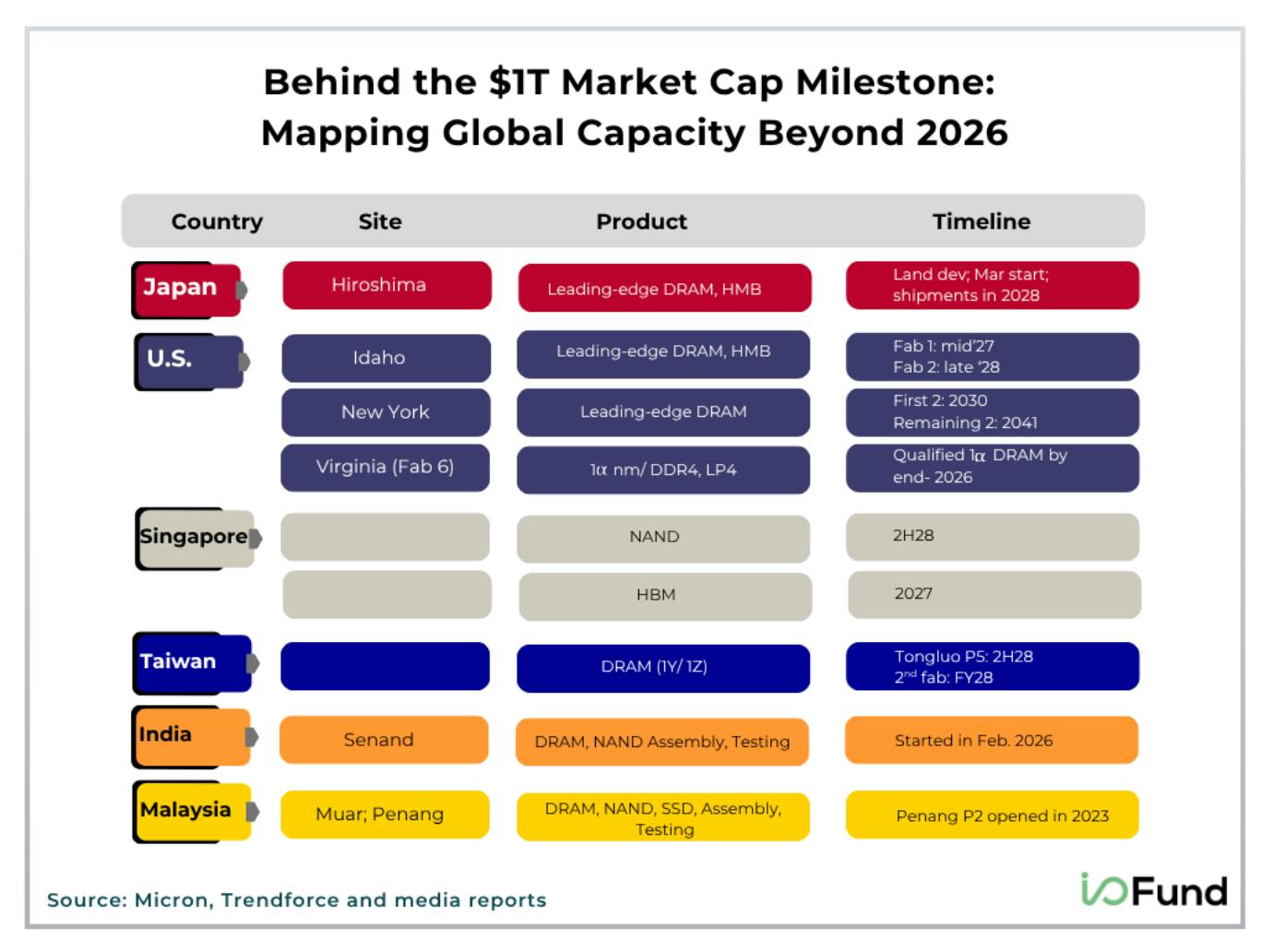
Image showing Micron’s planned fab expansions. The first leading edge DRAM and HBM site in Idaho is not expected to come online until mid-2027, with the second not coming online until late 2028. The first two leading-edge DRAM sites in New York do not come online until 2030, while shipments from the leading-edge DRAM and HBM site in Japan are not expected until 2028. Source: TrendForce
Meanwhile, in its latest earnings call, Jaejune Kim, EVP of Samsung’s Memory Business, said, “And unlike previous years, customers who are concerned about supply shortages are actually bringing forward their demand for 2027 already. So currently, just based on prebooked demand alone, the supply-demand gap is looking to widen further in 2027 versus this year.”
Specific to NAND, SanDisk’s CEO said at the JPMorgan Technology Conference, “We see this market undersupplied for a long period of time.” More specifically, he noted that in 2025, the company had a “clear point of view” that the market would become undersupplied through 2026. He added, “And I think we can say through the end of ’27, we have that same level of conviction now.”
Across these statements, we can see that executives from top memory companies are all indicating that shortages will continue until at least some part of 2028. Importantly, Samsung indicated that shortages would intensify in 2027, while Micron doesn’t expect meaningful output increases until 2028. Given this, it may not be so far-fetched to think supply and demand will not balance until near the end of the decade.
HBM and DRAM Demand Surge as AI Models and Infrastructure Scale
While the memory shortage is clearly in place today, it is important to understand the underlying factors within AI models and infrastructure driving this shortage and contributing to its continuation.
Model Complexity and KV Cache Requirements on HBM
Model complexity and the KV cache are two primary drivers of increased HBM demand, especially as it pertains to inference deployments. Increasingly complex models are being trained and deployed for multi-step inference or agentic tasks, requiring larger context windows.
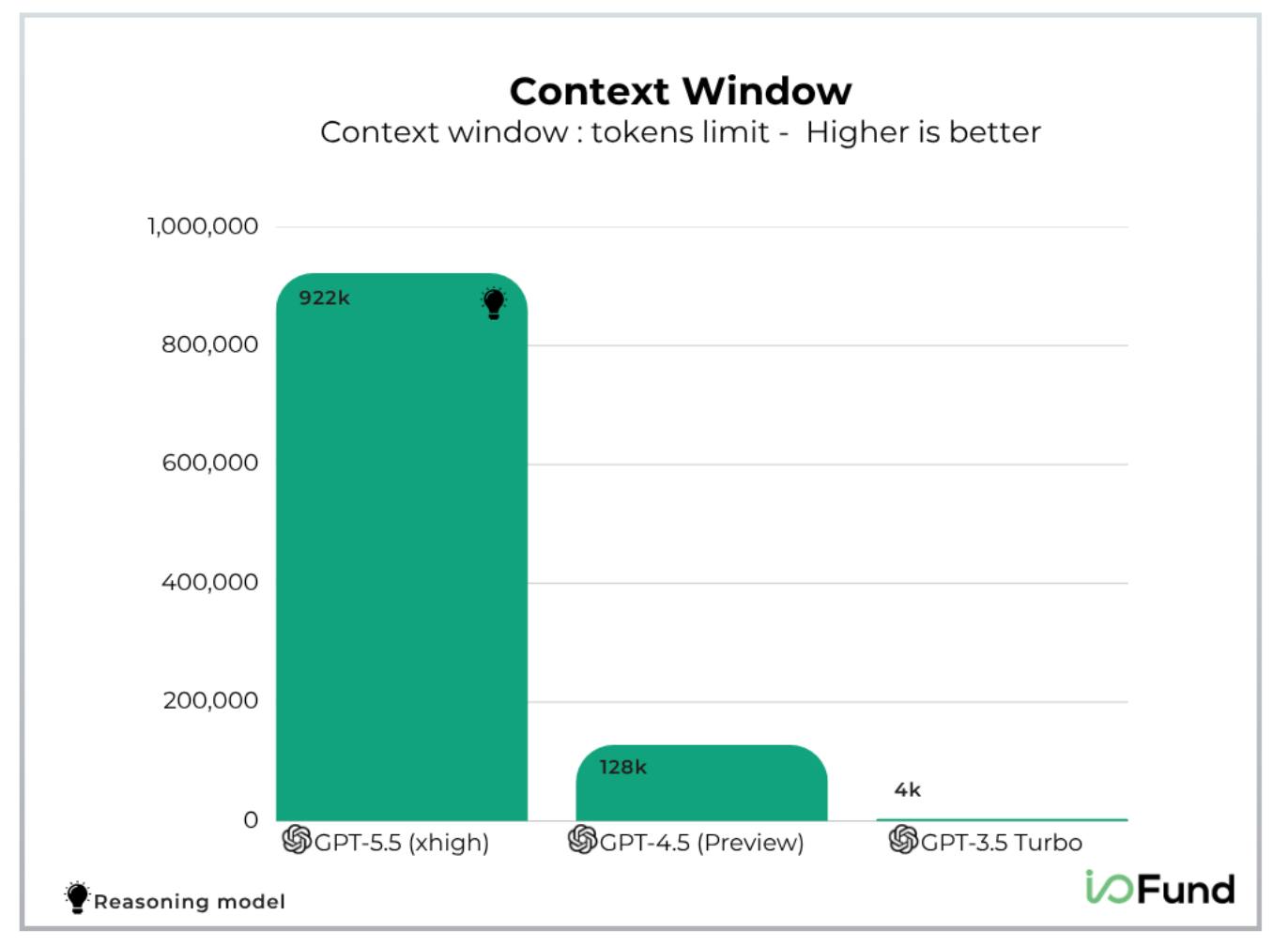
Context windows represent the amount of information that the model can remember at a given time to execute tasks, with window length increasing dramatically over time, such as for OpenAI’s models. For example, according to Artificial Analysis, OpenAI’s GPT-3.5 Turbo, released in 2023, had a context window of just 4k tokens. This increased to 128k tokens in GPT-4.5 Preview in early 2025, while OpenAI’s latest model, GPT-5.5 (xhigh), has a context window of 922k tokens, a 230X increase in the span of three years.
Chart showing the context windows of three OpenAI models. GPT-3.5 Turbo’s context window is 4k tokens, increased to 128k tokens in GPT-4.5 Preview, while OpenAI’s latest model, GPT-5.5 (xhigh), has a context window of 922k tokens. Source: Artificial Analysis
The reason this sharp increase in context windows is important for the memory thesis is because context windows define the potential size of a model’s KV cache, or the actual working memory that a model continually references during inference. HBM is particularly important here as the goal is to keep as much of the KV cache on HBM — the fastest memory available — as possible.
However, if HBM capacity is not large enough to hold the entire KV cache, that remaining portion can be offloaded to slower conventional DRAM or SSDs, introducing latency during inference or leaving expensive GPUs (or other accelerators) underutilized.
We can roughly put in perspective potential memory requirements for frontier models, using OpenAI’s GPT-4 with an estimated 1.8T parameters and a 128K context window as a benchmark. At FP8 precision, storing the model weights would require 1.8TB of HBM capacity (at 1 byte per parameter), while a 25% activation buffer would add 450GB.
On a single Nvidia GB200 NVL72, this would leave roughly 11.1TB of HBM capacity free for the KV cache. Assuming 120 layers and a hidden size of 16,384, KV cache requirements per token would be ~3.9MB at FP8, meaning one NVL72 could in theory support maximum tokens of ~2.85 million, or around 22 concurrent requests at the max 128K context window.
This problem becomes further multiplied as inference demand grows, resulting in more requests from many concurrent users. Consider that OpenAI has dozens of production models available and over 900 million weekly active users, implying that at peak usage it could be handling tens of millions of concurrent requests, each consuming KV cache memory.
HBM Content Soars Over GPU Generations
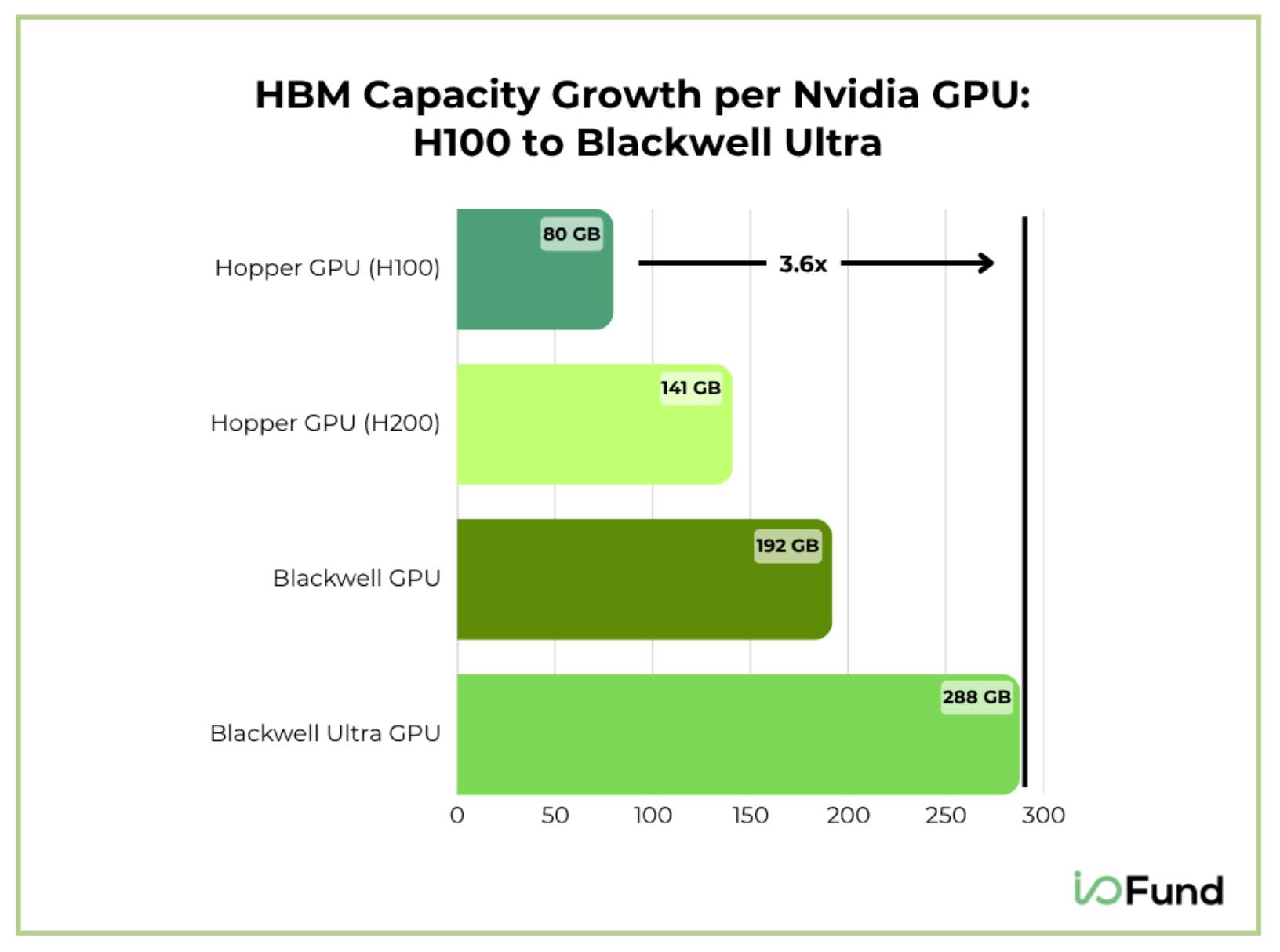
Notably, Nvidia’s 8-GPU DGX H100 server contained 640 GB of HBM, or 80 GB per chip. The B200 moved to 1.44 TB of HBM in an 8-GPU configuration, resulting in 180 GB per chip, or 125% higher than the H100. The B300 contained 288 GB of HBM per chip, 60% more than the B200, and 3.6X more than the H100.
Overall, the latest system available, the 72-GPU GB300, supports up to 21.7 TB of HBM. This results in rack scale deployments that contain nearly 34X more HBM content than the DGX H100 server. This shift came over approximately three years, with the H100 entering full production in September 2022, while the GB300 entered full production in August 2025. This rapid increase in HBM content over a short period is another significant contributor to HBM shortages. However, it is important to note that Rubin will remain at 288 GB per chip, but use HBM4 rather than the HBM3E in Blackwell to provide higher bandwidth.
Chart showing the increase in HBM content per Nvidia GPU from H100 to Blackwell Ultra. HBM content starts at 80 GB in H100 and moves progressively higher to 141 GB in the H200 and 192 GB in Blackwell to 288 GB in Blackwell Ultra, equating to 3.6X increase across these GPU generations. Source: Nvidia
This shift is similarly evident at AMD. The company’s Instinct MI250 GPUs, launched in November 2021, supported 128 GB of HBM per chip. Meanwhile, the company’s MI450 series will deliver nearly 3.4X HBM capacity than MI250 at 432 GB per chip. The “Helios” MI450 72-GPU rack scale system delivers 31 TB of total HBM4 content—or 1.5X higher than the GB300 NLV72. Shipments are expected in the second half of 2026.
Conventional DRAM Pressure Points: Vera Content Triples as CPU Demand Increases
As noted, Nvidia’s Vera CPUs will support more than triple the LPDDR5X per chip of the Grace CPU, which is likely to put additional pressure on conventional DRAM demand. However, this comes down to more than just per-chip DRAM content.
Nvidia has announced that it will launch a standalone Vera rack containing 256 CPUs—or 7X more than the 36 CPUs in the Vera Rubin NVL72. This is due to the increasing importance of agentic AI, which is expected to increase CPU demand significantly. With this, LPDDR5 demand could be further pressured from two sides: higher content per CPU and higher overall CPU sales.
Notably, TrendForce cites the rising importance of CPUs as a rationale for increasing its 2026 DRAM market forecast to $618.7 billion, representing 303% YoY growth. The firm projects DRAM growth of another 46% YoY in 2027, and for the overall DRAM and NAND market to hit $1.28 trillion. This would equate to a 5.7X increase in just two years versus the $225 billion market in 2025.
Risks to the Memory Thesis: TurboQuant and Long-Term Agreements
There are two major risks investors should watch as the memory trade matures, which is whether shortage-driven pricing surges will continue to flow disproportionately to memory suppliers, and whether software-based efficiency gains could reduce the intensity of memory usage.
In recent earnings calls, memory suppliers have discussed hyperscalers and AI infrastructure customers seeking longer-duration contracts of up to five years. There are some positives to these agreements, which is they smooth out the cyclicality that many investors fear given these agreements guarantee any inventory will be quickly absorbed, resulting in more stability.
On the flip side, memory stocks are surging precisely because pricing is uncapped right now, therefore this introduces a new era for many memory stocks to where they transition to becoming secularly certain, yet the epic volatility in both directions is more muted.
Notably, there are various deal structures for these agreements, yet in most instances, they lock-in demand for many years in exchange for some kind of cap in memory component pricing.
The second risk is model and system efficiency through improvements such as Google’s TurboQuant. TurboQuant is a compression method that directly addresses the KV cache bottleneck. Google says that TurboQuant can reduce KV cache memory size by 6X while simultaneously preserving model accuracy and accelerating speed by up to 8X.
However, the increased usage of HBM in Google’s own systems is a telling point that pushes back on TurboQuant fears. The company’s latest TPUs, the 8t and 8i, support 216 GB and 288 GB of HBM per chip, respectively. These figures are 13% higher and 50% higher than the 192 GB of HBM capacity offered by Ironwood v7. Thus, Google, which developed TurboQuant, is itself substantially increasing HBM capacity in spite of the efficiency gains.
Conclusion:
Micron has been one of our largest positions in 2026, and for good reason. Over the past 10 months, the company added more than $1 trillion to its market capitalization, which now sits near $1.35 trillion. That move reflects not only Micron’s execution, but also the market’s growing recognition that memory demand is entering a much larger cycle.
Investing in memory has been anything but easy. Many market participants feared the cycle was topping at the start of 2026, but the I/O Fund’s disciplined process kept us in the position at a high allocation, frequently above 10%, for year-to-date returns of 277%.
This analysis is a small sample of what we do behind our paywall. We are not simply stating memory is an important bottleneck, but rather we show, with data, how the shortage is pressuring every layer of the memory stack, including HBM for accelerators, LPDDR5X and DDR5 for CPUs, and NAND SSDs for storage and agentic inference.
As Q2 wraps up, the I/O Fund is preparing to identify the next wave of AI winners in our upcoming Top 15 AI Stocks for Q3 2026 report. Previous reports identified Micron as a major beneficiary, along with names such as Bloom Energy, up over 1800% since our April 2025 entry, and lesser-known AI networking stocks up over 600% since our November 2025 entry.
We publish more than 100 paywalled articles each year on AI stocks, hold weekly 1-hour webinars, and offer an actively managed portfolio with real-time trade alerts.
Don’t miss the next wave of the AI trade Join I/O Fund
Please note: The I/O Fund conducts research and draws conclusions for the company’s portfolio. We then share that information with our readers and offer real-time trade notifications. This is not a guarantee of a stock’s performance and it is not financial advice. Please consult your personal financial advisor before buying any stock in the companies mentioned in this analysis. Beth Kindig and the I/O Fund own shares in MU at the time of writing and may own stocks pictured in the charts.
Leo Miller, AI and Semiconductor Investment Writer at I/O Fund, contributed to this analysis.
Beth Kindig is the lead tech analyst for the I/O Fund with audited results that beat Ark in 2020 and returns of up to 1700% on her premium site in two years and 1150% in her free newsletter in three years on individual stocks and assets.