

This article was originally published on Forbes on Updated Sep 26, 2024, 10:29pm EDT
Cybersecurity is becoming increasingly important in the age of AI, as the number and sophistication of threats increase. Combining cybersecurity with AI has a natural affinity as cyberattacks are computer generated, and in turn, computers are uniquely capable of finding computer-generated threats. Utilizing AI to identify threats and for pattern recognition and anomaly detection is not new by any means, but rather what is now rapidly coming to market are platforms enabled with generative AI, to enable threat detection and prevention before attacks occur.
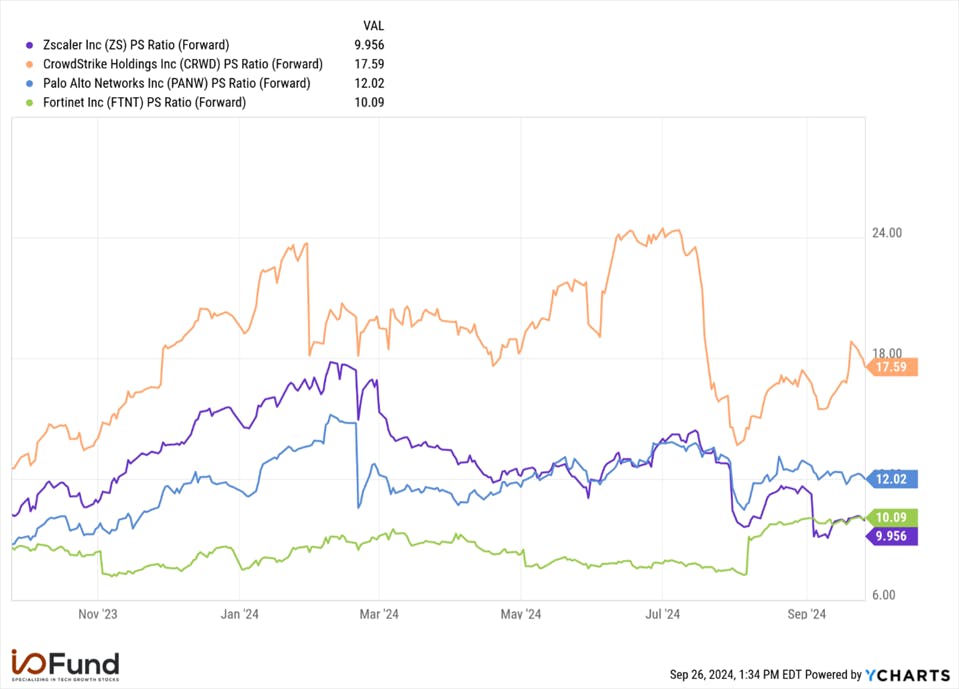
Despite cybersecurity being one of the most promising sectors to reap the benefits from AI, popular stocks have stumbled this year. CrowdStrike had a faulty update that caused global outages with high profile airlines affected. Palo Alto also recorded its largest-ever one-day decline as it cut its outlook; the company is taking a near-term hit as it pivots toward becoming a platform, which will fare better for AI purposes rather than a collection of disparate vendor products.
AI offerings are becoming more prevalent, and the first signs of AI-related growth are arising in the leading names in the industry. Below, I look at the demand environment for leading cybersecurity stocks CrowdStrike, Zscaler, Palo Alto, and Fortinet, and which ones have key metrics hinting toward underlying strength.
AI Opening New Opportunities as Threats Rise
Nearly one year ago, the I/O Fund discussed for its free newsletter readers how cybersecurity was the next industry to be disrupted by AI, not only by improving threat detection and prevention capabilities but also because AI-based attacks were on the rise. AI is aiding enterprises to expedite threat prevention, yet hackers are similarly expediting the end-to-end attack life cycle, and could potentially execute larger and more complicated attacks faster than ever before.
According to McKinsey, 51 percent of organizations believe generative-AI is driving new risks in cybersecurity, down slightly from 53 percent in a similar survey from 2023. However, only 33 percent of organizations are actively working to mitigate AI-related cybersecurity risks, with 16 percent already witnessing a negative consequence or event.
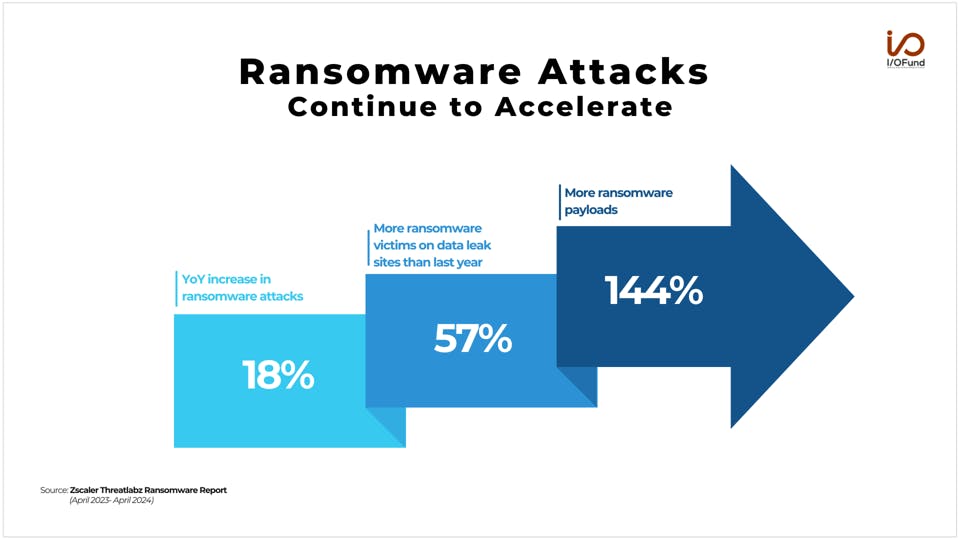
A report from the World Economic Forum predicts that AI could push cyber incidents and data breaches to a new record high in 2024, even after a 72% YoY increase in data breaches in 2023. Palo Alto said it is seeing an “uptick in mega-breaches” with multi-billion dollar impacts, as ransomware public extortion activity has risen more than 50% from 2022. Zscaler also sees ransomware attacks continuing to rise, up 18% YoY, though victims and payloads have gotten increasingly large, with 57% more victims and 144% more payloads.
The new dynamic created by AI in the industry from both a threat and protection standpoint offers a long-term growth runway. As Palo Alto puts it, the year 2024 “will be a phenomenal year in the utilization of AI in cybersecurity,” but it “will pale by comparison to what is yet to come.”
Sign up for I/O Fund’s free newsletter with gains of up to 2600% because of Nvidia’s epic run – Click here
Palo Alto Networks: 4x Growth to $200M AI ARR
Palo Alto’s management believes AI “continues to generate significant excitement in the market,” and “adoption is proceeding at a rapid pace faster [than] any other new technology.” They see AI not only creating “transformative use cases” enabling new revenue streams and efficiencies, but also enabling cybercriminals to broaden attacks, improve targeting, and scale beyond what can currently be controlled by humans.
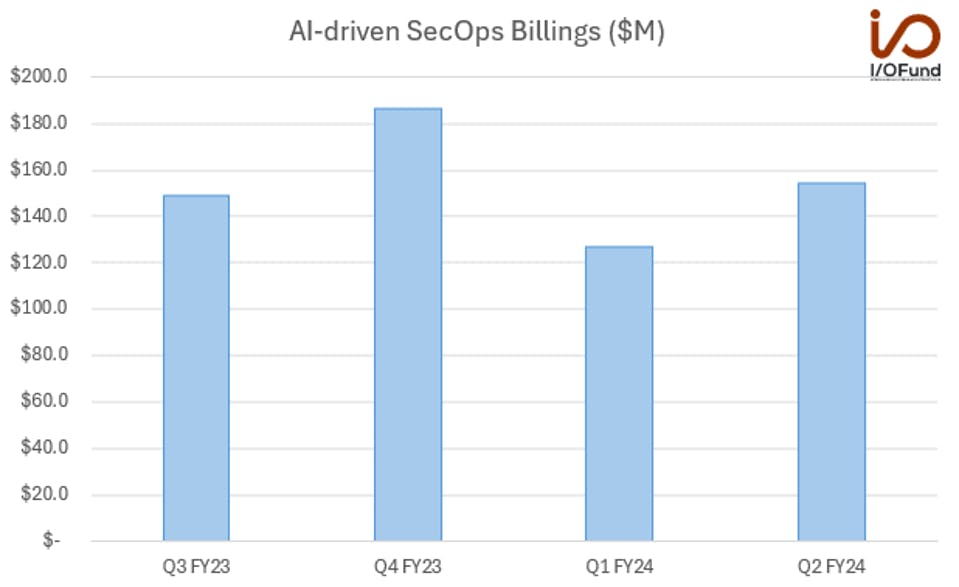
Palo Alto is rolling out a comprehensive AI product suite, with the launch of AI Access, AI SPM, and AI Runtime Security in May, combined with its AI-driven SecOps platform Cortex and AI integrations in its Prisma Cloud and SASE offerings. Palo Alto noted in Q4’s earnings call that its AI Access could be deployed to its 5,000+ Prisma Access customers, while nearly 1,000 customers were also interested in AI Access. This is an incredibly strong response given that early access to the solution was launched in July, only one month prior to management’s comment.
In fiscal Q4, Palo Alto disclosed that its AI ARR (AI Access, AI SPM, AI Runtime) had surpassed $200 million to close out the year, for 4x YoY growth. While growth is rapid, AI’s scale is still small, due to the recent timing of launches. However, AI already accounts for nearly 5% of Next-Gen Security (NGS) ARR, and is set to grow its share of NGS ARR as products scale.
Palo Alto is also seeing strong growth in Cortex, with ARR surpassing $900 million in fiscal 2024. Cortex XSIAM delivered north of $500 million in bookings, with customer count rising 4x YoY. Palo Alto has previously noted that XSIAM drives much higher ARR, with customers who adopt XSIAM having >5x ARR compared to those that do not. Continuing to accelerate customer adoption of XSIAM while growing Cortex’s customer base (up nearly 20% YoY to >6,100) can drive strong long-term growth for the fastest-growing product in Palo Alto’s history.
With the strengths arising in AI, Palo Alto is expecting NGS ARR growth to remain robust, though headline growth is decelerating due to the law of large numbers. NGS ARR is guided to increase 34% to 36% YoY in Q1 of fiscal 2025, reaching between $4.33 billion to $4.38 billion. On a dollar basis, that represents YoY growth of $1.13 billion, marginally higher than the $1.12 billion it added from Q1 2023 to Q1 2024, where YoY growth was reported at 53% — essentially, Palo Alto is maintaining the same growth in dollar terms despite operating at a larger scale.
Zscaler: AI Contributing 3 Points to Growth
Zscaler launched its AI Analytics solutions at the end of 2023, and is already seeing strong contributions from these new products, including its Risk360, Business Insights, Unified Vulnerability Management and more. Zscaler’s management believes that “the increasing use of AI is creating new avenues of growth,” and “the rising adoption of Gen AI is exposing new gaps in organizations’ security posture.”
Management said that AI Analytics was “seeing strong traction” in Q4, and “contributed nearly 3 points to new and upsell business growth in Q4 and 2 points for the entire fiscal ’24,” even with the products being available for just a portion of the year. While Zscaler did not break out AI’s contribution in dollar terms, it noted that it saw record new and upsell business in Q4 and a record $1 billion-plus in quarterly bookings (driven by the new and upsell business), suggesting that the AI Analytics was a strong driver for the quarter under the hood.
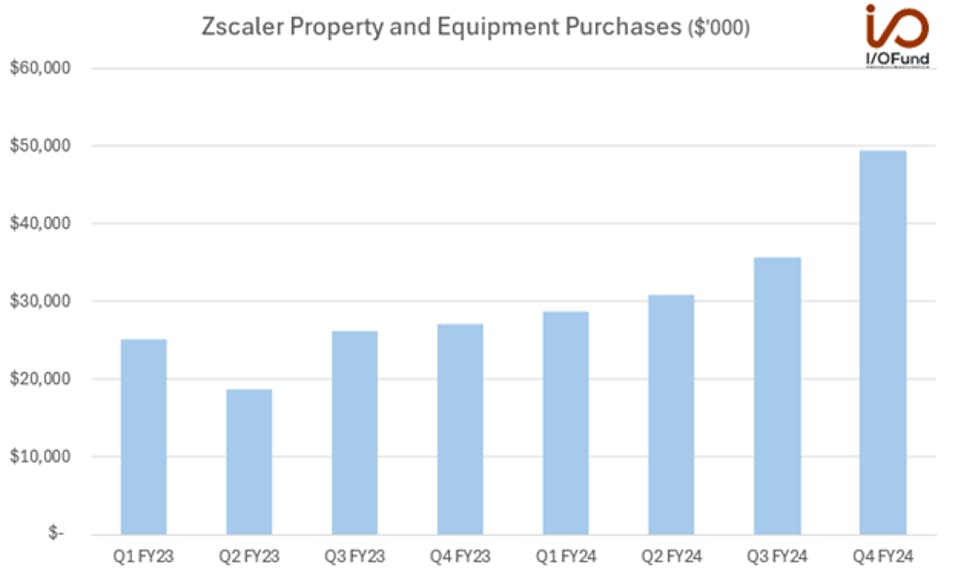
Zscaler is also prioritizing data center and AI investments to support this growth in AI Analytics. For fiscal 2025, management said that they expect “data center CapEx to be approximately 3 points higher as a percent of revenue compared to fiscal 2024,” due to investments to upgrade cloud and AI infrastructure. Property and equipment purchases have been accelerating on a quarterly basis to nearly $50 million in Q4, and totaled 7% of revenue for the entirety of FY24, so Zscaler looks to be eyeing a move closer towards the 10% range. As a result of these increased data center investments, free cash flow margin is expected to decline from 27% in FY24 to 23.5% to 24% in FY25.