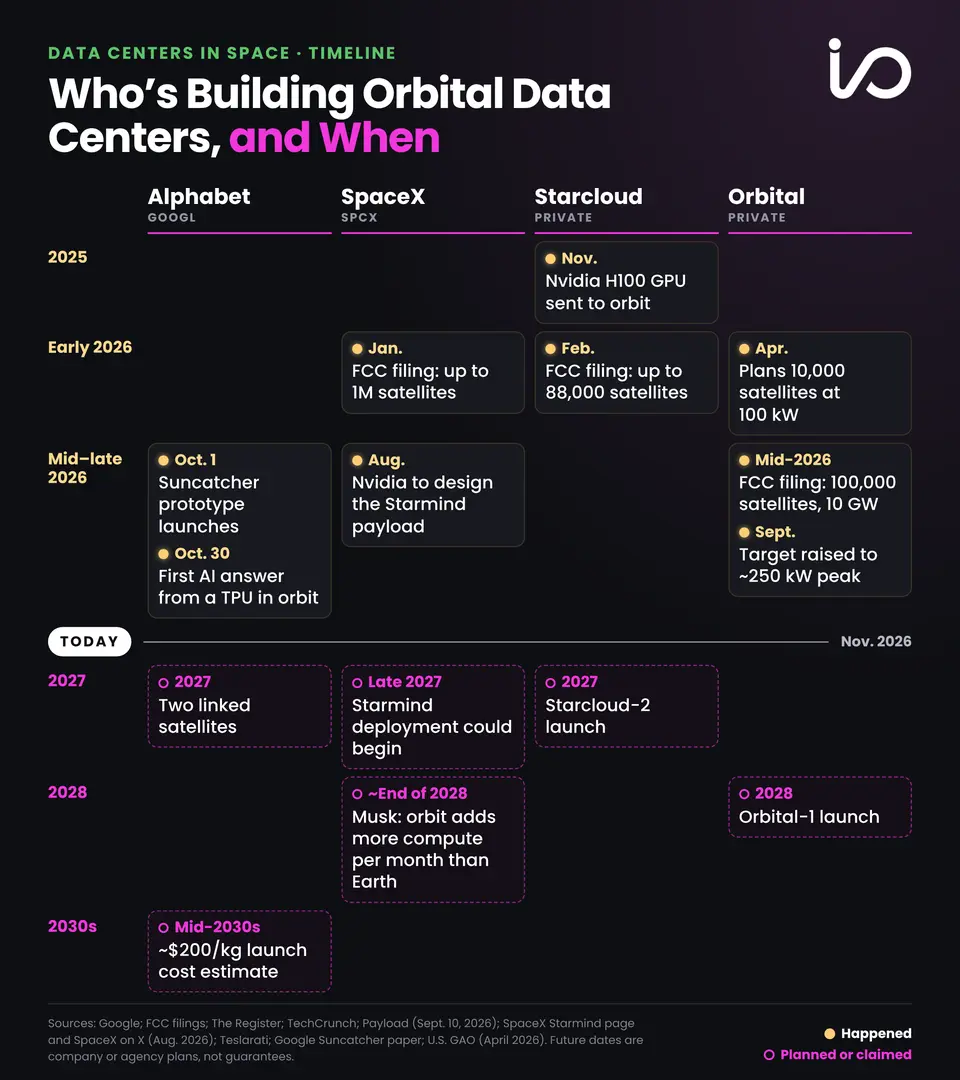


On October 30, Google revealed that its Gemma 4 AI model ran on a data-center-class TPU aboard its first Project Suncatcher prototype satellite. This satellite reportedly generates only around 1 kW of power, enough to power one of its four TPUs at a time for around 15 to 20 minutes.
On the same day, Elon Musk shared on X that “terrestrial compute will be peanuts compared to orbital compute, with SpaceX planning an orbital AI infrastructure project, Starmind. Each of the planned Starmind satellites will carry over 250 kW of solar power, with initial deployment expected to start as soon as late 2027.
As it stands, demand for AI compute continues to grow even as it faces a significant bottleneck in the form of physical power constraints. The International Energy Agency estimates that data center electricity consumption could rise from around 415 TWh in 2024 to around 945 TWh by 2030 in its base case. Both the Project Suncatcher prototype satellite and Musk’s Starmind satellites represent a different avenue to alleviate the power bottleneck by moving AI compute into space. The drawback for now is that both consume a fraction of the power a typical 1 GW terrestrial data center campus on Earth consumes. Against this backdrop, this article examines why companies are looking at AI data centers in space, who is building them, and what stands in the way of orbital AI compute.
Google’s Project Suncatcher Generates Its First AI Response From Space
Developed in partnership with Planet Labs, Google launched its Project Suncatcher prototype satellite into space on October 1 via SpaceX’s Transporter-18 rideshare mission. After following its commissioning checklist, Google received its first response from the Suncatcher satellite on October 30, generated from a data-center-class TPU in orbit. When passing over a ground station, engineers sent the onboard Gemma 4 AI model a prompt requesting a haiku about being in space. The satellite responded as it flew over Svalbard, Norway, “Blue marble below / Data streams in silent grace / Starlight feeds my core.”
In addition to the initial response, Google engineers prompted the model for more space-themed limericks and self-diagnostic system queries. This experiment showed that its TPU can run a model in orbit despite limitations of power and heat.
Google’s research paper lays out a plan for a future design featuring 81-satellite clusters flying within 1 kilometer of each other, located around 650 km above Earth and connected by lasers. After the haiku milestone, Google plans to launch two linked satellites into space in 2027.
Why Google Is Investing in Space-Based AI Data Centers
Orbital data centers, comprised of a group of satellites carrying AI chips, have gained attention recently as they could be well positioned to bypass growing land, power and permitting constraints. Orbital satellites can link to each other and to the ground, making them capable of working together like server racks in a data center located on Earth.
Google and SpaceX are turning to orbital AI compute to tackle the power constraint holding back data centers on Earth. Orbital satellites leverage abundant solar power, with cooling handled via radiators. According to the IEA’s estimates, around 20% of planned data center projects could face delays owing to grid connections. In Northern Virginia, for instance, the wait time stretches up to as long as seven years.
We highlighted the same bottleneck in our analysis about Oracle’s Project Jupiter, where the key challenge for data centers lay in getting access to permissioned megawatts on the ground. Orbital compute is one of the most extreme attempts at getting around the long wait times for accessing permissioned power.
According to Google’s research, a solar panel operating in a dawn-dusk orbit and staying in sunlight constantly, is capable of collecting up to 8 times more energy per year than one located at mid-latitude on Earth.
How Much Power Does a Space Data Center Need Compared with One on Earth?
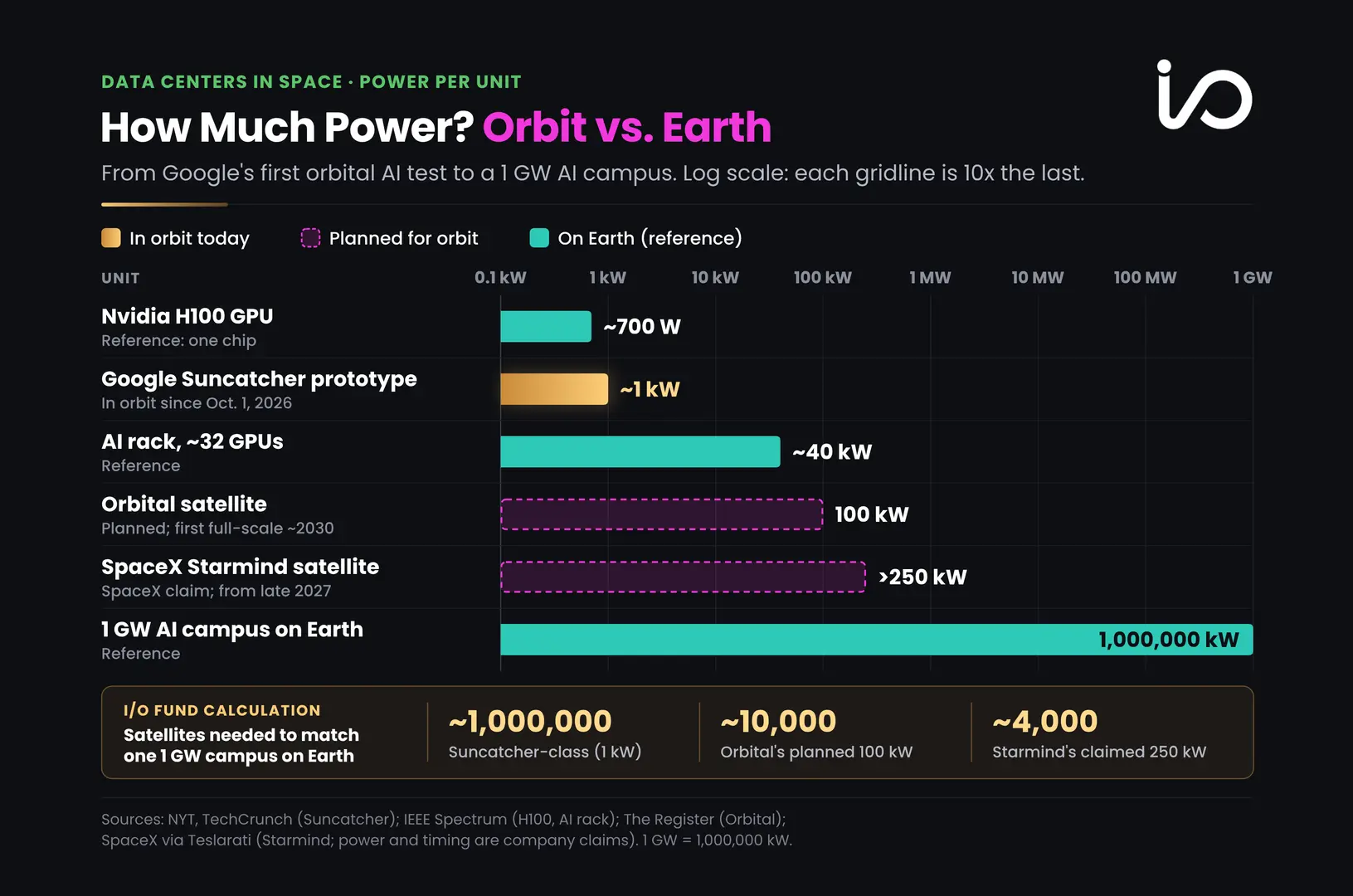
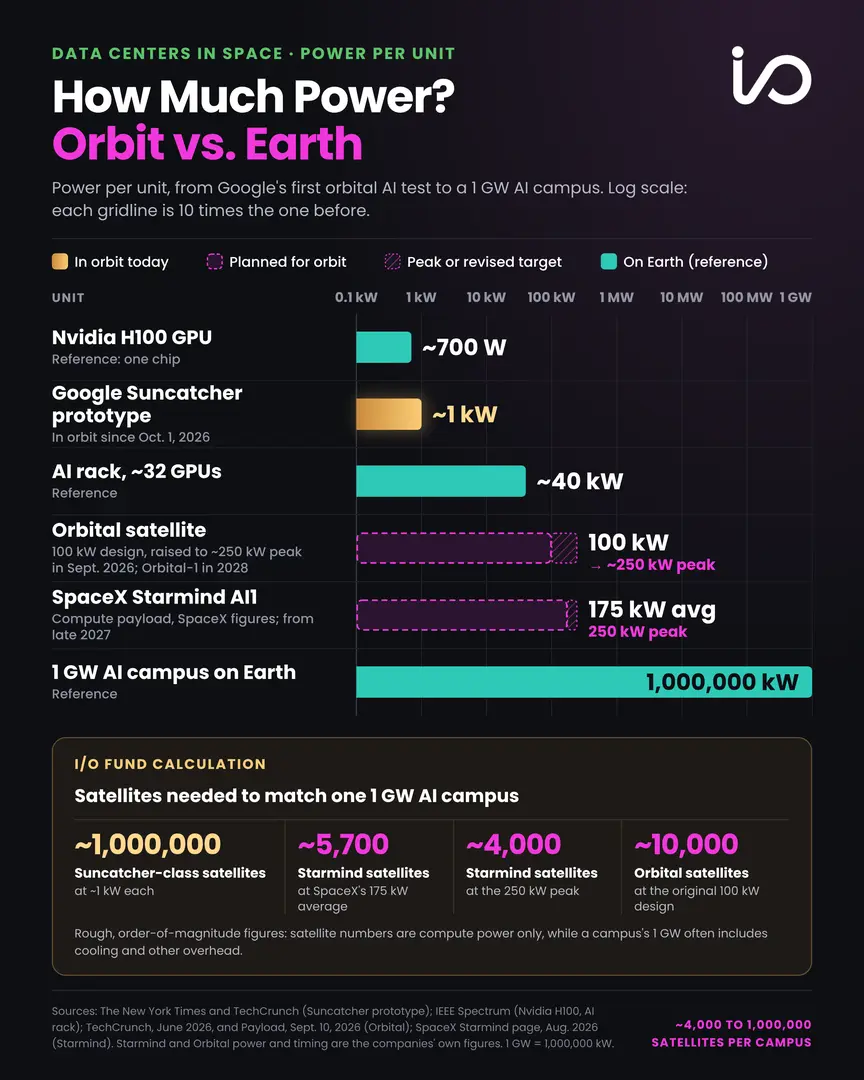
One challenge for orbital data centers lies within power consumption. Google’s Project Suncatcher prototype runs on around 1 kW, which, for comparison, is barely enough to power one older H100 GPU. Although SpaceX’s Starmind satellites are 250X larger at 250kW, this would not be enough to power two of Nvidia’s GB300 NVL72 racks, consuming 132kW to 140kW each.
For comparison, there are currently 12 active data centers in the US consuming a minimum of 250MW of power, with one of those above 1GW. By the end of next year, the number of 250MW+ data centers is expected to more than double to 26, with 1GW+ rising to four, per EpochAI.
According to our rough estimates, matching a 1 GW Earth-based campus would require around 1 million satellites like Google’s prototype. SpaceX lists an average of 175 kW for each Starmind satellite, so it would require around 5,700 or around 4,000 if every satellite ran at its 250 kW peak. Satellites designed by startup Orbital require 100 kW, which works out to around 10,000; although, in September, the company told Payload that it is raising the target to a peak of 250 kW. The satellite figures cover only compute power, while a data center campus on Earth that consumes 1 GW power often includes cooling and other overhead, so these estimates only project an order of magnitude.
AI’s power requirements are enormous, and identifying the companies positioned to benefit has been a major focus for I/O Fund. Our Bloom Energy position is up nearly 1,200% since our initial entry.
Find out which AI stocks we’re watching next in our Q4 Top 20 AI Stocks report. Members also get out live portfolio, real-time trade alerts and weekly webinars.
Get the Q4 Top 20 AI Stocks → Become a Premium I/O Fund Member
Three Key Obstacles Holding Back Data Centers in Space
While Google’s latest milestone demonstrates that it is currently possible to run AI models on an AI chip in orbit, it may take longer to put a full-fledged AI data center in space. In April 2026, the U.S. Government Accountability Office stated that power, heat-rejection and communications systems that large orbital data centers would need remain “unproven at AI-training scale.” Here’s a look at the three key obstacles holding back data centers in space for now: cooling, cost, and radiation and debris in space.
Obstacle 1: How to Cool a Space-Based Data Center
Unlike on Earth, orbital data centers don’t have access to air that can carry away the heat, and so it has to be radiated from large panels. ABI Research analyst Andrew Cavalier estimates that a 700-watt H100 needs around 1.4 square meters of radiator at 60°C, and a 40 kW rack needs around 80 square meters or roughly the size of a pickleball court. Moreover, radiation and atomic oxygen wear down radiator surfaces, so the area needed grows by as much as 40% over a satellite’s life.
Google has confirmed that it is testing “a combination of heat pipes and radiators.” As Cavalier forecasts, when it comes to space data centers, “the constraint is never the silicon. It’s the thermodynamics.”
Obstacle 2: The Cost of Operating Data Centers in Space