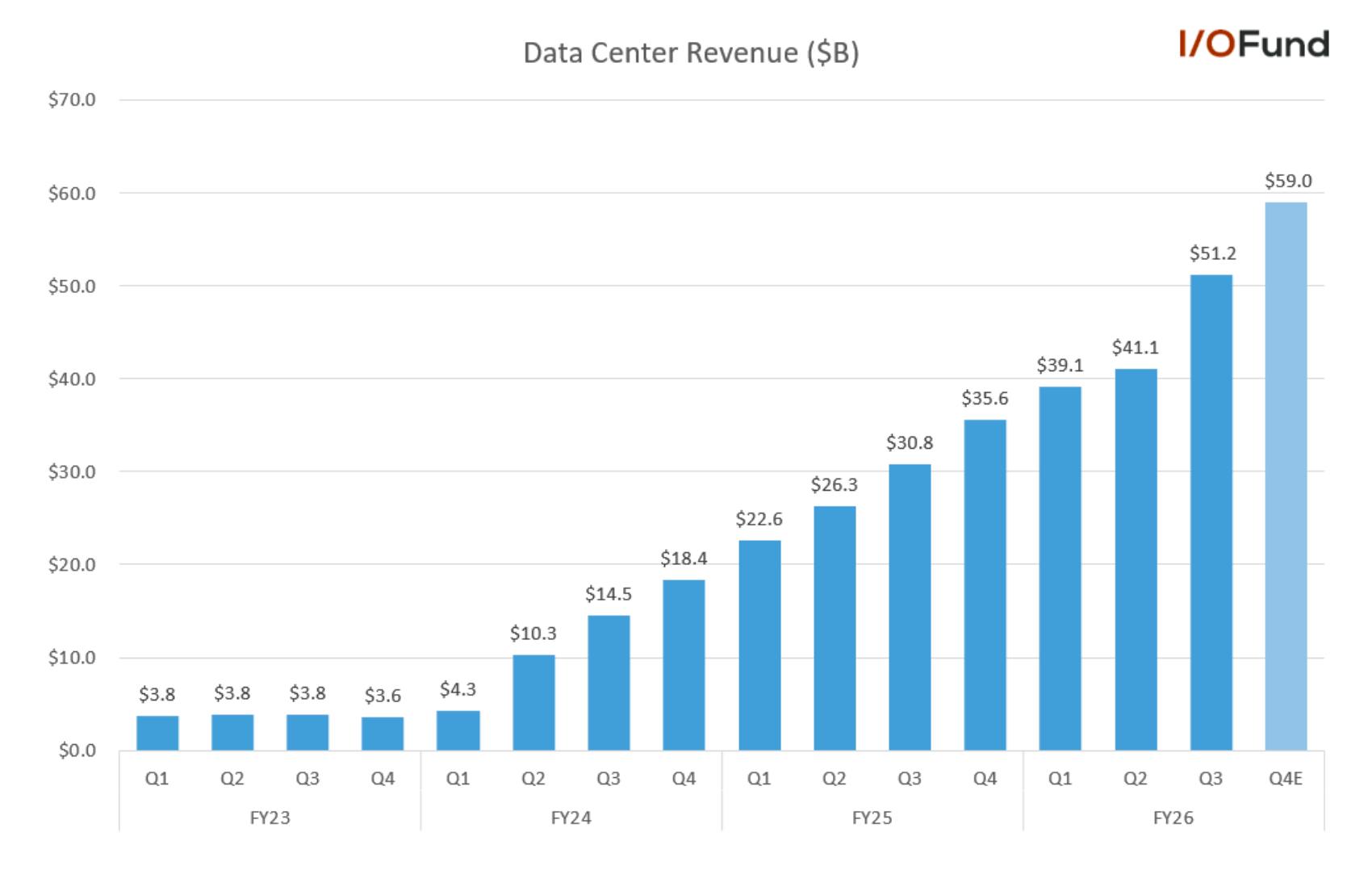

Two weeks ago, Nvidia blew the doors off with an earnings report that defies the company’s mega-cap scale. The long-awaited Blackwell and Blackwell Ultra architectures are shipping in volume, leading to 25% QoQ growth in the data center segment and surpassing a $200 billion data center run rate. Despite this, Nvidia’s stock barely budged as the market ignored the magnitude of the QoQ inflection. Consider that Apple, trading at a similar market cap, has not seen 66% YoY growth for fourteen years, and it required a global pandemic for Apple to report 25%+ QoQ growth outside of its holiday quarter.
When we narrow it down to Nvidia’s last earnings report – let alone subsequent reports – there is truly no comparison going back for a decade or more. However, the market dismissed the results and is instead stuck in a pit of speculative fears – meaning, there is no evidence in the financials, management commentary, industry estimates, or product roadmap (collectively referred to as “data”). Nonetheless, hypothetical risks that are immaterial today have become loud enough to bury an otherwise epic earnings report.
As I pointed out on Charles Payne’s Making Money, I live for those moments when a company delivers a strong earnings report and yet the market hands me a lower price.
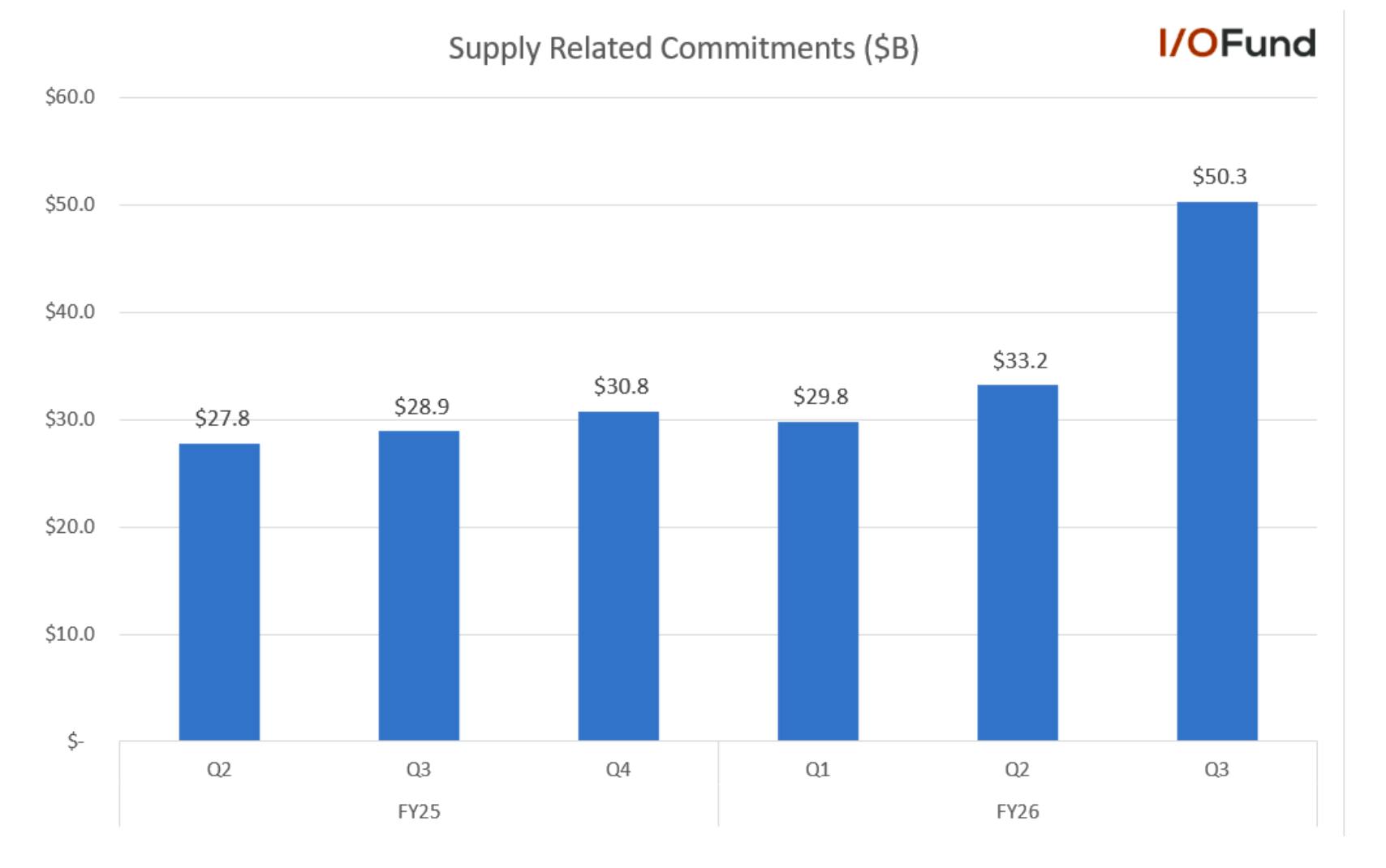
Underneath the noise of “AI bubble” debates, Google’s TPUs, debt leverage (which is a material issue), China fears (remember the DeepSeek panic?), supply chain constraints, rare-earth material shortages, and more — I like to remind investors that those risks were immaterial to Nvidia’s recent report or management’s guide.
Therefore, I maintain that the greatest risk is not an AI bubble or the credibility of these other risks – rather it’s that an investor misses out on what may be one of the strongest investing opportunities of our lifetime: what I’ve dubbed the AI Monetization Supercycle catalyzed by the inference phase.
Keep in mind that to short a stock like Nvidia could hypothetically return 30% or 40% whereas going long has returned over 3,500% since the I/O Fund’s first entry. It was not only Nvidia we participated in, but rather the I/O Fund has offered one of the strongest AI portfolios in the world – proven by our strong cumulative return. Currently, we have 15 positions, beating the Nasdaq YTD up from ten last year.
Below, I outline what I see ahead — points that warrant far more attention than the familiar media narratives, which have repeatedly underestimated the magnitude of the AI trend. Instead, you’ll find data-driven conclusions on the incoming monetization wave, including new insights to help investors connect the dots on what 2026–2027 may bring.
For a limited time, we’re offering $250 off our Advanced Tier. This Black Friday deal ends December 8th. Join here.
OpenAI’s Record $13B Revenue Confirms the AI Monetization Supercycle
To see the AI monetization Supercycle in action, we can simply look at OpenAI’s trajectory. The company went from $1 billion in revenue in 2023 to $3.7 billion in 2024 to now $13 billion in annualized revenue, which is the steepest rise in tech history. This was driven almost entirely by inference (API calls and ChatGPT usage). Furthermore, OpenAI recently stated revenue is “well more” than $13 billion.
The clues from OpenAI’s monetization trajectory is key as the market is anxiously awaiting the moment that Big Tech will show ROI from capex spend, and according to Broadcom and others, that day may soon be arriving.
Over the past year, Broadcom joined Nvidia, Alphabet, and Microsoft in calling out surging AI inference demand, noting that this rapid growth could drive increased demand for custom silicon in the second half of 2026, and with it, higher AI revenue.
Broadcom sees growth continuing, supported by the inference growth curve, as CEO Hock Tan said during FQ2 earnings call that Broadcom might witness an acceleration of XPU demand into the back half of 2026. He said, “In fact, what we’ve seen recently is that they are doubling down on inference in order to monetize their platforms. And reflecting this, we may actually see an acceleration of XPU demand into the back half of 2026 to meet urgent demand for inference on top of the demand we have indicated from training.”
Something similar was echoed in the most recent FQ3 call, with Tan stating: “But also as for these guys, they got to be accountable to being able to create cash flows that can sustain their path. They [are] starting to also invest in inference in a massive way to monetize their models.”
CoreWeave’s Q2 earnings call also echoed the incoming inference wave will lead to a period of heightened monetization: “As I always say, inference is the monetization of artificial intelligence.”
Matthew Bryson, Managing Director of Research at Wedbush Securities, expressed optimism on the broader AI sector’s shift toward revenue generation through inference applications, stating “What we’ve started to see over the last three, four months is that there’s been a huge increase in inference. This increase in inference – the applications that drive actual revenue for cloud providers and model builders – represents a critical development for the sector. It feels like right now we’re also seeing monetization of AI, and that was the concern,” he added. “If you’d asked me 12 months ago, where’s the revenue going to come from? All we’re seeing is model building, and now it looks like we’re not. We’re seeing applications.”
I/O Fund Lead Technology Analyst Beth Kindig discusses Nvidia’s stock after Q3 FY 2026 blowout earnings report on Fox Business
How OpenAI and Anthropic Projections Validate Nvidia Stock
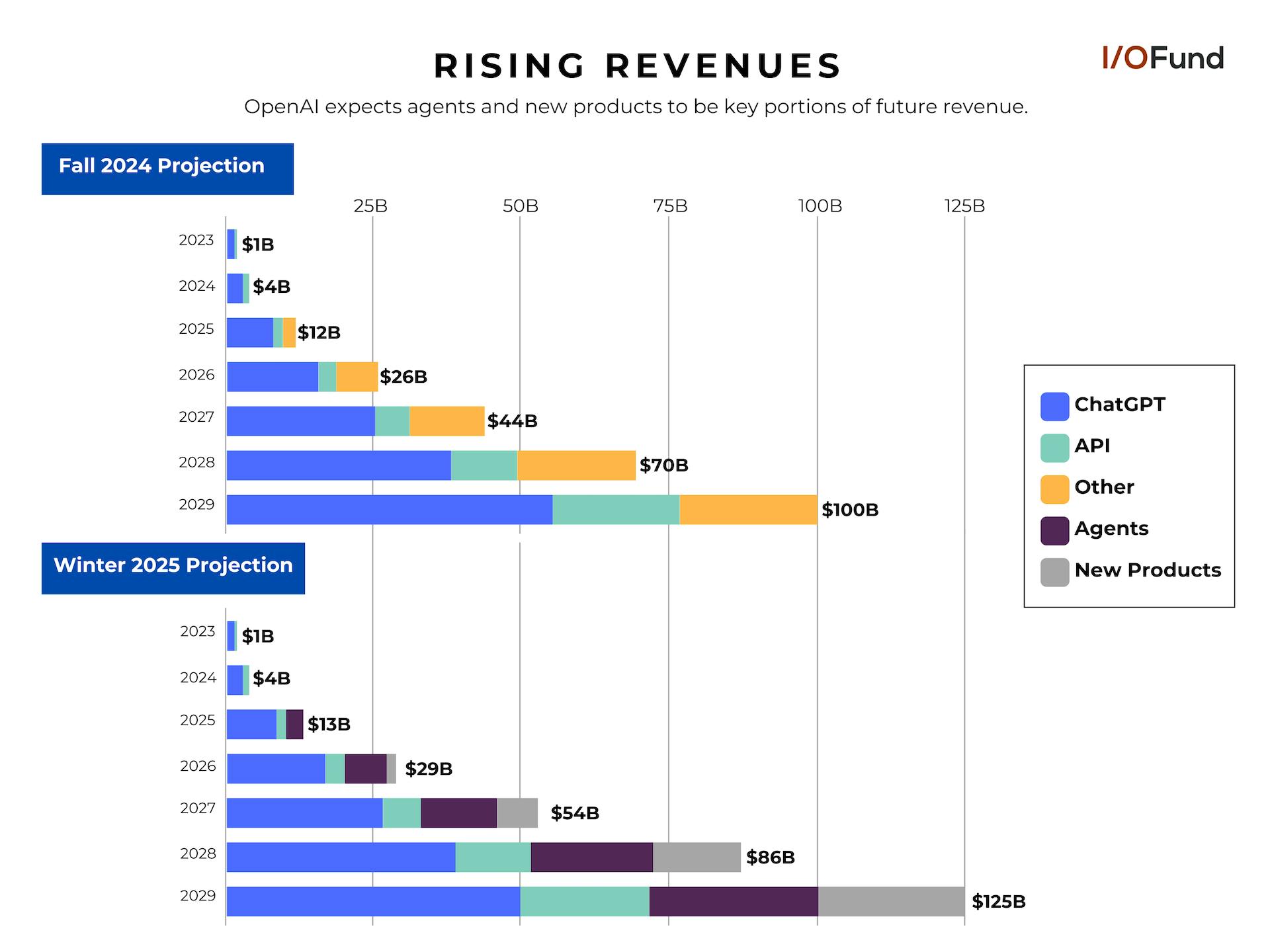
OpenAI and Anthropic are boosting long term revenue projections, underpinned by inference and inference-driven products such as AI agents. For example, in the most recent projection, OpenAI raised the tail end of its long-term forecast by as much as 25% from 2027 to 2029 versus its fall 2024 projection.
OpenAI now sees $54 billion in revenue in 2027, a nearly 23% raise from its prior projection for $44 billion, and $125 billion in revenue in 2029, a 25% raise. Notably, this growth is not stemming from ChatGPT, where 2029 revenue was actually cut from the mid-$50 billion range to $50 billion; instead, OpenAI projects around $20 billion from APIs, over $25 billion from AI agents and another $25 billion from other products and free user monetization (such as ads). For comparison, the $125 billion target reflects nearly 10X growth from 2025’s projected revenue of $13 billion.
Competitor Anthropic is also expecting rapid revenue growth through 2028, now projecting as much as $70 billion in revenue in its optimistic scenario as of early November. This forecast is supported by Anthropic’s near-term growth expectations for its ARR, with the company said to be on track to hit its $9 billion goal this year with a target to double or nearly triple this to $20-26 billion in 2026.
API revenue for Anthropic is expected to reach $3.8 billion in 2025, more than double OpenAI’s expectation for $1.8 billion, with Anthropic’s Claude Code model said to be close to reaching $1 billion in annualized revenue, up 150% from $400 million in July.
Recent token usage statistics from Google and OpenAI also suggest that this wave of AI inference is on rapidly on the rise. In October, Google boasted more than 1.3 quadrillion monthly tokens processed across its platform, up from 980 trillion in June and up 170% from 480 trillion just five months earlier in May.
Google also disclosed that its first party models like Gemini were processing 7 billion tokens per minute via direct API use in Q3, or more than 300 trillion monthly, roughly one quarter of Google’s overall tokens processed. This also outpaces OpenAI, which revealed in early October that it was processing 6 billion tokens per minute on its API, or ~260 trillion per month.
To put this in perspective, Google was processing just 9.7 trillion tokens per month in April 2024. Barely a year and a half later, and the company is almost processing that many tokens per minute.
Making headway on token throughput directly relates to the strength of Nvidia’s stock. For example, Microsoft has recently achieved a new AI inference record, with its Azure ND GB300 v6 virtual machines processing 1.1 million tokens per second on a single rack powered by Nvidia GB300 GPUs. It also marked a 27% speed improvement from 12,022 tokens/s per previous-generation Nvidia Blackwell GPU to 15,200 tokens/sec per Blackwell Ultra GPU and beat the previous Azure ND GB200 v6 record of 865,000 tokens/s by 27%.
AI Will Drive Strong Bottom Line Results Too
AI will not only impact the top line but will drive internal efficiencies to where there the first clue there is ROI on capex spend may be found in margin improvement.
Big Tech management teams are having initial discussions on the impact of using AI to drive operational efficiencies.
Alphabet’s CFO said in the Q2 earnings call, “So Sundar mentioned earlier, the use of AI tools within the company. So that’s another area where we can drive efficiency across the businesses to use these tools internally in terms of how we run the organization. Then we’re continuing on the same efforts that I’ve talked about before with regards to running the company with a high level of discipline, execution and driving efficiency across the business.”
According to McKinsey survey, most respondents say their organizations are using AI, and many have begun using AI agents as 64 percent of respondents said that AI is enabling innovation and 39 percent report positive EBIT impact at the enterprise level.
CrowdStrike announced earlier this year that the company was laying off 500 employees or about 5% of its workforce, due to artificial intelligence efficiencies. According to the World Economic Forum survey, about 41% of companies worldwide are expected to reduce their workforces in the next five years attributing to the rise of artificial intelligence.
Amazon announced in October that they are laying off 14,000 employees as the company invests more in AI. It marks the largest jobs cuts in the company’s history. Beth Galetti, SVP at Amazon said, “This generation of AI is the most transformative technology we’ve seen since the Internet, and it’s enabling companies to innovate much faster than ever before (in existing market segments and altogether new ones). We’re convinced that we need to be organized more leanly, with fewer layers and more ownership, to move as quickly as possible for our customers and business.” The company’s CEO warned about the job cuts in June this year. “We will need fewer people doing some of the jobs that are being done today.” Klarna has been most transparent about the impact of AI, revealing earlier this year that the company reduced its workforce by 40%.
Meta also revealed in October that the company will cut 600 positions from its Artificial Intelligence unit, which underscores the internal efficiencies that AI enables. This should not be confused with a pullback in AI investment — Meta is clearly spending heavily here, with capex increasing by 81% or $31.8 billion this year.
Morgan Stanley expects that software and internet companies to report positive return on investments from GenAI of 35% in 2025 and rise to 67% contribution margin by 2028. “[…] In fact, for the first time, return on investment (ROI) is expected to be positive with analysts expecting GenAI to yield a 34% contribution margin, or the equivalent of $51 billion in 2025. Last year, GenAI ROI, with expenses, resulted in a -5% contribution margin. By 2028, ROI is expected to remain positive and rise to a 67% contribution margin, or $722 billion return.”