
This article was originally published on Forbes on Updated Dec 19, 2024, 05:10pm EST Forbes on Updated Dec 19, 2024, 05:10pm EST
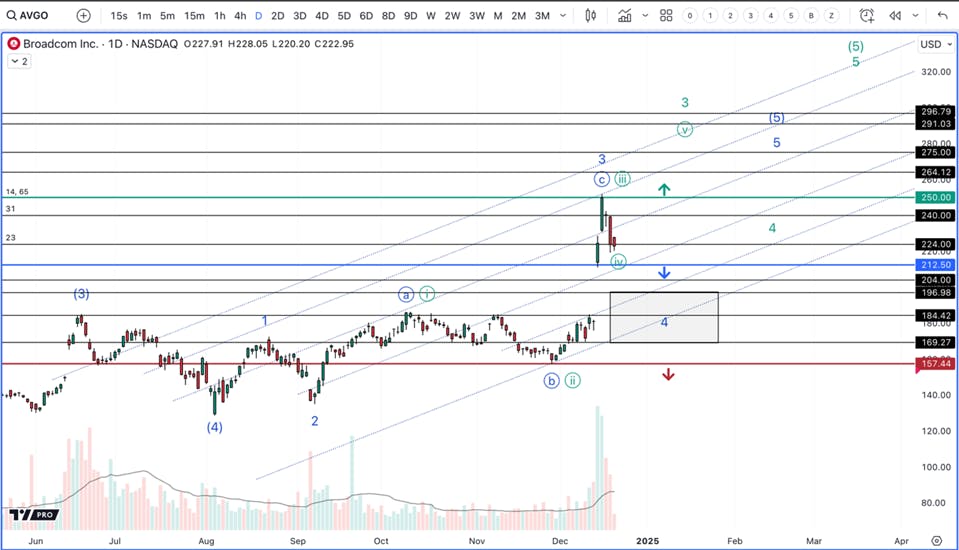
Broadcom’s stock surged 35% in two days despite a mediocre Q4, as management offered investors a picturesque addressable market forecast for 2027. Q4 was not the blowout report the market made it out to be, as Broadcom fell just short of revenue estimates while guiding Q1 barely above consensus. Despite this, the market did solidify that momentum continues to build for AI stocks entering 2025.
Broadcom’s commentary on the call as to the serviceable addressable market for its two leading AI segments, custom silicon and networking, is why the stock moved a whopping 25%. As a reminder, a serviceable addressable market refers to market size the company can service, and is not a forecast of the company’s revenue. While Broadcom gave investors a reason to dream, it’s not the stock’s ‘Nvidia moment’ despite the surge in the stock price resembling Nvidia’s 2023 breakout. Instead, Broadcom is reporting flat QoQ AI revenue with the 200% year-over-year number being old news (Broadcom had guided for $12B in AI revenue in Q3 and only marginally beat that figure).
Among the AI titans, Broadcom is the one of the only stocks to see lumpy AI growth, reporting flat AI revenue growth from Q2 to Q3 – with expectations it remains at a mere 3% QoQ growth to start fiscal 2025. This occurred roughly a month before tariffs are likely to affect its top customer – Apple.
Below, I provide data that shows the move in Broadcom’s stock was premature, creating outsized pressure on Broadcom to live up to AI juggernaut Nvidia in 2025, which is unrealistic given Broadcom has only ~25% of revenue from AI versus 80% of revenue from Nvidia. When you factor in 30%+ of Broadcom’s revenue comes from China, versus Nvidia at 15% for China exposure, what you have is an upside down scenario for Broadcom where tariffs could negatively impact more revenue than what AI is currently providing.
Sign up for I/O Fund’s free newsletter with gains of up to 2600% because of Nvidia’s epic run – Click here
A Tantalizing Forecast for Broadcom’s AI Opportunity
The Street is desperate to find the next Nvidia in the vast and complex sector of semiconductors and hardware providers. There were many raises/beats across AI-related semiconductors, including from many small, lesser-known names. Meanwhile, Broadcom’s report was one of the least spectacular as there was a very rare miss for Q4 revenue and a Q1 guide that was only $30 million above consensus.
Growth is challenged sequentially, with Q1 only set to grow 4% QoQ. Semiconductor revenue was seen declining nearly -2% sequentially as well, with management guiding for $8.1 billion in Q1 versus $8.23 billion in Q4. AI revenue was not much of a surprise either, as Broadcom had guided for full-year AI revenue of $12 billion in Q3, coming in not even 2% above the guide.
To offset the lackluster performance, the management team painted a picture for AI revenue growth to scale quickly with a tantalizing addressable market forecast for 2027.
Here’s what CEO Hock Tan said that energized the stock:
“We currently have three hyper-scale customers who have developed their own multi-generational AI XPU roadmap to be deployed at varying rates over the next three years. In 2027, we believe each of them plans to deploy 1 million XPU clusters across a single fabric. We expect this to represent an AI revenue Serviceable Addressable Market, or SAM, for XPUs and networking in the range of $60 billion to $90 billion in fiscal 2027 alone.
We are very well positioned to achieve a leading market share in this opportunity and expect this will drive a strong ramp from our 2024 AI revenue base of $12.2 billion. Keep in mind though, this will not be a linear ramp.”
Tan also added that Broadcom was in advanced development with two additional hyperscalers, rumored to be ByteDance and OpenAI, with possibilities to turn both into revenue generating customers before 2027.
The comments the ramp will not be linear likely refers to the ramp being back-half weighted, with the majority of revenue being recognized between 2026-2027. On the call, it was mentioned that its 3nm custom silicon will ship in the second half of 2025. Meanwhile, Broadcom is trading at an astronomical valuation that is higher than Nvidia’s.
In fact, Broadcom is up against its toughest year yet as Nvidia’s Blackwell systems are set to raise the bar competitively with custom silicon as powerful Blackwell systems combining 36 CPUs and up to 72 GPUs ship in volume in Q1 with a bigger ramp in Q2 of 2025. The 72 GPUs in the NVL72 will be used as a single accelerator for 1.4 exaflops of AI compute power. Nvidia’s proprietary NVLink Switch will reach 130 TB/second, which is “more than the aggregate bandwidth of the internet.” Outside of narrow use cases, custom silicon will not be able to compete with Nvidia in 2025, whereas in future years, custom silicon may have more of an opportunity to catch up. For example, when comparing with Nvidia’s 2023-2024 Hopper generation, Amazon’s Trainium2 instances with 100,000 processors “equals around 32,768 Nvidia H100 processors,” according to Tom’s Hardware. This helps to paint a picture as to why custom silicon revenue for Broadcom is at a low $300 million per quarter in custom silicon revenue compared to Nvidia’s $27 billion per quarter on GPUs (removing the $3 billion Nvidia makes in networking from the data center segment).
Going back to the comment of a $75 billion serviceable market by 2027, at the midpoint – let’s put this opportunity in perspective. For 2024, Broadcom reported AI revenue of $12.2 billion, up 220% YoY from $3.8 billion in 2023. As stated, this was guided in Q3 and was not a beat/raise or news to anyone who covers the stock.
CEO Hock Tan said he believes Broadcom’s current serviceable AI market is worth $15 billion to $20 billion this year, suggesting that Broadcom commands approximately 70% market share at the midpoint of that range.
Broadcom serves two major markets in AI – custom accelerators which Broadcom is referring to as XPUs, and networking and switches, ripe with competition from Nvidia, Arista, Cisco, and others.
It will certainly not be a straightforward path for Broadcom to maintain what it sees as a 70% share of these addressable AI markets. Nvidia is arguably a strong contender in networking with InfiniBand and is moving into ethernet with Spectrum-X, while there are many other networking suppliers involved with Broadcom’s hyperscale customers. As pointed out by the CEO regarding the serviceable addressable market: “There’s room for many players. All we are going to do is gain our fair share.”
Assuming Broadcom can reach 60% share at a $75B addressable market size, that correlates to approximately $45 billion in AI revenue in 2027, or nearly 3.7x growth over the next three years. In other words, that would require AI revenue growth of ~55% annually through 2027. While hyperscaler capex definitely supports such a ramp, this growth pales in comparison to the numbers Nvidia has been putting up. Meanwhile, Broadcom does not have the moat that Nvidia has, which I pointed out five years ago is the CUDA development platform.
Nvidia is currently on track for approximately $114 billion in data center revenue in fiscal 2025, up 140% YoY and up 661% from fiscal 2023. In fiscal 2027, Nvidia is expected to generate nearly $220 billion in data center revenue, or nearly 8x higher than Broadcom’s AI revenue estimate of $29 billion. This would be about 36% of revenue at the consensus estimate for $80 billion, which pales in comparison to the 80% range Nvidia has, and AI server makers, with one expected to see up to 40% of revenue from AI next year.
The I/O Fund previewed Nvidia’s path to a $200 billion data center segment in May 2024 for its free newsletter readers for gains of 39% since then, and gains of 2,550% since first calling out Nvidia’s AI GPU thesis and CUDA moat in November 2018. Premium members receive real-time trade alerts and analysis on numerous other AI data center beneficiaries. Learn more here.Nvidia’s path to a $200 billion data center segment in May 2024 for its free newsletter readers for gains of 39% since then, and gains of 2,550% since first calling out Nvidia’s AI GPU thesis and CUDA moat in November 2018. Premium members receive real-time trade alerts and analysis on numerous other AI data center beneficiaries. Learn more here.
Broadcom’s AI Revenue at a Glance
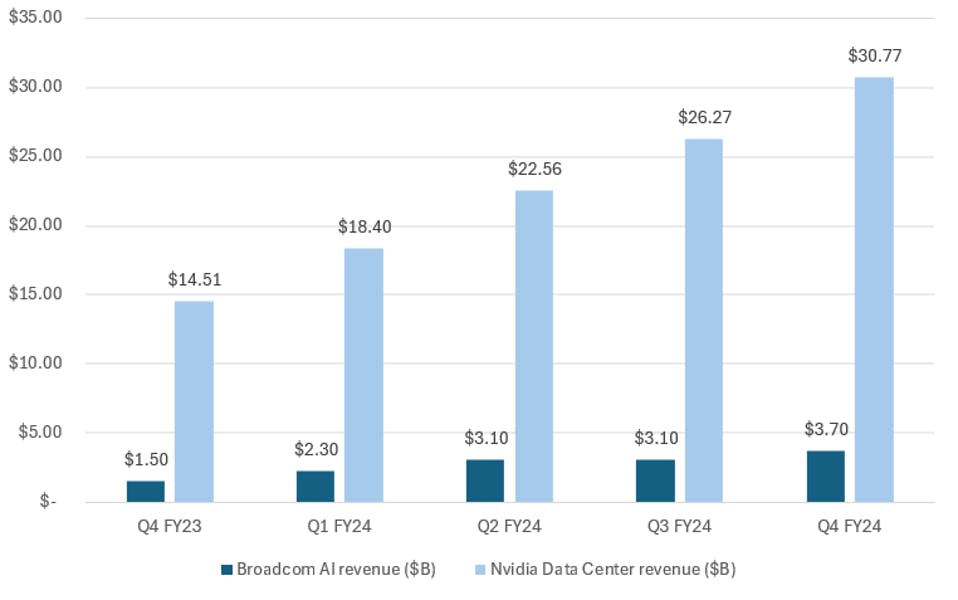
Broadcom capped off fiscal 2024 with nearly 150% YoY growth in AI revenue to $3.7 billion, with networking the primary contributor. QoQ growth was ~20% in Q4, rebounding from flat QoQ growth in Q3; however, Q1 is expected to see QoQ growth decelerate to the low single-digits.
Here’s what Broadcom’s quarterly AI revenue growth has looked like:
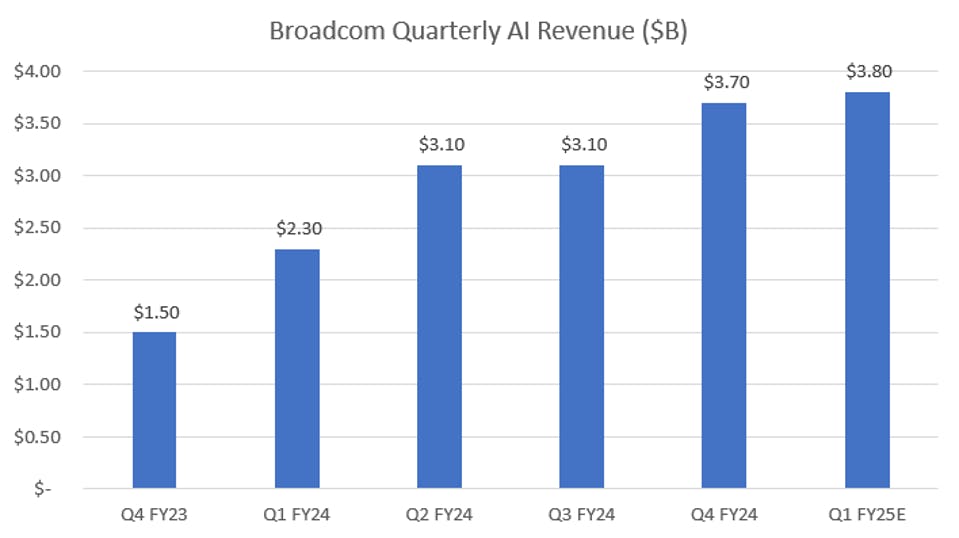
The non-linear, bumpy ramp the CEO referenced is quite visible – sequential growth was flat in Q3, and for Q1, management’s guide for $3.8 billion in AI revenue points to sequential growth of under 3%. Meanwhile, Nvidia has grown data center revenue by $4 billion sequentially for four consecutive quarters – Nvidia’s sequential growth alone more than outpaces Broadcom’s total quarterly AI revenue.
For Q4, management said that they saw growth from both AI accelerators and networking, though not at the same rate. Networking component shipments were much higher in the back half of the year, with this strength continuing into the first half of next year. Management provided some additional growth figures for AI networking, with revenue up 158% YoY, driven by 4x growth in AI connectivity revenue from Tomahawk and Jericho shipments. AI networking contributed 76% of networking revenue, implying AI networking revenue of ~$3.4 billion, and custom accelerator revenue of ~$300 million in Q4.
While custom accelerator accounted for just a small portion of AI revenue in the quarter, management foresees strong growth in the second half of 2025. Broadcom is set to begin and quickly ramp shipments of its next-gen 3 nanometer AI ASICs to hyperscaler customers in the second half of the year.