

This article was originally published on Forbes on Jan 27, 2023,12:17am EST
Ad-tech stocks across the board had a tough year last year. Investors are hoping that 2023 will be a better year, yet according to the projected ad spend for 2023, this may not be the case.
It’s clear that lower ad budgets in 2022 affected nearly every ad-tech stock, including companies that own large audiences, such as Alphabet and Meta. It did not matter if an advertising company has audiences as large as 2 billion or more, runs large R&D departments that can leverage AI, or is centered in the leading media growth trend of connected TV (CTV) ads. Broadly speaking, because ad spend budgets were slashed on a year-over-year basis, this one, single headwind caused 50% to 80% selloffs across the advertising industry. Therefore, it’s prudent to look at whether ad-tech budgets will increase this year or if 2023 will look more like 2022 in terms of top line growth.
Here’s What Happened to Advertising Stocks in 2022
The stock market of 2022 was hectic, and the blowoff top in 2021 is primarily blamed for this. However, irrespective of the stock market’s performance in 2021, the global economy and the United States economy is in a slowing growth environment.
Here is a quote from Insider Intelligence published in November:
“Total digital ad spending worldwide will not grow as robustly over the next two years as we expected in our Q1 forecast. We now project 2022 digital ad spending worldwide to reach $567.49 billion, up 8.6% over 2021. In our previous forecast, we expected 15.6% growth to $602.25 billion. Our Q1 forecast predicted digital ad spending worldwide would reach $756.47 billion by 2024, but we now expect it to reach only $695.96 billion.
The key words here are “will not grow as robustly as we expected.” Stock investors get trapped when growth slows and forecasts come down mid-year. This is because not only must stock valuations contend with a growth rate cut in half (8.6% versus 15.6%) — but analysts must also try and figure out when a bottom will form on the slowing growth. Most will lean conservative, which pushes valuations down even further.
GroupM also lowered their forecast for 2022, from 8.4% to 6.5% (excluding US political advertising), and pure play digital advertising was cut from 11.5% to 9.3%.
Sign up for I/O Fund's free newsletter with gains of up to 221% - Click here
What to Expect for Ad Spend in 2023
According to the sources noted above, 2023 will not be the year of recovery for ad budgets. As of now, growth is expected to be lower than 2022.
Magna predicts that global advertising revenue will grow to $833 billion in 2023, or about 5% year over year, compared to 7% in 2022. GroupM is projecting 5.9% growth, or $856 billion in 2023 (excluding US political advertising), compared to 6.5% in 2022 (excluding US political advertising). Both of these 2023 estimates reflect downward revisions of 1.5% and 0.5%, respectively. Including US political advertising GroupM is projecting 7.8% for 2022 and 4.6% in 2023.
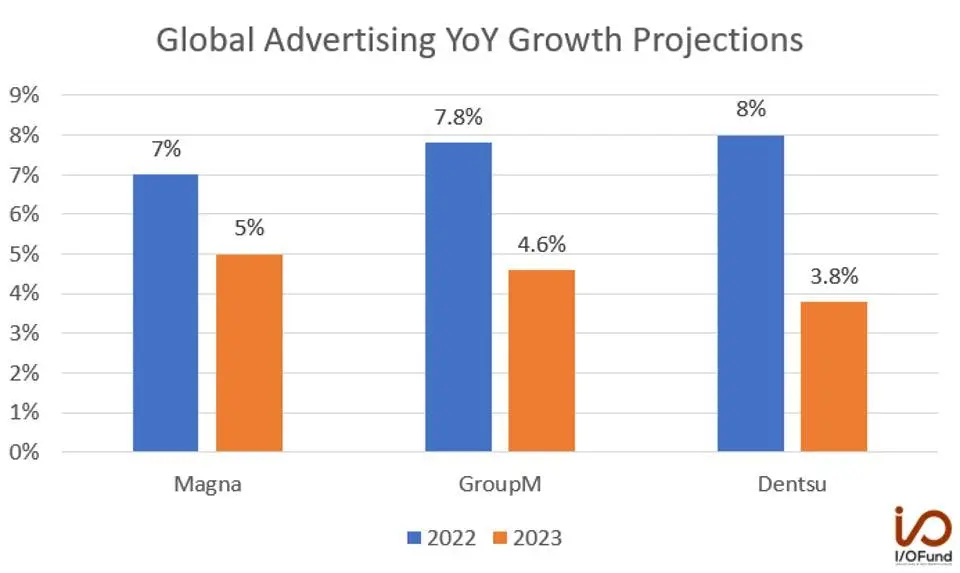
Source: Company Websites
According to Insider Intelligence, China will weigh heavily on 2023 numbers as the second-biggest digital ad market is expected to “post its lowest digital ad growth on record” due to “tougher regulations and economic headwinds.”
According to IAB, the U.S. advertisement market is expected to grow by 5.9% in 2023, which is lower than the 9% growth seen in 2022. The slowdown in growth is the direct result of the challenging macro environment.
On a brighter note, the CTV market is expected to grow 14.4% in 2023 and will grow faster than the overall advertisement market. They forecast Linear TV spending to see a drop of (6.3%). Across the advertising channels, digital video, including CTV, is expected to have the highest share of 22.4%, up from 19.3% in 2022.
There are also positive comments from other ad-tech companies on CTV. Hunain Khan, Director, Programmatic CTV supply at Xandr said, “2023 marks a new age of CTV, due to the increased amount of available premium inventory through AVOD platforms.”
Similarly, Hitesh Bhat, Director, CTV/OTT, EMEA at PubMatic said, “2023 will be an interesting year for CTV in Europe, but I’m avoiding “the year of CTV’ hyperbole. The ad-funded opportunity will grow significantly with the entrance of huge players such as Netflix, Disney+, Paramount+ and the combined HBO/Discovery+ offering. I think Netflix and Disney will be careful in terms of ad loads, so as not to annoy viewers who are still also subscribers.
The Dentsu ad spending report forecasts that global advertising spending in 2023 to increase by 3.8% YoY to $740.9 billion. It is lower than the 8% expected growth for 2022 and the 19.6% growth reported in 2021. The forecasts have been slashed from the July report, which projected a growth of 5.4% for 2023. Some of the reasons mentioned in the report for the slowdown include rising inflation, interest rates, recessions, and political uncertainty. The report suggests that if we exclude the media price inflation, ad spending is forecasted to drop (0.6%) in 2023.
The Americas region is expected to grow 3.7% YoY to $339.1 billion, the EMEA region to grow 3.8% YoY to $156.7 billion, and Asia Pacific is forecasted to grow 4% to $245.1 billion.
Digital ad spending is expected to grow 7.2% YoY to $422.8 billion. It is down from 13.7% expected growth in 2022. Digital ad spending accounted for 57.1% of all advertising spending in 2023. The share is expected to increase to 59.5% in 2025.
According to Insider Intelligence, digital ad spending is expected to grow 10.5% in 2023 from the expected 8.6% in 2022, both of these estimates reflect downward revisions of 2.6% and 7%, respectively.
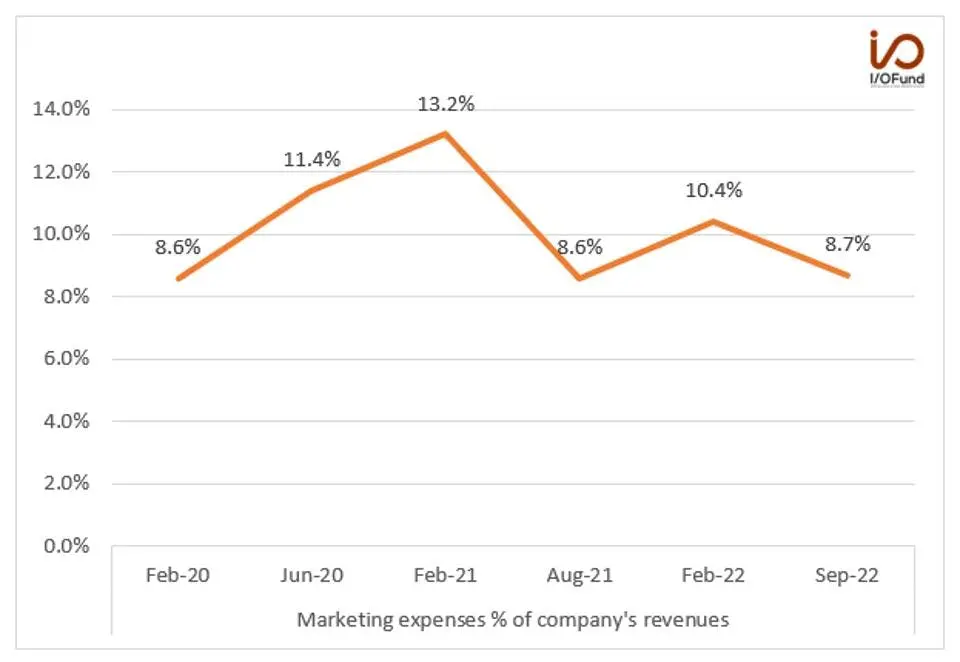
The CMO survey done in September 2022 showed that the marketing spending increased by 10.4% in the previous one year for marketers. However, they predict that the growth will slow down in the next one year to 8.8% and will start trending toward the pre-Covid level of 5.8%.
A majority of the companies say that the inflationary pressures are decreasing marketing spending levels. Marketing leaders in large companies report marketing spending reduction due to inflation and on the other hand, marketers in the smallest companies report an increase in marketing spending. The survey also suggests that the marketing expenses as a percentage of total revenue have reverted to the pre-Covid levels, as seen in the below chart. It reached a high of 13.2% in February 2021 to 8.7% as per the September 2022 survey.