Arm Stock Could Win as Agentic AI Shifts the Bottleneck to CPUs
April 02, 2026
Beth Kindig
Lead Tech Analyst
Earlier this month, Arm unveiled an AGI CPU to address one of AI’s biggest bottlenecks, which is orchestration. During the chatbot craze of 2023-2025, GPUs did most of the heavy lifting while CPUs had become an afterthought. Yet with agentic workloads, which is perhaps the single largest catalyst on the horizon for the AI trade in 2026 and beyond, the importance of CPUs is set to increase.
In agentic workflows, the GPU still handles inference, but between each inference call, the CPU is doing the orchestration - which are best described as handling tool calls, API requests and memory tasks. AI agents are surfacing this new constraint, which is how to prevent latency and underutilized GPUs following the exponential growth of orchestration needs.
For investors, what matters is that CPUs account for 50% to 90% of total latency in workflows, which means the CPU-to-GPU ratio in AI clusters will need to increase. Earlier this year, both AMD and Intel saw analyst upgrades based on the outstripped supply of CPUs leading to higher average sales prices of roughly 10% to 15%. Reuters also reported that Intel’s unfulfilled orders are reaching longer than six months while AMD delivery times are believed to be eight to 10 weeks.
Regarding how Arm fits in, the company’s expertise in lowering power requirements could matter more than the market expects. After years of supplying the architecture IP behind other companies’ CPUs, Arm is preparing to directly compete with its customers and x86 CPU competitors by transitioning to a chip designer themselves. This comes during a time when CPU cores are expected to go up 4X from 30 million CPU cores per gigawatt to 120 million CPU cores per GW.
Brief History of Arm
We covered Arm two years ago in our free newsletter, Arm Stock: AI Chip Favorite Is Overpriced, and how its mobile background and power-efficient focus positioned it well for increased AI adoption.
Arm offers the most popular CPU architecture in the world with more than 350 billion chips shipped since its inception, with the company essentially building a monopoly in the mobile CPU market with 99% market share stemming from its ‘heterogenous compute’ design and RISC architecture.
This design helped facilitate lower power requirements as the architecture allows different CPU parts to work together for improved efficiency, with workloads to be allocated across both high-performance and low-performance CPU cores to lower energy by balancing performance.
Arm is translating this expertise in power efficient chips to the data center, powering both Nvidia’s Grace and Vera CPUs, as well as custom CPUs from Amazon, Google and Microsoft. For example, Google says its Axion CPUs can offer up to 65% better price-performance and 60% better energy efficiency versus x86 alternatives, while Microsoft’s Cobalt 100 and Amazon’s Graviton4 CPU both have shown significant performance and price-performance advantages over competing x86 products.
The Role of CPUs in Agentic AI and the Coming 4X Increase in CPU Cores
Agentic AI represents a natural evolution from the query-and-response based nature of chatbots, to a more complex system capable of running dozens of different tasks and tools autonomously to reason through a problem and provide a response.
As a result, CPUs will play a more integral role in agentic and multi-agent systems to help solve how the system will schedule dozens of concurrent API requests and tool calls across independent agents, as quickly as possible with minimal delay. This is the orchestration constraint: how dozens of agents can make hundreds of concurrent requests needed to complete their independent workflows without causing significant latency or GPU underutilization.
Multi-agent systems are also expected to drive an exponential increase in token generation, which Arm estimated at up to a 15X increase in tokens per user, due to the increase in tool calls and API requests associated with each agent. This is expected to drive CPU core demand much higher, at a time where key x86 suppliers AMD and Intel battle growing supply constraints.
Arm CEO Rene Haas detailed at the company’s latest ‘Arm Everywhere’ event that a typical AI data center of today will feature around 30 million CPU cores per GW. Solving the flow bottlenecks of agentic inference will require “CPUs near the head node, CPUs next to the accelerator rack, more CPU racks inside the data center,” driving CPU core demand as much as 4X higher to 120 million cores per GW, per Haas.
CPU-Centric AI Systems
We are seeing evidence of how agentic AI and the importance of CPUs are beginning to affect incoming architecture designs. If you did not catch last week’s free stock newsletter, Nvidia Stock Prediction: The Path to a $20 Trillion Market Cap is Strengthening, I want to relay the importance of one sentence: “The goal is no longer to simply sell faster and more powerful chips, but to deliver superior economic value at the system level relative to custom silicon (in other words, let the battle begin).”
Think of the Groq LPX racks that cost Nvidia a record-breaking $20 billion that it is soon deploying, addressing the memory-intensive decode phase of inference to significantly accelerate token throughput. This system-level focus is now moving to CPUs, with Nvidia pivoting to deploy its Grace and Vera CPUs as standalone racks. Nvidia says that when “paired with Rubin GPUs as a host CPU, or deployed as a standalone platform for agentic processing, Vera enables higher sustained utilization by removing CPU-side bottlenecks that emerge in training and inferencing environments."
Arm’s big announcement was not just that it was launching its first in-house silicon and CPU rack platform, but that it will now be directly competing on the standalone CPU system side. Arm’s foray into the standalone rack market offers a new choice for hyperscalers and data center operators to seamlessly deploy CPU-centric racks alongside GPUs, customize the CPU-to-GPU ratio to optimize for agentic orchestration and enable power-efficient AI inference at scale from start to finish. It will also provide another outlet to avoid vendor-lock in to Nvidia’s ecosystem with both air-cooled and liquid-cooled CPU racks.
Key Advantages of Arm’s ‘AGI CPU’ for Agentic AI Workloads
Arm also marked its long-awaited foray into physical chip development with its ‘AGI CPU’, launched at its Arm Everywhere event last week. The company’s pivot into physical CPU and rack development is one the AI industry will watch with great anticipation given Arm’s history of owning significant IP in the mobile space combined with the company setting out to solve agentic AI’s orchestration challenges.
Leveraging Arm’s history of delivering high performance with low power requirements for mobile devices, the new AGI CPU is designed to offer a similar balance between high performance and low power consumption.
The AGI CPU was co-developed with key partner Meta, the chip’s first customer, who revealed they turned to Arm almost two-and-a-half years ago to see if there was a CPU option that fit Meta’s needs: “put in a lot more cores per watt, but we do not want to compromise on the performance piece.” Meta had only been finding options satisfying one of the two criteria: meeting the performance but with too much power, or meeting the power but with too little performance.
2X Performance of x86 and Record CPU Rack Density
The new CPU features up to 136 of Arm’s highest-performing Neoverse V3 cores, drawing just 300W of power in a single-unit (1U) dual-node server (blade) featuring two chips. This compares to x86 chips, such as AMD’s fifth-gen EPYC CPUs, which deliver 128 to 192 cores per chip but at 390W to 500W in a two-unit (2U) rack.
In an air-cooled rack, Arm can pack 30 blades (or 60 CPUs) for a total of 8,160 cores in a 36kW power envelope, saying this configuration can deliver up to 2X the performance per rack versus x86 chips based on its internal estimates. Arm says this 30-blade design is “setting records for air cooled” racks that is not feasible with other systems, as power consumption is too high.
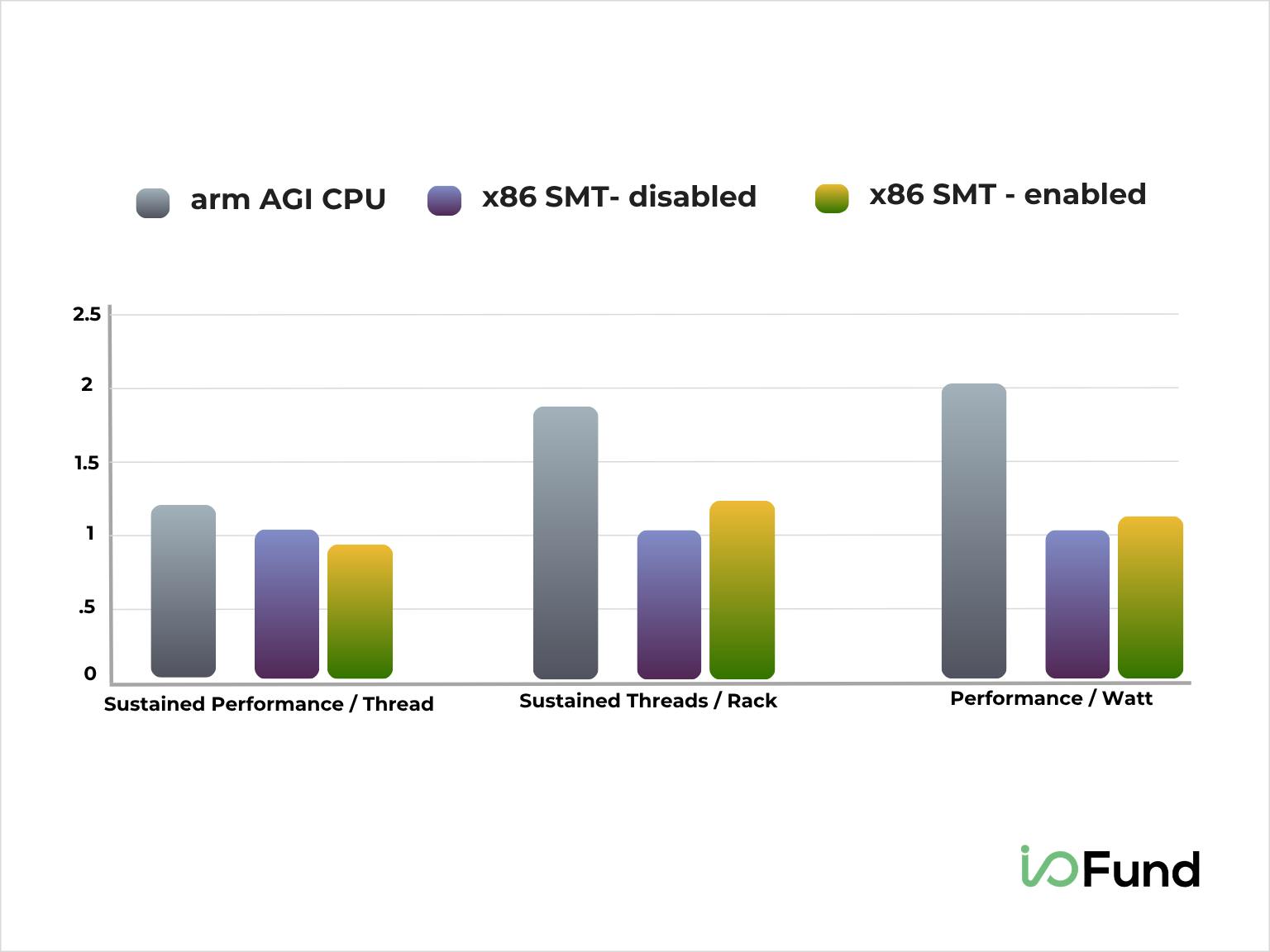
Comparison of sustained AI workload performance shows Arm’s AGI CPU outperforming x86 CPUs (with and without SMT) in performance per thread, total threads per rack, and performance per watt -- highlighting Arm’s efficiency advantage for agentic AI orchestration. Source: Arm
Arm is taking this a step further with a fully-liquid cooled, 200kW open-standard rack in partnership with Super Micro, packing 168 blades, or 336 CPUs, delivering a total of up to 45,696 cores. Arm EVP of Cloud AI Mohamed Awad stated that while it is a “200-kilowatt rack. We actually will consume about half that much power. We ran out of space. That’s why we couldn’t put more cores in there.”
This is one of the key advantages – it is not just about offering 2X the performance of x86 chips, but providing that performance boost while freeing up power for more compute or for more networking:
“So if you have a CPU that can draw less power, it could be just as performant, but use less power, it means you have more leftover for everything else that you want to do. That means more inference and more compute. That means more intelligence.”
mid
One Petabyte of Memory and Low-Latency Chip Design
However, Arm architected the new chip with other key optimizations in mind, notably on the memory side. The AGI CPU features 96 PCI Gen6 lanes with CXL 3.0 connectivity, which Arm says allows the new CPU to be attached to any accelerator of choice, allowing flexibility of deployments with Nvidia or AMD GPUs or custom chips.
The chip also features up to 6TB of memory, providing more than 1 petabyte (PB) of low-latency memory in the liquid-cooled 200kW rack. Arm is achieving this extreme low latency of <100 nanoseconds from memory via a dual chiplet design, with each chiplet having both the memory and I/O directly onboard to avoid multiple links across the silicon.
Arm says the new chip’s performance advantage over x86 could enable “up to $10B in capex savings per GW of AI data center capacity,” making it a compelling option for current and future agentic AI-optimized deployments to save money, save power and avoid Nvidia-lock in from its accelerator-agnostic nature.
Looking beyond AMD and Intel, Arm’s in-house design may also outperform Nvidia’s design based on Arm’s IP as the AGI CPU offers a step up in core count and memory at the rack level versus Nvidia’s Vera CPU, despite Vera running on custom Arm ‘Olympus’ cores.
Nvidia says the Vera CPU rack features 256 CPUs, each packing 88 cores for a total of 22,528 cores across the rack; this offers 45,056 threads with multi-threading. Vera racks will also offer up to 400 TB of memory capacity with 315 TB/s of memory bandwidth with PCIe Gen 6 lanes and CXL 3.1 connectivity, whereas Arm offers 2.5X the capacity though just ~274 TB/s of bandwidth at 6GB/s per core.
Quantifying the Impact of CPU-Optimized Agentic AI
Arm’s executives provided some initial commentary about long-term growth projections, seeing the new CPU as a rather lucrative revenue opportunity by the turn of the decade.
Arm expects the AGI CPU to generate $1 billion in revenue in fiscal 2027 and 2028 (June 2026 to March 2028), with the first generation of the AGI CPU now available and ramping further in 2H.
Arm outlined a second generation of the chip tentatively on deck for 2027, likely contributing to some of the revenue generation in 2028 and beyond. On a broader long-term view, Arm estimates the AGI CPU line could generate $15 billion in revenue in 2031, or ~60% of its 2031 revenue target of $25 billion, with a third generation potentially launching before then, though Arm provided no timeline for that chip.
This represents around a 15% share of what Arm believes will be a $100 billion TAM for data center CPU. This is a higher TAM than what Nvidia CEO Jensen Huang discussed at GTC, saying: “I'm not expecting CPUs to be that much and call it because CPUs just don't add up to much, okay. And so you could say CPU is another 5%” – or around a $50 billion TAM on $1 trillion.
The challenge in scaling from a fresh launch to $15 billion in revenue in a matter years is definitely doable, considering the current pace of capex growth and tens of billions in AI accelerator revenue flowing to Nvidia, AMD and Broadcom each quarter. However, the path ahead is not free of challenges, as Arm must still compete against Nvidia’s new standalone deployments, as well as the custom Arm-based CPUs hyperscalers have already built – Amazon’s Graviton, Google’s Axion, and Microsoft’s Cobalt.
Financials
Arm’s Financials Offer Superior Gross Margins
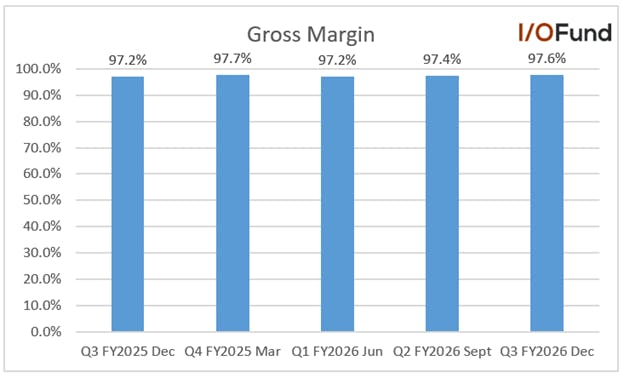
Arm has a profitable business model that constitutes licensing revenue and royalty revenue. The company reported a strong gross margin of 97.6% in Q3 FY2026 ending December.
Arm’s gross margin has remained consistently near 98% over the past five fiscal quarters, underscoring the strength and durability of its high‑margin licensing and royalty business model. Source: Company IR
Arm reported a GAAP operating margin of 14.9% and an adjusted operating margin of 40.7% in the recent quarter. The difference between adjusted operating margin and GAAP operating margin is that the company is a recent IPO and has high stock-based compensation of $285 million or 23% of revenue.
ACV Grew by 28%
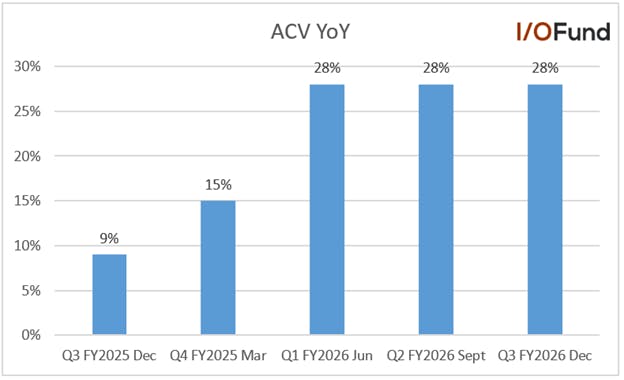
The company’s licensing and other revenue grew by 25% YoY and down (2%) QoQ to $505 million in FQ3. The revenue growth decelerated from 56% YoY and 10% QoQ growth in the previous quarter. Licensing revenue has been lumpy, and management mentioned on the earnings call that it varies quarter to quarter due to the timing and size of high-value deals. So, annualized contract value or ACV is considered a key indicator of the underlying licensing trend. ACV grew by 28% YoY and 1% QoQ to $1.62 billion in FQ3. ACV grew by 28% in the past three quarters.
Arm’s annual contract value growth accelerated from single‑digit levels in FY2025 to a sustained 28% year‑over‑year pace through FY2026, signaling strengthening demand and improved visibility in its core licensing business. Source: Company IR
AGI CPU Could Become a $15 Billion Revenue Line by FY2031
Arm is launching its own chip which will help the company grow revenues and profits. The company expects more than $1 billion in revenue from this business over the next two years with the majority of revenue to be recognized in FY2028 ending March.
Arm expects an exponential ramp to $15 billion in revenue in FY2031. The strong growth is primarily driven by solid demand and the increasing complexity of chips will lead to a significant rise in average selling prices. Gross margins are expected to be at least 50% and the adjusted operating margin of over 30% for the chip business.
The company’s licensing and royalty revenue is expected to be $10 billion in FY2031 ending March, with a gross profit margin of 99% and over 65% adjusted operating margin. Management increased this long-term adjusted operating margin guidance by 500 basis points.
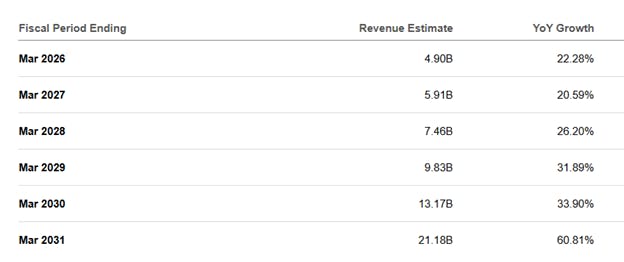
The company’s total revenue in FY2031 is expected to be $25 billion and adjusted EPS is expected to be over 9. The current consensus revenue estimates for FY2031 of $21.18 billion and adjusted EPS of $8.39 are lower by 18% and 7.3%, respectively.
Consensus revenue estimates project Arm’s revenue to grow from $4.9 billion in FY2026 to $21.2 billion by FY2031, with year‑over‑year growth accelerating sharply in the later years, reflecting expanding licensing, royalty, and AGI CPU contributions. Source: Seeking Alpha
Royalty Revenue Is Entering a Sustained 20% CAGR Phase
The company’s royalty revenue has grown at about a 14% CAGR in the past five years. It has accelerated to over 20% in the past two years as Armv9 and Compute Subsystems (CSS) have started to ramp. Looking forward, management expects that the royalty revenue Compound Annual Growth Rate (CAGR) will be 20% over the next five years. The company’s royalty rates have doubled from Armv8 to Armv9 architecture, and again to CSS.
Valuation
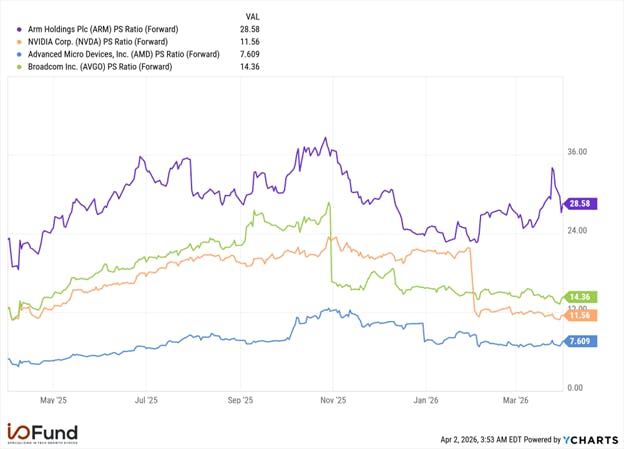
Arm is currently trading at a P/S ratio of 36.3 and a forward P/S ratio of 28.6. The company is trading significantly higher than its other semiconductor peers like Broadcom’s forward P/S ratio of 14.4 and Nvidia’s forward P/S ratio of 11.6.
The company’s revenue growth is expected to accelerate in the next five years compared to the previous period. The company’s revenue CAGR has been 19.3% from FY2021 to FY2026E. Analysts expect revenue to grow at a CAGR of 34% from FY2026E to FY2031E and will be even higher at 38.5% if we use the $25 billion management guidance. However, when looking at the AI segment of many semiconductor peers, the growth rate does not stand out, per se, to justify the high valuation. Rather, the consistency of licensing and royalties' revenue does stand out, and this recurring revenue will create a nice baseline when you combine higher growth from their merchant CPUs.
Arm’s forward price‑to‑sales multiple has remained elevated over the past year, with the forward P/S above 30x, reflecting strong expected future revenue growth. Source: YCharts
Cash Flows
The company’s cash flows have been lumpy due to high working capital and high capex to support the long-term growth. However, with the expected strong future profit growth, the cash flows should improve. The company also has a strong balance sheet with cash & short-term investments of $3.54 billion and no debt.
Conclusion:
Arm may be a right place-right time stock, to where the years where Arm sat uneventful compared to peers could payoff as they are more prepared to aggressively compete in the AI market. The valuation is an unknown, and an important aspect given merchant CPU revenue will take time to scale.
To offset this, Arm offers consistent (and rare) recurring revenue, strong margins and far less speculation than, say, an AI software stock that must invest heavily to remain competitive and prove they can build user traction. Instead, Arm offers decades of IP excellence, a 99% penetration in mobile, all while its x86 competitors like AMD and Intel struggle to keep up with their growing backlogs.
The AI trade has been in question lately, yet when the market regains confidence in AI again, Arm will undoubtedly be part of a select, core AI semiconductor pack positioned to deliver for the long haul.
Since our inception in May 2020, I/O Fund has delivered a cumulative return of 326%— if we were a hedge fund, we’d rank #1 and if we were a tech ETF or Mutual Fund, we’d rank #3 in the United States. To get our Top 15 AI stocks, real-time trade alerts, and weekly 1-hour webinars from a proven team in AI and tech stocks, sign up now.
Please note: The I/O Fund conducts research and draws conclusions for the company’s portfolio. We then share that information with our readers and offer real-time trade notifications. This is not a guarantee of a stock’s performance and it is not financial advice. Please consult your personal financial advisor before buying any stock in the companies mentioned in this analysis.
Recommended Reading:
More To Explore
Newsletter
Arm Stock Could Win as Agentic AI Shifts the Bottleneck to CPUs
Arm unveiled an AGI CPU to address one of AI’s biggest bottlenecks, which is orchestration. During the chatbot craze of 2023-2025, GPUs did most of the heavy lifting while CPUs had become an afterthou
Nvidia Stock Prediction: The Path to a $20 Trillion Market Cap is Strengthening
The $20 trillion market cap will not come from GPU unit growth alone, though unit growth remains very important. Rather, the value proposition will increasingly focus on economic output. This marks a
Nvidia Stock to See New Growth Catalyst; 35X Faster AI with Groq 3 LPX
At GTC this week, Jensen Huang stated the revenue opportunity for Nvidia’s artificial intelligence chips may reach at least $1 trillion through 2027, up from a previous target of $500 billion. While t
Palantir Stock is Out of Favor, but is the Growth Engine Still Intact?
Palantir stock sold off 38% from November to February and is down about 10% year-to-date. Even so, it has held up better than many software peers given the software sector has taken it on the chin lat
“Tech Bubble” Warnings Cost Investors a 550% Nasdaq-100 Run
Investors have been hearing “tech bubble” warnings for more than a decade — but instead of collapsing, the Nasdaq‑100 has gained 550%. If we look back ten years ago to 2015, headlines such as “Sell ev
My Top 2026 Stock Pick for the AI Boom
The market is fixated on when Big Tech will generate economic value from the $650 billion+ being poured into AI data center expansion annually. The market is missing the point. Monetization has never
I/O Fund Jumps to 326% Cumulative Return, Ranking Among Wall Street’s Best
I’m pleased to share the I/O Fund’s audited 2025 return of 37%, bringing cumulative performance since our May 2020 launch to 326%. This represents a 294% lead versus popular tech ETFs and a 152% outpe
Bitcoin After the Cycle Peak: What Comes Next and How We’re Positioning
Bitcoin rarely rewards narrative-based investors for long. Time and again, it has shown a habit of reversing its dominant trend against the prevailing story of the moment. A large portion of the I/O F
S&P 500 Outlook 2026: Rising Volatility Risk and Key Support Levels
Since November 2021, when the equal-weight Mag 7 Index does not confirm a new high in the S&P 500, it has been a reliable signal of a weakening market environment. A similar divergence is occurring to
The Future of AI Stocks? TSMC Commentary Suggests AI Megatrend
TSMC is one of the least sensational management teams in the AI stocks space, yet management explicitly called AI a multi-year “megatrend” in their most recent earnings call, with demand now being pul