Blogs -Big Tech’s AI Revenue Is Surging, but Suppliers Will Still Be the Bigger Winners 

Big Tech’s AI Revenue Is Surging, but Suppliers Will Still Be the Bigger Winners 


August 06, 2026

author

Beth Kindig

Lead Tech Analyst

  • As analysts call for AI capex to hit $1 trillion in 2027, Big Tech showed strong progress on AI monetization in Q2. 
  • Despite strong increases for AI revenue un rates, Big Tech’s capex to AI revenue ratios remain elevated from 1.5X to 4X. 
  • Higher AI capex extends the demand tailwind for suppliers which have already seen earnings growth multiples higher than the market and hyperscalers. 

Big Tech is finally proving that AI can generate meaningful revenue. Azure, Google Cloud and AWS all accelerated in Q2, reaching tens of billions in dollars in annualized revenue. 

Meanwhile, as is well-reported by now – Google and Amazon have posted negative free cash flow in Q2, as capex continues to rise faster than the cash generated from these investments. As discussed in last week’s article AI Capex to Hit $1 Trillion – And Estimates Are Still Too Low, improving AI economics may not reduce spending, rather it could accelerate it to $7.6 trillion spent between 2026-2031.  

This creates a question the market will be debating for years - if AI monetization is getting better, then why are Big Tech’s cash flows getting worse? In other words, why can’t monetizing AI offset these investments? 

That is the kind of question that short sellers will salivate over, yet remember; short sellers are not the winners of the AI boom. Instead, the stock market winners have decisively been those who positioned in lesser-known suppliers. 

In the analysis below, we spell out this important dynamic for AI investors. And as the I/O Fund has done for years and years, we also connect the dots as to who the real AI beneficiaries will be.  

Cloud Growth Accelerates Across the Board in Q2 Driven by AI 

Last week’s Q2 earnings provided several important pieces of evidence that AI is driving cloud accelerations at Azure, Google Cloud and AWS, as AI run rates and key metrics continue to tick higher.  

Microsoft Azure Growth Accelerates as AI Demand Outstrips Capacity 

Starting with Microsoft, we noted in our Q2 Big Tech earnings preview that its AI business hit a $37 billion run rate in Q3 FY2026, up 123% YoY and a nearly 3X increase versus early 2025. Despite that, Azure had failed to accelerate with growth consistently sitting near 39%-40%.  

We noted that accelerating Azure growth would be key to beating expectations, and this is exactly what transpired. Azure accelerated to 43% growth, above guidance for 39-40%, with Microsoft expecting Azure to accelerate further to 45% growth next quarter.  

mid

Microsoft also disclosed that the number of Foundry customers operating at 1 trillion token run rates rose 4X YoY. Paid Copilot seats rose to 30 million, with net additions doubling QoQ. Microsoft also added $51 billion in commercial RPO, with no contribution this quarter from frontier labs, with the overall RPO figure hitting $678 billion, up 84% YoY. 

Google Cloud Growth Accelerates to 82% YoY 

Google also put up impressive growth metrics, with Google Cloud accelerating to 82% YoY growth. This was a sharp acceleration compared to 63% growth in the prior quarter, with growth also over 2.5X higher than the 32% YoY achieved in Q2 2025. Meanwhile, Cloud operating profit soared 214% YoY to $8.8 billion as operating margin expanded 1,490 basis points YoY and 270 basis points QoQ to 35.6%. Cloud backlog increased over $50 billion sequentially and 385% YoY to $514 billion. 

Additionally, as we recently noted in our latest piece on token processing, Google processed 3.2 quadrillion tokens in May, up 7X in one year and up a whopping 330X in two years. The company also said its first-party model token processing hit 22 billion per minute in Q2, matching Q1’s growth rate at a 6 billion increase sequentially. 

AWS Posts Fastest Growth in Over 4 Years, Chips + AI Run Rate Hits $50B Combined 

The trend of accelerating cloud growth continued with Amazon’s AWS, which marked its fastest growth rate in more than 18 quarters in Q2. Revenue increased by 36.7% YoY to $42.2 billion, more than double the 17.5% growth in Q2 2025, and a more than 8 point acceleration versus 28% in Q1. AWS operating income also rose 58.9% YoY to $16.6 billion, while operating margin expanded 630 basis points YoY and 160 basis points QoQ to 39.4%. 

In just one quarter, AWS’s AI business saw its annual revenue run rate increase from $15 billion to over $25 billion, growing triple digits YoY. Additionally, the run-rate of its chips business eclipsed $25 billion, also growing triple-digits YoY and 25% QoQ and led by its Trainium accelerators and Graviton CPUs. Combined, this represents a $50 billion run rate across chips and AI services, or 30% of AWS’s total $169 billion annualized run rate. 

Notably, CEO Andy Jassy said there is a “real chance” that Amazon will sell Trainium chips to third-party data centers in the future, opening the door to increase its chips run rate further as the company indicated in April that a third-party approach could’ve seen its run rate already hit $50 billion. 

Meta Advantage+ Reaches $75 Billion Run Rate Despite Slower Revenue Growth 

Of all the Big Tech reports, Meta was decidedly the least impressive growth-wise. Total revenue rose 28% YoY, decelerating considerably versus 33% in the prior quarter, while its Q3 guidance also implies a further deceleration to 22% growth.  

Still, this doesn’t mean that Meta isn’t seeing significant AI monetization. The company notes that its end-to-end AI-powered Advantage+ solutions hit a $75 billion annual run rate during the quarter. This marks a 16.7% increase versus Q3 2025, and a 3.75X increase versus Q4 2024. 

AI Capex-to-Revenue Ratios Are Sky High Across Big Tech 

Looking at quarterly AI revenue run rates versus capex as a simple barometer for AI ROI across Big Tech shows a marked improvement in ROI over the last two years, though run rates still lag capex by a wide degree. 

As noted above, AWS saw its AI services and chips businesses both hit a $25 billion run rate in Q2, or ~$6.25 billion per quarter each (assuming run rate is calculated quarterly). Combined, both AI-driven businesses would be contributing $12.5 billion in quarterly run rate revenue in Q2, versus capex at $53.1 billion, or a 4.25X capex to AI revenue ratio.  

Looking back to Q1 2024 when Amazon revealed it reached a multi-billion run rate for AI, and assuming this would be roughly $4 billion annualized or $1 billion quarterly, this would give a 13.9X capex to AI revenue ratio. This suggests AWS has meaningfully improved its AI ROI over the last two years as its AI businesses ramp despite quarterly capex scaling 4X from $13.9 billion to $53.1 billion.  

For Microsoft, no new update was given for its exact AI run rate in Azure, though extrapolating from FQ3’s update of reaching a $37 billion run rate projects FQ4’s run rate to be around the $45 billion range. This would correspond to quarterly AI revenue of $11.2-11.3 billion, giving a capex to revenue ratio of 3.64X this past quarter. Looking back to FQ2 2024 (ending Jan 2024), Microsoft’s AI run rate is estimated to be around $4.75 billion, or around $1.19 billion quarterly, while capex was $11.5 billion. This corresponds to a capex to AI revenue ratio of 9.75X.   

Unlike peers, Alphabet has not been very upfront with its AI run rate, though assuming AI contributed a similar proportion of YoY growth as Microsoft in Q2, this would roughly project Google Cloud’s AI run rate to be ~$47 billion, or ~$11.7 billion per quarter. This would correspond to a capex to AI revenue ratio of 3.84X. Looking back to Q2 2024 where Alphabet first disclosed its YTD AI revenue in the billions, and assuming this would be approximately $1.5 billion that quarter, this would give a capex to AI revenue ratio of 8.8X. 

For Meta, Advantage+ reached a $75 billion run rate, implying a quarterly run rate of $18.75 billion. Compared to Q2 capex of $31.1 billion, this corresponds to a capex to AI revenue ratio of 1.66X. Looking back to Q4 2024’s $20 billion run rate, or $5 billion quarterly, offers a capex to AI revenue ratio of 2.84X. 

Free Cash Flow Headwinds Mount as Infrastructure Spending Outpaces Revenue 

Prior to this earnings season, we published our two-part series on capex and free cash flows, Big Tech’s Free Cash Flow is Turning Negative – Who's Next?. In this, we discussed how capex growth was outpacing both operating cash flow growth and the scale of AI monetization, concluding that Big Tech was at high risk of going FCF negative this year and next.  

Q2’s reports showed this dynamic arise earlier than expected, as Google saw FCF go negative for the first time since its IPO, followed by Amazon the week after, while Meta held on by its fingertips this quarter.  

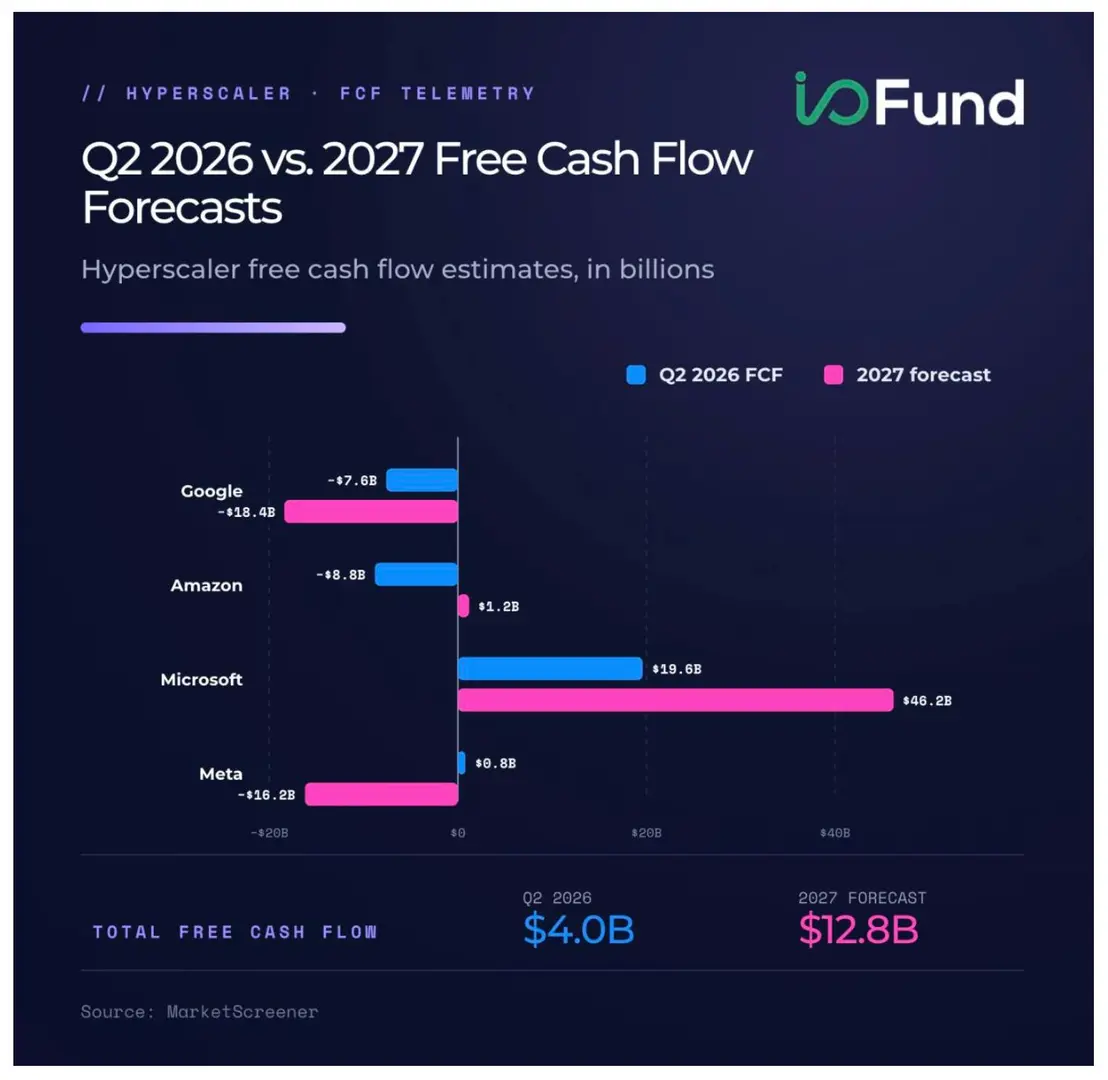
Looking ahead to 2027, FCF pressure remains, as both Google and Meta are forecast to see FCF drop deeper into negative territory with Amazon also on the brink of negative FCF. On the flipside, Microsoft is expected to be relatively well-insulated with FCF remaining resilient through next year at $46.2 billion estimated in 2027.  

Bar chart comparing Q2 2026 and 2027 free cash flow forecasts for Google, Amazon, Microsoft, and Meta. Microsoft's FCF rises to $46.2B in 2027, while Google and Meta are projected negative. Total FCF increases from $4.0B to $12.8B.

This chart compares Q2 2026 free cash flow (FCF) with 2027 forecasts across four hyperscalers. Microsoft is expected to remain the strongest cash flow generator, with FCF rising from $19.6B to $46.2B. Amazon improves from negative $8.8B to positive $1.2B. Google declines from negative $7.6B to negative $18.4B, while Meta falls from positive $0.8B to negative $16.2B. Combined FCF is projected to increase from $4.0B in Q2 2026 to $12.8B in 2027, driven primarily by Microsoft's growth. Source: MarketScreener; visualization by I/O Fund.

In Q2, Amazon put it rather bluntly to investors – short term FCF headwinds are necessary and being incurred as capacity must be built out to meet demand, but this is expected to create stronger long-term FCF growth once it hits the break-even point for servers. 

Semiconductor and Hyperscaler Earnings Growth Is Rapidly Diverging 

As hyperscalers spend massive sums on AI capex, I/O Fund’s strategy has centered around investing in the companies that are receiving that cash rather than those spending it. Looking at the growth of semiconductor earnings versus hyperscalers and the overall market provides strong validation as to why we have taken this approach.  

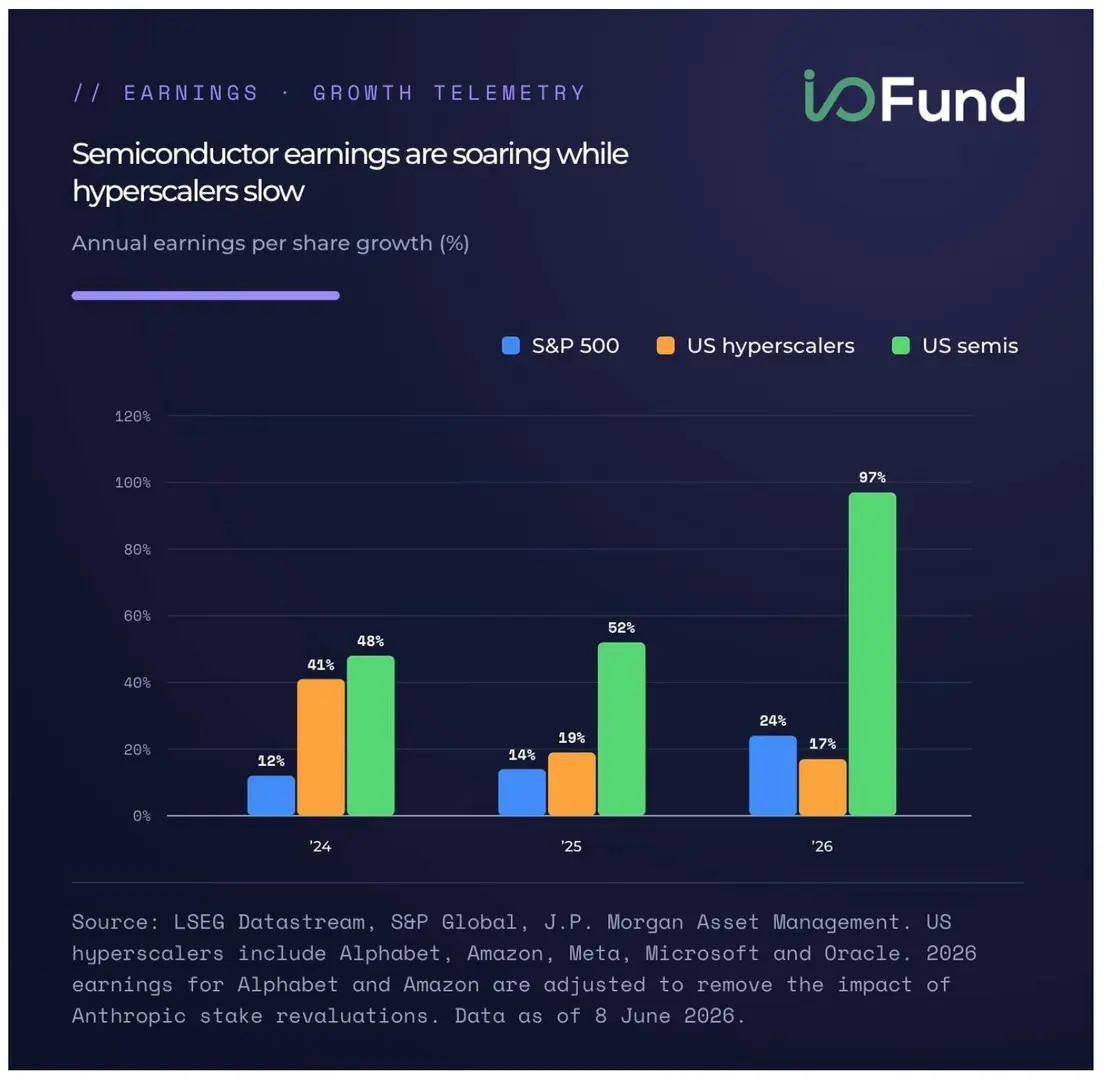
Data from JP Morgan shows that annual semiconductor earnings growth has outpaced hyperscalers for multiple years, and that divergence is only widening over time. Semiconductor earnings growth moderately exceeded the ~40% among hyperscalers in 2024, but then increased to ~50% in 2025, more than 2.5X the 19% growth hyperscalers achieved. That gap is expected to become much larger in 2026, with semiconductor earnings expected to rise by 97%, nearly 6X faster than hyperscaler earnings.  

Bar chart comparing annual EPS growth for U.S. semiconductors, hyperscalers, and the S&P 500 from 2024 to 2026. Semiconductor earnings growth rises from 48% in 2024 to 97% in 2026, significantly outpacing hyperscalers and the broader market.

This chart compares annual earnings per share (EPS) growth for the S&P 500, U.S. hyperscalers, and U.S. semiconductor companies between 2024 and 2026. Semiconductor earnings growth leads throughout the period, increasing from 48% in 2024 to 52% in 2025 and 97% in 2026. By comparison, hyperscaler earnings growth slows from 41% in 2024 to 19% in 2025 and 17% in 2026, while the S&P 500 grows from 12% to 14% and 24%, respectively. The data highlights a widening earnings growth gap between semiconductor suppliers and hyperscalers during the AI infrastructure buildout. Source: LSEG Datastream, S&P Global, J.P. Morgan Asset Management; visualization by I/O Fund.

Semiconductor PEG Ratio Drops Steeply, Supporting AI Supplier Thesis 

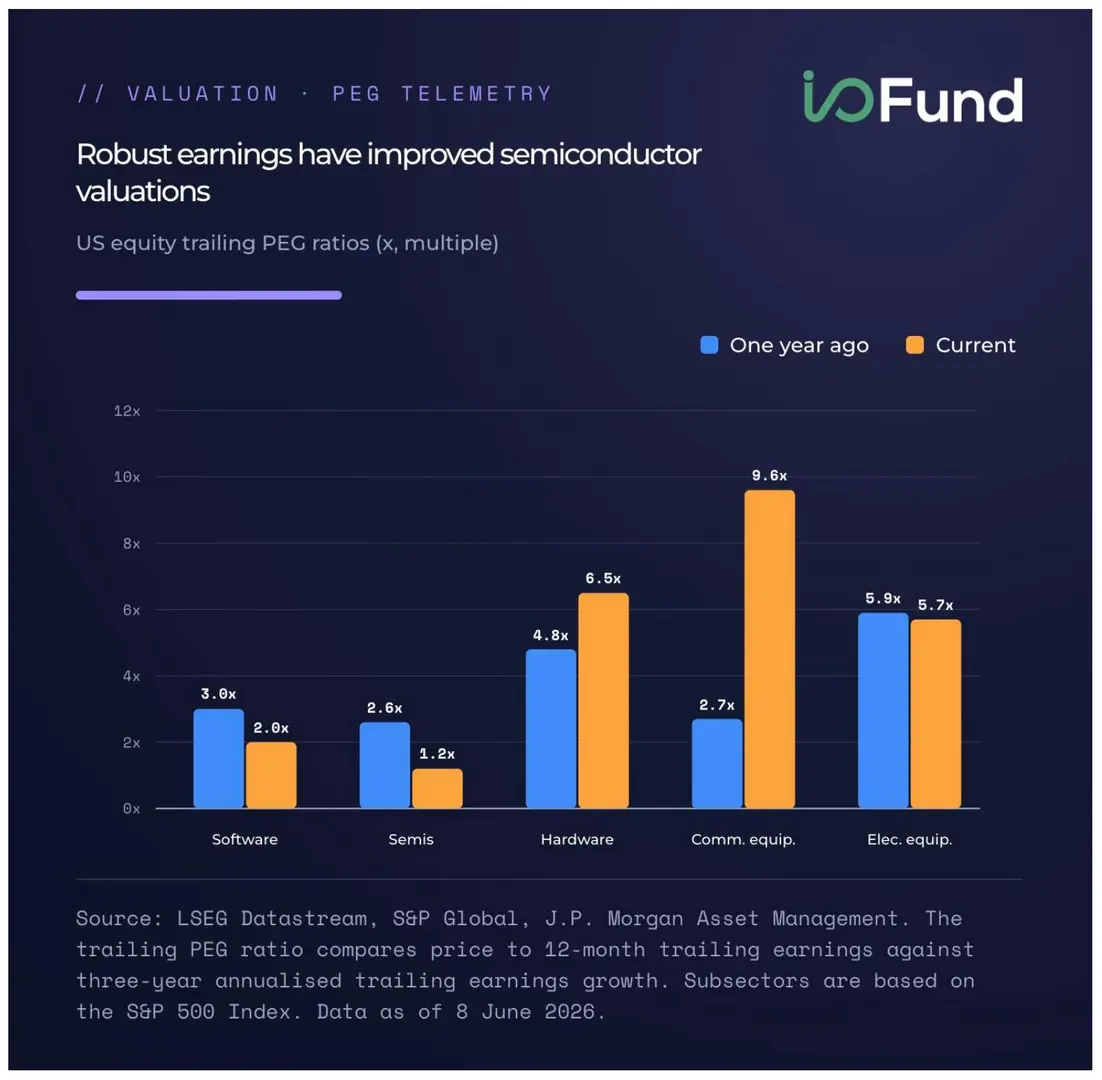
While shares of many semiconductor stocks have soared, soaring earnings have also put significant downward pressure on valuations. This is demonstrated through the trailing PEG ratio, which divides P/E ratios by EPS growth to help assess whether multiples are in line with earnings growth. 

The trailing PEG ratio among chip stocks has fallen from well above 2 to nearly 1 over the past year, lower than other subsectors tied to the AI buildout. While these estimates are as of early June, semiconductor benchmarks are down meaningfully in that span, likely pushing trailing PEG ratios down further. As inference demand is likely to lead to even higher levels of capex, semiconductor earnings can receive another strong tailwind in 2027, reinforcing the merits of our semiconductor-focused approach. 

Bar chart comparing trailing PEG ratios across U.S. equity sectors one year ago versus current levels. Semiconductor PEG ratios fell from 2.6x to 1.2x, while software declined from 3.0x to 2.0x. Hardware and communications equipment valuations increased.

This chart compares trailing PEG ratios for five U.S. equity subsectors one year ago and currently. Semiconductor valuations show one of the largest improvements, with the PEG ratio falling from 2.6x to 1.2x, reflecting stronger earnings growth relative to share prices. Software PEG ratios also declined from 3.0x to 2.0x. In contrast, hardware increased from 4.8x to 6.5x and communications equipment rose sharply from 2.7x to 9.6x, while electrical equipment remained relatively stable at 5.9x versus 5.7x. The data suggests semiconductor stocks have become more attractively valued despite strong gains driven by the AI investment cycle. Source: LSEG Datastream, S&P Global, J.P. Morgan Asset Management; visualization by I/O Fund.

Conclusion 

Big Tech is finally proving that AI can generate meaningful revenue, but Q2 also showed why stronger monetization may not translate into stronger near-term cash flows. Azure, Google Cloud, and AWS all accelerated, and AI businesses across both cloud and core products are reaching run rates well into the tens of billions.  

The key takeaway is that improving AI economics may reinforce the spending cycle rather than slow it down. From what is being communicated from Big Tech management teams, revenue will be reinvested into more data center capacity. This could lead to a few more years of elevated capex and free cash flow pressure.  

From our vantage point, however, the focus on Big Tech is a distraction. While hyperscalers grab the flashy headlines, the more compelling opportunities are the enabling technologies standing directly in the path of a nearly $1 trillion wind tunnel of annual capex. 

Our latest 90-page Top 20 AI Stocks for Q3 2026 report offers investors a comprehensive deep dive into the AI stack, mapping out the companies best positioned to capture capex spend. Previous winners identified in the report include Bloom Energy up 1150% since our first entry, Micron up 210% since our entry a few months ago, a lesser-known networking stock up 370% since November. All of this from the team that first identified Nvidia as an AI stock in 2018, up 6700% since our first entry. 

Don’t miss out on the AI trade. Subscribe Now. 

Please note: The I/O Fund conducts research and draws conclusions for the company’s portfolio. We then share that information with our readers and offer real-time trade notifications. This is not a guarantee of a stock’s performance and it is not financial advice. Please consult your personal financial advisor before buying any stock in the companies mentioned in this analysis. 

Leo Miller, AI and Semiconductor Investment Writer at I/O Fund, contributed to this analysis. 

👉🏻 Share with a Fellow Investor
Help someone else benefit from this insight.

Recommended Reading:

head bg

More To Explore

Newsletter

Data center illustration showing Google, Microsoft, Meta, and Amazon with AI revenue and capex spending trends. Capex spending rises faster than AI revenue between 2021 and 2026.

Big Tech’s AI Revenue Is Surging, but Suppliers Will Still Be the Bigger Winners 

Big Tech’s AI Capex has stomped estimates for multiple years and analysts are now calling for capex to surge to $1 trillion in 2027. However, hyperscalers have long battled investor concerns around wh

August 06, 2026
Futuristic AI data center filled with server racks and glowing network pathways, representing large-scale AI infrastructure investment and rising capital expenditures to meet growing demand.

AI Capex to Hit $1 Trillion – And Estimates Are Still Too Low

Big Tech capex is the driving force behind the AI infrastructure trade, yet Wall Street has repeatedly underestimated the sheer scale of the buildout. Currently, in 2026, the guidance for $732.5 billi

August 05, 2026
Abstract illustration of layered AI computing hardware processing digital tokens, symbols, and data streams representing AI infrastructure and inference demand growth.

Token Growth is Surging - Here Are the Beneficiaries 

The reality of AI demand growth has shattered early estimates for token processing, yet expectations continue moving up and to the right. In the second installment of our token processing series, we e

July 31, 2026
Abstract visualization of a flowing stream of digital tokens, numbers, and symbols representing AI token processing and inference demand growth.

AI Token Demand is Shattering Forecasts 

Total annual token processing is no longer measured in billions or trillions of tokens, but in the quadrillions and beyond. As annual token processing is now tracked in units with 15 trailing zeros, i

July 30, 2026
TSMC N3 wafer technology connected to Intel EMIB advanced packaging in an AI semiconductor manufacturing graphic.

Nvidia and Google Are Crowding TSMC’s N3 Node - Can Intel Fill the Gap?

Nvidia is moving its next-generation Rubin GPUs from 4nm to 3nm, yet Google’s latest TPUs are already on N3 and are expected to remain there. Meanwhile, a growing number of AI CPUs from Nvidia, Amazon

July 26, 2026
Illustration of Intel EMIB-T advanced packaging connecting AI compute dies and HBM memory as an alternative to TSMC CoWoS.

Intel vs TSMC: How CoWoS Packaging Constraints Could Create an Opportunity for Intel Foundry 

Taiwan Semiconductor (TSMC) is the single, most important company to the AI industry. However, to compete with the incumbent, Intel does not need to beat TSMC at leading-edge manufacturing. It only ne

July 24, 2026
Amazon, Meta, Microsoft, and Google displayed with financial charts, illustrating rising AI capex and growing free cash flow pressure across Big Tech.

Big Tech’s Free Cash Flow is Turning Negative – Who's Next? 

Big Tech’s AI revenue is accelerating, but free cash flow is moving sharply in the opposite direction. Across Google, Microsoft, Meta and Amazon, capex is rising much faster than operating cash flow a

July 19, 2026
Illustration of Google, Microsoft, Meta, and Amazon stock dashboards against a digital circuit-board background, symbolizing Big Tech earnings, AI growth, and investor performance.

Big Tech Earnings Preview: Is AI Monetization Finally Catching Up to Capex?

The most pronounced difference between 2026’s tech rally compared to rallies in the past is which companies have been left out of it. The names most associated with the AI trade have hardly participat

July 17, 2026
Side-by-side image of an NVIDIA CMX server and a CXL memory expansion card against a data center background.

Nvidia, CXL, and the Battle to Improve AI Inference Economics

This is Part 2 of our two-part series on AI inference economics. In Part 1 — Why Nvidia's Next AI Battle Is About Tokens per Watt, we laid out why tokens per watt has become the defining metric for in

July 12, 2026
NVIDIA BlueField networking platform card shown on a green digital network background.

Why Nvidia’s Next AI Battle Is About Tokens per Watt 

As hyperscalers move from building AI infrastructure to monetizing it, tokens per watt helps to reflect if revenue is scaling and if profitability is improving. Offload engines can increase tokens per

July 10, 2026
newsletter

Sign up for Analysis on
the Best Tech Stocks


Copyright © 2010 - 2026