
AI accelerators such as GPUs and custom silicon need no introduction. Compute has led the AI boom; a trend so powerful, it is displacing the FAANGs of the last decade with Nvidia firmly the world’s most valuable company and infrastructure suppliers like Broadcom has pushed past legacy peers such as Meta in market cap.
As the market weighs the so-called AI bubble, there are many disparate facts thrown at investors: dot-com analogies, tariff headlines, short-term stock pullbacks, and circular investments from companies such as OpenAI. What matters far more for the AI trade than all of these combined is Big Tech capital expenditures.
The cumulative amount that Big Tech is spending far outweighs the importance of earnings reports, fiscal year guidance, Nvidia’s networking growth or their product roadmap, if AMD has a new deal from OpenAI, Oracle’s insane RPO, Broadcom’s networking chips and custom silicon announcements – all of the above is being single-handedly driven by Big Tech’s large capital expenditure (capex) budgets.
The latest quarter showed a 19% QoQ increase in Big Tech spending, confirming continued conviction in the build-out of AI infrastructure. Each tech giant is dedicating tens of billions toward AI systems, confident in the growth and customer value these services generate. As we look toward 2026, the direction of AI stocks will continue to follow the trajectory of Big Tech CapEx — and right now, that trajectory is pointed higher.
AI Capex Forecasts Keep Accelerating: The $405 Billion Reality
One of the most persistent patterns since the AI boom began is that analysts have been behind the curve on capital-spending forecasts. As you’ll see below, expectations have risen quarter after quarter as Big Tech’s actual investments repeatedly outstrip projections. What started as a $250 billion estimate for AI-related CapEx in 2025 now sits above $405 billion. The scale and urgency of hyperscaler build-outs suggest that even today’s elevated numbers could again be revised higher in 2026.
In fact, capital spending for the AI buildout has risen 44.6% from initial estimates, a substantial jump considering the scale already measured in hundreds of billions. This time last year, the expectations were for $280 billion in Big Tech capex.
Morgan Stanley later forecast $300 billion in Big Tech capex for 2025. Capex estimates stood at $365 billion heading into Q3, and now we believe 2025 capex is on track to surpass $405 billion, representing YoY growth of 62%.
It’s easy to tune out the words “big tech capex” at this point but zoom out for a minute and consider that Big Tech’s TTM capex was $24B at the start of 2015, or up 15X over ten years. Where we end up by the end of the decade on capex spending will likely represent the biggest “boom” in history.
In terms of what the opportunity looks like moving forward, McKinsey is predicting 3.5X growth in gigawatts for AI data centers between 2025-2030. The costs associated with AI data centers range from $3 trillion to $8 trillion, or about $5.5 trillion at the midpoint. This correlates to about 3X growth if we assume the current run rate to 2030 is $1.8 trillion at the current capex of $405 billion.
On a more near-term basis, Goldman Sachs sees hyperscaler capex increasing sharply through 2027 – capex is projected to be $1.15 trillion from 2025 through 2027, more than double the $477 billion spent from 2022 through 2024.
Going back to the first point, analysts thus far have missed the mark in their estimates. Every quarter, sell side analysts rush to update their models. Therefore, the I/O Fund is penciling in that 3x is a baseline to work with over a 5-year time frame.
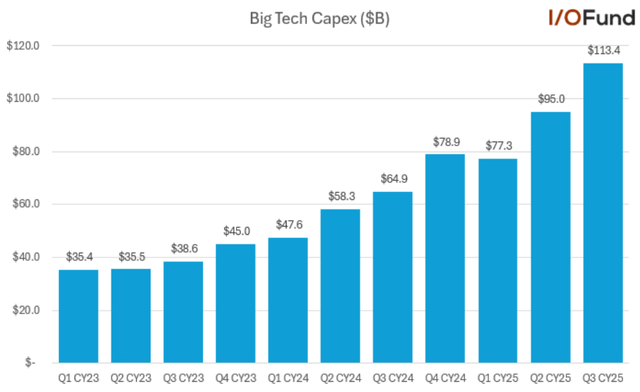
Big Tech AI Capex Jumps 75% YoY in Q3 to a Record $113.4 Billion
Big Tech Capex grew by 75% YoY and 19% sequentially to $113.4 billion in Q3. Most importantly, Q3’s 75% growth rate was the strongest growth so far this year, accelerating 12 points from 63% growth in Q2. This spells good things for key suppliers in the coming quarter.
Amazon’s Raises Annual Capex Guidance to $125 Billion
When listening to commentary on earnings calls, in sharp contrast to concerns over an AI bubble, what we hear from Big Tech management teams is a sense of urgency. From Amazon’s Andy Jassy last quarter: “The faster we grow, the more CapEx we end up spending because we have to procure data center and hardware and chips and networking gear ahead of when we’re able to monetize it. We don’t procure it unless we see significant signals of demand.”
This sense of urgency was echoed again in Q3: “You’re going to see us continue to be very aggressive investing in capacity because we see the demand. As fast as we’re adding capacity right now, we’re monetizing it.”
This boots-on-the-ground commentary implies that Amazon has direct visibility into how quickly capacity is selling out and the level of demand that can be met with accelerated capex investments. This is further supported by monetization trends in Amazon’s custom silicon business, Trainium, which reached a multi-billion dollar run rate, up 150% QoQ this quarter.
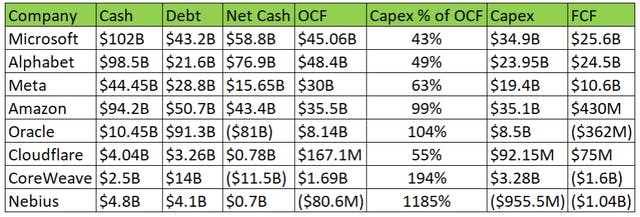
Amazon’s capex in Q3 rose 55% YoY to $35.1 billion, with the company raising the 2025 capex guidance to $125 billion, up 51% YoY. This represents more than 88% of projected operating cash flow for the company and more than 17% of revenue.
By spending more than its hyperscaler peers, Amazon was able to add 3.8 GW of capacity over the past 12 months, the most out of the group.
Microsoft’s Q3 Capex Sees 75% Increase YoY
Microsoft’s capex in Q3 was $34.9 billion, an increase of 75% YoY from $20 billion in the year-ago quarter. Sequentially, it grew by 44% YoY from $24.2 billion in the previous quarter. The company’s strong capex growth was primarily driven by increasing demand for its Cloud and AI offerings. This quarter, approximately half of the capex spend was on short-lived assets, primarily GPUs and CPUs, to support the Azure platform, first-party apps at AI solutions, and accelerating R&D activities. The remaining spending was for long-lived assets that will support monetization in the long term.
With strong accelerating demand, Microsoft is increasing its spending on GPUs and CPUs. Therefore, total spending is expected to increase sequentially in the next quarter and now expects the FY 2026 growth rate to be higher than FY 2025. To provide context, FY2025 ending June capex grew by 58% YoY to $88.2 billion.
Big Tech is set to spend $405 billion building the AI infrastructure of the future — and we invest in the companies set to benefit most. Discover how the I/O Fund tracks, analyzes, and identifies beneficiaries of this unprecedented CapEx cycle. Learn more here.
Alphabet Guides 2025 Capex Growth of 75%
The company’s capex grew by 83% YoY to $23.95 billion. Sequentially, it grew by 7% from $22.4 billion in the previous quarter. Most of the capex was spent on technical infrastructure with approximately 60% of that investment in servers and 40% in data centers and networking equipment. Management stated in the recent earnings call that they are witnessing positive returns on AI investments. “I would say it’s not just early signs because we’re seeing returns, obviously, in the Cloud business. You’ve heard us talk about the fact that we already are generating billions of dollars from AI in the quarter.”
Looking forward, the company expects to invest aggressively due to the strong demand from cloud customers as well as the growth opportunities across the company. Management now expects the 2025 capex to be in the range of $91 billion to $93 billion in 2025, up from the previous estimate of $85 billion. It represents a YoY growth of 75% at midpoint. The capex is further expected to increase in 2026, which further supports our view that AI stocks will benefit in 2026.
Meta Increases Capex Guide to 81% Growth
Meta’s Q3 capex was $19.4 billion, up 111% YoY from $9.2 billion in the same period last year. Sequentially, it grew by 14% from $17 billion in the previous quarter. The strong growth was primarily driven by investments in servers, data centers, and network infrastructure.
Management also increased the 2025 capex to a range of $70 billion to $72 billion, up from the prior outlook of $66 billion to $72 billion. It represents a YoY growth of 81% from the prior year. Due to the continued investments in AI infrastructure, Meta expects next year’s capex to be significantly higher than in 2025, particularly as their compute needs are higher than their expectations. Management stated in the earnings call, “As we have begun to plan for next year, it’s become clear that our compute needs have continued to expand meaningfully, including versus our own expectations last quarter. We are still working through our capacity plans for next year, but we expect to invest aggressively to meet these needs, both by building our own infrastructure and contracting with third-party cloud providers.”
Big Tech Capex Increase Provides a Boost to AI Stocks in 2025
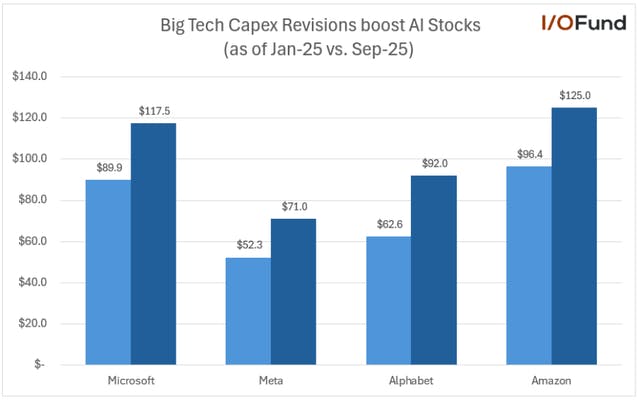
Since the beginning of the year, Big Tech Capex estimates have increased from $280 billion to $405 billion, an impressive 31% positive revision. Alphabet witnessed the highest positive revision of 47%.
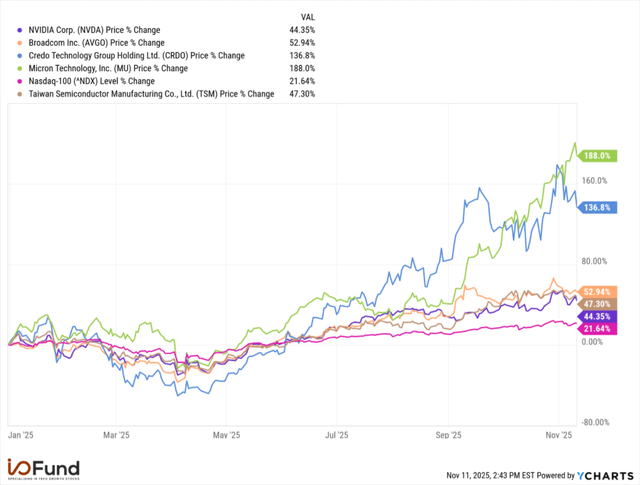
As seen in the chart below, AI stocks have outperformed the broader Nasdaq-100 index by a wide margin. We believe that this trend will continue in 2026 as Big Tech Capex continues to expand and the numerous earnings calls from companies indicate that demand far outweighs supply.
Source: YCharts