5 Soon-to-Be Trends in Artificial Intelligence And Deep Learning
Written by
Beth Kindig
Lead Tech Analyst
Published: February 5, 2020
Last Updated: February 5, 2020
On this page
This article was originally published on Forbes on Jan 31, 2020,08:06pm ESTForbes on Jan 31, 2020,08:06pm EST
Artificial intelligence is frequently discussed yet it’s too early to show real gains. AI’s major headwind is the cost of the investment, which will skew returns in the short-term. When the turnaround occurs, however, companies who are making the investment can expect to be rewarded disproportionately with a wide performance gap. In a recent report, McKinsey predicts AI leaders will see up to double the cash flow.
We can see some evidence of this in Alphabet’s revenue segment, Other Bets, which includes many AI projects with a loss of $3.35 billion in 2018. Of this, Deep Mind is responsible for $571 million in losses and owes its parent company $1.4 billion. The autonomous driving project, Waymo, had its valuation cut by 40% due to delays last September.
We see other companies taking on massive and expensive AI projects, such as Baidu, Facebook, Tesla, Alibaba, Microsoft and Amazon. Except for Tesla, these companies are flush with cash and can afford the transition costs and capital expenditures required for artificial intelligence.
Sign up for I/O Fund's free newsletter with gains of up to 403% - Click hereSign up for I/O Fund's free newsletter with gains of up to 403% - Click hereClick here
Despite tech giants pouring cash into AI investments, most of the industries that stand to benefit are not in the tech industry, per se. This week, I attended Re-Work’s Deep Learning and AI Summit, where AI engineers and executives gathered for presentations and discussions about the projects they’re spearheading.
Here are a few ways that AI is slated to make an impact sooner rather than later:
1. Training AI to Know What it Does Not Know
The next decade will determine if humans or machines are better are making a medical diagnosis as more health care companies turn to AI for accuracy. One problem that Curai is working on, is how to train a model to know when it doesn’t know, so a human can intervene to avoid the misclassification of unknown diseases. This approach is known as physician-in-the-loop.
Get Our Free Weekly Stock Newsletter
Get weekly stock insights, market analysis, and technology updates straight to your inbox.
Weekly stock insights
Market analysis
Technology updates
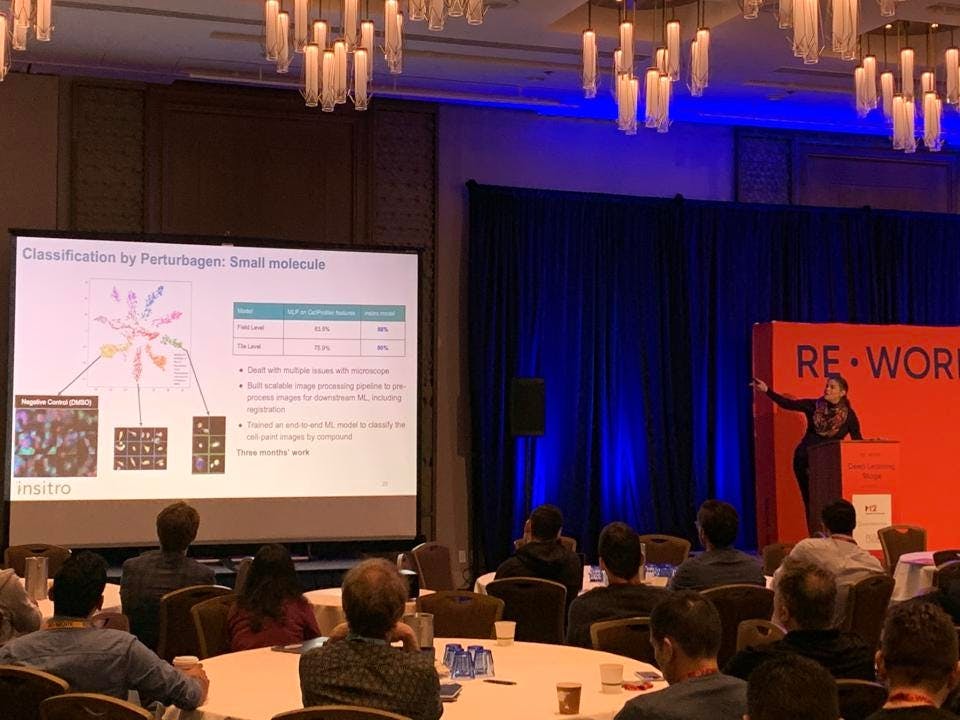
Daphe Koller of Insitro presents on Machine Learning and Drug Discovery at Re:Work Deep Learning and AI Summit
BETH KINDIG / RE:WORK DEEP LEARNING AND AI SUMMIT
2. Reducing Call Center Burden
United Health received 36 million calls in 2017 with 7.6 million calls transferred to a representative. The AI platform solution involves deep learning for a pre-check portal and claim queue, Automatic Speech Recognition (ASR) to translate audio to text, and Natural Language Processing (NLP) for unsupervised clustering, to generate new call variables and automate transfer calls.
3. Retail Giants making Big AI Investments
Retail had a large presence at the conference with Wal-Mart Labs, Proctor and Gamble and Target presenting on ways they plan to make the retail experience more optimized. Perhaps these companies are being more careful to embrace technology and AI after the last decade ushered in many competitors who stole critical turf (i.e. Amazon).
Imagine a shopping experience where the carts are plentiful, cashiers are always open, and inventory is fully stocked. Rather than focus on replacing cashiers, Wal-Mart is more focused on inventory control. This is a different approach than competitor Amazon Go, designed to be cashier-less.
4. AI Could Be the Answer to Restoring Privacy
Privacy has been in the headlines lately as regulators and social media users begin to question what is a fair exchange for a free service. While the battle is nearing two years since Cambridge Analytica, other companies are creating AI recommendation engines so powerful that little information is needed about the person making the choice; their preference is enough to determine what to recommend next.
Netflix is a leader here with its recommendation engine for content. Pinterest also employs a complex recommendation engine to surface the best image for an individual out of the billions of images on Pinterest’s platform. This is done through the process of query understanding to candidate generation to ranking to blending to the final result. In layman’s terms, this is how a discovery engine narrows down choices from billions to hundreds.
5. Prepare to Be Blown Away by AI-Assistants
Over the next few years, we will become hands-free and will have better posture and fewer car accidents. Once AI-assistants are fully built out, our interaction with mobile devices may become the brunt of criticism from future generations. Many companies are working to own this space as the ecosystem lock-in and data produced by AI-assistants will be incredibly valuable – expect a full-fledged battle between Amazon, Google, Facebook and Apple in this space.
Please note: The I/O Fund conducts research and draws conclusions for the Fund’s positions. We then share that information with our readers. This is not a guarantee of a stock’s performance. Please consult your personal financial advisor before buying any stock in the companies mentioned in this analysis.
Beth Kindig is the lead tech analyst for the I/O Fund with audited results that beat Ark in 2020 and returns of up to 1700% on her premium site in two years and 1150% in her free newsletter in three years on individual stocks and assets.