
In this post, we examine the AI platform, products, and other driving forces behind ServiceNow’s (NOW) beat-and-raise earnings results for Q2, plus:
- ServiceNow’s evolution from a provider of SaaS solutions for IT service management to an agnostic AI platform aspiring to impact nearly every facet of the enterprise.
- The company’s impressive QoQ acceleration across subscription revenue, margins, RPO, and large deal activity.
- The cost of meeting AI demand through cloud infrastructure costs, and the news of a deal for multi-billions in cloud commitments through 2030.
- Plus, who’s really winning the race in AI enterprise.
Last month, after ServiceNow reported second quarter results that exceeded expectations on multiple fronts, shares of NOW rose by 6%. The company is attempting to reposition itself beyond a provider of cloud-based digital workflows to what they are calling “the AI-powered operating system for enterprise transformation.”
Yet, the market is cautious as the stock is down nearly 20% YTD and lags other AI software stocks – our analysis below looks at the puts and takes weighing on the stock.
ServiceNow’s Q2 Results Help to Sustain AI Narrative
As CEO Bill McDermott enthusiastically delivered highlights from his company’s second quarter on the call, he echoed the company’s marketing with repeated use of the word “any,” as in the ServiceNow platform’s ability to integrate with any data, any workflow, any tech stack, any cloud and hyperscaler, any AI agent and LLM, any system across the enterprise, in any industry. McDermott is confident that his firm is delivering the unified solution to what he says is the #1 focus of leading enterprises and CEOs—AI transformation.
Many tech companies talk about their all-in-one platform as the be-all, end-all solution for every challenge facing the enterprise, but ServiceNow has the metrics to warrant watching the stock closely in future quarters. Most notably, Q2 2025 total revenue of $3.215 billion, representing 21.5% YoY growth in constant currency, up from 20% last quarter for an acceleration of 150 bps. The 150 bps acceleration in total revenue gives credence to McDermott’s statements that the company is seeing increased customer demand for AI transformation solutions, as well as strong execution across sales and product teams.
In addition, ServiceNow reported subscription revenues of $3.1 billion representing 21.5% YoY growth. This is up from $3.01 billion last quarter for QoQ growth of 3.3%. The current RPO of $10.9 billion represents growth of 21.5% YoY and is up from $10.3 billion last quarter for QoQ growth of 5.8%. Total RPO was $23.9 billion up from $22.1 billion last quarter for YoY growth of 25.5% and QoQ growth of 8.1%.
In Q2, ServiceNow guided for growth of 20% to 20.5% on subscription revenues yet current RPO growth is expected to lag at 18.5%. Typically, it’s best if cRPO growth exceeds subscription revenue growth. Notably, free cash flow is lumpy between quarters yet the company has a sizable free cash flow margin regardless at 48% last quarter and 16.5% this quarter. In both quarters, FCF expanded on a YoY basis.
For full year guidance, guidance was reaffirmed for subscription gross margin to hold steady at 83.5%, operating margins at 30.5%, and free cash flow margin at 32%—indicating confidence in long-term profitability and efficiency.
Now Assist Sees AI Deals Grow 50% QoQ
ServiceNow also delivered strong numbers showcasing momentum in large deals and increased annual contract value (ACV). In Q2, AI deals were up 50% QoQ, including 89 deals with $1 million in net new ACV. There are 528 customers that now have more than $5 million in ACV, a 19.5% YoY increase. The number of customers with more than $20 million ACV grew by 30% YoY, representing strong relationships with top customers. ServiceNow has also shared that 85% of the S&P 500 are actively using ServiceNow’s platform or services.
The primary driver of the increases in deal size and volume is Now Assist, the company’s flagship generative AI suite of applications, agents, LLM, and customizable tools built directly into the NOW platform. Now Assist drastically simplifies AI integrations and makes it easy for non-technical people to work with, talk to, manage, and customize all the AI capabilities available on the platform. The key components are Skills, which can be thought of as customizable building blocks for performing tasks like summarizing incidents or suggesting next steps in processes; AI Agents, which are autonomous agents with reasoning and planning capabilities extending far beyond chatbots, including the ability to automate tasks, solve problems, and proactively manage workflows; and Agentic AI Orchestrator, which acts as a coordinator with and manager of other agents and systems, not just from ServiceNow but from other companies, too.
Here is what was stated on the earnings call:
“Our beat and raise quarter showcases the mission critical nature of the ServiceNow AI Platform. Every business process in every industry is being refactored for agentic AI. ServiceNow has never been more differentiated as a full-stack agentic operating system for the enterprise.”
ServiceNow confidently reiterated its goal of reaching $1 billion in ACV from Now Assist by 2026. The I/O Fund foresees this being an important moment for the stock as few AI midcap software stocks have reached this scale. The company has this confidence due to agentic AI, and also due to Now Assist unifying additional solutions, workflows and data across multiple enterprise productivity tools—ITSM, CSM/CRM, HRSM, DevOps, Sales, and more.
Another key product in the generative AI suite is AI Control Tower, a centralized command center and single-pane-of-glass orchestration layer for managing, optimizing, and governing AI across the enterprise. Launched earlier this year, AI Control Tower allows third-party applications to integrate seamlessly into the ServiceNow platform, and it provides the business context organizations need to connect AI initiatives to core business services and technologies in the rest of the tech stack. It provides AI lifecycle management, real-time reporting, risk and compliance monitoring to help organizations scale AI responsibly and efficiently.
McDermott referenced AI Control Tower during the earnings call Q&A when he was asked to explain the success the company is having at the C-level and to define the one asset that will help ServiceNow win in the long run. He described AI Control Tower as the governance piece that unifies so many of the other apps and AI solutions organizations are juggling, minimizing the pain and complexity of integration including vendor management that enterprises have been facing for the past 50 years.
As today’s enterprises race to transform and consolidate every aspect of their business through AI, leaders are struggling to choose, let alone integrate, 10, 15, 20 or more components of the tech stack, with new AI offerings rolling out and vying for inclusion every day. AI Control Tower can manage systems and other agents from other companies, not just ServiceNow’s. The agents need managing just like people do, McDermott added.
Within two months of its launch, AI Control Tower surpassed the company’s internal targets for the entire year.
ServiceNow’s Stock Sells Off Due to Cost of Scaling AI
The day after its Q2 earnings release, shares of NOW retracted 3% as a regulatory filing revealed the company is set to spend $4.8 billion in total commitments for cloud infrastructure through 2030. The largest partner among the cloud providers is Google, for $1.2 billion over the next five years.
With leadership bullish on Now Assist reaching its goal of $1 billion in ACV by 2026, the company appears to be preparing to report AI revenue independent of other revenue sources. Given the run rate above and assuming no acceleration, we consider the spend net neutral as the ACV would net very little ($800M in 4 years). The market will want to see ACV higher than this to offset the spend.
The disclosure of $4.8 billion in cloud commitments share a similar narrative as the $85 billion annual cloud capex lift that Alphabet guided to last week —AI demand is skyrocketing, and so are the costs of meeting it. This is a dynamic that investors should factor in when assessing any stock in the AI sector.
Find out the Top Enterprise AI stock we like better …
This quarter, one enterprise AI stock reported commercial RPO that was so high, it’s nearly inconceivable. Commercial RPO represents the value of contracted commitments; so, in other words it’s revenue that has not yet been recognized but is in the pipeline to be recognized over the next few years.
The reported Commercial RPO from this Top Stock coupled with its growth rates puts this company on track to see anywhere from $100 billion to $200 billion in AI revenue by the close of the decade --- which would represent a significant milestone that only Nvidia has reached. Find out what the Top Stock is below.
Sign up for free below to get Beth’s latest write-up on the world’s leading AI software stock.
To access more in-depth analysis and AI growth stock recommendations, join tens of thousands of investors who are already following Beth and the I/O Fund.
Microsoft FYQ4: One of the Strongest Earnings Reports in Multi-Decade History
Recently, in the Top 15 AI Stocks analysis it was stated “If Nvidia holds the crown in the AI hardware arena, then Microsoft holds the crown in the AI enterprise arena.” Tonight, Microsoft proved why the AI Enterprise crown is rightfully theirs.
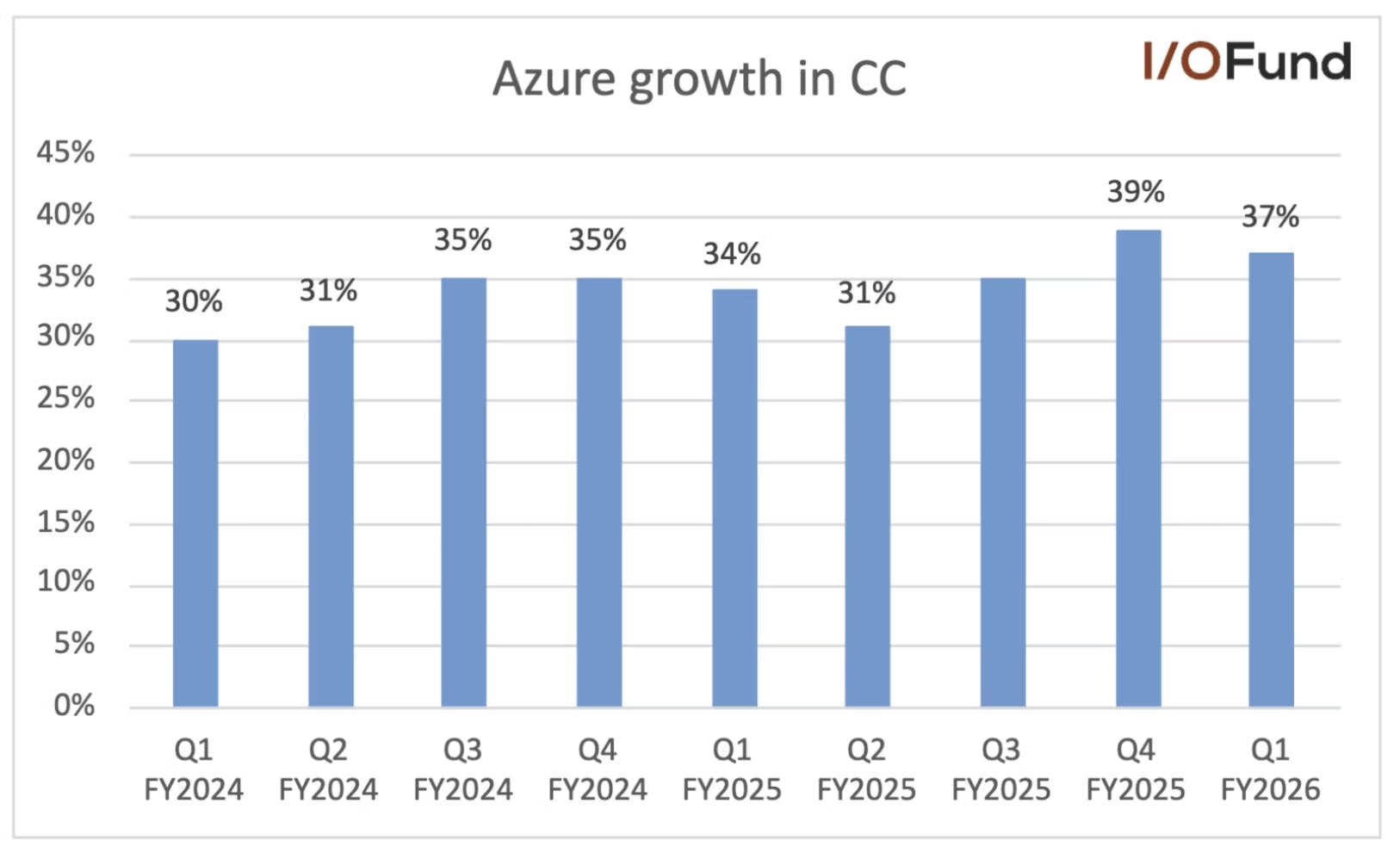
Management came out swinging this evening on multiple fronts. First off, the acceleration in Azure and Other Services to 39% up from 35% last quarter was significantly higher than expected, with the Street calling for growth of 33.7%. To grow nearly 40% at this scale is impressive.
Microsoft also revealed its Azure revenue number for the first time of $75 billion for FY2025 (although not entirely surprising as we were modeling for Azure to be hitting $80 billion very soon). From there, the CFO guided for 37% growth in Azure for next quarter – indicating continuing a high growth rate at scale will not be a problem in the near-term (note, H2 is expected to see lower growth than H1).
However, if we look at Commercial RPO, it’s clear something big is going on. Last quarter, we pointed out that Commercial RPO was the one key metric we were watching, stating: “Commercial RPO growth above 30% suggests that Microsoft’s stock could (finally) resume strength again.” At the time, RPO was at $315 billion, up 34% and 33% on a constant currency (CC) basis.