
This article was originally published on Forbes on Sep 29, 2023,12:05am EDT
Cybersecurity is one of the highest costs that enterprises face at 12% of IT budgets on average, and this cost is rapidly rising. While a company can lay off staff or reduce marketing and R&D expenses during a period of lower growth, enterprises cannot compromise on cybersecurity. The rise in the number of attacks and the increased sophistication of attacks means this expense will continue to grow, yet AI and automation can help.
According to Cybercrime Magazine, if cybercrime were a country, it would be the world’s third-largest economy, second to the United States and China. The costs that enterprises dedicate to cybersecurity are expected to increase from $8 trillion to $10.5 trillion by 2025. Statista agrees with Cybercrime Magazine’s estimates, stating the cost of cybercrime will reach $10.3 trillion by 2025 and $13.8 trillion by 2028.
At the I/O Fund, we are positioning for AI and automation to play an important role in this critical, no-compromise industry. There are 560,000 new pieces of malware detected every day, and software systems cannot keep up with this. AI is already assisting human teams in identifying which threats require more analysis, and in the near-term, this will meaningfully lower cybersecurity costs. There is also a shortage of cybersecurity talent, with a 2022 survey stating 59% of companies have a shortage in this department and may not be able to effectively handle a cybersecurity attack.
Below, we look at how AI is set to disrupt cybersecurity next and what is being said on the topic.
Sign up for I/O Fund’s free newsletter with gains of up to 221% – Click here
How AI Can Improve Incident Response and Threat Detection
Combining cybersecurity with AI has a natural affinity as cyberattacks are computer generated, and in turn, computers are uniquely capable of finding computer-generated threats. Automation reduces the number of false positives. Instead of getting every piece of telemetry that requires the security team to investigate, AI-assisted endpoint detection and response solutions eliminates the noise so that the security team is only responding to those that have the potential to be critical.
Fundamentally, cybersecurity is a data problem. Cybersecurity platforms ingest, correlate, and query petabytes of structured and unstructured data from disparate external and internal sources in real-time. Cybersecurity platforms then build rich context and deliver greater visibility by constructing a dynamic representation of data across an organization.As a result, AI-driven cybersecurity platforms are often highly accurate in triggering a response.
The number of endpoints in a corporate network are exponentially growing with 27 billion endpoints expected to be connected by 2025. There have been staggering studies done that show 68% of enterprises have experienced a compromised endpoint. Compromised credentials across desktops, laptops, and mobile devices are often the hardest points of access to secure. Algorithms can detect new malware on endpoints based on the attributes of known malware. Unauthorized access, data breaches and cyber threats from endpoints will also help to drive demand for edge-based, decentralized AI cybersecurity solutions.
The network security market is a large contributor to cybersecurity spend. Machine learning algorithms help systems to learn by experience, which helps to identify malware in encrypted traffic and find insider threats. Machine learning algorithms do not need to decrypt, rather can spot the malicious patterns and find threats hidden with encryption.
Cloud security is the fastest growing segment within cybersecurity. AI/ML can help to identify suspicious cloud app logins, detect location-based anomalies, and quickly identify threats through IP reputation analysis. Threat prevention is possible through ingesting cloud telemetry with AI systems, foregoing the need for expert rule engineering. Attack path simulation is also made possible with AI, to help simulate the path an attacker would take to reduce coverage gaps. Egress web traffic can be monitored without the need to configure virtual machines by focusing on limiting egress based on source, identity, destination and request types. Machine learning models can also detect new API threats based on large training data sets. These are a few examples of how AI/ML is improving cloud security.
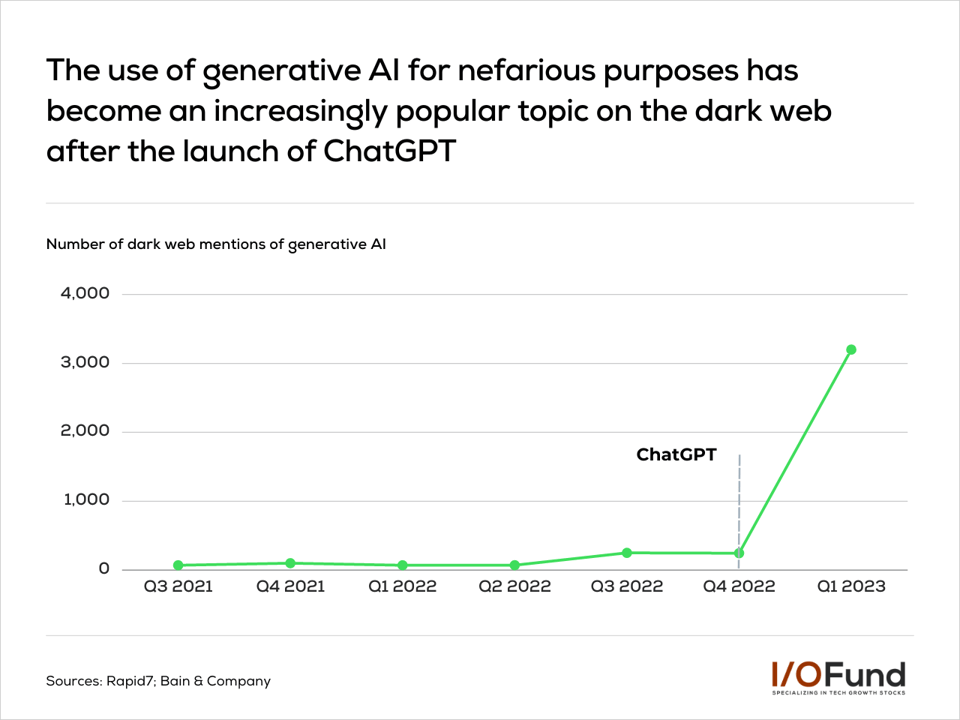
Chat-GPT heightens security risks as generative AI is capable of writing malicious code or acting as a sidekick to the human hacker writing malicious code. To level the playing field, the best defense will also be self-learning, generative AI tools. The downloads for Chat-GPT have plateaued considerably among consumers. Meanwhile, the use of Chat-GPT among hackers is rising on an exponential curve. This helps illustrate why the adoption curve for AI may be healthier among enterprises (rather than consumers) in the medium-term.
According to Mackenzie Jackson, a developer advocate with GitGuardian, Chat-GPT is likely to give rise to a greater number of hackers. This new generation is called “AI Hackers” because previously they could not hack on their own, but are now able to hack with generative AI as their sidekick.