Cybersecurity Continues To Lead Cloud Stocks
September 22, 2022
Beth Kindig
Lead Tech Analyst
This article was originally published on Forbes on Sep 16, 2022,03:24pm EDT
Last June, we discussed key reasons that cybersecurity stocks would hold up particularly well compared to other cloud verticals. The analysis pointed to enterprise spending expected to increase in 2022 from the previous year, according to Chief Information Security Officer (CISO) surveys.
Considering the level of cloud spending in both 2020 and 2021, an increase on already high budgets is impressive. The CISO surveys state that 44% will increase budgets in 2022 compared to 41% in 2021 and only 2% are expect to decrease compared to 6% the previous year.
In a similar study from PricewatershouseCooper, 69% predict a rise in cyber spending for 2022 and 26% expect a surge of 10% or higher spending year-over-year. This survey was done across a broader C-suite and executive sampling.
Our analysis in June also pointed out that according to a Gartner survey, 88% of the Board of Directors viewed cybersecurity as a business risk. According to Paul Proctor, VP at Gartner, “The influx of ransomware and supply chain attacks seen throughout 2021, many of which targeted operation- and mission-critical environments, should be a wake-up call that security is a business issue, and not just another problem for IT to solve.”
We had also stated on Fox Business News that a small cohort of companies emerged this past quarter to increase the top line while also reporting narrowing losses on the bottom line. We feel not losing site of opportunities during selloffs is how generational wealth is built.
Sign up for I/O Fund's free newsletter with gains of up to 403% - Click here
Cybersecurity Stocks Report Another Strong Quarter in 2022
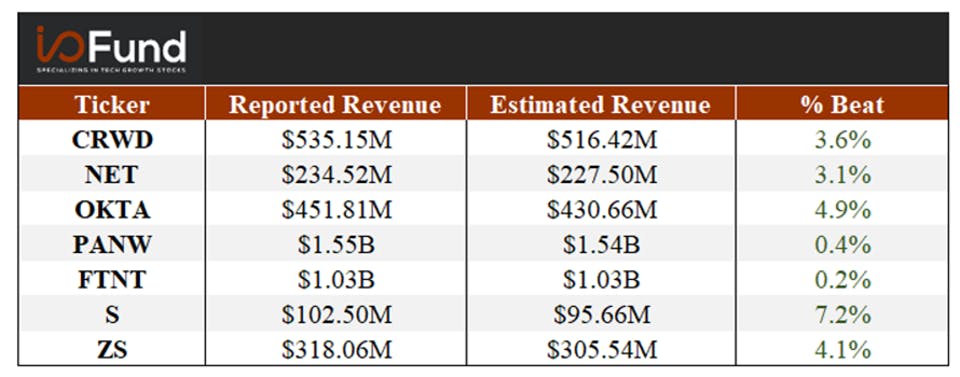
In Q2, cybersecurity stocks did not disappoint with revenue beats across the board. Although SentinelOne had the largest revenue beat, Crowdstrike had the largest beat from a higher revenue base.
Source: YCHARTS
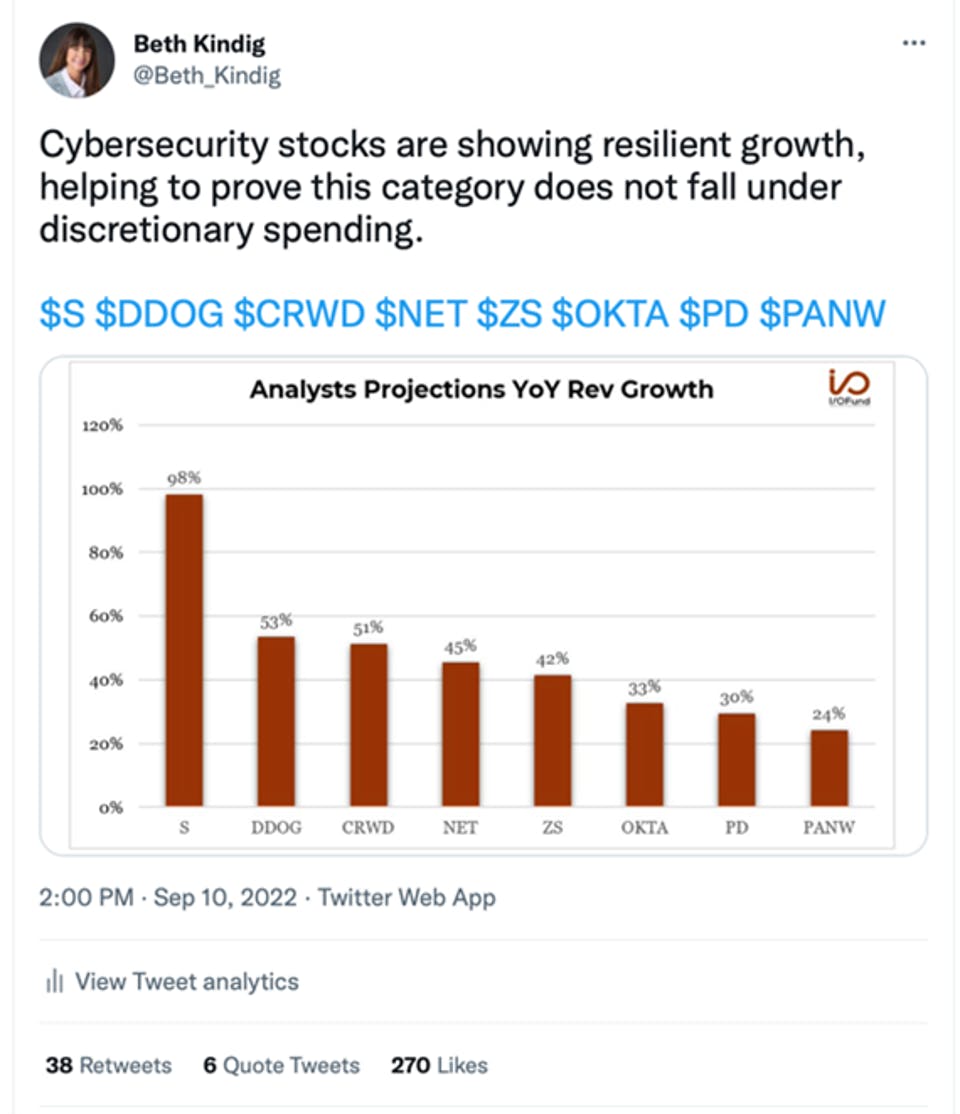
We pointed out on Twitter that one reason for the strong beats is that cybersecurity is not subject to discretionary spending.
Source: Beth Kindig
Sign up for I/O Fund's free newsletter with gains of up to 403% - Click here
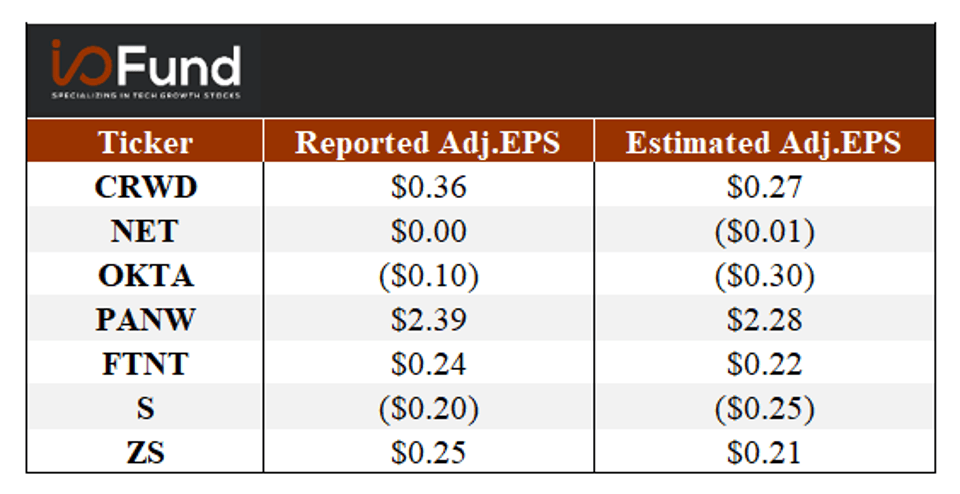
Palo Alto Networks and Crowdstrike have strong bottom lines and this is one reason both stocks have outperformed the Nasdaq this year. With that said, high growth is starting to gain traction again as SentinelOne and Zscaler have the stronger price action in the last 30 days.
Source: YCHART
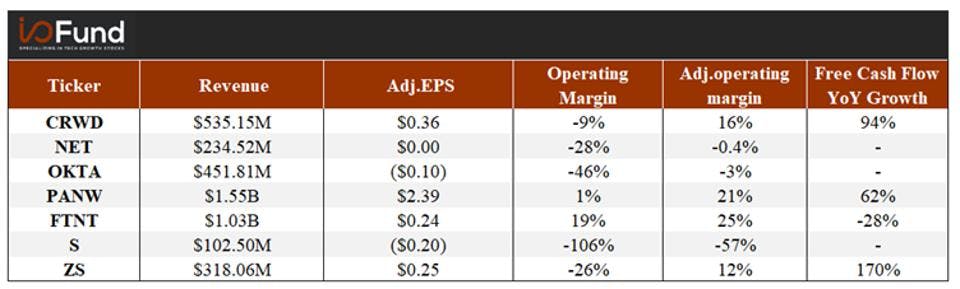
In the chart below, we see a handful of cybersecurity stocks have been able to grow free cash flow, such as Crowdstrike, Zscaler and Palo Alto Networks. The strong free cash flow is occurring in addition to growing the top line, which indicates cybersecurity is not a “growth at all costs” industry.
Source: CHARTS AND INVESTOR RELATIONS
Conclusion:
Cybersecurity continues to be a top priority in budgets and the results are showing up again in Q2. We found a strong pattern with cybersecurity stocks sustaining growth rates and strong bottom lines in Q1 and also in Q2. The cybersecurity sector overwhelmingly beat estimates compared to other sectors within tech and investors should take notice of this strength.
Please note: The I/O Fund conducts research and draws conclusions for the Fund’s positions. We then share that information with our readers. This is not a guarantee of a stock’s performance. Please consult your personal financial advisor before buying any stock in the companies mentioned in this analysis.
More To Explore
Newsletter
The Case for Bitcoin to $2 Million After This Bear Market
Our latest analysis lays out how we plan to navigate the rest of this bear cycle, along with the technical roadmap to $2 million — a view further supported by what we're seeing across the U.S. dollar,
Is the AI Dip a Buy? Key S&P 500 Levels and the One Bond Market Line to Watch
In our last broad market report on June 18th, we presented a case for caution, presenting numerous warning signs that we tend to see before a correction, ranging from institutional positioning to nume
Big Tech’s AI Revenue Is Surging, but Suppliers Will Still Be the Bigger Winners
Big Tech’s AI Capex has stomped estimates for multiple years and analysts are now calling for capex to surge to $1 trillion in 2027. However, hyperscalers have long battled investor concerns around wh
AI Capex to Hit $1 Trillion – And Estimates Are Still Too Low
Big Tech capex is the driving force behind the AI infrastructure trade, yet Wall Street has repeatedly underestimated the sheer scale of the buildout. Currently, in 2026, the guidance for $732.5 billi
Token Growth is Surging - Here Are the Beneficiaries
The reality of AI demand growth has shattered early estimates for token processing, yet expectations continue moving up and to the right. In the second installment of our token processing series, we e
AI Token Demand is Shattering Forecasts
Total annual token processing is no longer measured in billions or trillions of tokens, but in the quadrillions and beyond. As annual token processing is now tracked in units with 15 trailing zeros, i
Nvidia and Google Are Crowding TSMC’s N3 Node - Can Intel Fill the Gap?
Nvidia is moving its next-generation Rubin GPUs from 4nm to 3nm, yet Google’s latest TPUs are already on N3 and are expected to remain there. Meanwhile, a growing number of AI CPUs from Nvidia, Amazon
Intel vs TSMC: How CoWoS Packaging Constraints Could Create an Opportunity for Intel Foundry
Taiwan Semiconductor (TSMC) is the single, most important company to the AI industry. However, to compete with the incumbent, Intel does not need to beat TSMC at leading-edge manufacturing. It only ne
Big Tech’s Free Cash Flow is Turning Negative – Who's Next?
Big Tech’s AI revenue is accelerating, but free cash flow is moving sharply in the opposite direction. Across Google, Microsoft, Meta and Amazon, capex is rising much faster than operating cash flow a
Big Tech Earnings Preview: Is AI Monetization Finally Catching Up to Capex?
The most pronounced difference between 2026’s tech rally compared to rallies in the past is which companies have been left out of it. The names most associated with the AI trade have hardly participat