
This article was originally published on Forbes on Oct 8, 2020,11:23pm EDT
Rebound numbers from Q3 will look spectacular following the paralyzing effects of strict shelter-in-place orders in Q2. The economy is officially in a recession after posting two negative quarters of GDP growth at (5%) in Q1 and (32%) GDP in Q2. The latest estimate from Atlanta’s Fed GDPNow for Q3 2020 is showing a record rebound of 35.3%.
This represents an increase of 7.9% quarter-over-quarter and 3.1% below the pre-recession high. For comparison purposes, the Financial Crisis of 2008 bottomed at 4.0% below its pre-recession during the third and fourth quarters of its recession.
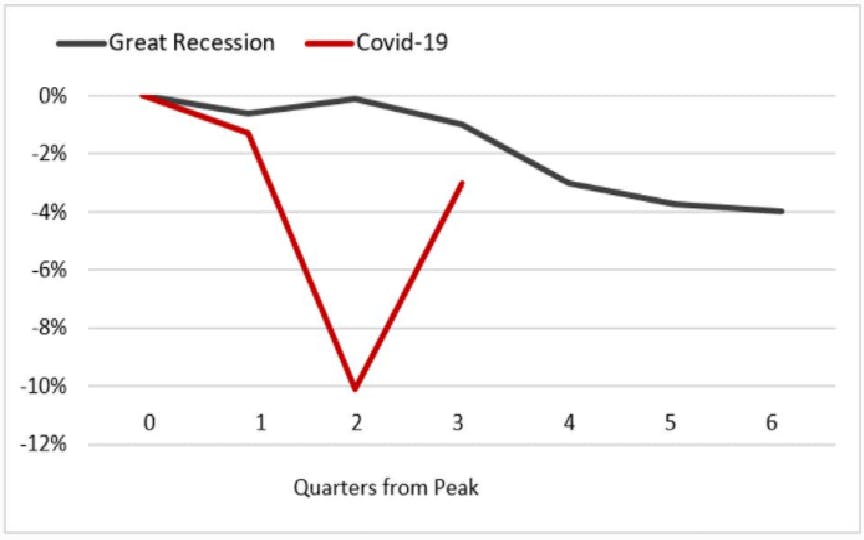
The chart above shows the projected Q3 rebound of 35.3% from the Atlanta Fed’s GDP Now released on October 6th, 2020.
Cloud and IT Budgets: Staying Objective
Some will argue the market is not the economy (which is true), however, cloud software can’t stop the spiraling effects of lower IT/cloud spending and tighter budgets that follow a weaker economy. One area that companies might reduce costs is to trim down on the number of cloud software and tools they use. Unemployment could exacerbate this if the subscriptions are paid per employee.
Spiceworks recently released a survey that shows 80% of IT-decision makers expect IT budgets to grow or stay steady over the next 12 months. This supports the notion that even during periods of uncertainty, IT and cloud are central and critical to operations.
With that said, the decision-makers polled stated the primary drivers in IT budgets are noted to decrease year-over-year except covid-related budget allocations. In the past, drivers such as employee growth, security concerns, and the need to upgrade IT infrastructure were expanding to support higher budgets.
Perhaps more indicative is the decrease in revenue that is being forecast across the 1,000 IT-decision makers that were polled. One-third of businesses expect revenues to increase from 2020 to 2021 which is down from 58%. One-third also expects revenues to decrease YoY which is up significantly from the previous two years when only 7% expected a decline in revenue.
Sign up for I/O Fund's free newsletter with gains of up to 403% - Click hereSign up for I/O Fund's free newsletter with gains of up to 403% - Click hereClick here
As the survey illustrates, cloud software will be more resilient than many other categories. However, there will be some cloud software companies that see an impact on one side of the equation or both sides of the equation – this means either fewer new customers or more churn or downgrades in existing customers or both. There are three points where weakness can occur (fewer sign-ups, churn, and downgrades). Notably, companies that have annual recurring revenue will be more protected.
In this article, we go back through earnings calls to see what management is saying in each respective company:
These companies had positive things to say about budgets …
Twilio:
“Our customers in nearly every industry have had to identify new ways to communicate with their customers and stakeholders, from patients to students to shoppers and even employees essentially overnight… Twilio was built for this. The things we've always brought to our customers, digital engagement software agility and cloud scale are enabling organizations to innovate now even faster than ever. Messaging, email voice and video are allowing companies to engage with their customers safely while reimagining their digital engagement strategies in ways that will be resilient for years to come…And now we're seeing the strength of that diversification really play out during COVID, as we've seen new industries, new use cases offset some of the more negatively impacted areas.” - CEO Jeff Lawson Q2 Earnings Transcript (8/4/20)
Fastly:
“The need for a trustworthy and modern edge platform has never been greater. Developers and security operators are at the center of the transformation and they can only drive transformation effectively if they can build quickly and securely…Fastly is in this unique position to be a usage-based model with the most innovative companies in the world. And so when you stack on, the most — the largest innovators and you look just at their results, whether it be Pinterest or Shopify, the list goes on and on.” CEO Joshua Q2 Earnings Transcript (8/5/20)
Crowdstrike:
…. “even in this challenging macroeconomic backdrop, cybersecurity is mission-critical and more important now than ever, as the threat environment escalates and the attack surface continues to grow…as organizations rapidly adapt to the new distributed workforce paradigm and move more workloads to the cloud, it has become clear that the endpoint is the new security perimeter, and the inadequacies of the complex brittle patchwork of legacy solutions continues to be exposed.” — CEO George Kurtz Q2 Earnings Transcript (9/2/20)
Bandwidth:
“The second factor driving our outperformance was the increased usage driven by COVID-19-related remote work requirements which peaked in April and thereafter dissipated throughout the quarter, but remained at elevated levels as compared to pre-pandemic period…While it is becoming increasingly difficult to differentiate COVID-19-related usage from organic usage growth, we estimate that COVID-19 revenue impact in the second quarter to be in the range of $4.5 to $5 million.” — CFO Jeff Hoffman Source: Q2 Earnings Transcript (8/2/20)
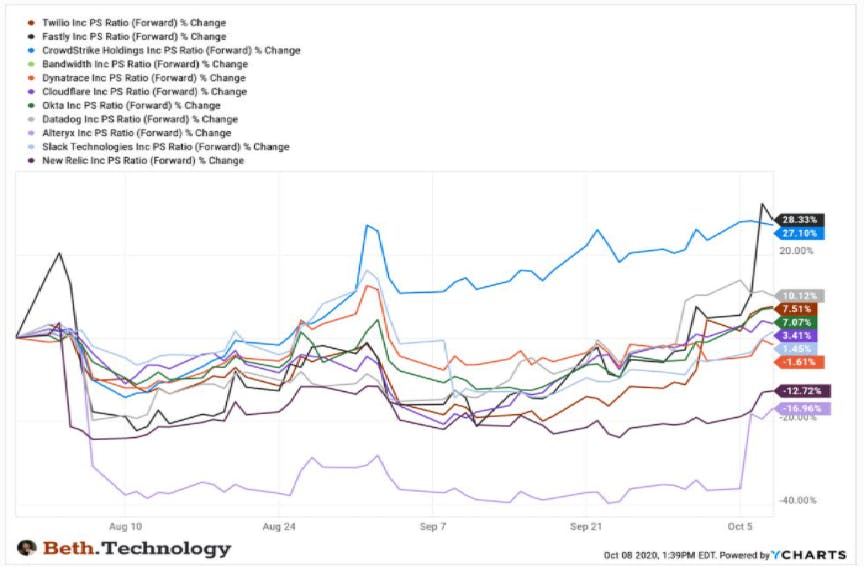
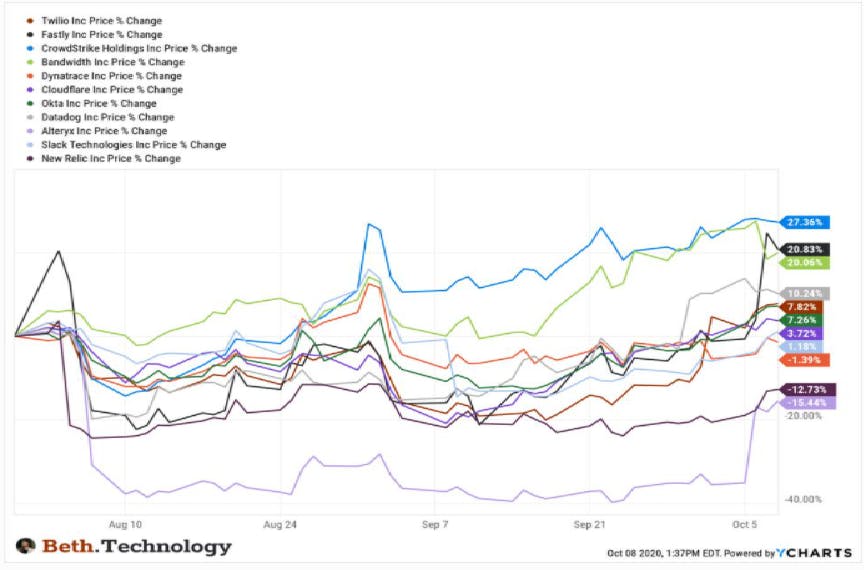
Price-to-sales change for the stocks covered in this analysis since the start of cloud software earnings reports on August 1st, 2020.
These companies were more some headwinds and some tailwinds cancel each other out for a neutral outlook …
Dynatrace:
“Despite the global pandemic continuing to delay some new sales cycles…Customers tell us that they consider Dynatrace an essential element of executing a successful digital transformation as they drive towards greater agility, efficiency, and business effectiveness…what we’re seeing is that as digital transformation accelerates, the need for a Dynatrace class solution even goes up. And that’s what we saw the beginnings of it in our fiscal Q1 and we continue to see it as we look out into Q2 and beyond with the sales cycles we’re now in.” - CEO John Van Siclen Q1 Earnings Transcript (7/29/20)