The AI Revenue Leader Nobody Is Talking About—Second Only to Nvidia Stock
Beth Kindig·DEC 18, 2025·18 min read
On this page
While many investors are wondering whether the AI trend is entering dot-com territory, I believe AI’s most powerful move has not even begun.
In a series of analyses on the incoming AI monetization wave, the I/O Fund has laid out a data-driven case that AI is on the cusp of monetizing; a sharp rebuttal to those who believe AI is topping. Earlier this month, my firm connected the dots on Nvidia’s earnings report, the strongest in nearly two years, and highlighted why Broadcom’s commentary is quietly signaling that the best is yet to come.
In this analysis, however, I turn to what may be the most important clue of all: Meta.
Meta’s stock sits at the center of the AI spending debate, as Big Tech continues to shock markets with outsized AI-driven capital expenditures. What is being overlooked is that Meta’s stock is already reporting a long-awaited return on investment from the AI data center buildout.
Below, I highlight several key metrics from Meta’s latest earnings report that illustrate the company is beginning to offer measurable returns on its AI investments. When viewed alongside our prior analysis on Nvidia and Broadcom, this discussion broadens the perspective to include one of the most closely scrutinized AI stocks in terms of capital expenditure. Although AI remains in a nascent stage, the data presented below provides early evidence that elevated AI capex is starting to translate into a clearer path toward monetization.
Meta Advantage+ Reaches $60 Billion ARR, Outpacing OpenAI by 3X
In the analysis “Nvidia Stock and the AI Monetization Supercycle Nobody is Pricing In” I encouraged investors to look at the evidence the AI Monetization Supercycle is already offering tangible results. For example, we can look at OpenAI’s trajectory from $1 billion in revenue in 2023 to an estimated $20 billion annualized revenue today – which represents the steepest rise in technology history. This was driven almost entirely by inference (API calls and ChatGPT usage). The CEO has stated OpenAI will reach hundreds of billions in annualized revenue by the end of the decade – although this requires ample execution, it’s a hint as to the sheer force of the incoming monetization wave.
What may surprise you is that Meta’s Advantage+ is outpacing OpenAI by 3X and is also offering the strongest AI revenue among the FAAMGs. Unless you track earnings reports as closely as my firm, the information from this past quarter could have easily flown under radar as Meta’s management team offered an update on Advantage+ that nobody was expecting:
“This quarter, we saw meaningful advances from unifying different models into simpler, more general models, which drive both better performance and efficiency. And now the annual run rate going through our completely end-to-end AI-powered ad tools has passed $60 billion.”
The $60 billion run rate was achieved within 3.5 years, which is on par with when OpenAI began to monetize in 2023 through year-end 2025. The last update we got from Meta’s management on AI powered ads was in March of 2025 with a stated $20 billion annual run rate – which means AI ads have grown 3X in 7 months’ time.
Perhaps an even bigger shocker is that Meta may be ahead of Microsoft for AI revenue. The last update we got from Microsoft is from Fiscal Q2 ending in January, where AI revenue was stated to be $13 billion, growing at a pace of 175% year-over-year.
“This quarter we saw continued strength in Microsoft Cloud, which surpassed $40 billion in revenue for the first time, up 21% year-over-year. Enterprises are beginning to move from proof-of-concepts to enterprise-wide deployments to unlock the full ROI of AI. And our AI business has now surpassed an annual revenue run rate of $13 billion up 175% year-over-year.”
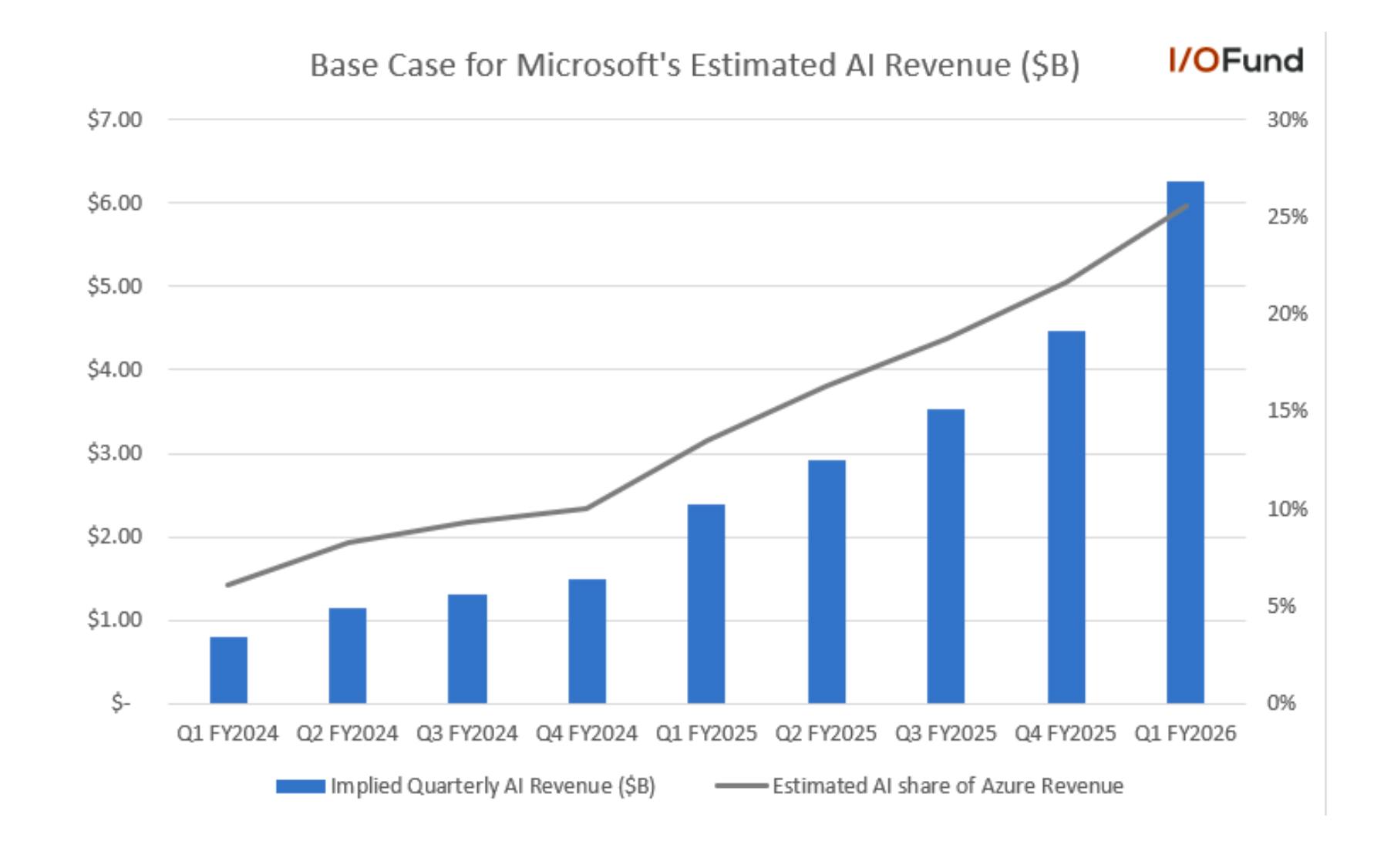
The base case for Microsoft assumes AI contributing approximately 22 points to growth as of fiscal Q1, or around 56% of its YoY growth in dollars. This could imply AI revenue at 26% of Azure’s total revenue, or around $25 to $26 billion on a nearly $100 billion annual run rate for Azure.
Chart illustrating Microsoft’s base case of AI revenue accounting for about 26% of Microsoft Azure revenue. It assumes AI is driving significant Azure growth.
Overall, it would require a step-up from 175% growth YoY to 460% year-over-year for Microsoft to match Meta’s AI revenue – an aggressive growth rate that I believe Microsoft would have already discussed with investors. Therefore, I believe probabilities favor Meta being in the lead on AI revenue, as it stands today. That means Meta would be in second place – second only to Nvidia – on AI revenue.
Meta’s Advantage+ results are one of the clearest real-time signals that the AI monetization wave is already underway, not theoretical.
Subscribe to our free AI & tech newsletter for weekly research and charts on AI monetization across leaders like META, NVDA, and MSFT. Click here.Subscribe to our free AI & tech newsletter for weekly research and charts on AI monetization across leaders like META, NVDA, and MSFT. Click here.
How Meta AI Advantage+ Generates $4.52 ROI Per Dollar
Advantage+ automates campaign targeting, budget allocation, and creative generation, providing advertisers with an easy-to-use tool that integrates generative AI directly into Meta’s ad ecosystem. Advantage+ is powered by Andromeda, which is an internally developed AI system that optimizes ad ranking, recommendation quality and content delivery by leveraging machine learning models more efficiently. By improving how models are executed, Andromeda allows Meta to extract more performance per unit of compute, which is key as the AI powered ads platform seeks high-volume inference.
Meta revealed earlier this year that “for every dollar spent on its AI-enabled Advantage+ products, advertisers generate on average $4.52 in revenue for their businesses,” or an increase of ~22% versus typical campaigns, highlighting how ad performance improves while using the AI-powered platform.
In Q3, Meta emphasized that “Advantage+ continues to drive performance gains, [and] advertisers who run lead campaigns using Advantage+ are seeing a 14% lower cost per lead on average than those who are not.” This compares to a 10% lower cost per lead as of April, showing that the platform continues to drive results while lowering costs per lead.
Meta Stock: $10B Growth Proves AI Advertising Acceleration
There is additional evidence that Meta is seeing tailwinds from AI recommendation models, which in turn drive higher ROI for advertisers and increase time spent across its family of apps.
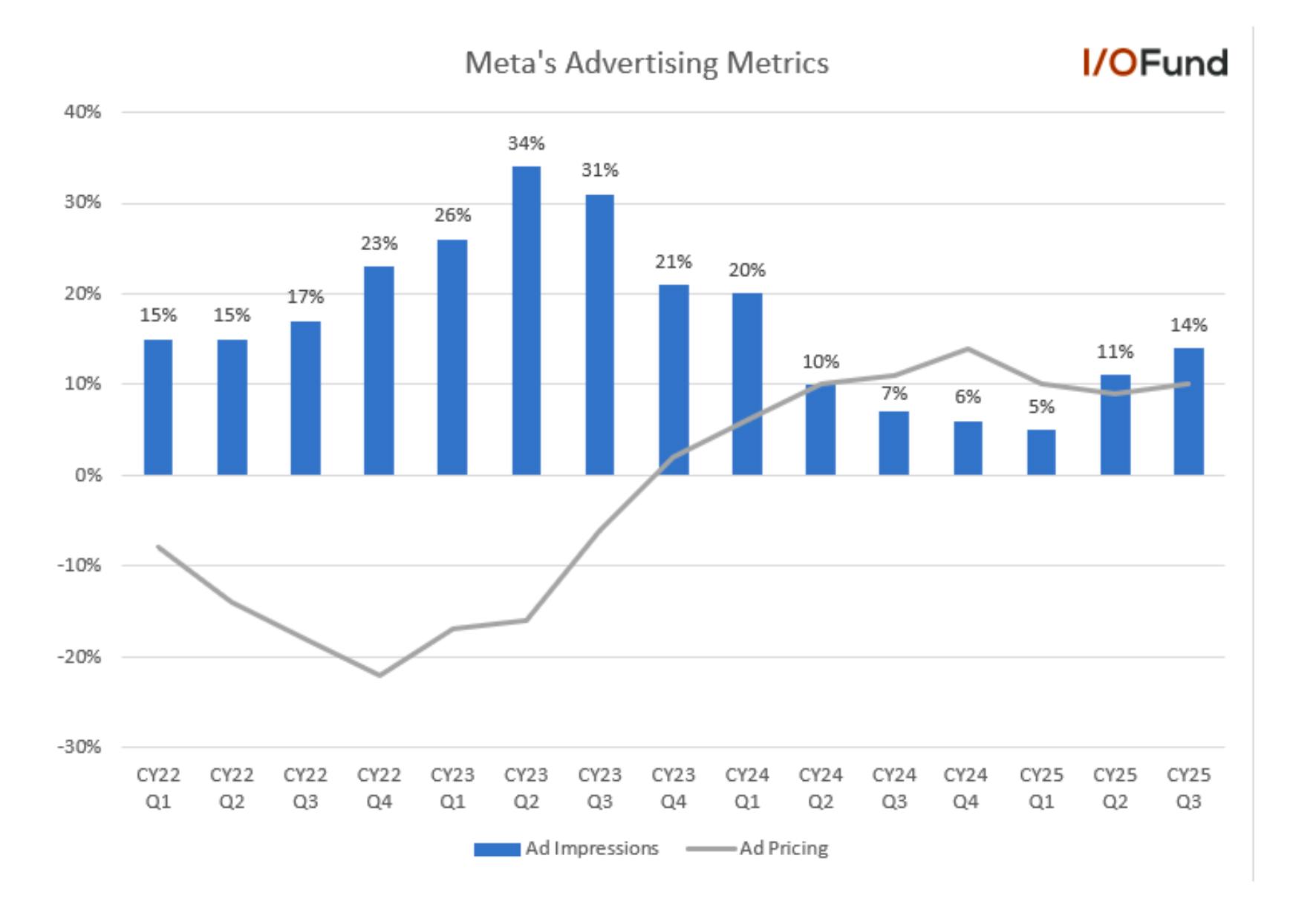
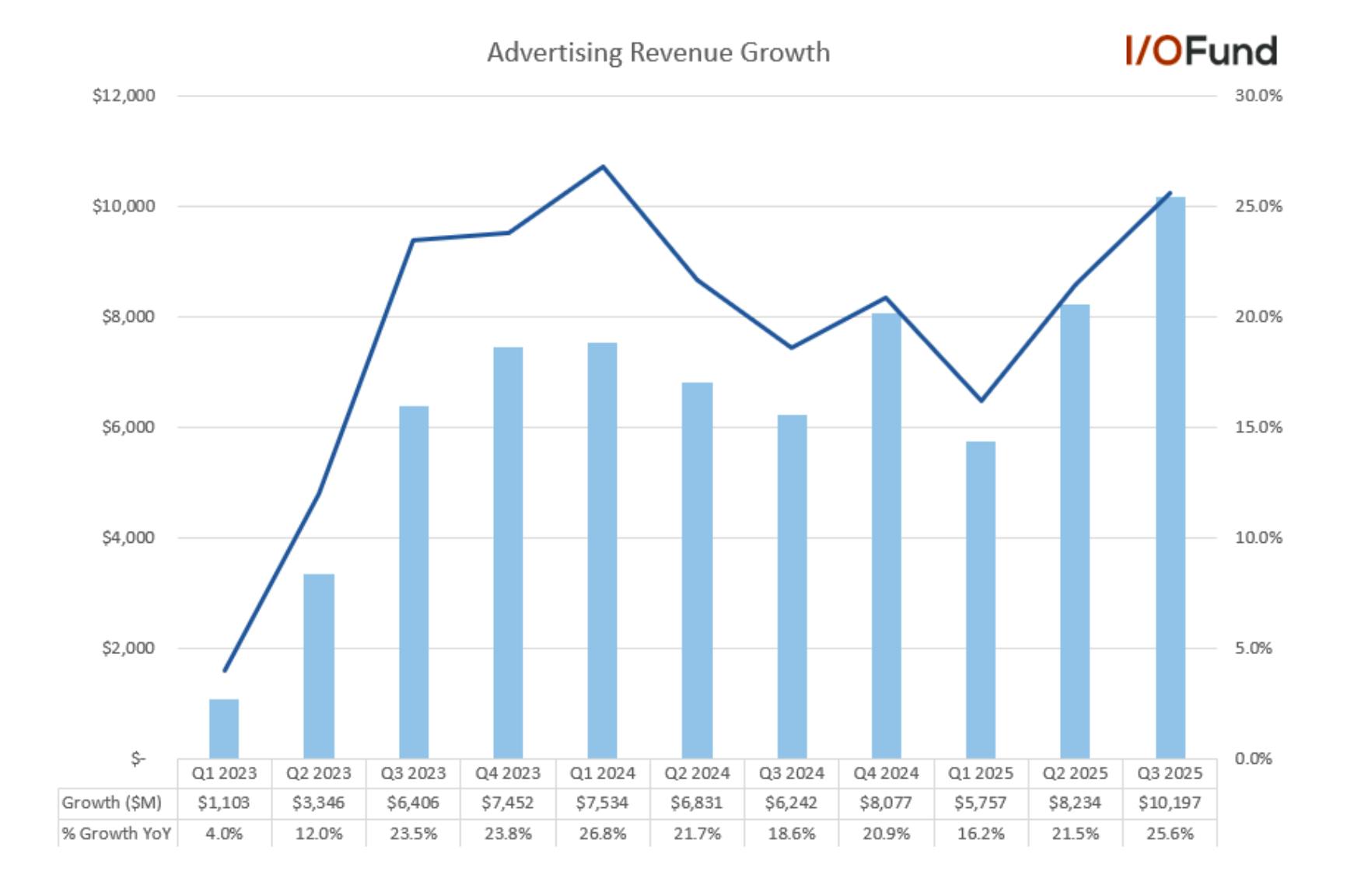
In Q3, advertising revenue grew 25.6% YoY, accelerating more than nine points since Q1 and marking the fastest growth in six quarters. Ad impressions rose 14% YoY in Q3, accelerating from 11% in Q2 and marking a strong inflection from just 5% growth in Q1. Pricing remained steady, rising just one point to 10% YoY.
Meta Stock Ad Impressions: AI drives 3-point acceleration to 14% YoY in Q3.
However, the dollar growth in advertising stands out more — Meta has delivered its two largest YoY growth quarters on a dollar basis in Q2 and Q3, at $8.23 billion and $10.2 billion, even outperforming Q4 2024’s holiday-boosted growth of $8.08 billion. This high dollar growth is poised to continue in Q4 2025, with guidance pointing to ~$9.3 billion to $10.7 billion in QoQ dollar growth.
Meta ad revenue accelerated to 25.6% YoY growth in Q3, up from 21.5% in Q2, highlighting the success of AI recommendation models.
Put another way, Meta is delivering larger YoY dollar growth in advertising revenue on a larger base – Q3 2025 grew $10 billion YoY off a $40 billion base, versus $7.5 billion growth in Q3 2024 on a $33.6 billion base.
AI Drives Record ARPP Continues to Accelerate Heading into Q4
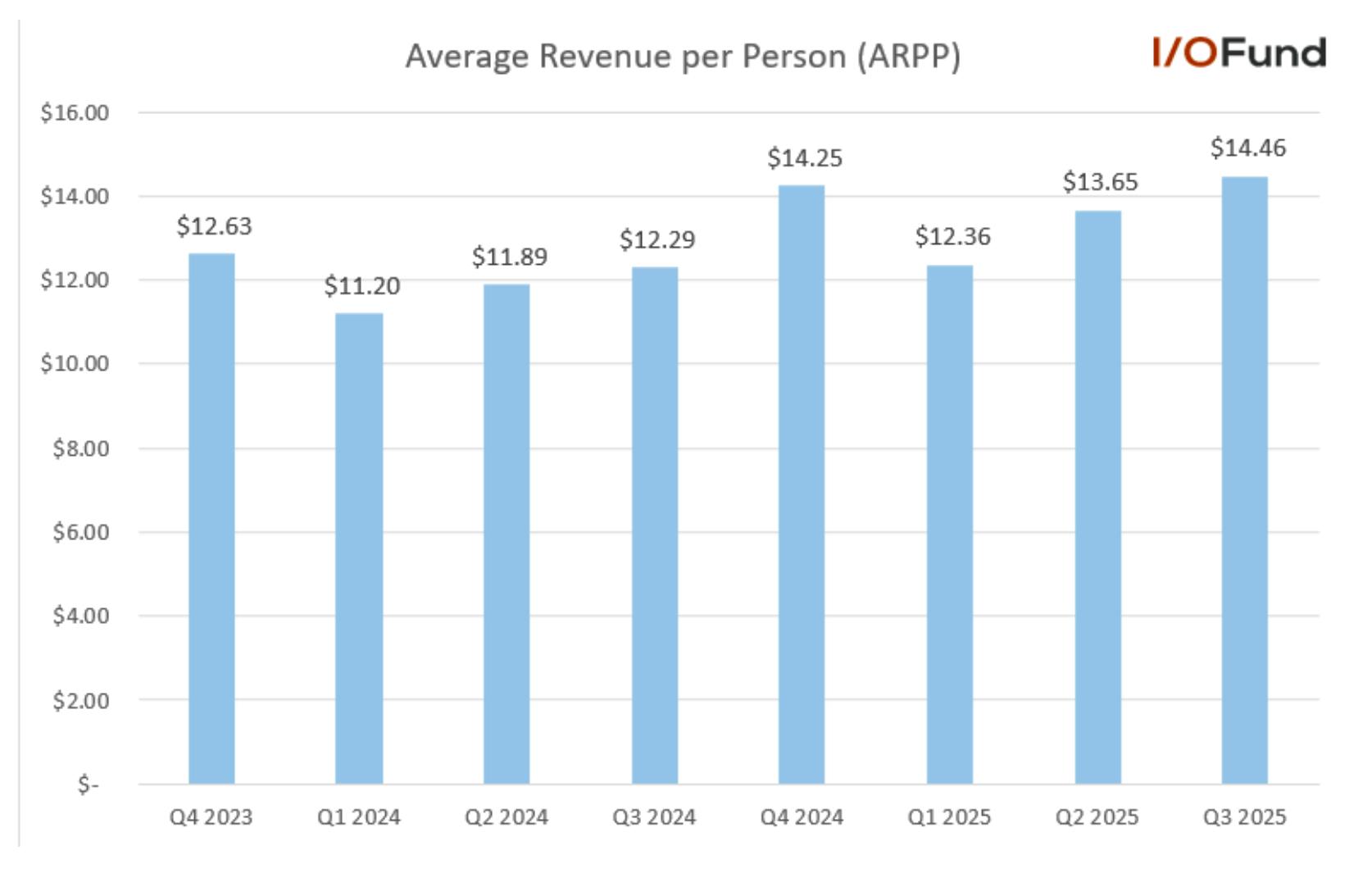
Perhaps the most important metric for Meta’s ads monetization is ARPP (average revenue per person), with the metric continuing to accelerate in Q3 ahead of the seasonally stronger holiday quarter. ARPP reached $14.46 in Q3, accelerating to 17.7% YoY from 14.8% in Q2. More impressively, this marked a record high for ARPP, surpassing Q4 2024’s seasonally stronger ARPP of $14.25.
Meta ARPP: AI-driven efforts push to a record $14.46 in Q3.
This sets the stage for ARPP to push well beyond $15, potentially to $16 in the upcoming quarter, highlighting that Meta’s AI-driven ad performance improvements and monetization efforts are bearing fruit.
Annual Revenue Revisions Seeing Sharp Increase Since July
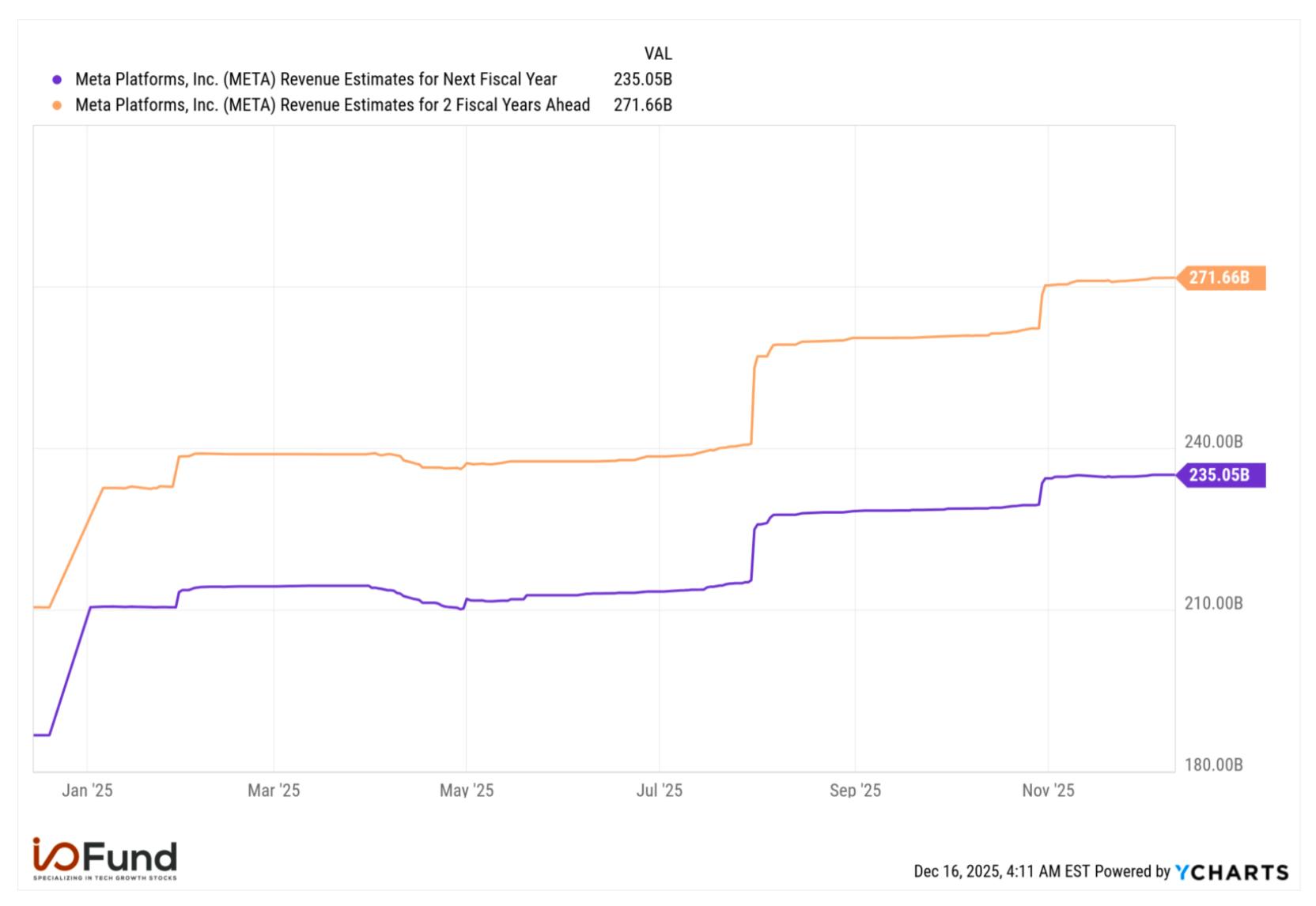
What’s notable about the revenue front is the sharp upward revisions to annual revenue estimates, with 2026 and 2027 moving sharply higher since this summer.
Back in July, prior to Q2’s earnings, Meta was expected to generate $215.1 billion in revenue, with that now sitting at $235.1 billion. On a YoY basis, growth has been revised from 14.0% to 17.9%. A smaller uplift considering 2025 comps have toughened, having risen from 14.7% to 21.3% over the same period.
For 2027, Meta was expected to generate $240.6 billion in late July, with that now sitting at $271.7 billion, with YoY growth moving from 11.9% to 15.6% on a higher base.
Chart showing the increase in Meta’s forward revenue estimates.
Meta Ad Performance: Leveraging GEM, Lattice, and Andromeda AI Models
Meta outlined two monetization levers in Q3 – improving ad performance, and an ability to continue delivering engaging content to users.
This first monetization lever stems from improving ad performance for its advertisers, mostly driven by the company’s three foundational models as well as its end-to-end ads automation platform Advantage+. Meta opts for tracking conversions to gauge ad performance, despite it being a complex metric to track considering advertisers can optimize for different types of conversions. CFO Susan Li stated that value-weighted conversion rates showed “very strong” YoY growth in Q3, outpacing impressions.
Meta’s three foundational models all serve a different function, with the same end goal of improving ad quality and conversions to drive higher ROI for advertisers:
GEM (Generative Ads Recommendation Model) is described by Meta as the ‘super brain’ that can rapidly process, catalog and analyze trillions of data points, to then recognize subtle patterns in user activity to provide the most relevant ads at the right time. Meta says GEM was rolled out more broadly earlier this year after initial testing on Reels saw GEM boost conversions by up to ~5%. GEM delivered a 5% increase in conversions on Instagram and a 3% increase on Facebook in Q2, and in Q3 Meta “doubled the performance benefit we get from adding a given amount of data and compute” to continue scaling training capacity at an attractive ROI.
Get Our Free Weekly Stock Newsletter
Get weekly stock insights, market analysis, and technology updates straight to your inbox.
Weekly stock insights
Market analysis
Technology updates
Lattice is described as a ‘giant library’ that generalizes learnings across different campaign objectives (clicks, views, etc), surfaces (Reels, Story, Feed, etc) and subjects, in order to predict an ad’s performance. Lattice increases ad efficiency as it runs fewer models, while the knowledge-sharing effect increases ad quality and conversions – Meta said earlier this year that Lattice has increased ad quality by 12% and conversions by 6%. In Q3, Meta rolled out Lattice to app ads, driving a ~3% gain in conversions on that objective.
Andromeda is described as a ‘personal concierge’, or Meta’s vast ML ad recommendation and prediction system that, at its core, aims to predict exactly which ads a user will find the most interesting. For Andromeda, Meta says, “Imagine having a personal concierge who knows your tastes so well that they don’t just understand that you covet shoes, but that you like to wear red flip flops at the beach.” Meta said that in Q3, it significantly improved Andromeda’s performance by combining retrieval and early-stage ranking models, driving a 14% increase in ad quality on Facebook. Andromeda is also the core engine powering Advantage+ automation tools.
Moving to 2026, Meta discussed that it is “working on combining these 3 major AI systems into a single unified AI system that will effectively run our family of apps and business using increasing intelligence to improve the trillions of recommendations that it will make for people every day.”
A single model that combines the strengths of GEM, Andromeda and Lattice could theoretically understand user preferences and activity at a much deeper level, improve ad ranking quality, relevance and conversions across its family of apps, and save on inference. For example, Meta does not use GEM for inference as its size makes it too cost-prohibitive, rather it transfers knowledge to smaller run-time models; a single model incorporating GEM’s knowledge could potentially run inference in a more cost-effective manner.
Meta AI Lever 2: Reels Reaches $50 Billion ARR Due to Increased Engagement
On the second monetization lever of increasing engagement, Meta is executing quite well, with improvements in its recommendation models helping drive time spent on its apps higher. More time spent then allows ad impressions to grow without substantially increasing ad load, underpinning this reacceleration in impressions growth seen in Q3 and more growth moving forward.
Management pointed out that “overall time spent on Facebook and Instagram grew double digits year-over-year, driven by continued video strength as well as healthy growth in nonvideo time on Facebook.” Video time spent on Instagram was more than 30% higher versus last year, while AI ranking optimizations helped drive 10% more time spent on Threads in Q3. This video growth has pushed Reels to a $50 billion annual run rate in Q3, up 5X from its last update in Q2 2023 when it reached a $10 billion run rate.
Improving ranking models remains a key focus for Meta moving through 2026, with management expecting new model innovations to help “significantly scale up the amount of data and compute we use to train our recommendation models in 2026, yielding more relevant recommendations.”
Meta’s Upcoming Capex Surge and Possible FCF Crunch
Some of the most important quotes from Q3’s call circled back to Meta’s view on capex and why it believes aggressive expansion of capacity and thus capex is a necessity. CEO Mark Zuckerberg believes it is the “right strategy to aggressively front-load building capacity so that way we’re prepared for the most optimistic cases” on when AI superintelligence arrives, so Meta is prepared to capitalize on this opportunity.
If building superintelligence takes years longer than expected, Zuckerberg says Meta can “use the extra compute to accelerate our core business which continues to be able to profitably use much more compute than we’ve been able to throw at it. And we’re seeing very high demand for additional compute, both internally and externally.
These comments underscore why Meta is aggressively raising its capex spending this year and next – Zuckerberg believes that the upside potential of superintelligence is so large that it is worth the risk of overbuilding to not fall behind OpenAI or Google (with compute capacity being the main advantage), with Meta able to use extra compute in the meantime to improve core AI ad capabilities and drive growth.
However, the tradeoff for this is lower free cash flow and potential operating margin headwinds. Meta expects capex dollar growth to be “notably larger in 2026 than 2025,” while total expenses “will grow at a significantly faster percentage rate in 2026” driven by infrastructure costs, incremental cloud costs and depreciation, followed by employee compensation.
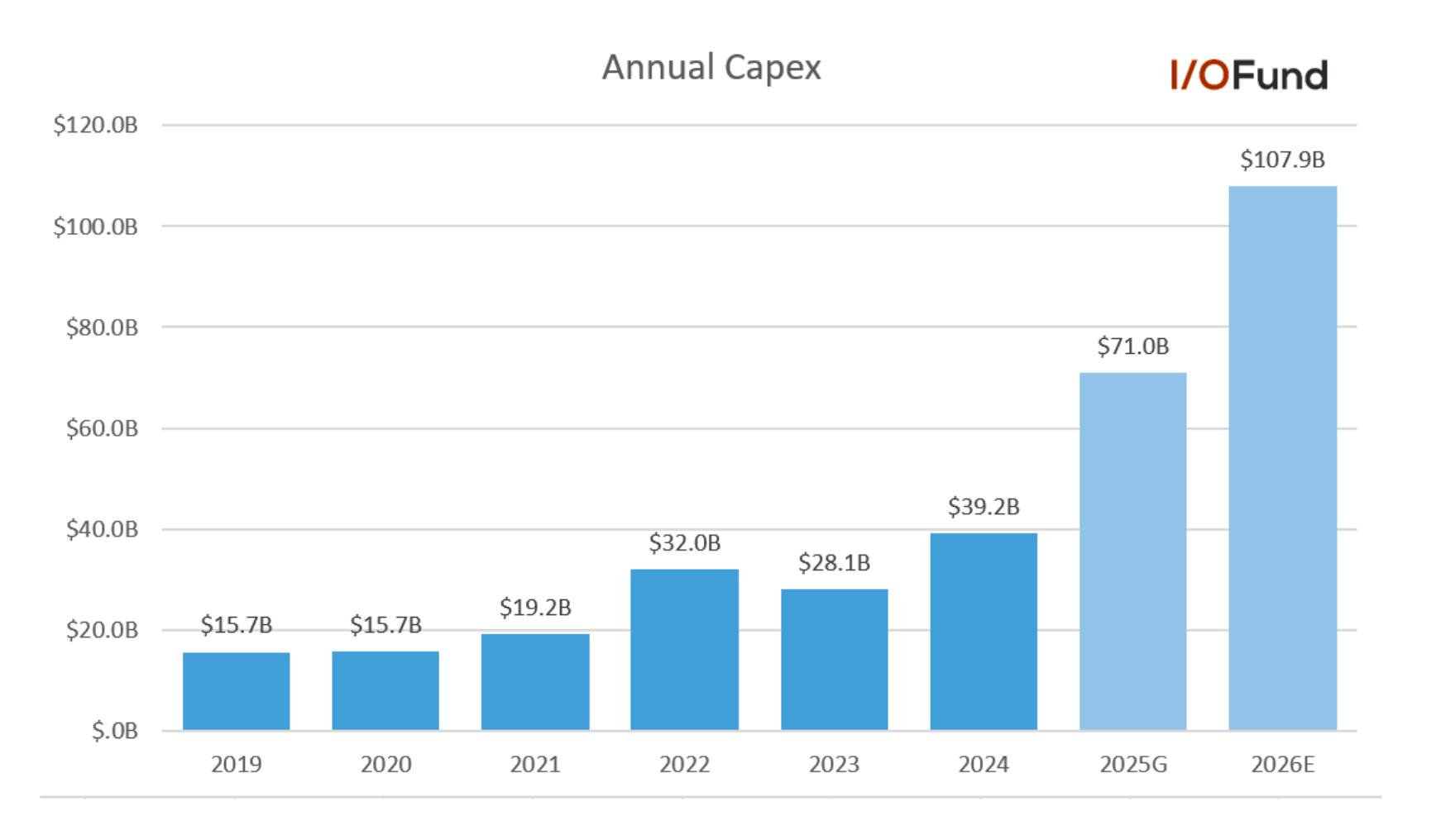
This implies 2026 capex of at least $103 billion, as current guidance for 2025 at $70-72 billion implies a minimum of ~$32 billion YoY growth. However, considering management’s comments for notably larger dollar growth, there is potential for capex to come in at or above $110 billion, up ~55% YoY, above current estimates for $107.9 billion. Put another way, Meta could spend ~$30 billion more in 2025 and 2026 than it did in 2019 through 2024 combined.
Meta capex is projected at $107.9 billion in 2026 as it prepares to monetize the AI superintelligence opportunity.
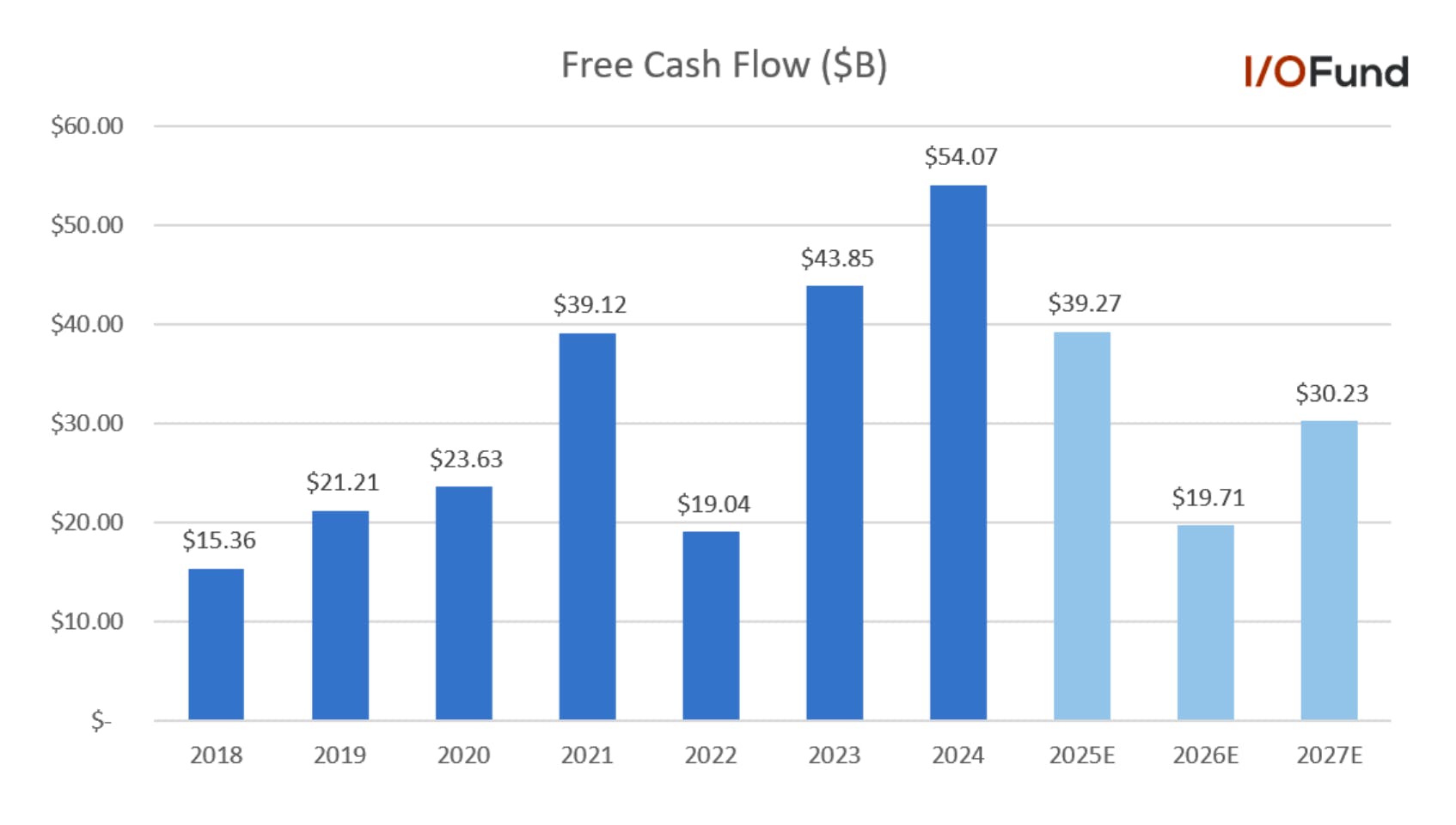
The capex surge will potentially cause another free cash flow crunch similar to 2022, with current consensus estimates pointing to FCF of $19.71 billion in 2026, down nearly (50%) YoY and (63.5%) from 2024.
Meta’s AI-driven capex surge will potentially cause another free cash flow crunch in 2026. This mirrors the 2022 crunch when FCF fell to $19.04 billion from $39.12 billion in 2021.
How Meta’s Capex Compares to Other Big Tech Stocks
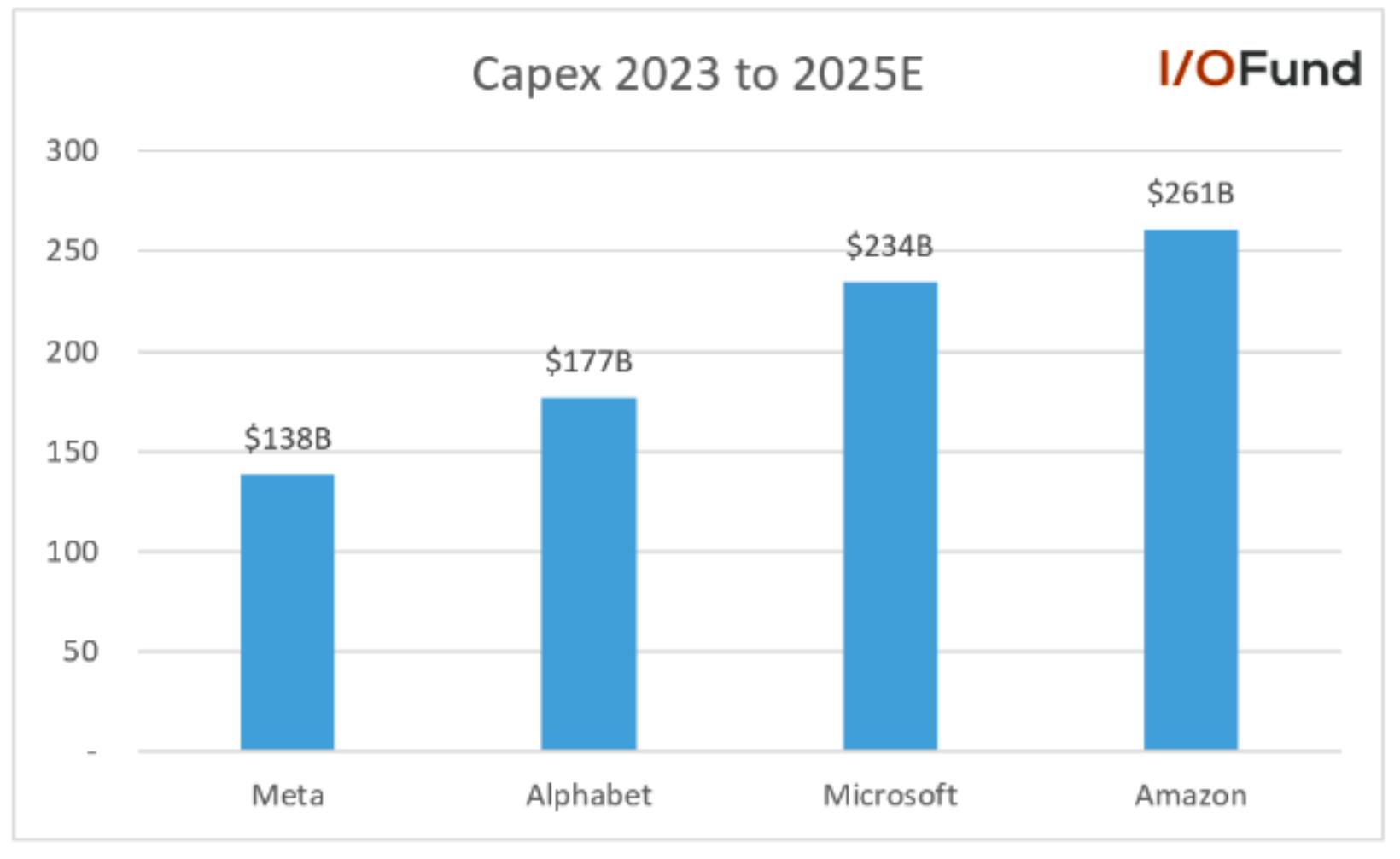
We recently discussed Big Tech Capex spending following Q3 earnings results in our article, Big Tech’s $405B Bet: Why AI Stocks Are Set Up for a Strong 2026. As seen in the chart below, Meta has the lowest cumulative capex for the years 2023 to 2025E of $138 billion. This figure is lower than that of other Big Tech Companies, such as Alphabet at $177 billion, Microsoft at $234 billion, and Amazon at $261 billion.
Meta has the lowest cumulative capex for the years 2023 to 2025E among the Big Tech Companies
Big Tech companies are now beginning to report their AI revenue in the quarterly earnings results, unlike AI semiconductor companies, which have consistently been providing this figure. During the June quarter, Microsoft revealed that Azure surpassed $75 billion in annual revenue. If we assume that AI revenue constitutes 26% of Azure revenue, Microsoft’s AI revenue would be a base case of $20 billion up to $26 billion if we assume the same growth rate as last year, well below the $60 billion for Meta. I do foresee a scenario where Microsoft is higher than the base case, yet it’s unlikely the growth rate is at the 450%+ growth rate required to pass Meta. Similarly, Alphabet and Amazon who spent far more than Meta are not revealing AI numbers, which theoretically means the numbers are lower than Meta’s.
Meta’s Free Cash Flows hit by high Capex
Meta has strong operating cash flows. However, due to high capex to support AI investments, the company’s free cash flows were down (31.5%) YoY to $10.63 billion in Q3. Capex rose 110.5% YoY to $19.34 billion, driven by investments in servers, network infrastructure and data centers. Based on 2025’s capex guide, which was raised to $70-72 billion (up 81% YoY at midpoint), Q4 capex is on track to be ~$21 billion, up 41.5% YoY. Meta is expected to see a steep free cash flow crunch moving through 2026 as a result of surging capex and would be a risk item to keep an eye out for in the coming quarters.
Conclusion:
While much attention is given to Nvidia and AI semiconductors for visible AI-driven growth, we are beginning to see an impact in Big Tech’s software segments. Meta’s advertising revenue accelerated to the mid-20% range, and YoY dollar growth surpassed $10 billion in Q3. Revenue forecasts continue to strengthen over the next few years with revisions of up to $30 billion, or up 10-14% since July, underscoring the Street’s confidence in Meta’s ability to leverage AI to improve monetization.
More impressively, Meta’s AI ads automation platform has reached a $60 billion run rate in Q3 in three and a half years from its launch. This is 3X Broadcom’s AI revenue, 3X OpenAI ARR and could even put Meta as the #2 stock by AI revenue ahead of Microsoft. Notably, the I/O Fund is the first firm to point out Meta’s quiet dominance relative to Microsoft, as we consistently find an edge in earnings data that others have overlooked.
However, the thorn in Meta’s side stems from the compute and capex side, as the company is aggressively building data center capacity to prepare itself for the most optimistic scenario of reaching superintelligence. Not only is capex guided to surge to over $100 billion in 2026, potentially creating another cash flow crunch reminiscent of 2022’s metaverse-linked spending spree, but expense growth is also expected to outpace revenue growth by a wide degree and weigh heavily on operating margin.
This year, my firm has 15 positions beating the Nasdaq YTD, up from ten positions last year – helping to cement the I/O Fund as one of the world’s leading AI portfolios. Our cumulative return of 210% over a five-year period would rank us #2 if we were a hedge fund and #5 if we were an ETF – notably, this strong cumulative return does not yet include our 2025 performance.
Want our real-time trade alerts and full AI portfolio positioning, including a newly updated 3,800-word deep dive on Meta’s near-term risks and potential entry points? Join our Advanced plan here. Advanced members also receive weekly webinars and full access to our actively managed portfolio of lesser-known AI stocks.
Please note: The I/O Fund conducts research and draws conclusions for the Fund’s positions. We then share that information with our readers. This is not a guarantee of a stock’s performance. Please consult your personal financial advisor before buying any stock in the companies mentioned in this analysis.