Blogs -Where I Plan To Buy Nvidia Stock Next

Where I Plan To Buy Nvidia Stock Next


January 02, 2025

author

Beth Kindig

Lead Tech Analyst

This article was originally published on Forbes on Dec 23, 2024,05:03pm EST

Blackwell is the word for Nvidia as the AI leader heads into 2025, with multiple configurations and a mid-year upgrade (B300/GB300) for its new powerful GPU set to ramp significantly over the next few quarters. As recapped to the I/O Fund’s premium members after its Q3 earnings report, the I/O Fund is tracking multiple supply chain signals indicating Blackwell sales will likely far exceed the GPU sales we saw in 2023 and 2024 combined – to the tune of bringing Nvidia to $200 billion in data center revenue.

Analysts are already increasing their forecasts for Blackwell shipments for Q4 and for Q1, with forecasts for 250,000 to 300,000 shipments in Q4 nearly tripling to 750,000 to 800,000 in Q1. This compares to previous views seeing Q4 shipments of 150,000 to 200,000 ramping to 550,000 in Q1. This suggests Blackwell revenue estimates for Q1 are already moving 40-60% higher, potentially driving positive revenue revisions throughout the year as it becomes Nvidia’s primary GPU product.

Nvidia has tailwinds in 2025 from increased pricing power with Blackwell, output and shipment estimates already rising before the ramp begins, AI capex still quickly growing, and GPU clusters starting in the 100K range where Hopper maxed out, even as competition from AMD, Broadcom and others begins to increase.

Nvidia also has the benefit from the end of its fiscal year early next year, with the Street soon looking to 2026 numbers – which very well could be too low given the signals Blackwell is already giving. At the moment, Nvidia is trading at just 30x 2026’s estimated earnings of $4.43, its cheapest bottom line valuation since shares were $95 in May 2024 – and Blackwell still holds the potential to drive quarterly revenue beats the same way Hopper has and with margins returning to Hopper’s highs.

The bigger picture for Nvidia moving forward is that Blackwell holds the potential to dwarf Hopper, and the I/O plans on keeping its members informed on what it sees ahead for Nvidia with frequent updates for members. With that in mind, here’s what the I/O Fund sees as 2024 ends and 2025 begins.

Sign up for I/O Fund's free newsletter with gains of up to 2600% because of Nvidia's epic run - Click here

Nvidia Technicals: A Swing Higher In the Cards

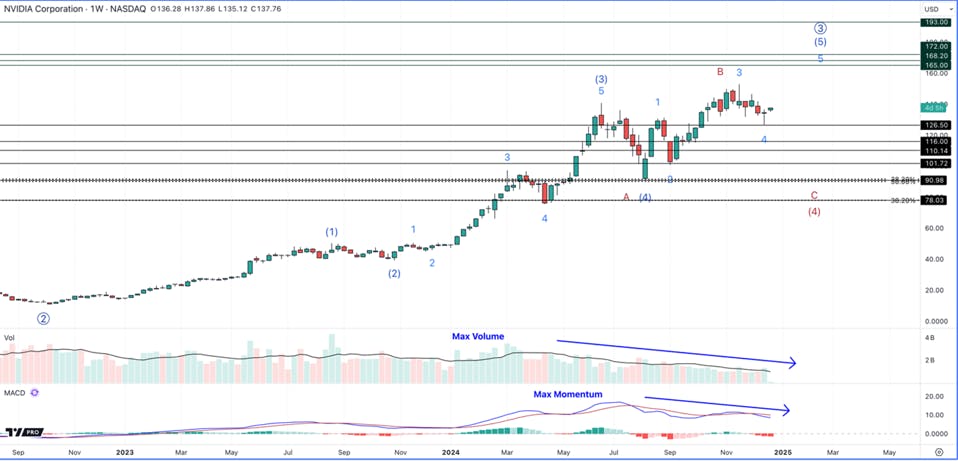
Nvidia appears to be setting up for the next swing higher. As long as any further weakness holds over $116, this move should target between $165 - $173, with the potential to reach as high as $193.

If this swing gets confirmed, it would likely be the final 5th wave in the historic uptrend that started in October of 2022. This does not mean that the technicals do not support significantly higher prices, it only means that Nvidia will first have to deal with a notable correction in both price and time before it sees those levels.

The pattern off the October 2022 low developed as a classic 5 wave pattern. In early 2024 price went vertical. This was accompanied with max volume and peak momentum. This is the standard pattern seen in 3rd waves, and it tends to be the most powerful part of a 5 wave pattern. From the perspective of sentiment, this is the part of the trend where everyone realizes at once the direction of the trend. Shorts cover at the same time as the crowd buys, creating that standard pattern in 3rd waves.

This would mean that the correction in June of 2024 was the 4th wave, and that this is likely in the final 5th wave higher. The sentiment pattern in 5th waves to new highs in price, but on lower momentum and lower volume, which is what is happening now.
Nvidia Chart 1

Nvidia appears to be setting up for the next swing higher. Source: I/O Fund

Zooming into the 4th wave correction that started in June of 2024 offers a better idea of the two potential paths that I am currently tracking.
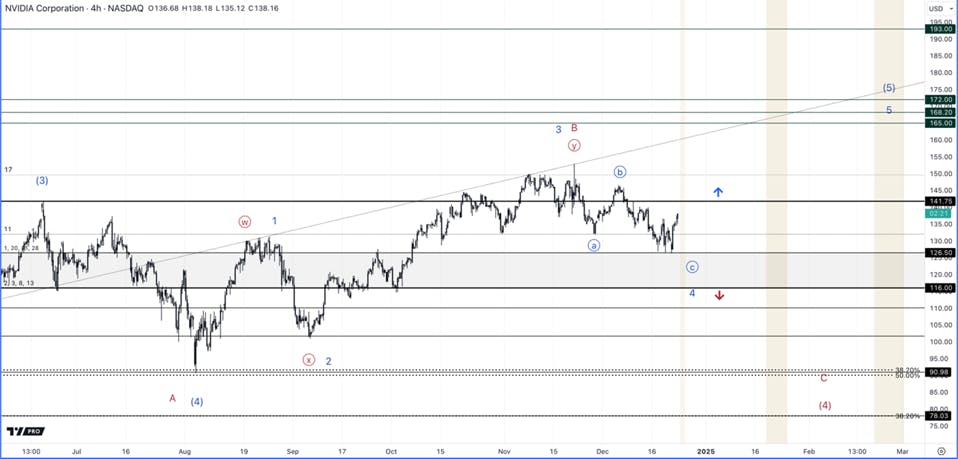
Nvidia Chart 2

Zooming into the 4th wave correction that started in June of 2024 gives a better idea of the two potential paths that I am currently tracking. Source: I/O Fund

  • Blue – The final 5th wave is playing out as an ending diagonal pattern, which is common for 5th waves. This type of pattern is a 5 wave pattern in itself that is characterized with large swings in both directions. Our target zone for the bottom on this 4th wave is $126 - $116. If Nvidia can push over $140.75, then then odds favor this scenario.
  • Red – Nvidia is in a much more complex 4th wave. If this is playing out, NVDA would see the $116 level break, which opens the door to a potential low at $101, $90, or $78.

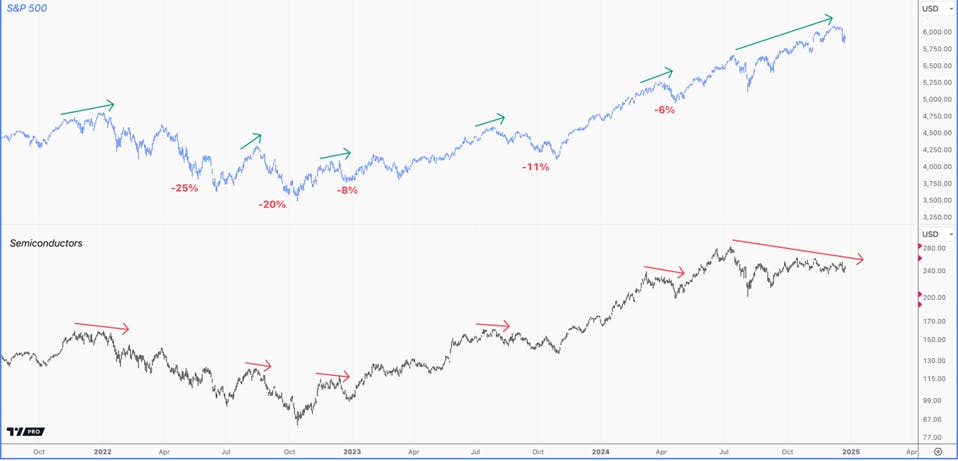
One final point worth mentioning is how the broad semiconductor sector is performing in relation to the S&P 500. Semiconductors tend to be much more sensitive to the consumer, and economy than most sectors. For this reason, in periods of economic expansion, semiconductors tend to lead, outperforming the broad market.

However, when this sector starts to move against the broad market, it tends to be a warning that volatility is ahead. In fact, every time that the semiconductor sector has made a lower high while the broad market made a higher high – i.e., semiconductors do not confirm the move higher – this preceded some period of volatility since the 2021 top.

S&P 500 and Semiconductor Charts

When semiconductors start to move against the broad market, it tends to be a warning that volatility is ahead. Source: I/O Fund

This pattern can be seen going back to 2000 and consistently warned of weakness. As of now, this is one of the largest and longest periods of divergence between the semiconductor sector and the broad market on record.

If the broader semiconductor sector stays below its July 2024 high, I would consider this a warning. This does not mean that I do not see potential upside, it only means that any long positions the I/O Fund takes will have strict targets at which we take gains and stops to protect us in case the market turns against us.

Every Thursday at 4:30 pm Eastern, the I/O Fund team holds a webinar for premium members to discuss how to navigate the broad market, as well as various stock entries and exits. We offer trade alerts plus an automated hedging signal. The I/O Fund team is one of the only audited portfolios available to individual investors. Learn more here.

Conclusion

Make no mistake, Nvidia is the best stock of the decade and it’s only four years in. The I/O Fund has an aggressive buy plan at key levels should the stock pull back, and we have a backup plan should the stock overcome the peer pressure we are seeing from the semiconductor industry and meaningfully breakout.

Nvidia has been our largest position for the last 4 years. The I/O Fund sent out nine buy alerts to our readers to buy this position below $20 in 2021 – 2022. The I/O Fund believes the future is bright for Nvidia, and believe the potential next swing is worth playing. However, with all the warning signs, any new long position will have strict risk controls until these warnings reset.

The I/O Fund is also closely analyzing the supply chain to identify overlooked beneficiaries of the AI infrastructure buildout, sharing this information as well as potential buy and sell plans and real time trade alerts with premium members. The I/O Fund recently entered two separate beneficiaries for gains of 23% and 17% since November. Learn more here.

I/O Fund Portfolio Manager Knox Ridley and I/O Fund Equity Analyst Damien Robbins contributed to this report.

Please note: The I/O Fund conducts research and draws conclusions for the company’s portfolio. We then share that information with our readers and offer real-time trade notifications. This is not a guarantee of a stock’s performance and it is not financial advice. Please consult your personal financial advisor before buying any stock in the companies mentioned in this analysis. Beth Kindig and the I/O Fund own shares in NVDA at the time of writing and may own stocks pictured in the charts.

Recommended Reading:

This Is Not Broadcom’s ‘Nvidia Moment’ Yet

Semiconductor Stocks Exposed To China With Tariffs Incoming

Shopify Stock Is A Black Friday Beneficiary That Faces Key Test In Q4

Nvidia’s Stock Has 70% Potential Upside For 2025

head bg

More To Explore

Newsletter

Data center illustration showing Google, Microsoft, Meta, and Amazon with AI revenue and capex spending trends. Capex spending rises faster than AI revenue between 2021 and 2026.

Big Tech’s AI Revenue Is Surging, but Suppliers Will Still Be the Bigger Winners 

Big Tech’s AI Capex has stomped estimates for multiple years and analysts are now calling for capex to surge to $1 trillion in 2027. However, hyperscalers have long battled investor concerns around wh

August 06, 2026
Futuristic AI data center filled with server racks and glowing network pathways, representing large-scale AI infrastructure investment and rising capital expenditures to meet growing demand.

AI Capex to Hit $1 Trillion – And Estimates Are Still Too Low

Big Tech capex is the driving force behind the AI infrastructure trade, yet Wall Street has repeatedly underestimated the sheer scale of the buildout. Currently, in 2026, the guidance for $732.5 billi

August 05, 2026
Abstract illustration of layered AI computing hardware processing digital tokens, symbols, and data streams representing AI infrastructure and inference demand growth.

Token Growth is Surging - Here Are the Beneficiaries 

The reality of AI demand growth has shattered early estimates for token processing, yet expectations continue moving up and to the right. In the second installment of our token processing series, we e

July 31, 2026
Abstract visualization of a flowing stream of digital tokens, numbers, and symbols representing AI token processing and inference demand growth.

AI Token Demand is Shattering Forecasts 

Total annual token processing is no longer measured in billions or trillions of tokens, but in the quadrillions and beyond. As annual token processing is now tracked in units with 15 trailing zeros, i

July 30, 2026
TSMC N3 wafer technology connected to Intel EMIB advanced packaging in an AI semiconductor manufacturing graphic.

Nvidia and Google Are Crowding TSMC’s N3 Node - Can Intel Fill the Gap?

Nvidia is moving its next-generation Rubin GPUs from 4nm to 3nm, yet Google’s latest TPUs are already on N3 and are expected to remain there. Meanwhile, a growing number of AI CPUs from Nvidia, Amazon

July 26, 2026
Illustration of Intel EMIB-T advanced packaging connecting AI compute dies and HBM memory as an alternative to TSMC CoWoS.

Intel vs TSMC: How CoWoS Packaging Constraints Could Create an Opportunity for Intel Foundry 

Taiwan Semiconductor (TSMC) is the single, most important company to the AI industry. However, to compete with the incumbent, Intel does not need to beat TSMC at leading-edge manufacturing. It only ne

July 24, 2026
Amazon, Meta, Microsoft, and Google displayed with financial charts, illustrating rising AI capex and growing free cash flow pressure across Big Tech.

Big Tech’s Free Cash Flow is Turning Negative – Who's Next? 

Big Tech’s AI revenue is accelerating, but free cash flow is moving sharply in the opposite direction. Across Google, Microsoft, Meta and Amazon, capex is rising much faster than operating cash flow a

July 19, 2026
Illustration of Google, Microsoft, Meta, and Amazon stock dashboards against a digital circuit-board background, symbolizing Big Tech earnings, AI growth, and investor performance.

Big Tech Earnings Preview: Is AI Monetization Finally Catching Up to Capex?

The most pronounced difference between 2026’s tech rally compared to rallies in the past is which companies have been left out of it. The names most associated with the AI trade have hardly participat

July 17, 2026
Side-by-side image of an NVIDIA CMX server and a CXL memory expansion card against a data center background.

Nvidia, CXL, and the Battle to Improve AI Inference Economics

This is Part 2 of our two-part series on AI inference economics. In Part 1 — Why Nvidia's Next AI Battle Is About Tokens per Watt, we laid out why tokens per watt has become the defining metric for in

July 12, 2026
NVIDIA BlueField networking platform card shown on a green digital network background.

Why Nvidia’s Next AI Battle Is About Tokens per Watt 

As hyperscalers move from building AI infrastructure to monetizing it, tokens per watt helps to reflect if revenue is scaling and if profitability is improving. Offload engines can increase tokens per

July 10, 2026
newsletter

Sign up for Analysis on
the Best Tech Stocks


Copyright © 2010 - 2026