The Harsh Truth: Retail Investors Take the Brunt of Market Losses
Beth Kindig·MAR 28, 2025·7 min read
On this page
Next week, the I/O Fund will be releasing our official 2024 returns, along with our updated cumulative and annualized returns. However, before we release our returns, we think it’s prudent to discuss the importance of verified returns for retail investors.
Retail Investors Take the Brunt of Market Losses
The unfortunate reality is that retail investors disproportionately suffer losses compared to institutional investors. According to a study by Dalbar Inc., the average retail investor underperformed the S&P 500 by 6.1% annually over a 20-year period with a 5.5% gap in 2023, which was higher than the gap in 2022 – showing that bull markets often do not reward retail investors in the way that it’s perceived. According to the report, this is because “investors tend to sell out of investments during downturns and miss out on rebounds.” Additionally, Bloomberg found that 80% of day traders quit after the first two years.
A University of Oxford professor explains this disparity: “Retail investors will always lose money because they lack the ‘education,’ whereas financial professionals are well-informed – that’s what they do.”
This is especially concerning given that retail investors now make up 25% of the market, a sharp increase from 10-15% before the pandemic, according to Bloomberg Intelligence (Bloomberg, 2023). With more individual investors participating, the need for risk management and verified returns has never been greater.
The I/O Fund will officially release our 2024 returns and cumulative returns next week, with results that prove our firm has handily beat not only the indexes but also Wall Street’s best firms. Stay tuned to your inbox!
The Role of Quant Machines in Extreme Volatility
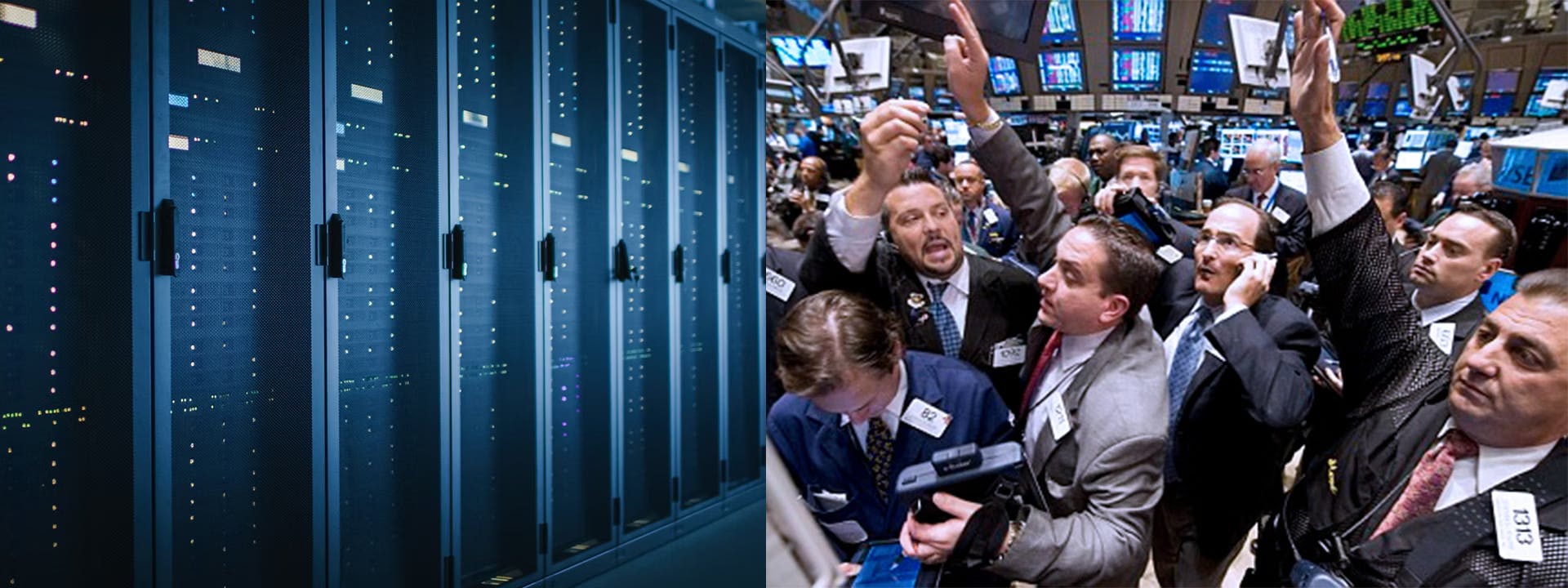
One of the primary culprits behind today’s extreme market swings is high-frequency trading (HFT) and algorithmic investing. While many newer investors picture a stock trading floor with market makers assisting trades, the reality is far different. Instead, the market is largely controlled by colocation data centers filled with high-speed servers executing trades in milliseconds.
Algorithms thrive on volatility, often triggering rapid selloffs that disproportionately hurt retail investors
Research shows that HFT firms account for 50-60% of U.S. equity trading volume, making them dominant players in the market. These algorithms thrive on volatility, often triggering rapid selloffs that disproportionately hurt retail investors, who don’t have the same tools to react instantly. A study by the CFA Institute found that flash crashes, largely caused by algorithmic trading, wipe out billions in market value within minutes, often before retail investors can even process what’s happening.
For example, during the May 6, 2010, flash crash, the Dow Jones Industrial Average plunged nearly 1,000 points in just 10 minutes, temporarily erasing nearly $1 trillion in market value—a drop largely attributed to high-frequency trading algorithms. Similarly, in December 2018, a wave of algorithm-driven selling caused the S&P 500 to drop nearly 20% in a matter of weeks, triggering widespread panic among retail investors.
Join thousands of investors who trust I/O Fund’s expert stock analysis on AI, semiconductors, cryptocurrency, and adtech — sign up for free! Click here!
A report from the Bank for International Settlements (BIS) further found that high-frequency trading increases market fragility, as it can amplify both buying and selling pressure, creating price swings that disproportionately impact smaller traders. Per Ox Journal: “Although, all these benefits do come at a cost, derived also from the increase in liquidity that these algorithms provide; the cost is the increase in volatility. To be exact, Zhang finds that high-frequency trading increases short-term intraday volatility by 30%.”
Without access to sophisticated trading tools, retail investors are left vulnerable to these rapid market fluctuations.
Why Risk Management Tools Are Essential
Get Our Free Weekly Stock Newsletter
Get weekly stock insights, market analysis, and technology updates straight to your inbox.
Weekly stock insights
Market analysis
Technology updates
Unlike institutional investors, retail traders rarely have access to advanced risk management tools, leaving them vulnerable to market swings. This is where the I/O Fund bridges the gap. Our firm provides:
Real-time trade alerts – Ensuring transparency and timely decision-making.
Advanced portfolio strategies – Utilizing hedging techniques to mitigate downturns.
A study by Morningstar found that investors who utilized risk-managed portfolios had 30% less volatility in returns over a 10-year period compared to those without structured strategies.
The Importance of Verified Returns
One major factor contributing to retail investor losses is the lack of transparency in the financial space. Institutional investors do not take performance claims at face value—they demand verified proof. Every hedge fund is required to report returns, reducing the chances of misleading data.
Over the past few years, the I/O Fund has invested over $175,000 into accountability and transparency for our members. When we launched in July of 2019, for the first year or so, we used a forum hosted by Tribe for our trade alerts for a cost of about $10,000 per year, but by January of 2021, we had migrated to SMS and email tools that were the least likely to experience an outage for our real-time trade alerts (Twilio and Mailchimp). This costs us $30,000 to $40,000 per year, depending on our trading frequency.
In addition to this, we use an auditor from a large firm in San Francisco to mathematically review and verify the performance of our I/O Fund portfolio trading account and crypto account. The process is quite extensive and it takes up to four months to complete. This costs $4,500 per audit and we’ve completed six audits for a total of $27,000 spent on this process. Accountability is expensive but we feel it’s worth it.
Raising the Standards for Retail Investors
The I/O Fund was founded on the principle that retail investors deserve the same high standards that institutional investors insist upon. By demanding transparency, utilizing professional risk management strategies, and offering deep dive research, retail investors can position themselves for success rather than becoming caught up in market volatility.
As we finalize our annual audit for 2024, we remain committed to providing the highest level of accountability in the industry. Our 2024 performance results will be published soon and we look forward to continuing to raise the bar for retail investors everywhere.
To further extend our goal of providing exceptional quality research for retail investors, we are pleased to announce the launch of our new Discovery tier after diligently working on this endeavor for nearly a year. The new tier is designed to surface dozens of new ideas each year and give our members a wider range of research into AI hardware, software, crypto and other areas that extend well beyond the I/O Fund’s portfolio.
Here is some coverage we have published over the past month on the Discovery tier:
A high beta stock with 21X growth potential from supplying power quickly to key AI hyperscalers
Power management integrated circuits (PMICs) company with signals for strong growth in H2
Nuclear and natural gas supplier for AI data centers
Coming soon: Biggest incoming IPO in the AI sector
For a limited time, get a 25% discount on Discovery priced at $299 through April 10th using code SAVE100DISC Learn more here.
Please note: The I/O Fund conducts research and draws conclusions for the Fund’s positions. We then share that information with our readers. This is not a guarantee of a stock’s performance. Please consult your personal financial advisor before buying any stock in the companies mentioned in this analysis.