
This article was originally published on Forbes on Nov 30, 2023,09:40pm EST
Cybersecurity stocks have performed well in 2023, rising about +26.5% YTD, with the security backdrop boosted by an increase in data breaches and ransomware. Quarterly spending has increased approximately +12.7% YoY to ~$37.6 billion through the first half of the year, although commentary from sector leaders Fortinet and Palo Alto raised some concerns about spend optimization, with billings forecasts from the two weaker than expected.
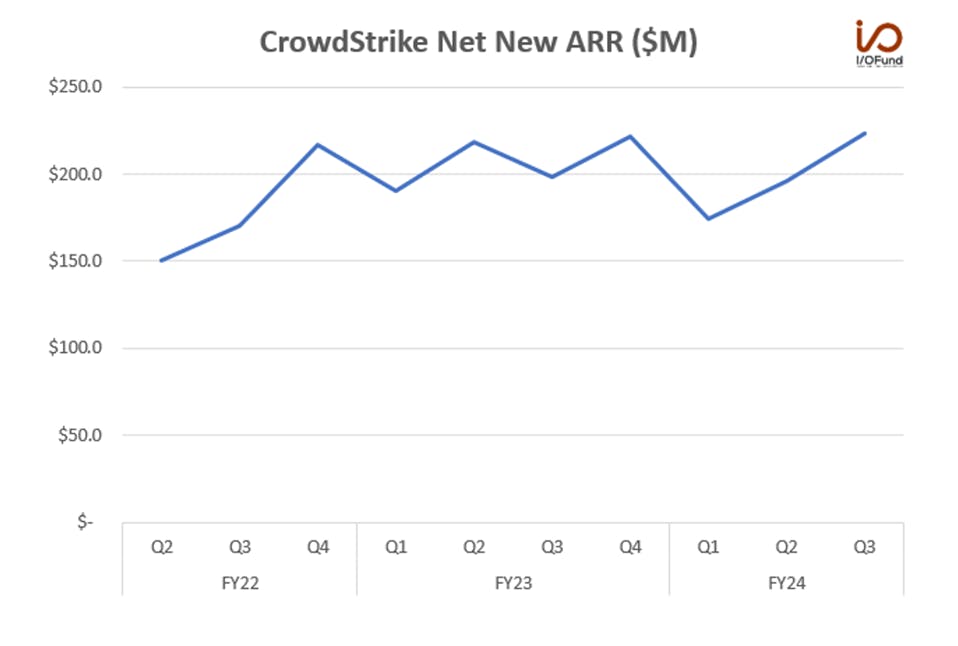
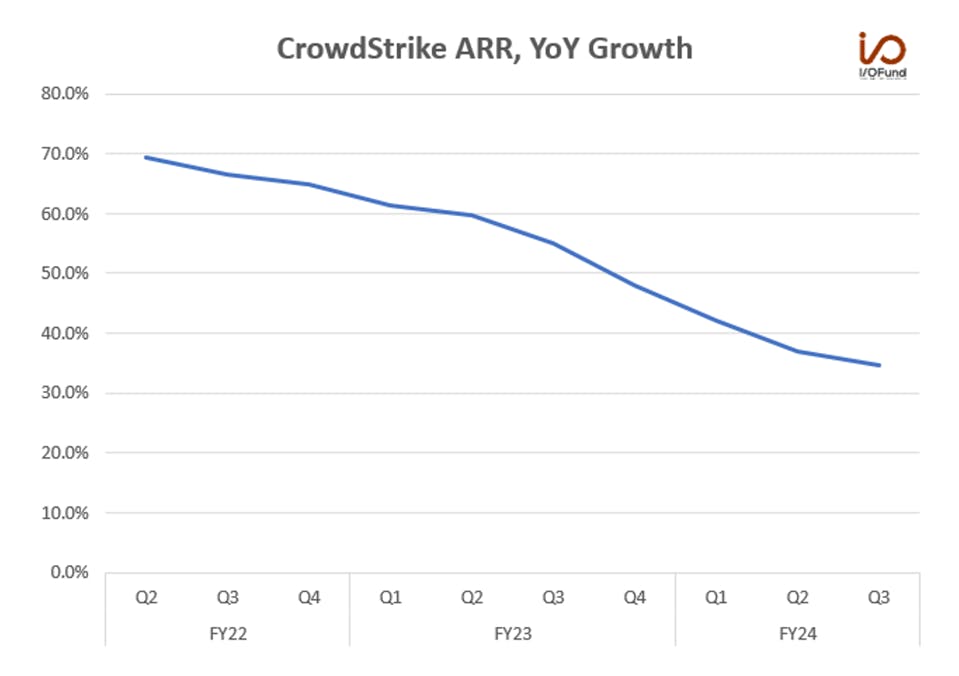
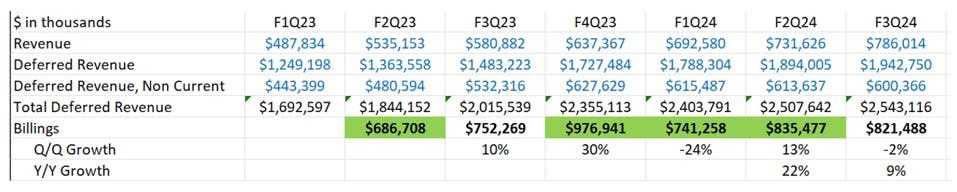
Despite beating on the top and bottom lines, Zscaler provided flat billings guidance while revenue growth is set to slow. CrowdStrike was GAAP profitable from operations for the first time ever as net new ARR reached a record, but billings and ARR growth both decelerated.
Cybersecurity Market Growth Slows in Q2
Zscaler and CrowdStrike reported their October quarters this week with both providing important commentary that the macro environment is tougher than usual. CrowdStrike’s management said that buyers still remain cautious since the “macroenvironment remains challenging with continued increased budget scrutiny.” Zscaler said that while the “global macro environment remains challenging, and customers continue to scrutinize large deals, … customer sentiment seems to be stabilizing.”
Looking back at the cybersecurity market through Q2 offers a bit of color on those broader trends impacting growth this year. The market registered a third straight quarterly deceleration in Q2, per Canalys estimates, as the global market recorded +11.6% YoY growth to $19.0 billion.
This marked a slight deceleration from the +12.5% growth in Q1 to $18.6 billion, and a sharper deceleration from the +15.8% growth rate seen in 2022, as the cybersecurity market topped $71 billion for the year.
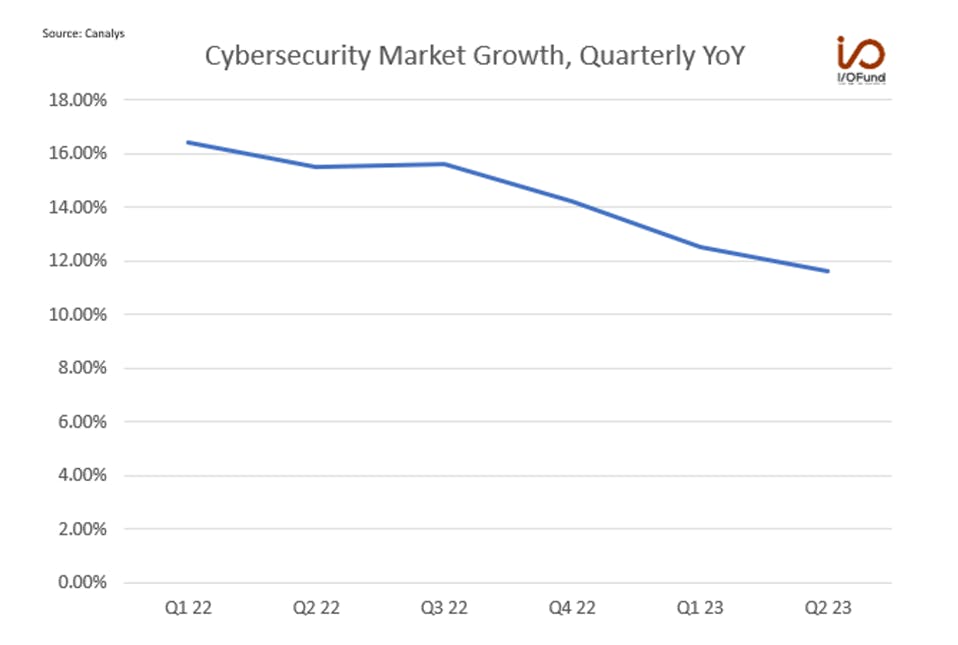
Growth in North America remained resilient at +12.6% YoY in Q2, the bellwether of the market considering it accounts for more than half of total spending. Latin America and EMEA growth remained in the double digits, though both decreased approximately 180 to 210 bp sequentially. APAC growth saw the largest slowdown, from +10.7% YoY in Q1 to +8.8% YoY in Q2.
Headwinds Remain in Play in Q3
Budget cuts, consolidation, and optimization are some of the trends at play in the cybersecurity market that are pulling 2023’s growth rates lower. Microsoft CEO Satya Nadella said in January during its fiscal Q2 earnings call that customers were “consolidating on our security stack, in order to reduce risk, complexity and cost.”
CrowdStrike CEO George Kurtz echoed Nadella’s view in the company’s Q1 earnings call in March that customers “want to reduce cost and headcount, reduce the number of point products and agents, reduce complexity and simplify operations.”
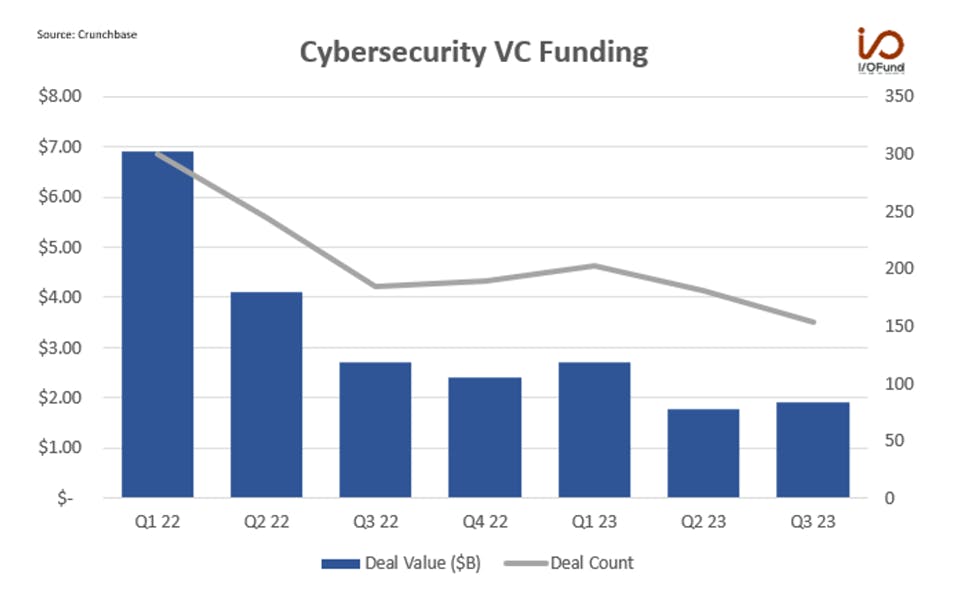
Venture capital funding deals and deal value also reflect this challenging environment persisting through Q3. According to Crunchbase, deal count declined just over (-15%) from Q2 to 153. Although deal value was marginally higher at $1.9 billion compared to ~$1.8 billion in Q2, it was about (-30%) lower YoY as large late-stage deals faded. VC funding has totaled just $6.4 billion YTD, on track to mark the lowest level of funding for cybersecurity startups since 2019, which totaled $8.8 billion.
Despite such cost and complexity concerns, companies are still committed to protecting data and operations. It’s this point that will drive long-term growth of the industry in the face of these near-term headwinds: there will always be more data to protect.
Sign up for I/O Fund’s free newsletter with gains of up to 221% – Click here
Fortinet: Q4 Guidance Soft, Billings to Decline YoY
Fortinet declined (-12.4%) following its Q3 earnings report for three key reasons: Q3 revenues marginally missed estimates, Q4 revenue guide was below consensus, and most importantly, Fortinet is projecting a YoY decline in net billings.
Fortinet reported revenues of $1.33 billion in Q3, which missed expectations by just $20 million. For Q4, Fortinet guided revenues $80 million lower at midpoint than the consensus estimate of $1.49 billion.
Q4 billings were projected to be between $1.56 to $1.70 billion, representing a YoY decline of ~(1%) to (9%). Management’s transition to SASE and security operations, and challenging network comps, are some of the factors behind the revenue slowdown with Fortinet seeing “modest” revenue growth for the next few quarters.
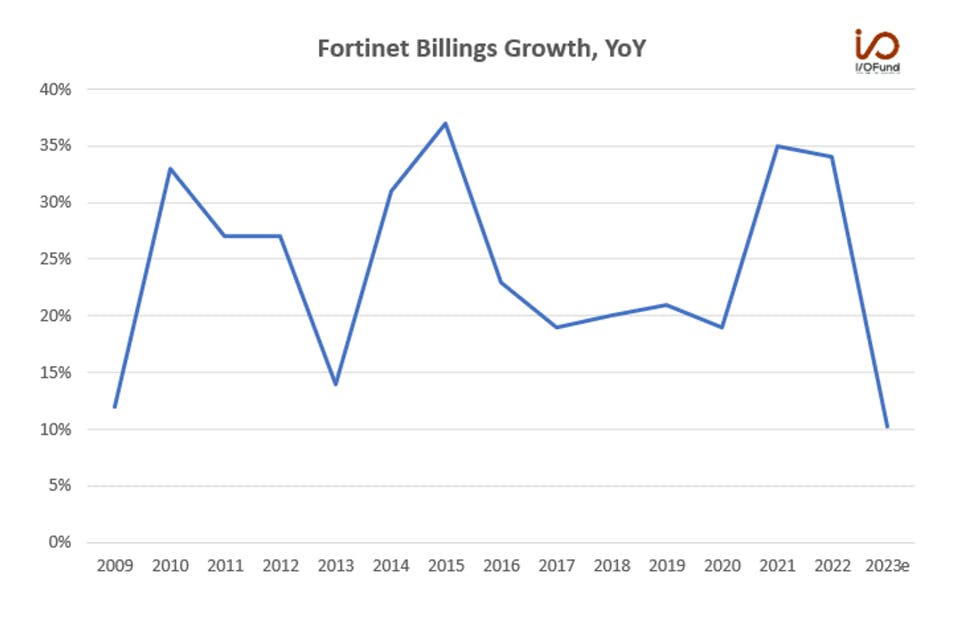
Fortinet’s billings slowdown and the lowered revenue forecast is a concern as 2023 would mark Fortinet’s slowest billings growth since its IPO in 2009. Growth is estimated at just +10.2% YoY at the $6.165 billion midpoint. It’s also a significant slowdown from the +34% and +35% billings growth seen in 2022 and 2021. Management said the growth slowdown in Q3 stemmed from “1 month shorter contract duration and importantly, lackluster appliance demand.”
A slowdown in product revenue growth is likely a driving factor behind the lowered revenue forecast for 2023. Product revenue is forecast to increase only +9% YoY to $1.935 billion – this is well below 2022’s +42% growth, 2021’s +37% growth, and its +23.7% average growth rate since 2009. CEO Ken Xie said that “the Secure Networking market is experiencing slower growth as product demand returns to normal levels following two years of elevated growth.” He added that “building and product revenue fell below our expectation” due to that slowdown in Secure Networking.
Palo Alto: Billings Weaker than Expected, Underlying Metrics Strong
Palo Alto shares fell (-5.4%) following its fiscal Q1 earnings report, but have since gained more than +14% to rise to new highs. The initial negative reaction stemmed from a lowered billings forecast as well as hints that revenue growth is slowing below 20%, but other underlying metrics remained strong.
Palo Alto reported +20% YoY revenue growth to $1.88 billion and +16% YoY billings growth to $2.02 billion, which came in below its prior outlook for $2.05 to $2.08 billion in the October quarter. This miss is amplifying concerns that revenue and billings growth is decelerating — revenue growth was at the lowest level since fiscal Q4 2020, while billings growth was at the lowest level in more than four years and marks a second quarter with growth below +20%.
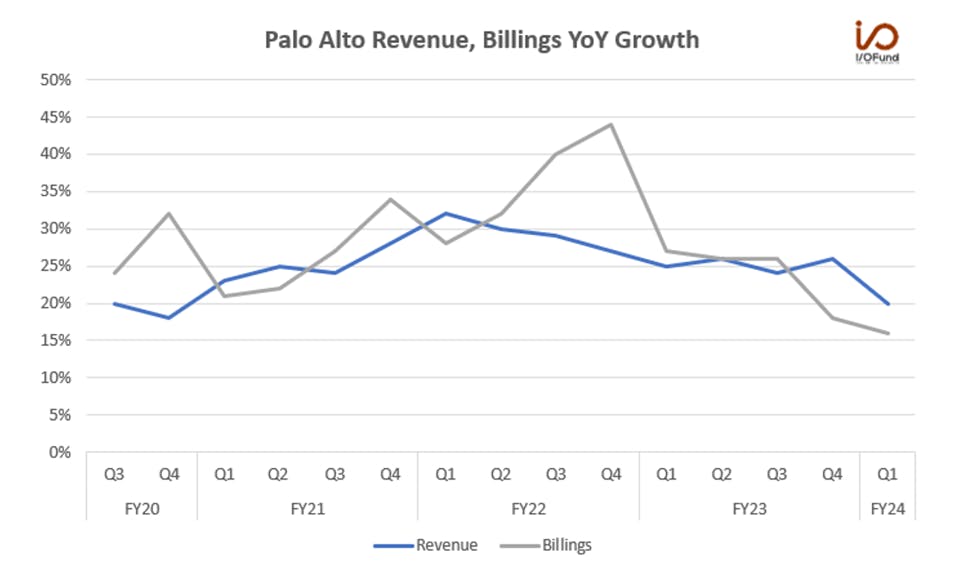
For the full year, Palo Alto lowered its billing forecast to $10.7 to $10.8 billion, from a prior view of $10.9 to $11.0 billion. This correlates to YoY growth of +16% to +17%, roughly in line with the recent quarter’s +16% growth rate. Palo Alto cited volatility in contract duration, increased financing demand, and increased demand for deferred billings plans for the lowered forecast. CFO Dipak Golechha said that the company “saw the rising cost of money have an important and incremental impact on customer behavior in [fiscal] Q1.” Similar to Fortinet, Palo Alto saw minimal growth in product revenue, at just +3% YoY, with the majority of revenue growth driven by service revenue, +25% YoY.