

This article was originally published on Forbes on Nov 16, 2023,05:19pm EST
Apple’s Services segment was one of the brightest spots in a relatively in-line earnings report at the beginning of November, topping an $85 billion run rate as growth jumped back to the high double-digits after a string of single-digit growth. Services demonstrated that its growth flywheel continues to strengthen with multiple outlets of opportunity in sight — from AI, to further growth in the installed base, to price hikes across different Services bundles.
Services Growth Outpaces iPhone, Apple
Since fiscal 2018, Services has become increasingly important to both the top and bottom lines for Apple. The segment has seen its share of revenue rise from under 15% five years ago to 22.2% at the end of September. Since then, Services has seen its annual run rate increase from ~$40 billion to over $85 billion, on track to surpass a $100 billion run rate potentially as early as the second half FY24.
FY21 was a breakout year for Services – the segment recorded greater than 24% YoY growth and generated more than $10 billion in gross profit each quarter, as its gross margin neared 70%. Gross margin has continued to stay above the 70% range, rising as high as 72.6% in Q2 FY22.
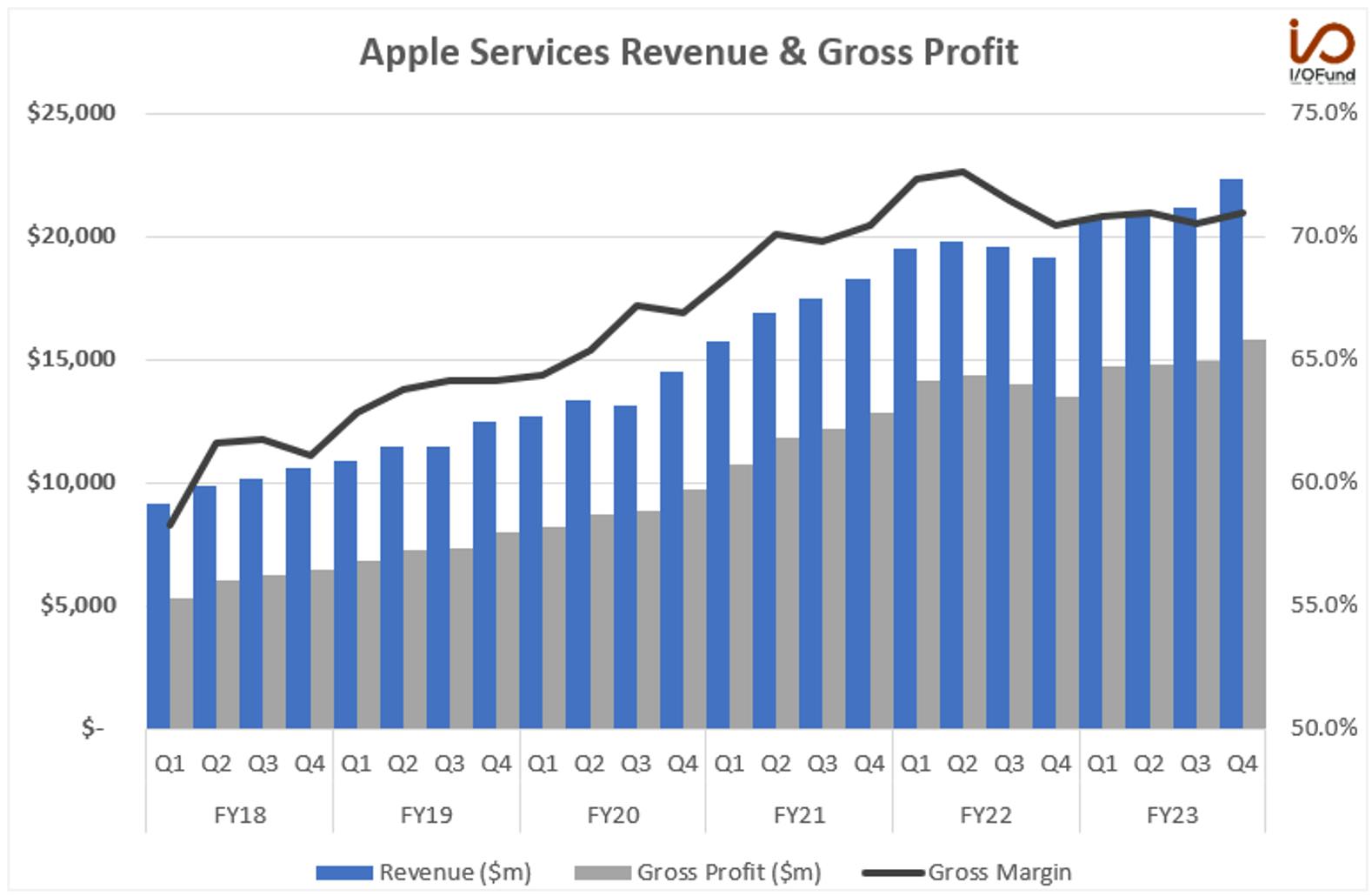
FY23 ending in September saw a full year growth rate of 7.1% YoY for $85.2 billion outpacing both iPhone and company-wide growth, with Q4 being the strongest quarter of the fiscal year with a growth rate of 16.3% YoY. The I/O Fund recently covered Apple’s earnings report more in-depth following fiscal Q4 here.
Since FY18, Apple has grown revenue at a 7.6% CAGR, meanwhile, Apple’s company-wide gross profit has grown at a 10.1% CAGR over the same period with profits partly impacted by Services’ rising contribution and expanding margin.
Compared to Apple, Services is seeing revenue and gross profit grow at much quicker rates – more than 9 percentage points higher for both metrics. Since FY18, Services revenue has grown at a 16.5% CAGR, outpacing Apple’s 7.6% growth rate as well as the iPhone’s 4.0% CAGR, due to the unevenness in revenue in between upgrade cycles – iPhone delivered YoY revenue declines in FY19, FY20, and FY23.
Services’ gross profit has expanded at a 20.1% CAGR, rising around 150% since FY18, from $24.2 billion to $60.3 billion as gross margin has expanded 10 percentage points, from 60.8% to 70.8%. This strong revenue and gross profit growth over the past five years has seen Services gain importance to Apple’s margins and its bottom line.
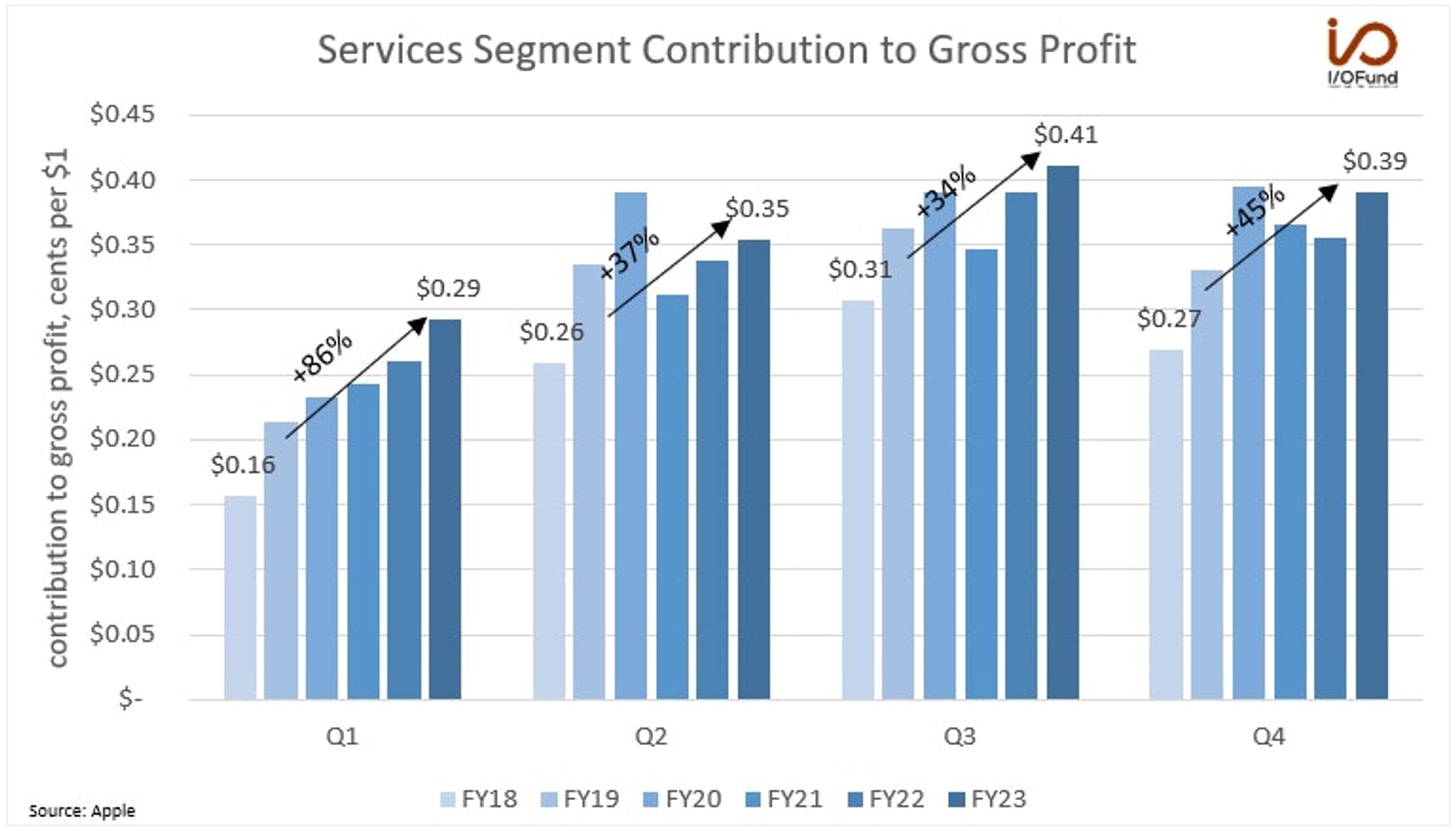
In FY18, Services contributed 23.7% of Apple’s gross profit, whereas today, Services contributes 36% of gross profit.
The breakdown looks like this:
As Services’ share of revenue rose from 15% to 22.2%, it helped pull Apple’s gross margin ~580 bp higher in just five years. Product gross margin – iPhone, Mac, iPad, etc. – increased just 210 bp, meaning this expansion in gross margin is primarily coming from Services.
FY21 was a breakout year for Apple’s gross margin, expanding from 38% to more than 42% because of that growth in Services. Apple is guiding for gross margin to expand further in fiscal Q1 next year, to the 45% to 46% range – an expansion of 200 to 300 bp YoY, with Services’ growth rate forecast to be in the high-teens again.
Sign up for I/O Fund’s free newsletter with gains of up to 221% – Click here
Services Seeing Multiple Growth Outlets
Services growth has been broad based, with new revenue records across a range of different offerings, and the segment has multiple growth outlets to lever in the future, from growth in paid subscribers, AI, and price hikes.
CEO Tim Cook explained on Apple’s Q4 earnings call that the Services segment “achieved all-time revenue records across App Store, advertising, AppleCare, iCloud, payment services, and video, as well as the September quarter revenue record in Apple Music.” CFO Luca Maestri added that Services “reached all-time revenue records in the Americas, Europe and rest of Asia-Pacific and a September quarter record in Greater China.”
What is driving these record levels across multiple Services offerings and in every geography worldwide is solid growth in active devices and strong growth in paid subscriptions. Paid subscriptions have risen at more than 27% annually over the past five years to 1 billion by the end of FY23.
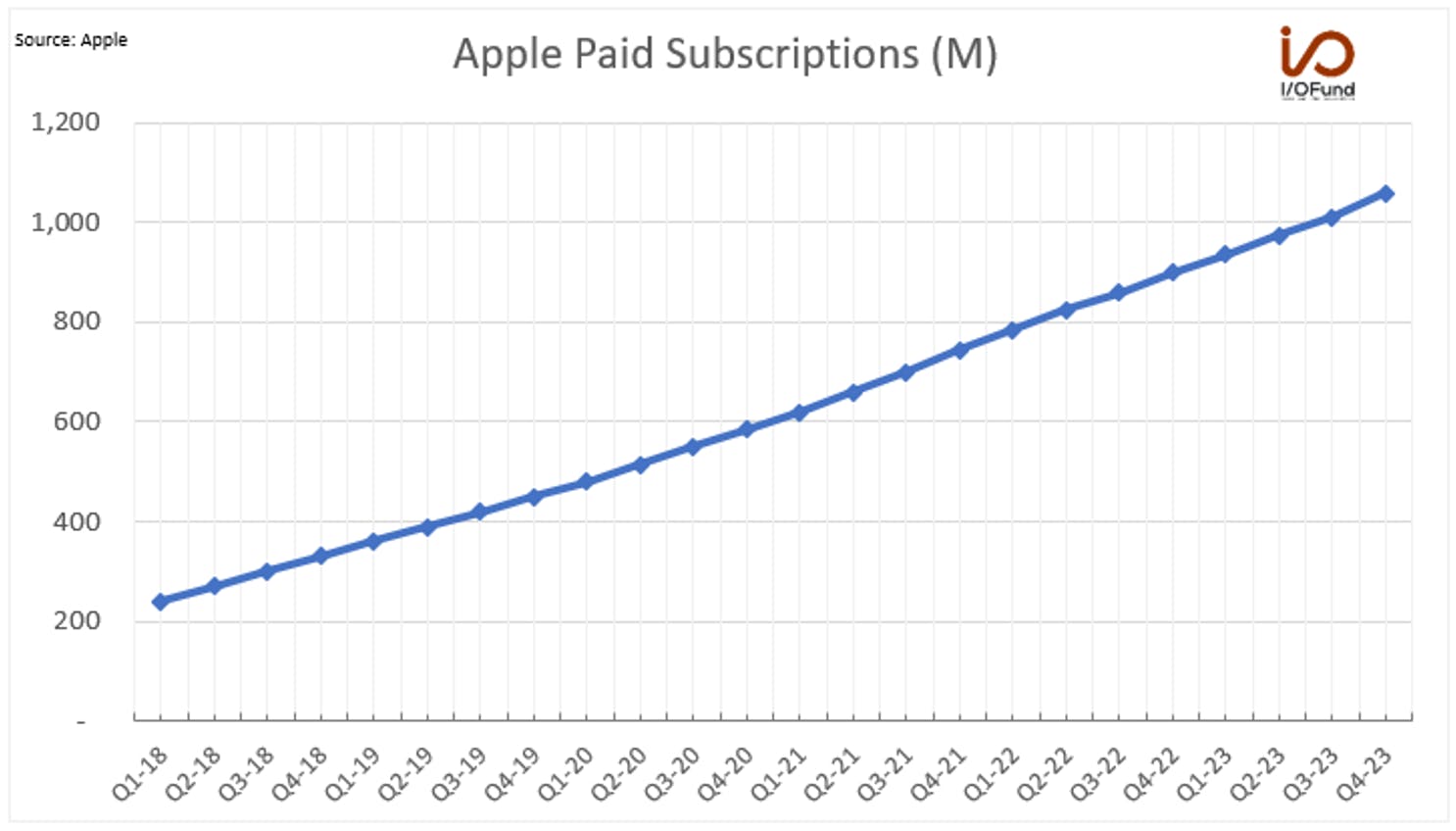
Apple has surpassed 2 billion installed devices, and “continues to grow at a nice pace and establishes a solid foundation for the future expansion of the ecosystem.” Thus, the organic growth flywheel for Services remains soundly intact – growth in installed devices driving growth in paid and transacting accounts at a higher degree.
At the start of FY18, Apple reported that it had an installed active device base of 1.3 billion devices, meaning it had a ratio of about 0.18 paid subscriptions per 1 active device. Since then, installed devices have grown more than +50% to over 2 billion, while paid subscriptions have grown nearly +360% to almost 1.1 billion, or a ratio of about 0.5 paid subscriptions per active device.
Reaching new all-time highs in its installed device base signals further growth lies ahead for Services, especially as the ratio of paid subscriptions per active device continues to rise. Other outlets of growth arise from Apple’s recent price hikes and potential monetization opportunities from AI.
Additional Levers
Apple recently enacted some price hikes for News+, Arcade, and its One bundles, with the hikes ranging from $2/mo to $5/mo. As a whole, the price hikes could generate an additional ~$5 billion in annual revenue with just a 15% attach rate to Apple’s more than 1 billion paid subscriptions — however, the price hikes could incur a small amount of churn, among more price-sensitive consumers.
In terms of AI, Apple is not releasing any details about projects in development, though it is rumored that some of the AI products Apple is working on would improve Siri and Messages’ capabilities, or add features to Keynote, Pages, and Apple Music. Apple’s large language model ‘Apple GPT’ is reportedly under development, but a commercialization route is still undetermined. The next-generation of Apple’s software, iOS 18, macOS 15, and watchOS 11, are poised to bring AI features to Apple’s devices next year, as it works to catch up in the generative AI deployment race against OpenAI and Google.