
Earnings Report

Press Announcement: Official Launch of I/O Fund and Audited Results

Written by

Beth Kindig

Founder, CEO and Lead Technology Analyst

Published: April 15, 2021

Last Updated: April 15, 2021

We have a new name, new website and audited 2020 results.

This week we’ve got big news to share.

First off, my team has released audited performance results that outperformed $ARKK since the Fund was founded on May 9th, 2020 and we are currently beating the Nasdaq across roughly 34 positions. You can view the press release here.

How does a team of four dedicated people beat a team of 38 at Ark Invest or a team of hundreds at Goldman Sachs and Morgan Stanley? I discuss this below.

As you are aware, I’ve been publishing under Beth.Technology, but this name no longer fits the services we provide. I’ve evolved from a tech insider with a blog to an actively managed tech fund that offers in-depth research and real-time trades.

I can no longer run a site with my name only as this is a team effort. We are rebranding Beth.Technology as I/O Fund.

I/O stands for input-output and is used across all computing (cloud, AI, ML, etc). We specialize in tech growth, and this name symbolizes our singular focus on this niche.

As you’ll see, we outperform some of the best funds on Wall Street.  
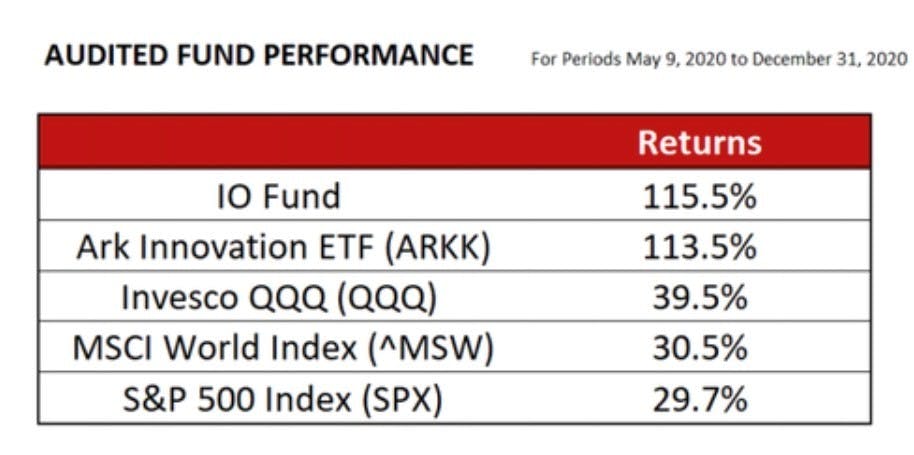
audited fund performance

With audited returns of 115.5% from May 9, 2020 to Dec. 31, 2020, I/O Fund narrowly outperformed ARKK within the same timeframe. Our actively managed fund was founded on May 9th, 2020 following the launch of the premium service on July 15, 2019.

One reason a small team of four can achieve this performance is that individual investors have more tools they can use, including hedges, small caps and allocation to crypto.

The second reason is that we believe in each other and know our respective positions very well. By combining our specialized strengths, we outperform the major indexes and larger teams.

I’m amazed at how collected my team is under pressure and how humble they are during rallies. I’ll introduce you to Knox Ridley, David Marlin and Jessica Ablamsky below. First, I want to tell you about myself and how I’ve come to analyze tech companies day-in and day-out.  

An Edge on Wall Street

Ten years ago, I started a blog on startups and tech companies for the private sector called CitizenTEKK.

I worked with more than 300 startups to help communicate the importance of their products to wider audiences. I also wrote white papers and analyst reports for deals in the private sector for about 5 years. 

These reports simplified complex technical concepts so busy executives could make big decisions quickly on venture investment rounds and strategic partnerships, or decide whether their company should be an early adopter. 

Due to high switching costs, adopting technology is often a costly investment. My research reports helped guide these big decisions.

About three years ago, I took this experience and brought it to public markets. The reason is simple. I saw lots of errors being made when retail investors attempted to understand tech products. Even worse, financial analysts with no experience in tech were feigning expertise. 

Because I was trained specifically to communicate at the highest level on the importance of complex tech products and their strategic value, I saw an area where I could help.

I’m not an engineer—and that is a good thing. Engineers built products. I was trained to communicate the purpose of those products and their strategic value.

That experience provides an edge you can’t find anywhere else. Stock screeners, algorithms, quant models, etc—these are plentiful and therefore erode competitive edge. Meanwhile, having experience in communicating the strategic value of hundreds of complex tech products is the edge that institutions seek.

This is demonstrated by my results. I predicted the biggest stock drop in history in Q2 2018 with Facebook's miss and the biggest IPO loss in history with Uber in Q2 2019. I break down company strategies and product roadmaps before they become apparent to the market, which is why invested in Zoom and Roku from the IPOs and have been holding for a more than 1,000% gain.

My free newsletter is consistent and full of original research. In a world where research is ripped off and recirculated, you can rest assured everything I publish is original—and has been dating back to 2011. 

This is extremely important, because borrowed research can’t stand the test of a steep selloff. I held Roku through two pullbacks of 60% or more.

Don’t guess with your hard-earned money. Seek out experience and find someone who offers more than the dime-a-dozen algorithms and trading software. I won’t always be right, but I’m able to outperform analysts at institutions because they haven’t spent a day inside of a tech company or a day working with a product. 

Cathie Wood is a great example. She’s an excellent money manager but hasn’t worked with tech products or analyzed hundreds of startups and companies. I’m probably into the thousands by now.

Experience in tech is one reason why we beat Ark in our first year and why we are beating the Nasdaq right now.

It’s been a thrilling experience to bring my skills to retailers and I have no plans of slowing down. For fun, I thought I’d give you some throwback videos on when I presented to audiences on tech products.

Beth Kindig, founder and lead tech analyst of I/O Fund

Get Our Free Weekly Stock Newsletter

Get weekly stock insights, market analysis, and technology updates straight to your inbox.

  • Weekly stock insights
  • Market analysis
  • Technology updates

Mobile App Security: 5 Tips for Mobile Developers (BlackHat 2016, Las Vegas)

Beyond China and US: The Next Gaming Growth Market

How to Survive the Maturation of Mobile Games: Beth Kindig at GamesBeat 2015

How We Navigate Volatile Growth Stocks

Portfolio Manager Knox Ridley uses technical analysis to predict tops, call bottoms and help our readers navigate major market moves. We tested a quant with algorithms against Knox and Knox beat the machine every time.

He looks at dozens of charts every day, and the ability to connect dots across multiple charts is not a match for a machine. (This is good news for anyone who thinks machines will permanently replace humans).

He also cares deeply about helping individual investors realize the highest returns and offers his entries, exits and hedges in real-time.

His dedication to our readers is unparalleled. He posts daily on our private subscriber forum and analyzes key charts during bimonthly webinars to share what actions he is taking and why.

The results speak for themselves. Knox is the I/O Fund portfolio manager who competes with hedge funds. I can’t claim the performance as that is actually Knox’s performance results as the PM.

It would be easier if we simply recommended stocks and did not disclose our activity. But this wouldn't help our readers who have to weather steep sell-offs in volatile growth tech stocks. Knox is right alongside our readers in the trenches—with full disclosure about what he is buying, when and at what price.

Our goal of beating Ark on the upside and the Nasdaq in down markets has been achieved since our inception on May 9th. This is largely due to Knox Ridley’s expertise. Details on audited results were released to our subscribers last month and are available in our recent press release.

In a recent webinar, Knox provided a general market update and levels to watch for the Nasdaq 100. For his most recent analysis of NDX, you can click here. 

Taking Advantage of Momentum 

Tech growth moves fast. Last year, we realized that we need a nimble and smart equity analyst to help us track small caps, SPACs, earnings revisions and adjustments to valuations. Last August, we added David Marlin to our team. A former prop trader in Manhattan, David has a keen eye for momentum stocks.

There are thousands of equity analysts working at various investment banks, but very few of them understand tech growth like David. The unique space I/O Fund specializes in requires someone who can look at high valuations and determine which stocks deserve the valuations and which do not.

We believe we are invested in the two best SPACs thanks to David’s dedication to organizing this trend for our premium subscribers. We also believe we are positioned well for tough Covid comps, with specific picks from David, due to his maniacal focus on fundamentals, forward growth estimates and valuation.

David contributes regularly to our forum, webinars and the I/O Fund portfolio of about 30 positions. He is also a weekly contributor to the in-depth research our service provides and works alongside Knox on a proprietary hot list. 

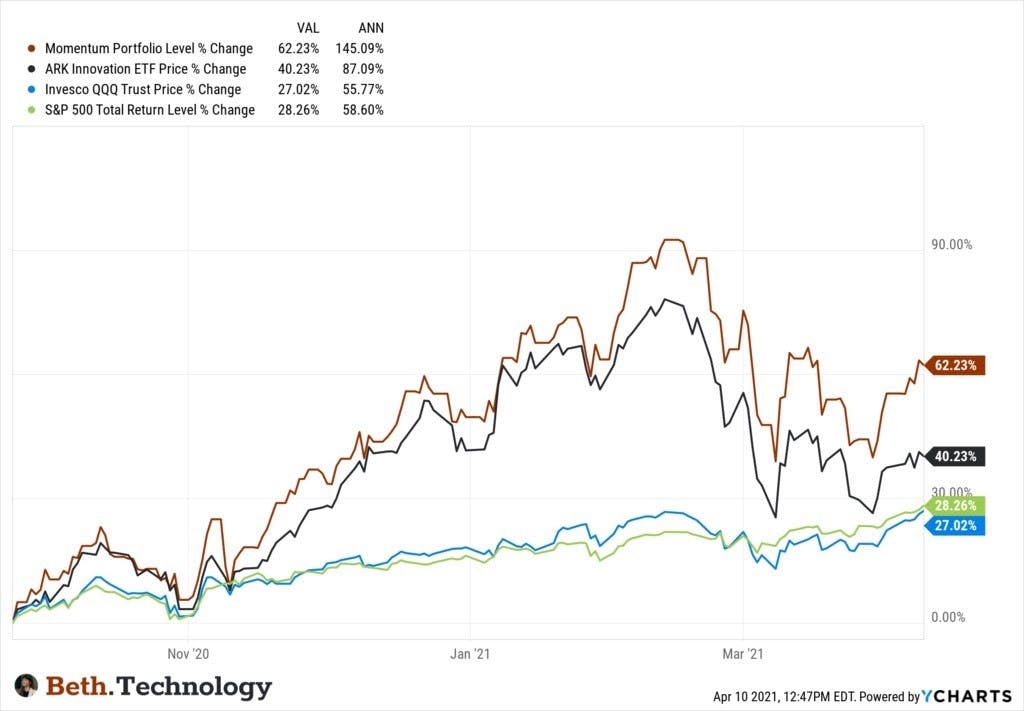
When David first came on, we wanted him to help expand our coverage on stocks that we didn't previously cover. In David's first article for us, he outlined his top nine momentum stocks.

An equal weighted portfolio of David's top 9 picks since the date of the article (9/24/20) would have returned 62.23%, good for an annualized gain of 145.09%. David's top picks significantly outperformed Ark Innovation ETF ARKK, the QQQ, and the S&P 500 during the same time frame.

broad market stocks chart

Holding for Big Gains

Jessica Ablamsky is a savvy tech investor who helps our team stay social and active even when we are heads-down with research. Jessica keeps track of details for the I/O Fund and is on our forum daily to help moderate important discussions. 

As we have all seen over the past year, growth tech stocks are more volatile than the overall market. If you want to hold on for big gains, it’s important to maintain a strong thesis on long term holds and not get scared out of them during pullbacks. 

Jessica keeps a cool head during corrections and is always there to remind investors that volatility is normal and to be expected. She is dedicated to helping retail investors outperform the Nasdaq and is always on the lookout for good opportunities to add to long term holds. 

She recently covered Poshmark and has in-depth analysis coming out on Pinterest, a stock she owns and knows well. Jessica’s attention to detail and keen sense around investments is something that benefits our community. 

Earnings Coverage to Resume Next Week

If you made it this far, we thank you for your support. We are incredibly excited for this new rebrand and grateful you let us share this with you. My free analysis will remain the same while the premium site offers the following:

  • Research
  • Portfolio with 30+/- positions
  • Real-time trades and audit
  • Forum 
  • Webinars

Thanks again! We will resume coverage of earnings next week.

About the author

Beth Kindig

Beth Kindig

Profile

Beth Kindig is the Founder, CEO and Lead Technology Analyst at I/O Fund, with more than 15 years of experience covering private and public technology companies. Known for her early Nvidia research beginning in 2018 and bold, high-conviction calls on emerging technology trends, Beth also manages I/O Fund's audited technology portfolio, which has returned 326% since May 2020, or 29.2% annualized. She is a regular guest on Fox Business and Bloomberg and has appeared on CNBC.

Curation

Expand your knowledge

View all posts
Beyond Hyperscalers: Here’s the Next $1 Trillion AI Infrastructure Opportunity
AI STOCKS

Beyond Hyperscalers: Here’s the Next $1 Trillion AI Infrastructure Opportunity

Since 2022, Big Tech capex has been the clearest barometer of AI demand. But the market’s reaction to Google’s latest earnings shows investors are questioning how long that spending can last. While the market frets over hyperscalers’ cash flows, a second wave of AI infrastructure spending has quietly emerged, driven by enterprises and neocloud customers.

AI STOCKSOCT 30, 2026
Google’s $250 Billion AI Chip Opportunity Takes Aim at Nvidia
AI PLATFORMS

Google’s $250 Billion AI Chip Opportunity Takes Aim at Nvidia

In April, there was a major shift in the AI accelerator market, and for once, it didn’t come from Nvidia. Six months later, merchant TPUs are moving from announcement to commercial execution, with Google recognizing its first revenue from TPU systems in Q2 (from a small base). Last quarter, Cloud revenue growth accelerated to 82% for $24.8 billion, compared to $22.5 billion expected. In addition, new details around the TPU 8t show that Google’s threat to Nvidia is not limited to inference. At the time, we pointed out that Google may be one of Nvidia’s strongest AI challengers, as Big Tech is closest to the problems that accelerators must solve. The problem that Google is prioritizing is lower cost per token, with token economics becoming a predominant concern as AI spending is pushing Big Tech’s free cash flows into the red. Below, we discuss two reasons why Google’s AI story is about to change, not from advancements in AI software, but by going after one of the most profitable hardware businesses the tech industry has ever seen.

AI PLATFORMSOCT 23, 2026
AI Debt Nears $500 Billion in 2026: What It Means for Nvidia, Oracle, CoreWeave and AI Stocks
AI STOCKS

AI Debt Nears $500 Billion in 2026: What It Means for Nvidia, Oracle, CoreWeave and AI Stocks

AI-related debt reached $466 billion through September 2026, more than four times last year’s pace. We break down who is borrowing, the three ways new AI chip deals are being structured, and where interest costs land across Nvidia, Oracle, CoreWeave, Broadcom and Big Tech.

AI STOCKSOCT 23, 2026