
Data Center

OpenAI’s 457 MW TensorWave Deal: What It Means for AMD Stock

Written by

I/O Fund Editorial Team

Research Team

Published: November 26, 2026

Last Updated: November 26, 2026

Key Points

  • On November 16, TensorWave and OpenAI confirmed a six-year agreement for 457 MW of dedicated AMD Instinct MI455X capacity, the first neocloud publicly named under OpenAI’s 6 GW AMD partnership.
  • First capacity is expected in H1 2027 and full deployment by early 2028, so any AMD revenue from the deal would land in 2027, the year AMD expects revenue to grow more than 80%.
  • The contract value and financing are undisclosed. By I/O Fund’s calculation, 457 MW implies roughly $4.6 billion to $9.1 billion of AMD hardware. This is an illustrative figure, and not a disclosed one.
  • Risks to watch include TensorWave scaling up from about 8,000 GPUs today, tight AI chip supply, and dilution from OpenAI’s warrant for up to 160 million AMD shares.

On November 16, TensorWave, an AI cloud provider running AMD GPUs exclusively, revealed that OpenAI had signed a six-year agreement for 457 MW of dedicated AI infrastructure built on AMD Instinct MI455X GPUs. Although OpenAI had announced in October 2025 that it planned to deploy 6 GW of AMD GPUs, this is the first such announcement publicly naming a neocloud partner.  

This deal turns part of OpenAI’s partnership with AMD into contracted data center capacity with a start date. TensorWave expects first capacity from this deal to start in H1 2027, so AMD could start generating revenue from this deal in 2027 and early 2028. However, the deal fails to shed light on key investor concerns, such as what the contract is worth and who is paying to build it.  

In this article, we examine what the deal disclosed, what is missing from it, and what it means for OpenAI, TensorWave and AMD.  
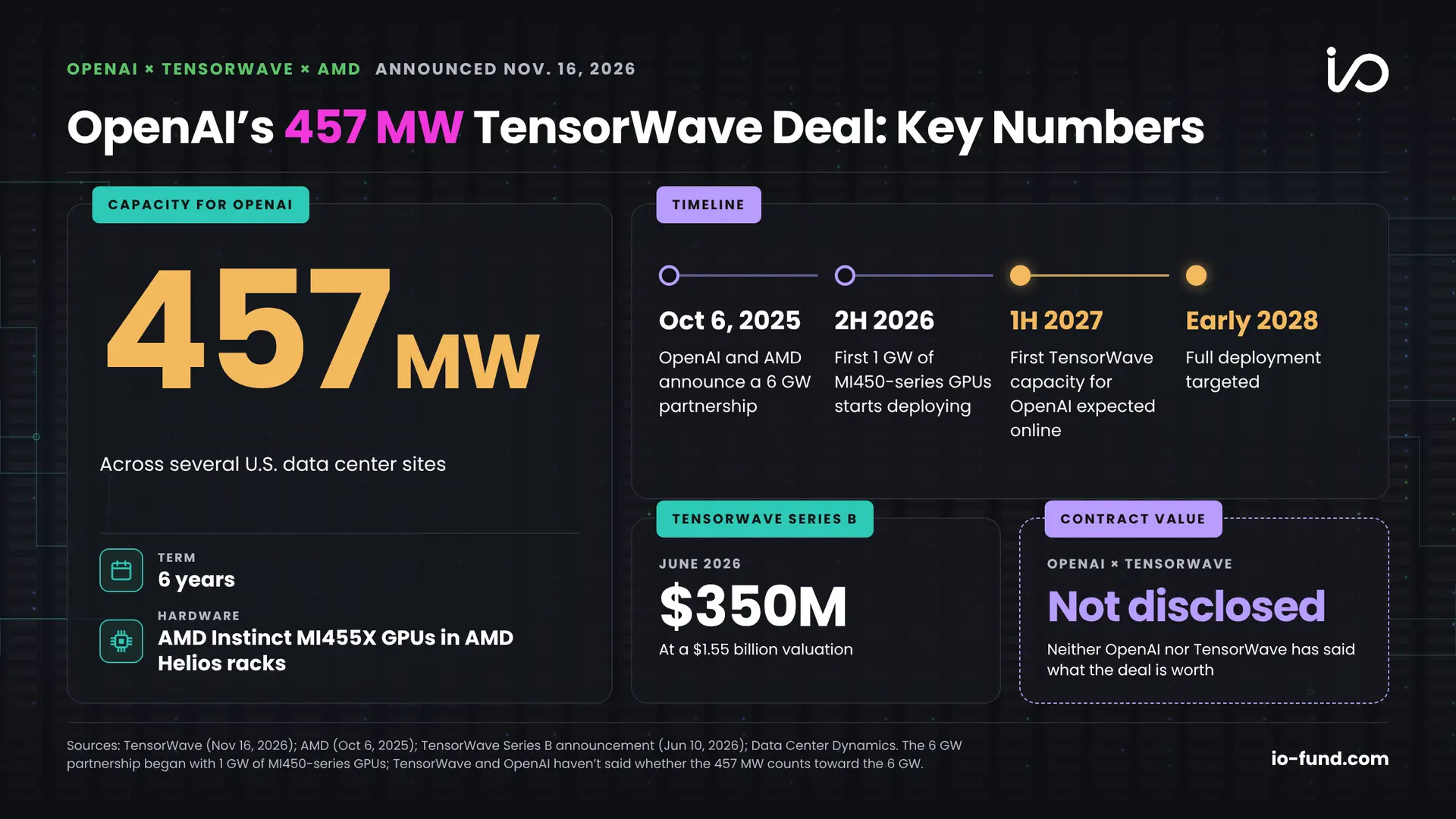
OpenAI's 457 MW TensorWave deal includes AMD MI455X GPUs, first capacity in 2027, and full deployment by 2028.
OpenAI’s agreement with TensorWave covers 457 MW of AMD MI455X-powered capacity across multiple U.S. data centers. The timeline points to initial deployment in 2027 and full buildout by early 2028, while key details such as the contract’s value remain undisclosed.

OpenAI’s 457 MW Deal Adds Dedicated AMD AI Infrastructure

TensorWave’s largest deployment contract to date gives OpenAI access to 457 MW of the company’s single-tenant AI capacity, spread out across multiple U.S. data center sites, over six years. This capacity runs on AMD Instinct MI455X GPUs in AMD’s Helios rack-scale systems with Ethernet networking. OpenAI is expected to use this capacity to support large-scale training and inference, focusing on memory-intensive workloads.  

Piotr Tomasik, president and co-founder at TensorWave, observes, “TensorWave was built to prove that AMD infrastructure could operate at the scale and reliability that the world’s most demanding AI companies require.” With this deployment, TensorWave is “helping deliver a meaningful portion of the infrastructure behind OpenAI and AMD’s next generation of AI compute.”  

How Much AMD Revenue Could the OpenAI-TensorWave Contract Bring?

Although OpenAI and TensorWave have not yet disclosed the contract’s value and analysts have not estimated this deal so far, we can estimate its scope with per-gigawatt figures. Going by AMD CEO Lisa Su’s estimates, each gigawatt is worth “double-digit billions” of revenue, which we had previously estimated to be between $15 billion and $20 billion per GW.  

By our calculation, 457 MW at $10 billion to $20 billion per GW works out to roughly $4.6 billion to $9.1 billion of AMD hardware over the build. This is simply an illustrative figure, and not a disclosed one. As part of this deal, TensorWave, and not OpenAI, is most likely AMD’s direct buyer. A portion of each data center’s cost goes to non-AMD equipment, and the megawatt figure is not defined. Any revenue from this deal is likely to fall outside AMD’s Q4 2026 guidance of around $17 billion, but could land within 2027, the year AMD expects its revenue to grow by over 80%.  

In its earnings call on November 3, AMD shared that it expects its data center AI business to surpass its server CPU revenue for the first time in Q4. Lisa Su forecasts server revenue should roughly double in 2027, up from the over 70% growth guided earlier, and that data center should make up over 80% of 2027 revenue. In addition, she shared that AMD had “secured more supply to support that growth.” 

OpenAI’s contracts signed with other neoclouds shed some light into the sense of this deal’s scale. CoreWeave has signed three agreements with OpenAI since March 2025, of up to $11.9 billion in March, up to $4 billion in May and up to $6.5 billion in September, totaling up to $22.4 billion. In January 2026, OpenAI signed a three-year deal with Cerebras to acquire up to 750 MW of computing power at over $10 billion, as per Reuters. Cerebras builds or leases the data centers and OpenAI pays to use its cloud. Meanwhile, neither OpenAI nor TensorWave has disclosed a value for the six-year 457 MW contract so far. 

Does the TensorWave Deployment Count Towards OpenAI’s 6 GW AMD Commitment?

Neither OpenAI nor TensorWave has explicitly confirmed whether this 457 MW capacity would count towards OpenAI’s 6 GW commitment to AMD. However, Uday Ruddarraju, OpenAI’s CTO for compute, did comment to The Next Web, “We’re excited to advance our previously announced partnership with AMD through this agreement with TensorWave.” Going by this statement, the deal could be within the OpenAI-AMD partnership, accounting for around 7.6% of the total commitment or about 46% of the first 1 GW phase.  

On October 6, 2025, AMD had announced OpenAI’s commitment to deploy 6 GW of AMD GPUs across multiple generations, starting with 1 GW of MI450-series GPUs in H2 2026. For AMD, this partnership “is expected to deliver tens of billions of dollars in revenue,” as per the company’s CFO Jean Hu.  

Under the terms of this deal, AMD issued OpenAI a warrant for up to 160 million AMD shares. This warrant vests in tranches as OpenAI deploys AMD GPUs and AMD’s share price hits set targets. An exercise price was set at $0.01 per share and the final tranche requires AMD’s stock price to touch $600, as per a report on Reuters. Although AMD has not confirmed that any tranche has vested, during its Q3 earnings call, it recorded a non-cash warrant charge of around $1.1 billion.  

Find out our Top 20 AI stocks for Q4 including the three most powerful trends in AI with many lesser-known names: Hint: Not one Big Tech stock made the Top 20. See which AI stocks made the list → Get Premium Access 

Why OpenAI Chose TensorWave, an AMD-Only Neocloud

TensorWave has been known to run only AMD hardware since it was founded in December 2023, which gives OpenAI an operator well versed with AMD’s software stack. The company claims to be the first public cloud to deploy AMD’s MI300X chips, and also runs a cluster of 8,192 MI325X GPUs in Las Vegas. TensorWave served as a launch partner for Helios in July 2026.   

A news report on Fortune framed this deal as OpenAI’s attempt to diversify beyond Nvidia. The report quotes an unnamed source saying that OpenAI’s models still run “almost entirely” on Nvidia GPUs. JPMorgan’s Michael Cembalest relayed a frontier AI lab’s observation on November 14 that porting models to AMD takes “only 3 days,” now, down from six to 12 months previously.  

Beth Kindig, founder and lead tech analyst of I/O Fund

Get Our Free Weekly Stock Newsletter

Get weekly stock insights, market analysis, and technology updates straight to your inbox.

  • Weekly stock insights
  • Market analysis
  • Technology updates

For the period after 2026, Cembalest estimates that AMD holds around 18% of announced compute agreements against Nvidia’s 28%. Although OpenAI’s 457 MW TensorWave deal is far smaller in comparison to its Nvidia-linked and hyperscaler commitments, it gives OpenAI a dedicated cloud for AMD capacity outside the hyperscalers. 

The Financing Behind the OpenAI Infrastructure Buildout

The OpenAI-TensorWave contract provides no details on how it is being financed as of writing. TensorWave has raised over $500 million in equity, including a $43 million SAFE in October 2024, a $100 million Series A in May 2025 and a $350 million Series B in June 2026. Both priced rounds were co-led by Magnetar and AMD Ventures, as per the company’s Series B announcement. In addition, TensorWave has also revealed that it has secured over 2 GW of long-term data center capacity.  

AMD’s venture arm funds TensorWave, TensorWave buys and deploys AMD GPUs, and OpenAI holds a warrant for up to 160 million AMD shares that vests as it deploys AMD’s hardware. Nvidia has similar agreements in place with CoreWeave and Nebius, which we have covered in our previous analysis.  

There are also no details on how OpenAI is paying for this deal. According to estimates from Bernstein analyst Mark Moerdler, OpenAI could spend around $614 billion on compute through 2030, although widely circulated reports peg the figure higher at around $750 billion. On November 6, OpenAI raised $11 billion in a first close. Reports on The Wall Street Journal estimate OpenAI’s adjusted Q3 operating loss to be around $10.9 billion.   

Key Risks: Can TensorWave Scale Fast Enough?

TensorWave runs a cluster of around 8,000 GPUs presently and needs to ramp up hundreds of megawatts online in around 15 months. According to Fortune, TensorWave will need to roughly triple its staff to cater to OpenAI’s capacity.   

Separately, as per Fermi’s 10-Q filing, the lease between a Fermi subsidiary and TensorWave at Project Matador was “terminated in accordance with its terms” on November 10, after the closing date passed without an extension. The lease was for 222 MW of total facility power, valued at around $6.5 billion over 15 years. Fermi disclosed the termination during its November 12 results, and secondary coverage reveals that the related AMD credit support agreement has also concluded. However, no public source has connected this termination to the OpenAI deal.  

What to Watch Next in the OpenAI-TensorWave Partnership

AMD’s next public updates will occur on December 1 at the UBS Technology and AI conference and on December 9 at the Barclays Global Technology conference. Later, AMD’s Q4 report due early next year could reveal whether the Helios ramp matches its guidance, and whether any OpenAI warrant tranche has vested.  

TensorWave’s first OpenAI capacity, expected sometime in H1 2027, will be the first indicator of whether TensorWave can build at this scale. Full deployment in early 2028 gives the company longer to build out this capacity. 

Deals like OpenAI’s 457 MW TensorWave contract are what we track every week. Get Beth Kindig’s free analysis of AI demand, capacity and earnings, read by 40,000+ investors every Friday. 

Learn about AI chip and data center deals, decode earnings from the perspective of AI adoption, and gain market context for your AI stock positions.   

Send me Beth’s free analysis → Get Free Weekly AI Stock Analysis 

OpenAI-TensorWave Deal FAQs

What is the OpenAI-TensorWave deal?

On November 16, TensorWave said OpenAI signed a six-year agreement for 457 MW of dedicated AI capacity on AMD Instinct MI455X GPUs. It is the first neocloud publicly named under OpenAI’s 6 GW AMD partnership. 

When will AMD see revenue from the TensorWave deal?

TensorWave expects first capacity in H1 2027 and full deployment by early 2028. Any AMD revenue from this deal would fall in 2027, the year AMD expects revenue to grow by over 80%. 

How much is the OpenAI-TensorWave deal worth?

The contract value hasn’t been disclosed. By I/O Fund’s calculation, 457 MW implies roughly $4.6 billion to $9.1 billion of AMD hardware, an illustrative figure, not a disclosed one.  

Does the TensorWave deal count toward OpenAI’s 6 GW AMD commitment?

Neither OpenAI nor TensorWave has confirmed it, though OpenAI said the deal advances its “previously announced partnership with AMD.” If it counts, 457 MW would account 7.6% of the 6 GW commitment. 

What are the main risks of OpenAI’s 457 MW contract with TensorWave?

TensorWave must scale from about 8,000 GPUs to hundreds of megawatts in around 15 months, while AMD says demand for its chips is higher than supply. TIKR estimates full exercise of OpenAI’s warrant could dilute AMD shareholders by about 9.6%. 

Please note: The I/O Fund conducts research and draws conclusions for the company’s portfolio. We then share that information with our readers and offer real-time trade notifications. This is not a guarantee of a stock’s performance and it is not financial advice. Please consult your personal financial advisor before buying any stock in the companies mentioned in this analysis.  

Aiswarya Gopan, AI and Semiconductor Investment Writer at I/O Fund, contributed to this analysis.

👉🏻 Share with a Fellow Investor
Help someone else benefit from this insight.

Recommended Reading:

About the author

I/O Fund Editorial Team

I/O Fund Editorial Team

The I/O Fund Editorial Team writes educational guides that explain investing concepts, market terms, and the technology behind today's markets. All content is researched from trusted sources, fact-checked, and reviewed by an I/O Fund analyst before it is published. This content is for educational purposes only and is not investment advice or a stock recommendation.

Curation

Expand your knowledge

View all posts
Nvidia Stock: 5 Reasons the AI Trade Has Only Begun
AI STOCKS

Nvidia Stock: 5 Reasons the AI Trade Has Only Begun

This week, Nvidia dispelled fears of the AI trade slowing with one simple number; fiscal 2028 revenue growth is guided to be 75% up from 70% despite a higher FY27 revenue base. Vera Rubin generated $20 billion in revenue in its first quarter of production shipments, which is Nvidia’s fastest ramp ever. The Q4 guide is softer than it appears as it includes an extra week. If we adjust to a 13-week quarter, it works out to $121 billion or roughly 4% sequential growth after three quarters of 20% sequential growth. The guide excludes $2.4 billion in licensed Hopper sales to China that contributed to Q3.

AI STOCKSNOV 20, 2026
Amazon’s AI Data Center Expansion Faces a New Roadblock Ahead of November 17 Vote
DATA CENTER

Amazon’s AI Data Center Expansion Faces a New Roadblock Ahead of November 17 Vote

Amazon dropped data centers on its $427 million Ashburn campus after local pushback. Loudoun votes November 17 on a 12-month pause for data center approvals. Is permission the new bottleneck for the AI buildout?

DATA CENTERNOV 16, 2026
AMD Stock: Two-Catalyst Punch Leads to 80% Growth Next Year
SEMICONDUCTOR STOCKS

AMD Stock: Two-Catalyst Punch Leads to 80% Growth Next Year

In August, our premium article "Venice Meets Helios" pointed to two strategic product releases that were arriving soon - AMD’s Venice CPUs and the highly anticipated Helios MI400 Series. At the time, management expected server CPU revenue to grow more than 70% in 2027, while total Data Center revenue would grow “well over 100%,” driven by the Helios ramp. Three months later, AMD has raised its outlook considerably, and the two product ramps are now exceeding the I/O Fund’s original expectations. Server CPU revenue is now expected to more than double in 2027, up from the previous outlook for 70%+ growth. Meanwhile, Data Center AI revenue (GPUs) is expected to significantly more than double.

SEMICONDUCTOR STOCKSNOV 13, 2026