Nvidia Stock: 5 Reasons the AI Trade Has Only Begun
Written by
Beth Kindig
Founder, CEO and Lead Technology Analyst
Published: November 20, 2026
Last Updated: November 20, 2026
On this page
This week, Nvidia dispelled fears of the AI trade slowing with one simple number; fiscal 2028 revenue growth is guided to be 75% up from 70% despite a higher FY27 revenue base. Vera Rubin generated $20 billion in revenue in its first quarter of production shipments, which is Nvidia’s fastest ramp ever.
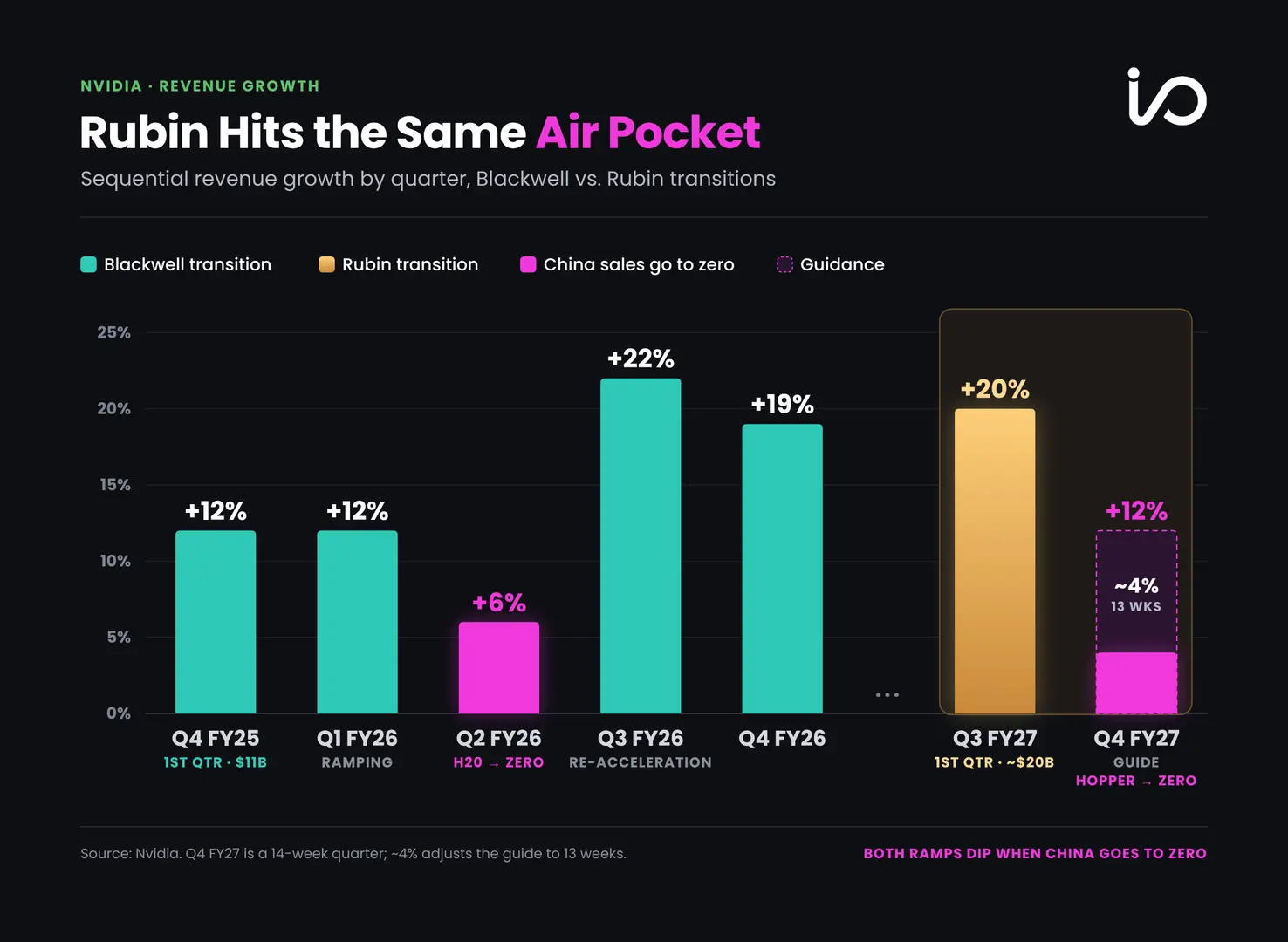
The Q4 guide is softer than it appears as it includes an extra week. If we adjust to a 13-week quarter, it works out to $121 billion or roughly 4% sequential growth after three quarters of 20% sequential growth. The guide excludes $2.4 billion in licensed Hopper sales to China that contributed to Q3.
Don’t sweat it, though; we’ve been here before. When Nvidia transitions between product generations, the market typically panics as it reads the lull as a permanent slowdown. In fact, some of my very best AI entries have occurred during the pause between generations.
As of now, Rubin’s first quarter is nearly double Blackwell’s at $20 billion compared to $11 billion, respectively. Management also stated the ramp is “off to an extraordinary start. During the Blackwell transition, sequential growth slowed to 12% in each of the first two quarters of the ramp, then to 6% in Q2 when H20 sales from China went to zero. After that, sales re-accelerated to 22% and 19% QoQ.
Nvidia’s Rubin platform generated approximately $20 billion in first-quarter shipments, nearly double Blackwell’s initial ramp. The chart also shows both product transitions experiencing a temporary slowdown when China-related sales fell to zero, followed by stronger growth as demand reaccelerated.
Margins are the weaker part of the story, but you’d have to be living under a rock not to expect memory costs to weigh on profitability. Gross margin is expected to fall from 74.9% to 71%-72% in Q4, which the CFO said was a bottom with margins expected to return to 72%-73%.
Now that we’ve gotten some of the obligatory earnings coverage out of the way, let’s talk about what’s really on everyone’s minds – is the AI trade over? Or perhaps equally concerning, is AI slowing to the point the glory years are behind us?
Before we discuss the facts, I would encourage investors to pay close attention to who is spreading fear, uncertainty and doubt when the underlying fundamentals remain strong. Valid concerns are worth considering, but investors should deeply question why the concerns are brought up after a steep selloff rather than before it.
Psychology is a major component of successful investing, and there is not a more important time to protect your mindset than when stock prices are at a multi-year low. Case in point, you’d have to go back at least 10 years to find Nvidia trading this low; therefore, it’s reasonable that many years go by until investors see some of these valuations again.
With that in mind, below are five reasons we believe the current panic may be presenting investors with a rare buying opportunity, rather than signaling the end of the AI trade.
1. Demand Exceeding Supply Still Defines the AI Trade
The defining characteristic of the AI infrastructure cycle continues to be demand greatly exceeding supply. AI suppliers are building against contracted demand, which is distinguished from previous tech bubbles when suppliers were building on speculative demand. For example, SK Hynix has stated they are effectively sold out through 2029.
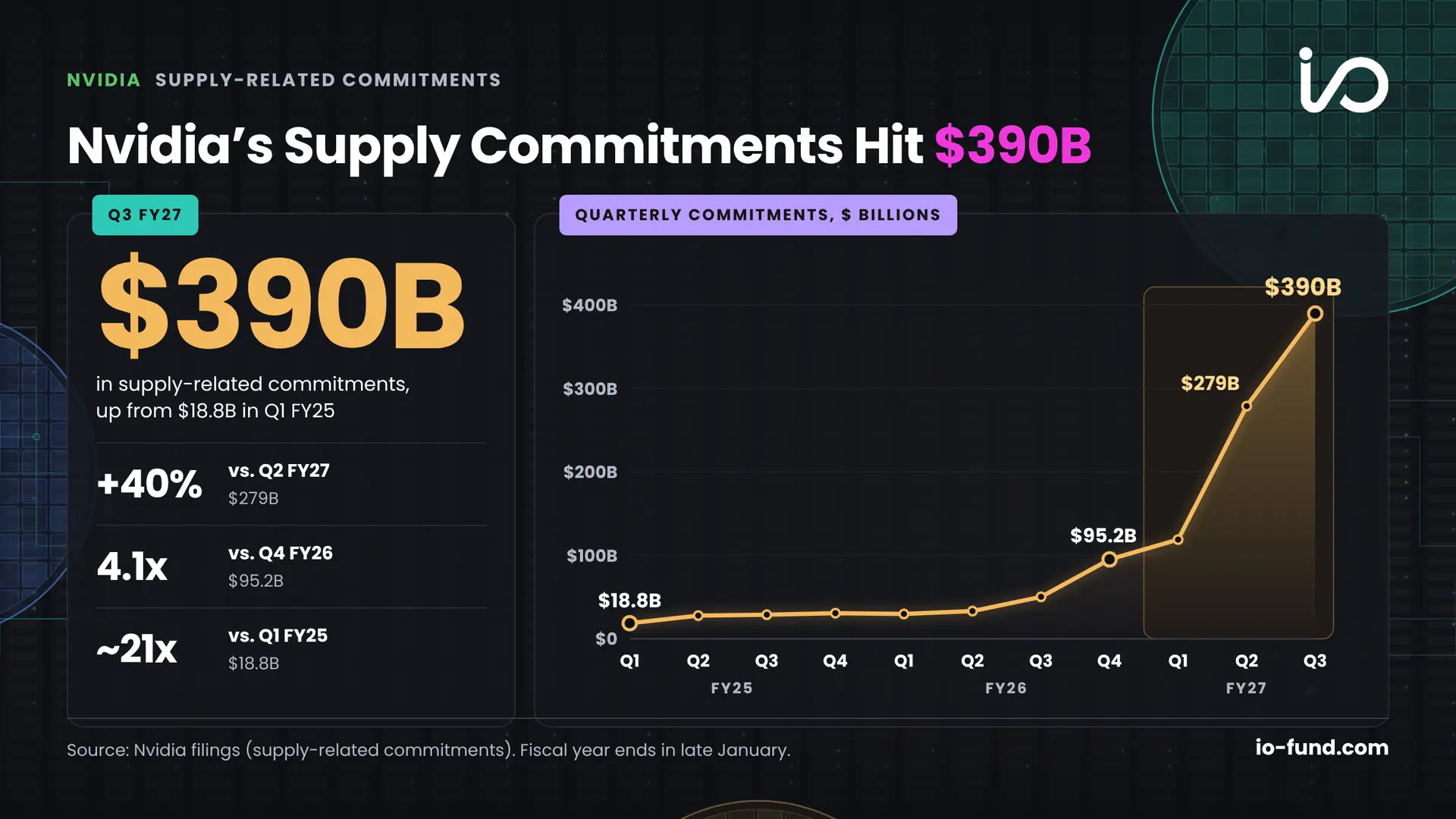
Nvidia’s supply-related commitments rose to $390 billion, which reflects the sheer scale of supply chain expansion as this is up 3X over two quarters, given commitments were $119 billion in the April quarter.
Nvidia’s supply-related commitments have expanded dramatically alongside AI infrastructure demand, rising from less than $20 billion in FY25 to $390 billion by Q3 FY27. The sharp increase reflects the scale of supply chain investment required to support ongoing growth in AI data center deployments.
Another indication of the strong demand from Nvidia’s report was the statement that cloud industry backlog increased from $2 trillion to $2.5 trillion. The 25% sequential increase reinforces a significant step-up in cloud customers’ future demand, supported by multiyear visibility.
Here is what was stated on the earnings call by CFO Collette Kress: “Our hyperscale customers’ cloud revenue growth accelerated for the sixth consecutive quarter. Cloud industry backlog now sits at $2.5 trillion, up from $2 trillion just three months ago, underscoring the significant multi-year opportunity ahead of our partners and of NVIDIA.”
2. Prices Will Decline, but Revenue Will Rise
Nvidia reported that token prices have declined 60% since May, yet rather than weaken demand for compute, lower prices are helping to accelerate consumption. Weekly token volume on OpenRouter increased 35X YoY and 3.5X over the past three months. Agentic workloads now account for approximately 80% of tokens.
Perhaps even more interesting, the CFO stated that Hopper GPUs are being recontracted at much higher prices: “All of this is creating a powerful flywheel. Token prices have fallen nearly 60% since May, accelerating token usage and demand for compute. As a result, GPU rental prices are rising across generations. Hopper GPUs have recontracted at up to twice their original price under the multi-year agreements, while the B300 rates have risen more than 60% since their introduction.”
Now, that’s a real head-scratcher for a traditionally trained Wall Street analyst as older servers would typically be expected to depreciate in value rather than command higher rental rates. However, that’s assuming a more balanced supply-demand environment, to where older servers are competing with newer servers. Instead, we are seeing demand strong enough to support multiple generations of GPUs simultaneously.
As the cost of consuming AI declines, usage can start to dramatically increase. You’ve heard the term Jevons Paradox, which describes how improvements in efficiency leads to increased consumption. That’s the principle driving longer server depreciation.
Because we are moving from the compute-intensive training stage to the inference stage, not every workload will require the latest GPUs. Therefore, workloads where older generations remain economically competitive can be handled by Hopper or Blackwell, while Rubin takes on tasks that can benefit from its higher performance and efficiency. We are seeing a similar concept with agent orchestration, where CPUs handle coordination and workflow management, allowing GPUs to handle inference.
There will certainly be a tipping point one day. It will be marked by supply catching up with demand and rental prices beginning to normalize. The signal will be that prices peak from a saturated market.
However, longer server depreciation cycles support the opposite conclusion, where supply is so greatly constrained that older GPUs are seeing higher rental rates. This is one of many clues suggesting the AI market has not yet topped.
3. The AI Trade is Bigger than AI Accelerators – Even for Nvidia
There are broader concerns that AI capex will come in below expectations in 2028, leading to a slowdown in AI accelerator growth.
From my perspective, that’s not necessarily a bad thing, and it shouldn’t be a surprise.
In fact, I had already predicted that growth rates for AI accelerators would eventually moderate, and that Nvidia’s next major catalyst would come from software rather than hardware alone. In April, I modeled that if Nvidia’s share of the accelerator market slipped from 90% to 70% while capex grew 60% annually, its compute growth rate would fall to roughly 24%. In that same analysis, I was clear that my $20 trillion thesis doesn’t rest on hardware, predicting that “Nvidia exits the decade as one of the largest AI software companies.” Although this was a model based only on Nvidia, the same concept can be applied to other AI accelerator companies, to the point where many AI accelerators are coming from software companies themselves.
The first phase of the AI buildout was dominated by compute-intensive training, which naturally led to Broadcom and Nvidia becoming two of the world’s most valuable companies. During this stage, Nvidia captured an extraordinary share of the market at 98% of merchant GPUs.
However, as I explained in April, the shift toward inference would gradually weaken Nvidia’s competitive advantage in certain workloads. Training is where engineers rely most on CUDA’s libraries and developer tools, while inference frameworks like vLLM and TensorRT-LLM reduce that dependency. As I put it at the time, “the CUDA empire will not neatly hold as the inference market plays out.”
For about a year now, we publicly stated that Nvidia’s stock was likely topping, and that as one of the first AI-Nvidia bulls on record, we were stepping aside from our position. This is an order of magnitude more helpful to state when prices are high, than the many forecasts coming out now that AI has sharply sold off.
“For those who have followed me since 2018, it has been a fantastic ride. I am still looking for the same thrill of steep upward stock trajectories unique to the AI market; only in different tickers.”
Get Our Free Weekly Stock Newsletter
Get weekly stock insights, market analysis, and technology updates straight to your inbox.
Weekly stock insights
Market analysis
Technology updates
Note that I am not saying the AI trade is topping, but rather that a new group of massive winners will emerge as we happily move beyond AI accelerators being the primary growth market. Even Nvidia’s own results show that the buildout is “finally broadening beyond Big Tech,” and the same is true across the supply chain. In September, we stated: “As inference scales, memory capacity and bandwidth are becoming increasingly important bottlenecks, creating opportunities for companies that were not necessarily the biggest winners during the training phase.”
Many investors assume a tech market tops when hardware becomes commoditized. This is not true. A tech market tops when software proliferates and saturates it. The sign is millions of websites, millions of mobile apps, hundreds of mobile games or thousands of cloud software companies. That was true of dot-com, mobile, gaming and cloud, and one day it will be true of AI.
4. Why Slowing Hyperscaler AI Capex May Not Matter
Slowing hyperscaler capex is partly a matter of the law of large numbers. When annual spending reaches hundreds of billions of dollars, maintaining the same percentage growth becomes increasingly difficult, even when absolute spending continues to increase.
But there is a reason this may not matter for the AI trade and could even be a net positive, which is that we are moving beyond an AI economy supported by five companies to one supported by dozens, potentially hundreds, or even thousands of companies.
As I recently pointed out on Fox Business, the market is contradicting itself. For years, one of the biggest criticisms of the AI trade was that five companies could not support an entire economy. Now that the AI trade is beginning to broaden beyond hyperscaler capex, the market is in sheer panic over the prospect of slowing growth.
Nvidia’s earnings reports over the past few quarters are providing an important clue as to where the AI trade is headed given AI Clouds, Industrial and Enterprise (ACIE) revenue reached $47 billion, up 18% QoQ and tripling YoY. Non-hyperscalers now account for 44% of Nvidia’s data center revenue.
As we move into the second half of the decade, AI demand will come from a broader mix of customers rather than a handful of hyperscalers. This is the definition of a healthy market, one characterized by a diversified customer base rather than customer concentration.
5. Agentic AI Is Creating a New Infrastructure Supercycle
Nvidia’s earnings report also reinforced that agentic AI is creating an entirely new infrastructure cycle that goes well beyond AI accelerators. Unlike traditional AI chatbots that respond to individual queries, agentic AI introduces a much more complex workflow, where systems autonomously coordinate dozens or even hundreds of tasks to reach a final result.
CPUs are playing a much more integral role, helping solve how systems schedule dozens to hundreds of concurrent tool calls and API requests across agents with as minimal latency as possible.
This is creating an entirely new market for rack-scale CPU systems, with Nvidia, Arm, and AMD moving quickly to capture the opportunity. These platforms are specifically designed to handle the high-concurrency environment required for multi-agent systems, with Nvidia’s Vera CPU racks, featuring 256 chips, capable of supporting more than 22,500 concurrent sandboxes, or ~7X what can theoretically be supported within an NVL72 rack’s 3,168 CPU cores.
Nvidia is also taking design a step further, with its new agentic AI architecture combining Vera Rubin GPUs handling inference, with Vera CPUs executing agents and BlueField-4 DPUs for security:
“It includes NVIDIA Vera Rubin infrastructure for running enterprise workloads, including closed and open models built with NVIDIA Nemotron™; NVIDIA Vera CPUs for operating agent harnesses; open source NVIDIA OpenShell software; and NVIDIA BlueField® DPUs for running the NVIDIA Sentry unified security software framework that provides continuous out-of-band monitoring of agent behavior and in-silicon policy enforcement.”
Despite these CPU-centric architectures being quite a new introduction, Nvidia’s management stated that CPU demand far outstrips supply (which goes back to the defining characteristic of the AI trade). On that, Nvidia expects CPUs to more than double in fiscal year 2028.
For investors, what was equally interesting about the press release was not only the clear indication that inference requires a different architecture than compute-intensive training, but also this: “As enterprises prepare to deploy billions of AI agents, safety and control must be built into the computing architecture.”
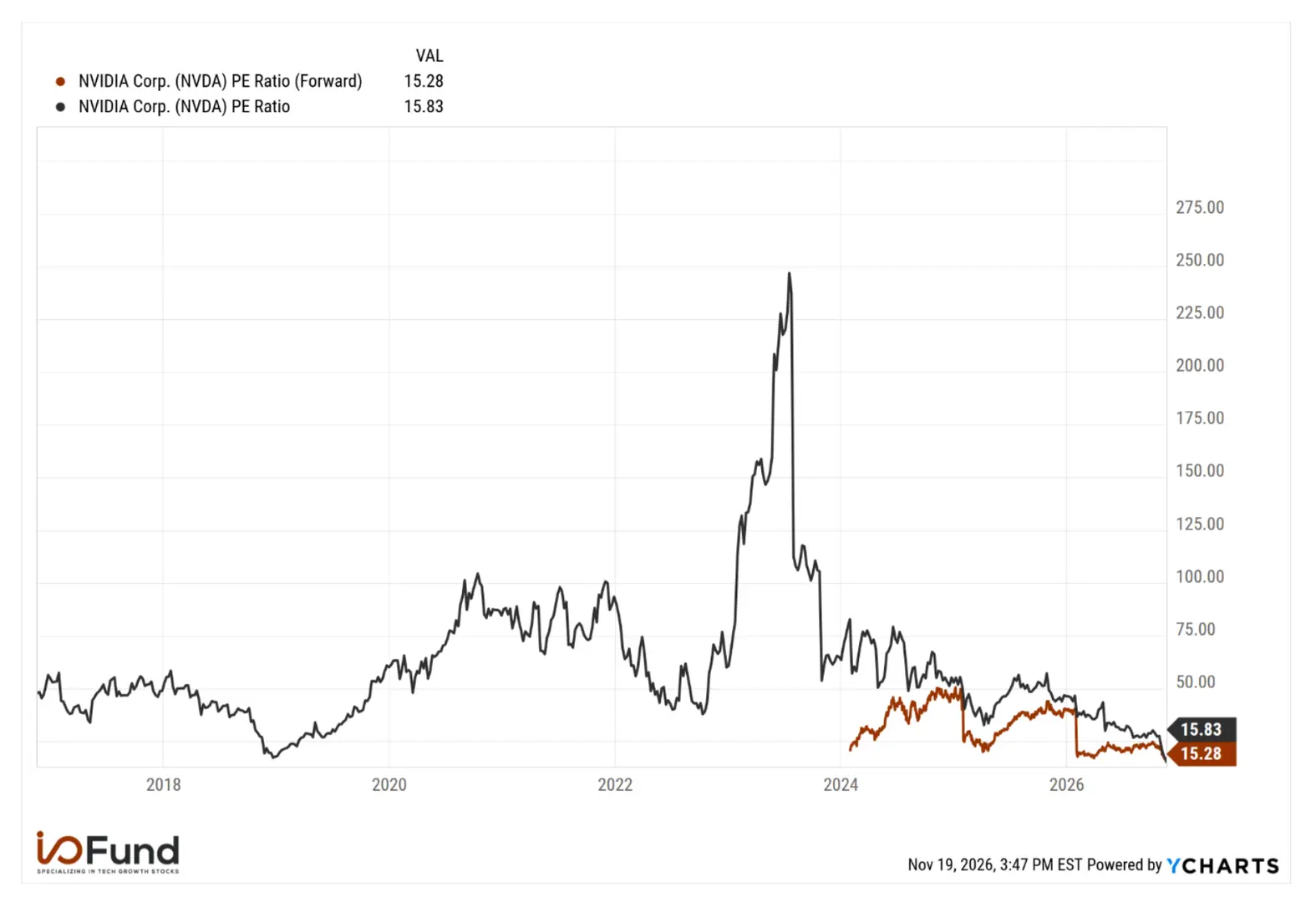
This is the case for both the top and bottom lines, with Nvidia seeing its lowest PE multiple since 2013, lower than even the December 2018 crypto-related rout. As of today, Nvidia trades at a 15.8X P/E ratio, below that December 2018 low of 17.3X and far below its 48.8X average over the last three years. Nvidia’s forward P/E multiple is equally as depressed at 15.3X, more than 50% below its 31.8X average since early 2024.
Nvidia’s valuation multiples have compressed significantly over time despite continued growth in the AI market. By late 2026, both the trailing PE ratio (15.83x) and forward PE ratio (15.28x) sit near historical lows, reflecting earnings growth that has outpaced share price appreciation.
This is similar on the top line, with Nvidia trading at a 9.8X P/S ratio and an 8.3X forward P/S, rivaling its multiples at the October 2022 low. For a company expected to see both its revenue and earnings grow 95%+ in FY27 and 70%+ in FY28, at these valuations, the downside appears limited.
“Case in point, since Nvidia’s watershed earnings report in May 2023 — the event that effectively ignited the AI trade — every time the Broad Semiconductor Sector (SMH) has made a new high without Nvidia confirming, it has signaled the prevailing trend is running on fumes and setting up for a reversal. As of today, SMH sits more than 30% above its late-October 2025 top, while Nvidia is still 1% below that same level – an uncomfortable warning sign beneath the recent strength of the broader semiconductor sector.”
We subsequently raised our cash position to 30% before deploying that capital over the past few weeks. In hindsight, our timing was impeccable, and we could have raised even more.
Those who do the opposite, which is to issue warnings, downgrades, and fear-driven headlines only after a steep selloff, are providing little to no value to investors. At best, these warnings are useless, at worst, they are financially damaging.
Now, in typical I/O Fund fashion, we’re taking the opposite stance once again. While others are warning that the AI trade has topped, we’ve gone on a buying spree, building positions in the AI suppliers we believe will emerge as massive winners in the years to come.
For investors who want to know exactly what we’re buying, including real-time trade alerts, weekly webinars and our Top 20 AI Stocks list, we’re offering $250 off our flagship Advanced Market Signals membership during our Black Friday sale, one of our deepest discounts of the year. ➝Get $250 Off Now.
Please note: The I/O Fund conducts research and draws conclusions for the company’s portfolio. We then share that information with our readers and offer real-time trade notifications. This is not a guarantee of a stock’s performance and it is not financial advice. Please consult your personal financial advisor before buying any stock in the companies mentioned in this analysis. Beth Kindig and the I/O Fund own shares in NVDA at the time of writing and may own stocks pictured in the charts.
Beth Kindig is the Founder, CEO and Lead Technology Analyst at I/O Fund, with more than 15 years of experience covering private and public technology companies. Known for her early Nvidia research beginning in 2018 and bold, high-conviction calls on emerging technology trends, Beth also manages I/O Fund's audited technology portfolio, which has returned 326% since May 2020, or 29.2% annualized. She is a regular guest on Fox Business and Bloomberg and has appeared on Real Vision, CNBC, Yahoo Finance, BBC, MarketWatch, Forbes, and more.