Amazon Plans to Offer Trainium Outside AWS in 2027: What It Means for AI Developers and AI Chip Adoption
Written by
I/O Fund Editorial Team
Research Team
Published: November 12, 2026
Last Updated: November 12, 2026
Key Points
On October 29, Amazon said it plans to offer its Trainium AI chips outside AWS starting in late 2027, as revenue commitments for Trainium rose more than 20x year over year.
Amazon's new TorchNeuron tool, released in public beta on October 20, lets developers run standard PyTorch code on Trainium2 and Trainium3 chips with one configuration change instead of a complete rewrite.
TorchNeuron is still early and Amazon has not yet shared a general-availability date. About 22,000 PyTorch tests are skipped on Trainium, input sizes must stay fixed, and custom low-level code still has to be rewritten.
On this page
On October 29, Amazon confirmed that it plans to start offering its custom AI chip, Trainium, outside AWS from late 2027. So far, Amazon Trainium was only rented out through its own cloud environment. On the company’s Q3 earnings call, CEO Andy Jassy stated, “With Trainium demand so strong, customers continue encouraging us to make it available outside of AWS.”
Amazon’s latest earnings also revealed that revenue commitments for its Trainium and Graviton server processes grew by over 20x YoY each while AWS revenue was up 39.3% to $46 billion, marking a sixth consecutive quarter of growth acceleration. This announcement follows Amazon’s TorchNeuron release on October 20, a free tool that makes it easier for AI developers to run PyTorch code on Trainium chips without rewriting it.
Amazon Trainium Commitments Up 20x, Chip Sales Growing Triple Digits
Jassy also confirmed on the earnings call that Amazon’s chips business “continues to grow triple digit percentages year over year.” Although Amazon did not confirm the latest dollar figure, Jassy had confirmed during the Q2 earnings call that Amazon’s chips, including Trainium and Graviton, had passed an annual revenue run rate of $25 billion.
As the AI buildout accelerates, demand for Amazon’s custom AI chips is running ahead of supply. The company has confirmed that short-term capacity on prior-generation Trainium is selling at a premium compared to H1 2026, while Amazon says customers using its custom chips have realized over $2 billion in costs savings in Q3 alone. Moreover, running inference accounts for well over half of AWS’s AI revenue, as shared by Jassy.
Frontier AI Labs Use Amazon Trainium, But What About Enterprises?
Designed by Amazon’s Annapurna Labs, the Trainium custom AI chip is used for training and running AI models. The latest generation Trainium3 is made by TSMC on its 3nm process. Presently, Amazon offers Trainium only through AWS, and it counts Anthropic and OpenAI among its largest customers.
Anthropic runs its Claude models on Amazon Trainium chips while OpenAI has committed 2 GW in capacity on this hardware. However, both of these frontier AI labs started using Trainium well before TorchNeuron, and have engineering teams that are capable of writing custom code for Amazon’s chips. With TorchNeuron, Amazon is aiming to sign on a broader base of startups and enterprises that don’t have engineers who can write custom code on Trainium chips. In April, Amazon had confirmed that its Trainium3 capacity was nearly fully subscribed, so tools like TorchNeuron can help bring in newer customers that extend demand for the next wave of capacity.
TorchNeuron Lets PyTorch Run on Trainium with Minimal Code Changes
TorchNeuron is a free, open-source tool that AI developers can use to run PyTorch code on Amazon’s Trainium2 and Trainium3 chips with only one configuration change. Amazon says 85% of AI researchers and developers use PyTorch, and most of that code was built to run on Nvidia GPUs.
Instead of rewriting their code for Amazon’s chip, developers change one setting that tells PyTorch where to run it, swapping “cuda” for Nvidia GPUs with “neuron” for Trainium. Before this, running PyTorch on Trainium meant using Amazon’s own programming tools. The tool had been in private beta since late 2025, used by over 30 early customers in robotics, world models and voice AI, before Amazon released it in public beta on October 20.
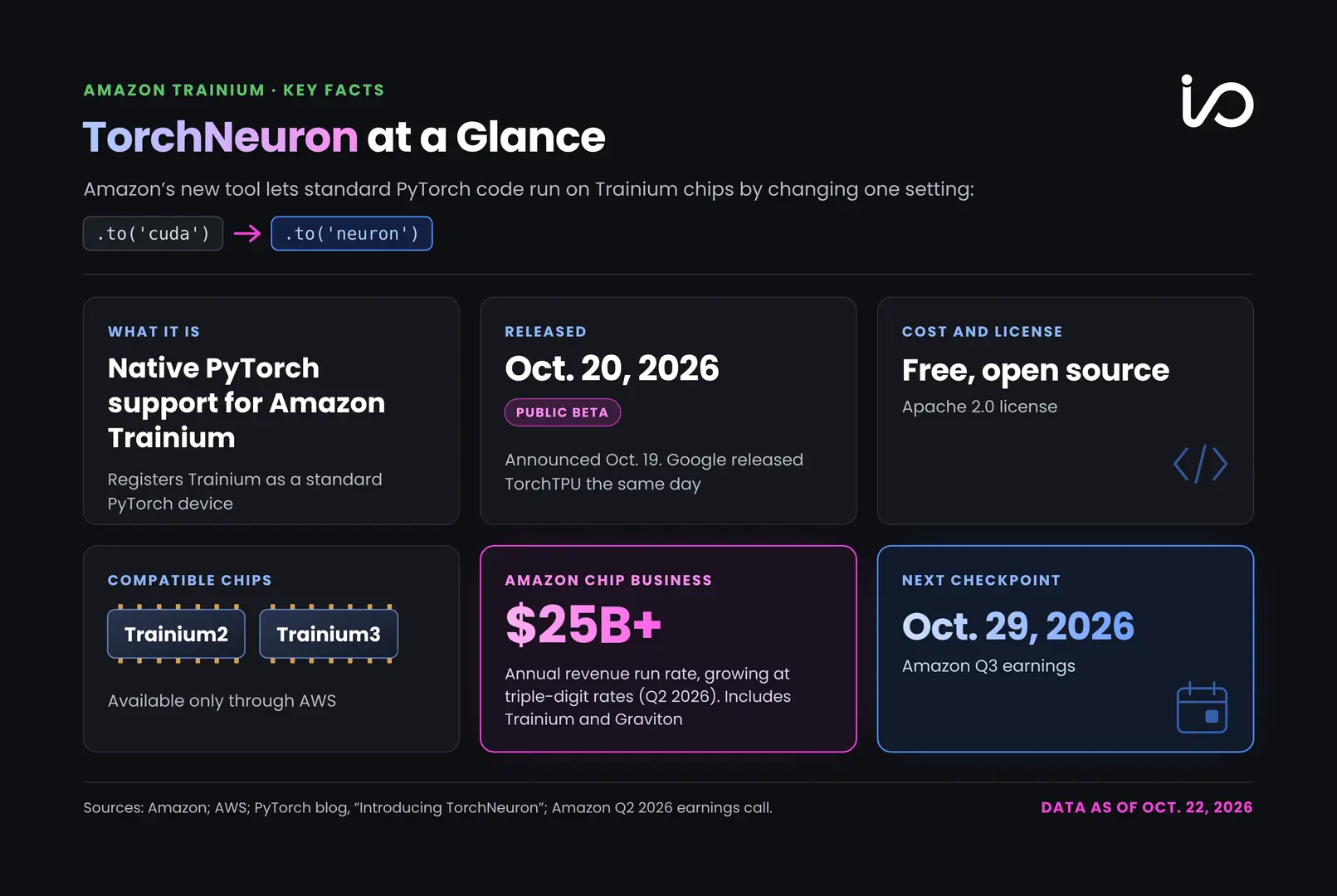
TorchNeuron registers Amazon Trainium as a native PyTorch device, allowing developers to move standard PyTorch code with a single configuration change. Key highlights include TorchNeuron’s Oct. 20, 2026 public beta launch, Trainium2 and Trainium3 support, Amazon’s $25B+ annual custom chip revenue run rate, and Amazon’s Oct. 29 earnings report as the next milestone for assessing Trainium adoption.
Colin Brace, Vice President of Technology Software at Amazon’s Annapurna Labs, told GeekWire, “If you know PyTorch, then you know Trainium.” In a Reuters interview, Brace remarked that the goal of AWS’s latest software release is about “meeting customers where they’re at.” Jassy also spoke about TorchNeuron during Amazon’s Q3 earnings call.
Amazon has seen early positive results with TorchNeuron. As mentioned on the PyTorch blog, speech AI company Deepgram processes about 60% more audio per dollar on Trainium than on its existing GPUs in the benchmarks it evaluated.
Amazon has submitted 26 code changes to the open-source PyTorch project aimed at removing dependencies on Nvidia-specific hardware, potentially making it easier for developers to run workloads on alternative chips. While these changes may not impact the larger AI labs in the near term, they could lower adoption barriers for startups and enterprises seeking alternatives for inference workloads. More broadly, making PyTorch more hardware-agnostic could benefit other chipmakers beyond Amazon’s Trainium.
Inference Is Where Amazon TorchNeuron Matters Most
TorchNeuron may eliminate the need to rewrite code, but getting developers onto Trainium is only the first step. and Amazon’s own documentation shows that once developers arrive, not all of their work will run well yet. As of writing, Amazon has not yet announced a general-availability date for TorchNeuron, making coverage a bigger gap.
In AWS’s August run of PyTorch’s test suite, about 22,000 of 154,000 tests were skipped because the operations they cover don’t yet run natively on Trainium. When code hits one of those operations, it either slows down, because the work shifts to the server’s regular processor, or fails outright if the model has been compiled for speed. Amazon says it will close these gaps “in sequential releases.”
Get Our Free Weekly Stock Newsletter
Get weekly stock insights, market analysis, and technology updates straight to your inbox.
Weekly stock insights
Market analysis
Technology updates
Trainium also needs inputs to stay the same size, so prompts of different lengths have to be padded, which creates additional work for chatbots and AI agents. Many AI labs write their own low-level CUDA code for extra speed, and that code has to be rewritten in Amazon’s Neuron Kernel Interface. Two Nvidia tools used at large scale, CUDA graphs and NCCL, aren’t supported in TorchNeuron’s first release.
However, Amazon will take almost one more year to make Trainium available outside the AWS environment, so developers who choose to move to it before late 2027 will need to commit to Amazon’s cloud. While Amazon has confirmed a timeline for when this will change, it is yet to reveal more details on how it plans to sell Trainium capacity, whether in the form of chips, servers or full racks, and how it plans to price them.
Amazon remains one of the most important companies in AI, but the biggest winners over the next several years won’t necessarily be the largest companies.Find out which AI stocks we currently rank ahead of Amazon inside theI/O Fund’s Top 20 Stocks Report, including real-time trade alerts, weekly webinars and an audited portfolio with anindustry-leading annualized return.
Amazon Isn’t Alone: Google and Microsoft Are Also Building Their Own AI Chip Ecosystems
Amazon is not the first to run PyTorch without CUDA. PyTorch already runs on AMD GPUs and Apple chips, and Google open-sourced TorchTPU a day after Amazon’s TorchNeuron announcement, to let PyTorch run on its TPUs as well.
TorchNeuron is one of several efforts running in parallel by hyperscalers looking for more hardware options. Google collaborated with Meta, Hugging Face, and others to open-source TorchTPU, allowing PyTorch code to run on Google TPUs with a configuration change. Unlike AWS, Google already sells TPUs to select external customers, so code moved to TPUs isn’t tied to one cloud the way Trainium code is tied to AWS for now.
Beyond Amazon and Google, Microsoft also announced in mid-October that it plans to use its homegrown Maia chips as the main inference system for its own AI products. As TechCrunch observed, developers won’t leave Nvidia en masse as most of the larger AI companies are more likely to use several types of AI chips side by side instead.
What to Watch Next for Amazon Trainium
TorchNeuron looks to be part of a broader push by Amazon to ease the adoption of its Trainium chips. According to a report on The Wall Street Journal, Amazon is said to be in talks to acquire AI startup Decart, which makes software to move AI workloads off Nvidia chips, in a deal estimated to be valued around $7 billion. Although no deal has yet been announced as of writing, Decart has previously reported running video inference on Trainium3 at 4x speed and half the cost of GPUs.
For Amazon’s TorchNeuron, the next key milestone lies in its general-availability release. With Amazon promising operator coverage “in sequential releases,” investors also need to see how Amazon sells Trainium outside AWS environments in late 2027. The company has previously forecast that its cash capex could reach $220 billion and expects to spend “meaningfully more” in 2027 on data centers, chips and other AI infrastructure.
TorchNeuron’s release lowers the entry barrier to Amazon Trainium for AI developers and researchers, while the most demanding workloads are likely to stay where they run today for now. Custom low-level code and unsupported operations remain the main hurdles. With TorchNeuron and its plan to move Trainium outside AWS in 2027, Amazon appears to be working on driving Trainium adoption from both the software and access side.
Amazon remains one of the most important companies in AI, but the biggest winners over the next several years won’t necessarily be the largest companies.Find out which AI stocks we currently rank ahead of Amazon inside theI/O Fund’s Top 20 Stocks Report, including real-time trade alerts, weekly webinars and an audited portfolio with anindustry-leading annualized return.
Amazon Trainium and TorchNeuron FAQs
What is Amazon Trainium?
Trainium is Amazon’s custom AI chip for training and running AI models. It is offered through AWS today, and Amazon plans to offer it outside AWS from late 2027.
Who designs and manufactures Trainium?
Amazon’s Annapurna Labs, acquired in 2015, designs Trainium. TSMC makes Trainium3 on its 3nm process.
What is TorchNeuron?
TorchNeuron is a free, open-source tool, in public beta since October 20, 2026, that lets PyTorch code run on Trainium2 and Trainium3 with one configuration change.
Please note: The I/O Fund conducts research and draws conclusions for the company’s portfolio. We then share that information with our readers and offer real-time trade notifications. This is not a guarantee of a stock’s performance and it is not financial advice. Please consult your personal financial advisor before buying any stock in the companies mentioned in this analysis.
Aiswarya Gopan, AI and Semiconductor Investment Writer at I/O Fund, contributed to this analysis.
The I/O Fund Editorial Team writes educational guides that explain investing concepts, market terms, and the technology behind today's markets. All content is researched from trusted sources, fact-checked, and reviewed by an I/O Fund analyst before it is published. This content is for educational purposes only and is not investment advice or a stock recommendation.