
For more than two decades, enterprise software has been one of Wall Street’s favorite business models: build the product once, scale up additional users at almost no extra cost, and collect recurring revenue at gross margins near 80%. Agentic AI is challenging enterprise software’s successful business model from two different directions simultaneously.
Unlike traditional SaaS products where an additional user action costs almost nothing to serve, autonomous AI agents consume compute for every reasoning step, data retrieval, and action they perform. This transforms software’s cost of goods sold into a direct, variable expense that grows corresponding to usage.
With increasing AI adoption and rising compute costs, the enterprise software sector is experiencing a sharp split into two halves. The first half are the ones getting squeezed, vendors relying on flat, seat-based pricing being forced to absorb rising compute bills internally. This group is seeing their gross margins narrow and revenue growth decelerate. On the other side, thriving vendors are monetizing agent workloads separately, through consumption credits, usage metering, or per-resolution billing. These vendors are successfully passing inference costs to their customers and accelerating top-line growth.
How AI Agents Create Variable Compute Costs for SaaS Companies
Conventional SaaS’s financial foundation lies in high operating leverage, with fixed upfront R&D costs but minimal incremental expenses for scaling from 1,000 to 100,000 user seats. This is why software vendors have traditionally enjoyed gross margins of 75% to 80%.
AI agents disrupt SaaS’s traditional “build once, sell many times” model. Every task an agent performs, whether it’s reasoning through a problem, pulling data or taking an action, burns tokens, and tokens cost money. The more complex the task, the higher the token usage, and the bigger the bill. Anthropic’s engineering measurements estimate that a single agent uses 4x more tokens than a standard chat, which can go up to 15x for a multi-agent system.
As tasks with higher complexity consume more tokens, the compute burden on software platforms expands exponentially. For instance, Google’s monthly token volume surged from 9.7 trillion in May 2024 to 3.2 quadrillion by May 2026.
AI Adoption Is Driving Margin Compression Across SaaS Vendors
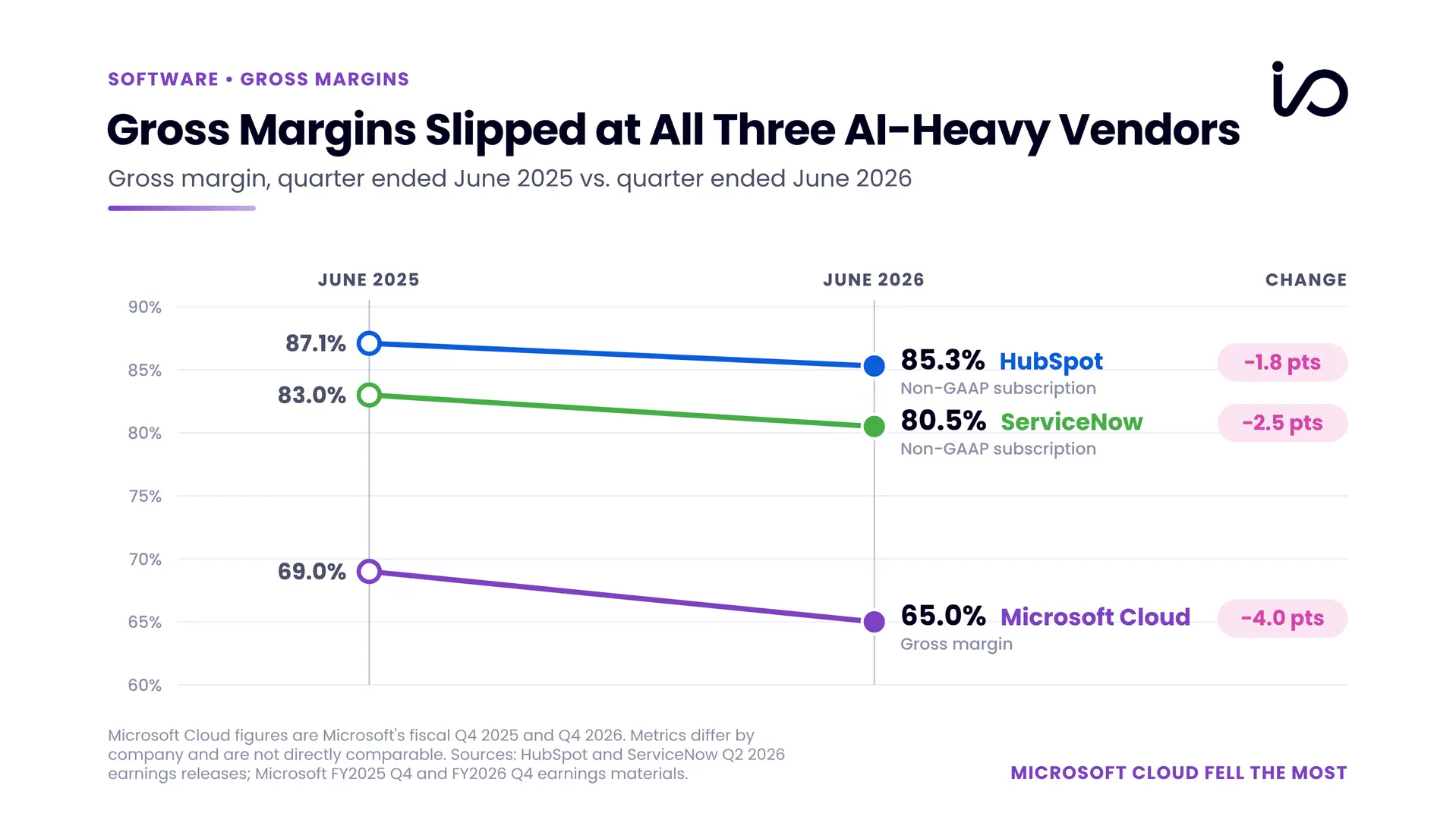
The financial impact of this compute burden has already started showing up in public earnings reports. ServiceNow’s subscription gross margins fell from 83% to 80.5% over the past year. Management has explicitly attributed this decline across two consecutive quarters to rising AI adoption costs. During the same period, Microsoft Cloud’s gross margins contracted from 69% to 65%, driven by heavy AI infrastructure outlays and expanding usage.
HubSpot’s non-GAAP subscription gross margins slipped from 87.1% to 85.3% due to rising AI usage. Workday’s cost of subscription services rose 17.8% in its latest quarter, outpacing subscription revenue growth of 13.9% as the company expanded its agentic AI strategy.
Google’s monthly tokens grew 330x in two years, and the forecasts keep falling behind. Sign up for our free weekly newsletter to see how we track AI token demand and which infrastructure stocks stand to benefit as it climbs.
AI Native Software Companies Face Structurally Lower Gross Margins
AI-native application startups show a similar trend emerging, where compute is the primary COGS and this cost structure leads. Because these applications rely on frontier LLMs for nearly every customer action, their gross margins range from 25% to 60%, compared to traditional SaaS’s 80% gross margins.
Bessemer’s fastest-growing “Supernovas” average around 25% gross margins, with many frequently dipping into negative territory due to usage spikes. Replit is another example where gross margins contracted from 36% to 23% in 2025 due to surging AI usage, while Cursor ran negative gross margins on select plans before overhauling its pricing structure.
SaaS Companies Shift From Seat-Based Pricing to AI Usage-Based Pricing
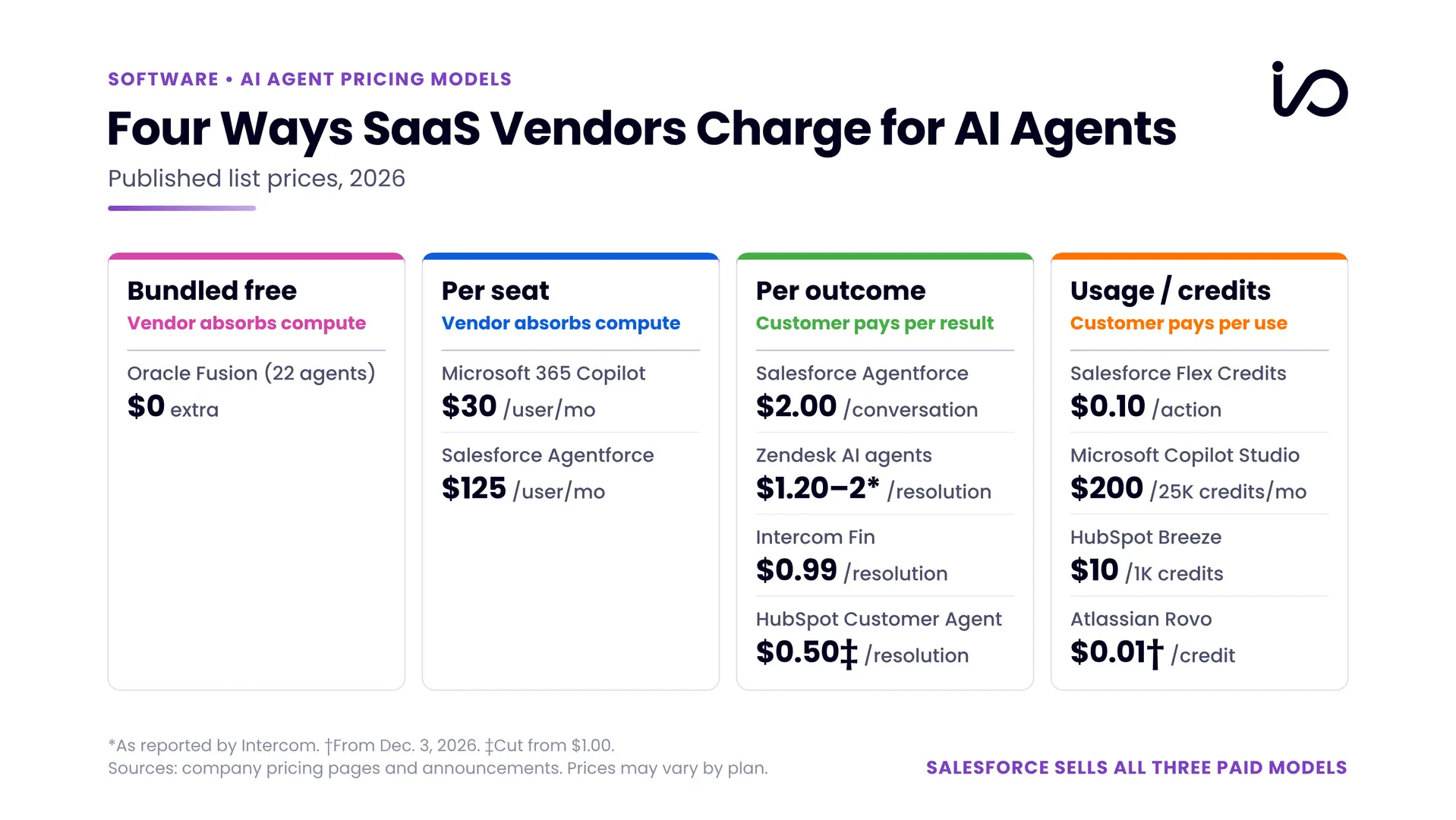
To defend gross margins, enterprise software platforms are now experimenting with new pricing models, resulting in wide price variations across the sector. Salesforce charges $2 per Agentforce conversation or $0.10 per action via Flex Credits. Intercom charges $0.99 per resolution for its Fin agent, while Zendesk bills between $1.20 and $2 per resolution.
However, intense competition has already triggered price wars among vendors for agentic AI solutions. HubSpot slashed its Customer Agent price by 50% to $0.50 per resolution, while Oracle now bundles 22 AI agents into Fusion at no additional cost. Meanwhile, Salesforce’s Chief Revenue Officer stated that the company is willing to accept unprofitable flat-fee agent deals upfront to secure accounts.