AI Debt Nears $500 Billion in 2026: What It Means for Nvidia, Oracle, CoreWeave and AI Stocks
Written by
I/O Fund Team
Research Team
Published: October 23, 2026
Last Updated: October 23, 2026
On this page
In early October 2026, three large AI hardware financing deals made headlines. SpaceX is reportedly looking to raise $40 billion to acquire Nvidia processors, and Broadcom is reportedly turning to its private credit platform to raise $50 billion for OpenAI to purchase custom accelerators. At the same time, Oracle is said to be in talks with Apollo Global Management and Goldman Sachs to lease AI chips via a separate investor-funded entity.
AI compute is becoming a financeable infrastructure asset class. Instead of relying solely on operating cash flow, the sector is now turning to debt markets at an unprecedented pace. Getting a clearer understanding of what this shift means for the AI industry requires a deeper look at who is borrowing, how these financing deals are being structured, and where interest costs land across AI stocks.
AI Debt Nears $500 Billion as Borrowing for AI Infrastructure Surges
As AI capex scales towards $1 trillion and beyond, the primary method of funding the data center buildout has shifted in recent months. Hyperscalers and leading AI firms have turned to the debt markets this year, with AI-related debt issuance surging year to date.
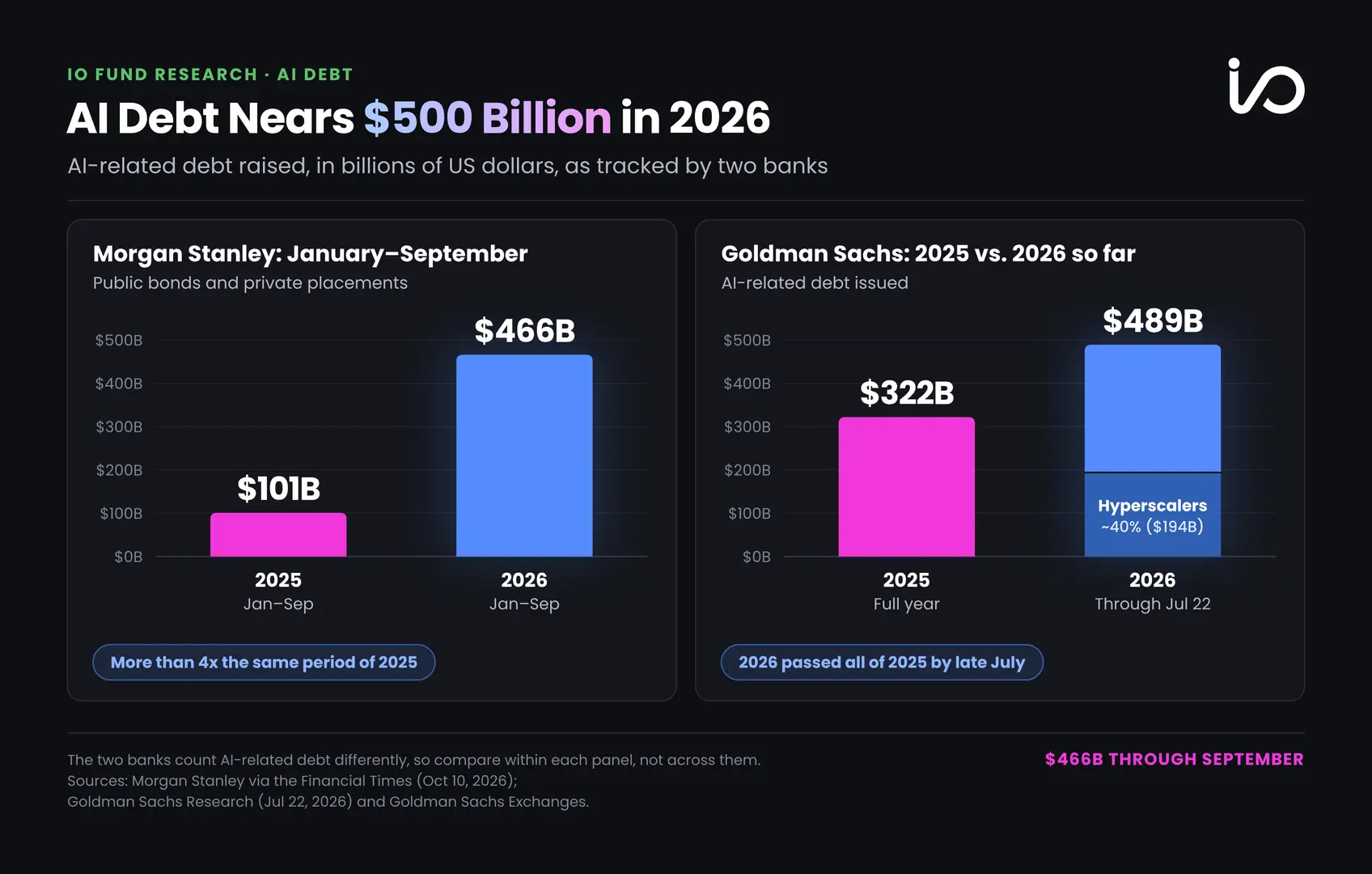
AI-related debt issuance has accelerated sharply in 2026. Morgan Stanley data shows debt raised reaching $466 billion through September, up from $101 billion during the same period in 2025. Goldman Sachs data shows AI-related debt climbing to $489 billion by July 22, surpassing the full-year 2025 total of $322 billion, with hyperscalers accounting for about $194 billion, or 40%, of the 2026 total.
Morgan Stanley estimates that cumulative AI debt issuance, including public corporate bonds and private placement transactions, has touched $466 billion through September 2026, more than 4x the $101 billion raised during the corresponding period in 2025. According to Goldman Sachs, $489 billion in AI-related debt had already been issued by July 22, 2026, well over the total $322 billion raised across all of 2025. Around 40% of this amount was borrowed by hyperscalers and large tech firms per Goldman Sachs’ estimates.
The International Monetary Fund, in its October 2026 Global Financial Stability Report, stated that five tech companies, Alphabet, Amazon, Meta, Microsoft, and Oracle, accounted for almost 10% of all investment-grade corporate bond issuance globally in 2026, from a mere 0.5% in 2024.
According to Morgan Stanley, monthly AI-related debt issuance peaked at a record $113 billion in June 2026 and slowed to $23 billion in September, mainly because much of the year’s borrowing had already been done. The slowdown can also be attributed to investor concerns about long-term payoff and local opposition to new AI data center projects, as a Financial Times report suggests.
Three Emerging Financing Models for AI Infrastructure Buildout
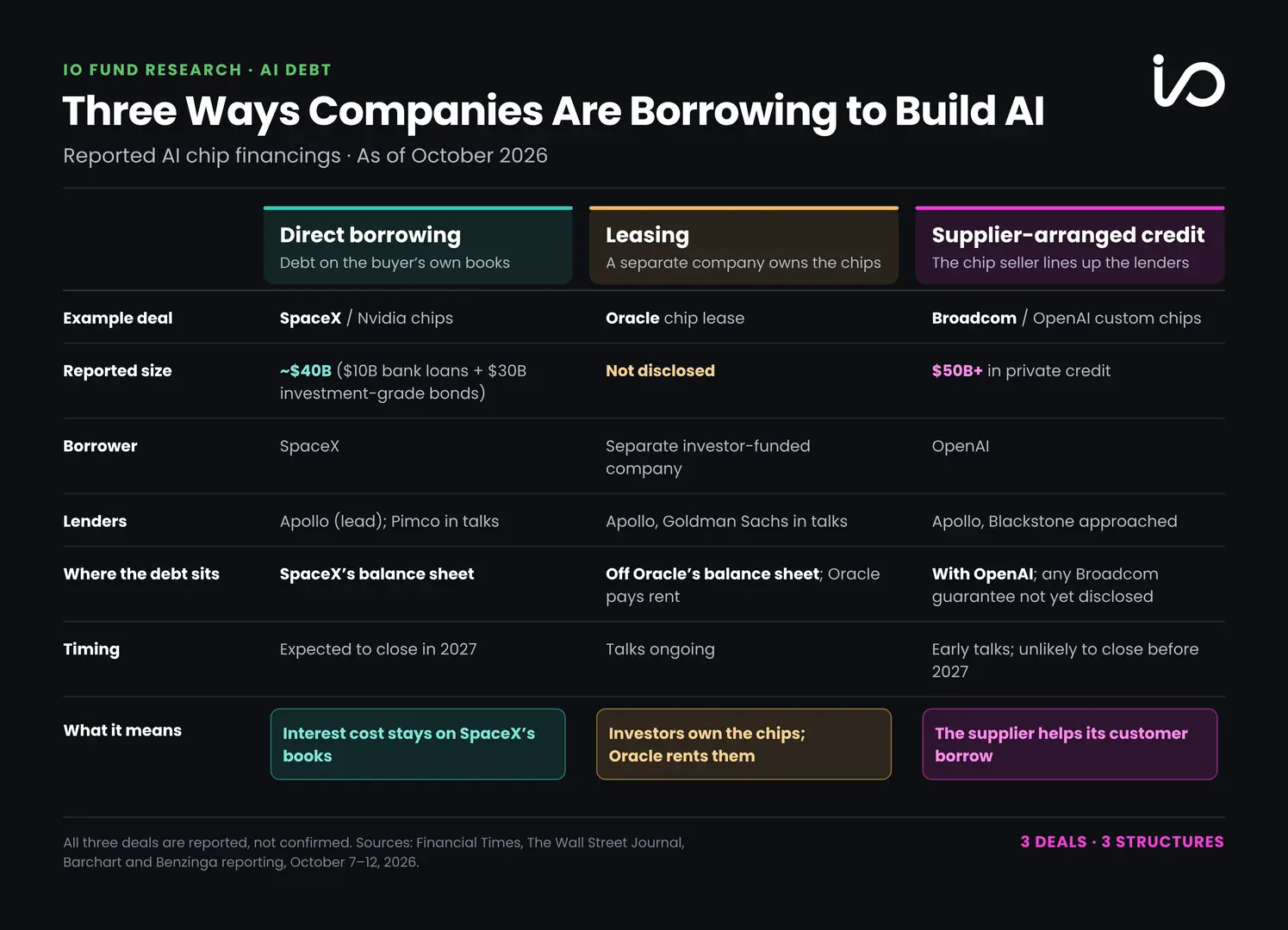
The SpaceX-Nvidia, Broadcom-OpenAI, and Oracle deals reveal three distinct structural models for funding AI hardware buildouts.
Three reported AI hardware financing structures are emerging across the AI ecosystem. SpaceX is using direct borrowing to acquire Nvidia GPUs, Oracle is pursuing an off-balance-sheet chip-leasing model, and Broadcom is arranging private credit to support OpenAI’s custom AI chip purchases.
SpaceX’s reported $40 billion package combines $10 billion in commercial bank loans with $30 billion in investment-grade bonds led by Apollo. Borrowing against corporate credit lets SpaceX secure constrained GPU supplies rapidly without diluting equity holders.
Broadcom is reportedly arranging over $50 billion in private credit, from AI XPV platform partners Apollo and Blackstone, so OpenAI can finance custom silicon purchases while serving as the borrower. This arrangement is not a first for Broadcom, as this mirrors a similar financing secured for Anthropic. In that deal, Broadcom reportedly guarantees up to $42 billion in senior notes, which it would pay only if Anthropic defaults and the chips’ resale value falls below a set level.
Oracle is reportedly engaging with Apollo and Goldman Sachs to establish a structure for third-party investors to fund a separate company that purchases chips and leases them to Oracle. This helps Oracle keep the debt off its balance sheet and it will sit with this new company instead. Leasing is already central to Oracle’s buildout, noting last quarter that it has $288 billion of new data center leases that have not yet started, with terms of 15 to 19 years. These leases will only appear on the balance sheet once they begin.
Oracle and CoreWeave Debt Show Where AI Debt Costs Appear First
Higher borrowing costs have a direct impact on debt-funded AI infrastructure builders. With the 10-year US Treasury yield touching 5.35% on October 7, annual debt servicing costs have become a very important financial metric to monitor.
Oracle reported $125.3 billion in total notes payable and borrowings, or more than 3x its cash and marketable securities of $37.1 billion in Q1 FY27. Quarterly interest expense grew 55% YoY to $1.43 billion, or more than 7% of revenue.
A look at CoreWeave’s Q2 2026 financials reveals $2.6 billion in revenue with a quarterly capex of $9.4 billion, most of which is financed by debt. CoreWeave’s total debt touched around $35.6 billion, and the company raised its FY2026 capex guidance to $35-$39 billion. Additionally, the neocloud provider reported Q2 interest expense of $640 million, up 140% YoY, while guiding to $860-$940 million for Q3, meaning more than 25% of its revenue goes to servicing its debt. CoreWeave has approximately $15 billion of its total debt due through 2028, though some of the higher-interest debt with 10%+ rates are due in 2030 and beyond. Our Nebius vs. CoreWeave analysis examined the difference in debt structures between the two neoclouds and how both are financing their rapid capacity buildouts.
Get Our Free Weekly Stock Newsletter
Get weekly stock insights, market analysis, and technology updates straight to your inbox.
Weekly stock insights
Market analysis
Technology updates
I/O Fund is up 61% YTD vs. 16% for the Nasdaq-100, with 14 positions outperforming the index as of October 16th. Our latest 95+ page Q4 Top 20 AI Stocks report identifies the lesser-known stocks leading AI’s biggest trends. Join I/O Fund to access the report and our real-time portfolio.Join I/O Fund today.
How Rising AI Debt Impacts Nvidia, Broadcom, and Big Tech
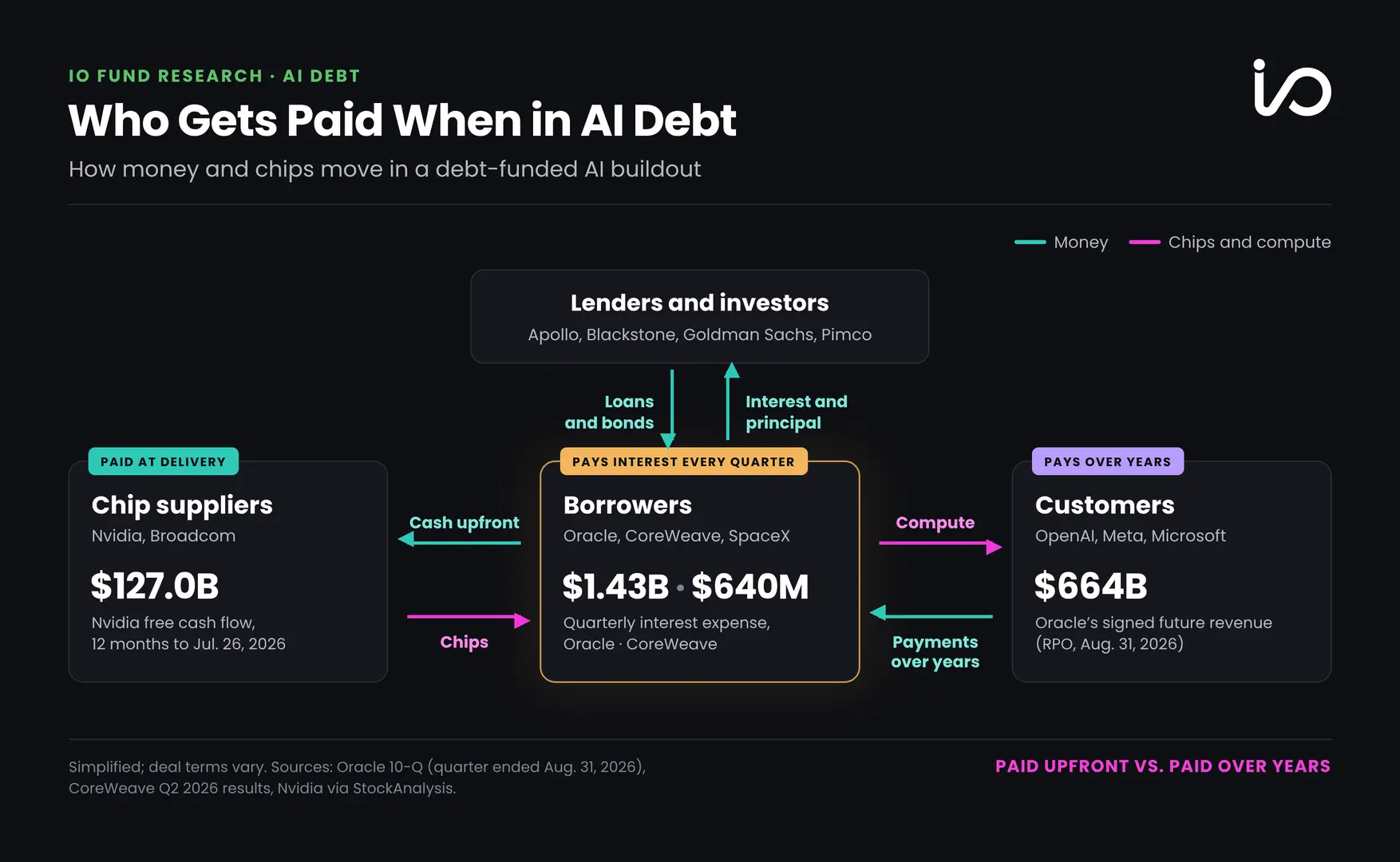
The chart below shows how money and chips move through a debt-funded AI buildout. Lenders fund the balance-sheet borrowers, such as Oracle, CoreWeave and SpaceX. Those borrowers pay chip suppliers upfront for hardware, then rent compute capacity to customers such as OpenAI, Meta and Microsoft. Suppliers collect cash when chips are delivered, borrowers pay interest every quarter, and customer revenue arrives over multi-year contracts.
A look at Nvidia’s financials reveals free cash flow worth $127 billion for the 12 months ending July 26, 2026. Nvidia has signed preliminary agreements with six institutional partners, Apollo, BlackRock, Blackstone, Brookfield, Goldman Sachs, and KKR, to support its ecosystem expansion efforts. Its platform targets over $500 billion in third-party capital, with CEO Jensen Huang stating that Nvidia retains the option to backstop up to $125 billion across these structures.
Borrowers finance AI infrastructure with debt, paying suppliers such as Nvidia and Broadcom upfront for chips while collecting customer payments over years. The model channels $127B to chip suppliers, supports $664B of future customer revenue, and requires ongoing interest payments to lenders.
Broadcom plays a similar role, reportedly arranging lending for OpenAI and already guarantees part of the debt in its Anthropic financing, so some risk flows back to the supplier. The IMF’s financial stability report highlighted 14 circular financing arrangements across the broader GPU ecosystem, a structural trend we detailed in our analysis of circular GPU financing back in June 2026.
The hyperscalers that buy compute are also among the largest borrowers. As our Big Tech free cash flow analysis from July showed, faster capex growth has narrowed free cash flow across this sector. In Q2 2026, Alphabet reported its first negative quarter since its 2004 IPO, with free cash flow dipping to -$5.9 billion, as capital spending rose to $44.9 billion in a single quarter. However, over the past 12 months, Alphabet’s free cash flow remains positive at $53.3 billion. Goldman Sachs estimates that hyperscalers have room to borrow about $2 trillion more while maintaining investment-grade credit ratings.
Key Catalysts for the Next Phase of AI Infrastructure Financing
Several immediate catalysts will reveal how debt service costs and capital risks are distributed across the value chain as the AI infrastructure buildout scales. In the near-term, the focus will be on syndication terms and final pricing for Broadcom’s private credit deal for OpenAI and SpaceX’s $40 billion debt raise, in addition to formal disclosures detailing the off-balance-sheet treatment and lease terms of Oracle’s proposed chip-leasing entity. Additionally, Oracle’s earnings report due on December 14, 2026 will offer key management commentary on interest expenses, free cash flow trajectories, and how it executes its multi-billion-dollar capex commitments.
Meanwhile, specialized compute operators like CoreWeave face an ongoing test of balance-sheet resilience as actual Q3 interest expenses get measured against management’s guidance range of $860 million to $940 million. Across both fixed and floating private credit facilities, base borrowing costs remain closely interlinked with macroeconomic conditions and benchmark interest rates, specifically how the 10-year US Treasury yield moves. These milestones can help reveal whether rising cloud hosting revenues can comfortably keep pace with debt service or if higher yields could start impacting capital structures across the AI sector.
The I/O Fund has built a strong track record in lesser-known AI winners,including an energy stock up more than 1,300%since our initial entry last year,an optical networking stock up 325%, and two of our largest AI positionsup 183% and 130% year to date.
We publish more than100 paywalled articles each year on AI stocks, supported by anactively managed portfolioandreal-time trade alerts.
Please note: The I/O Fund conducts research and draws conclusions for the company’s portfolio. We then share that information with our readers and offer real-time trade notifications. This is not a guarantee of a stock’s performance and it is not financial advice. Please consult your personal financial advisor before buying any stock in the companies mentioned in this analysis. Beth Kindig and the I/O Fund own shares in NVDA and may own stocks pictured in the charts.
Aiswarya Gopan, AI and Semiconductor Investment Writer at I/O Fund, contributed to this analysis.