How Much Nvidia Business Does Microsoft’s Maia 300 AI Chip Really Replace?
Written by
I/O Fund Team
Research Team
Published: October 23, 2026
Last Updated: October 23, 2026
On this page
On October 12, 2026, Microsoft announced its Maia 300 custom AI chip, with CEO Satya Nadella calling it his company’s “biggest bet yet on our own silicon.” Microsoft is expecting to scale to multi-gigawatt deployments of Maia 300 in 2027, with the chip expected to deliver significant throughput gains versus the current Maia 200 generation in production.
While most of the narrative suggested that Microsoft’s Maia 300 AI chip could mean a shift in its data center spending strategy, Nvidia’s stock dipped only 1% on the announcement. The reason for this lukewarm reaction likely lies in the details behind the headlines that tell a narrower story.
Microsoft’s in-house AI chip program is not designed to replace Nvidia GPUs in use within Microsoft’s current infrastructure. From a commercial perspective, because Microsoft isn’t selling or renting Maia to anyone else, it’s a far smaller challenge to Nvidia than rival hyperscaler chips. Meanwhile, the same suppliers in the AI value chain, semiconductor foundries like TSMC and HBM memory suppliers, are poised to benefit either way.
Microsoft Maia 300 Roadmap, Deployment Timeline, and Performance Claims
Behind the Maia 300 lies a hardware evolution spanning several years, aimed at complementing merchant GPUs used in Azure data centers. Microsoft’s inaugural Maia 100 processor was announced in 2023 followed by Maia 200 in January 2026. Microsoft has currently deployed the Maia 200 in its data centers across the US, Europe, and Australia, powering inference workloads for Microsoft 365 Copilot, Teams, and internal MAI models. GitHub Copilot and Microsoft Foundry are expected to move to this hardware by late 2026.
Microsoft’s Maia 300 represents a major step up from Maia 200, doubling rack density, adopting HBM4 memory, and significantly increasing memory bandwidth. Production deployments are scheduled to begin in 2027, with Microsoft projecting up to 7x higher token throughput and 40% more tokens per megawatt than leading GPU-based systems, though these performance claims have not yet been independently verified.
The Maia 300 marks a significant shift in rack-scale engineering for Microsoft. Scott Guthrie, Microsoft’s executive vice president of Cloud + AI, explained that Microsoft “will scale our Azure Maia family to multi-gigawatt deployments starting in 2027,” making the new chip its primary inference system. This chip is engineered for reasoning over long documents, fast back-and-forth conversation and multi-step agentic work.
According to Microsoft’s projections, a fully configured 96-accelerator Maia 300 rack can deliver up to 7X the token throughput of a Maia 200 rack and generate 40% more tokens per megawatt than leading GPU-based systems. It should be noted that Microsoft’s claim of 40% more tokens per megawatt represents only a vendor-reported expectation rather than an independently verified benchmark for now.
Hyperscalers’ share of Nvidia’s data center sales fell from 59% to 55% in a year. Microsoft, Google and Amazon are all building their own chips. Get I/O Fund’s free weekly analysis of what that means for Nvidia and the AI chip supply chain.Sign up for the free newsletter.
Maia to Account for 10% of Microsoft’s AI Chip Spending
A review of how Microsoft’s capex flows through its cloud architecture provides a better understanding of the Maia 300 versus Nvidia debate and its potential impact on the broader semiconductor market. In fiscal Q4 2026, Microsoft’s capex touched $41 billion, roughly two-thirds of which funds short-lived assets, primarily CPUs and GPUs. Management’s guidance expects quarterly capex to rise to cross $50 billion for fiscal Q1 2027.
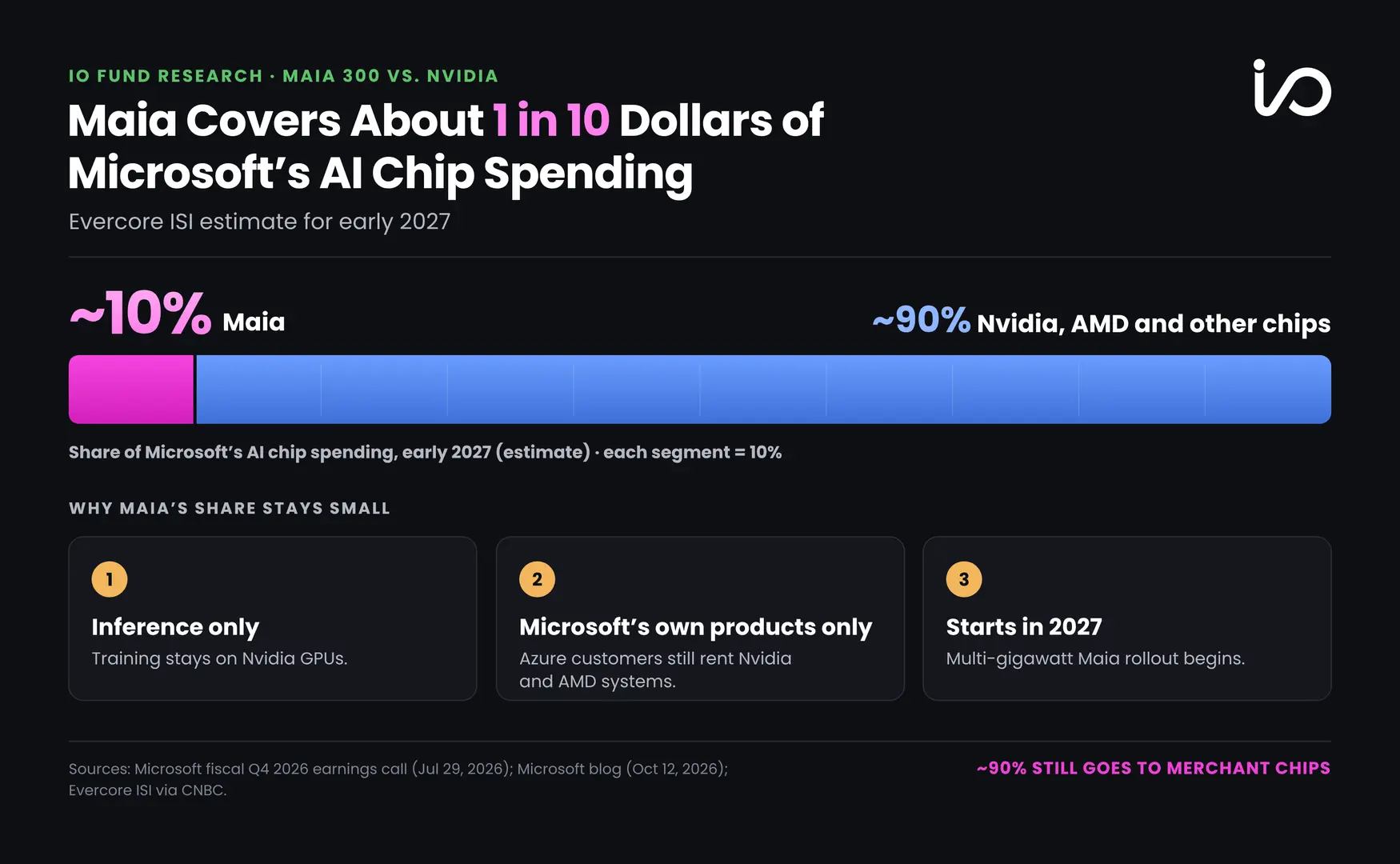
Microsoft’s AI chip spending narrows at each layer of deployment. Maia 300 is limited to inference workloads, supports Microsoft’s own products rather than Azure customers, and begins large-scale deployment in 2027. As a result, Evercore ISI estimates Maia could account for only about 10% of Microsoft’s AI chip spending by early 2027.
The spending breakdown reveals that the actual dollar impact of Microsoft’s AI chip narrows significantly at each operational layer. Training stays on GPUs, where Nvidia’s CUDA software and networking still lead. Azure’s cloud customers will keep renting Nvidia and AMD systems, while the Maia generations will power core products and services such as Copilot. Evercore ISI estimates that by early next year, Maia will account for about 10% of Microsoft’s total AI chip spending.
On the other hand, Nvidia continues to expand its customer base at a rapid pace. In Q2 FY27, Nvidia’s total revenue rose 106% YoY to $96.2 billion. Hyperscalers accounted for 55% of data center sales, down from 59% a year earlier, even as Nvidia’s revenue from non-hyperscaler data center clients, including enterprise and cloud competitors, rose 138% to $40.3 billion.
Why Microsoft Still Needs Nvidia Despite Building Its Own AI Chips
Unit economics offers the most direct reason behind why Microsoft designs custom AI hardware even as it remains a major GPU buyer in the market. Microsoft’s custom AI chip serves as an internal cost hedge.
The company’s own services like Microsoft 365 Copilot generate a massive volume of repetitive inference requests every day. Custom accelerators like the Maia 300 are tuned exclusively for these query patterns, reducing power and processing costs per token. This, in turn, helps protect Microsoft Cloud’s gross margins, which stood at 65% in Q4 FY26, even as customer usage expands. As a result, it is likely that Microsoft will leverage the Maia 300 as a cost hedge to protect cloud gross margins rather than taking on Nvidia’s growth engine.
Get Our Free Weekly Stock Newsletter
Get weekly stock insights, market analysis, and technology updates straight to your inbox.
Weekly stock insights
Market analysis
Technology updates
Alongside developing its custom AI chip, Microsoft has reiterated its commitment to buying merchant GPUs. On its July earnings call, CEO Satya Nadella confirmed that the company will be among the first hyperscalers to deploy Nvidia’s next-generation Vera Rubin systems and AMD’s Helios racks. According to Microsoft General Manager Alistair Speirs, preserving a multi-vendor fleet gives the company “a little bit of optionality” in deploying the optimal hardware for rapidly advancing models. In the long term, Microsoft CTO Kevin Scott has shared an aim to power a majority of internal operations with homegrown silicon. Microsoft also holds rights to OpenAI’s data center chip designs through 2032, which gives it one more avenue to explore custom silicon.
Why Google TPU and AWS Trainium Threaten Nvidia More Than Microsoft Maia 300
Commercial distribution is a key strategic factor to consider when comparing custom silicon programs across hyperscalers. Google TPU capacity gets rented to third-party enterprises through Google Cloud, with Anthropic among its largest users, in addition to selling them to a select group of customers in their own data centers. Amazon Web Services follows a similar practice by offering Trainium and Inferentia instances to external cloud clients while reportedly evaluating selling the chips for customers’ own data centers, as per Bloomberg. Supplying custom AI hardware to outside developers puts Google and AWS in direct competition with Nvidia over its merchant customer base.
On the other hand, Microsoft utilizes its custom AI chip within its own operations, letting Maia support internal software features rather than renting instances directly to Azure’s clients. Although media reports state that Microsoft has discussed hosting strategic partners like Anthropic on Maia, the company has not yet announced external commercial availability.
TSMC and HBM Suppliers Benefit Regardless of Which AI Chip Wins
Instead of disrupting the semiconductor value chain, Microsoft’s plans to expand its in-house AI chip program could benefit the very same chip manufacturing and memory partners that supply merchant GPU makers. Maia 300’s core compute processor uses modular chiplets manufactured on TSMC’s advanced 2nm N2P process nodes. According to a report on The Information, Microsoft is in talks with TSMC over manufacturing capacity for more than 300,000 units to support Maia 300’s 2027 rollout timeline.
High-bandwidth memory remains one of the AI industry’s most severe supply bottlenecks at present. Each Maia 300 accelerator incorporates eight stacks of HBM4 memory, delivering 288 GB of capacity and 18 TB/s of bandwidth, amounting to 27.6 TB of HBM4 memory per 96-chip rack.
Whether hyperscalers deploy merchant GPUs or build custom ASICs, leading foundries like TSMC and HBM memory producers remain vital for the success of the global AI buildout.
The Real Question Is Whether Microsoft Takes Maia Beyond Its Own Products
The introduction of Maia 300 is a sign that cloud infrastructure is maturing, as hyperscalers deploy tailored silicon to optimize their workload economics. However, it is too early to claim that Microsoft’s AI chip will impact Nvidia’s dominance, especially considering the initiative’s narrow operational scope. Microsoft operates Maia 300 as a targeted gross margin hedge for its own products’ inference, while depending on Nvidia’s dominant infrastructure to support model training and third-party cloud infrastructure.
When Microsoft reports earnings on October 28, its capital spending and Microsoft Cloud gross margin could offer signs of whether its own chips are lowering the cost of running AI. Later, at its Ignite event between November 17 and November 20, the bigger question will be whether Microsoft offers Maia to Azure customers. If it does, Maia could follow Google’s TPU business and turn into a more direct threat to Nvidia. No matter how these two key events develop, TSMC and HBM memory makers stand to benefit as Microsoft adds its own chips alongside the Nvidia and AMD systems it keeps buying, so their commentary on capacity is worth monitoring.
The I/O Fund has built a strong track record in lesser-known AI winners, includingan energy stock up more than 1,300%since our initial entry last year,an optical networking stock up 325%, and two of our largest AI positions areup 183% and 130% year to date.
We publish more than100 paywalled articles each year on AI stocks, supported by an actively managed portfolio and real-time trade alerts. Our portfolio is up 61% YTDcompared to the Nasdaq-100 up 16% YTD – ornearly 4X the index.
Access the I/O Fund’s research on the top AI stocks.Subscribe here.
Please note: The I/O Fund conducts research and draws conclusions for the company’s portfolio. We then share that information with our readers and offer real-time trade notifications. This is not a guarantee of a stock’s performance and it is not financial advice. Please consult your personal financial advisor before buying any stock in the companies mentioned in this analysis. Beth Kindig and the I/O Fund own shares in NVDA and may own stocks pictured in the charts.
Aiswarya Gopan, AI and Semiconductor Investment Writer at I/O Fund, contributed to this analysis.