What Is an Optical Transceiver? AI Data Center Optics Explained
Written by
I/O Fund Editorial Team
Research Team
Published: November 26, 2026
Last Updated: November 26, 2026
Key Points
An optical transceiver converts electrical signals into light so data can travel between machines over fiber.
AI needs a lot of them: about three per GPU in Nvidia's GB300 NVL72 rack, and about six per GPU in Vera Rubin designs.
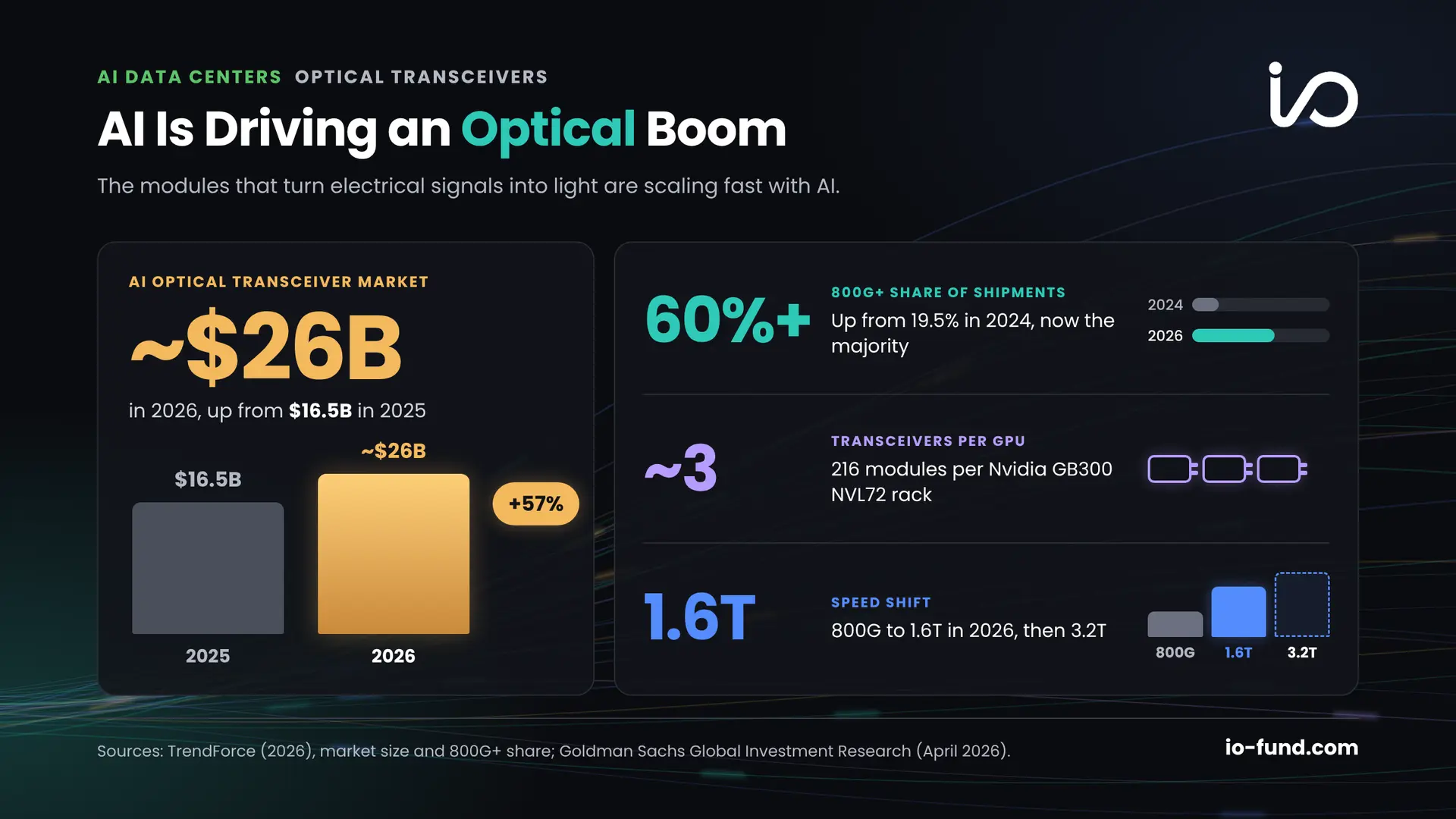
The AI optical transceiver market is expected to grow more than 57%, from about $16.5B in 2025 to $26B in 2026 (TrendForce).
Lasers are the main supply bottleneck, and supply may stay tight through 2027.
On this page
An optical transceiver is a key component of an AI data center, turning electrical signals into light so data can travel from one machine to another over fiber. According to Goldman Sachs’ estimates, each GPU in Nvidia’s GB300 NVL72 rack needs around three optical transceivers, and the Vera Rubin rack designs that follow need around six of them. GPUs and memory chips have garnered the most attention in the AI buildout, but thousands of GPUs can only function as a single system when they are linked together to support data movement between them.
The AI optical transceiver market is expected to grow 57% to approximately $26 billion in 2026, driven by rising adoption of 800G and 1.6T optics, increasing transceivers per GPU, and expanding AI data center infrastructure.
In this article, we explore what an optical transceiver is, why AI needs so many of them, the market size of optical transceivers, why there is a tight supply of them, and key innovations in this sector.
What Is an Optical Transceiver?
An optical transceiver is a small plug-in module that converts electrical signals from chips and switches into light, transmits that light via fiber optic cable, and then converts it back into electrical signals at the other end. Optical transceivers are used in AI data centers to link GPU servers to network switches and connect switches to each other.
How Does an Optical Transceiver Work?
Inside its module lies a laser that produces light, and a modulator that writes data onto it in the form of rapid pulses. At the receiving end, it uses a photodetector to turn those light pulses back into an electrical signal. A digital signal processor chip cleans up and re-times the signals on the way in and out. As per Juniper Networks, the DSP chip accounts for over 25% of a typical optical transceiver’s cost.
Most transceivers utilize a pluggable model so they can slide into a port on the front of a switch or a network card, similar to a USB stick. An optical transceiver functions as a translator at each end of a fiber, converting electrical signals transmitted by chips into light and back again.
Inside a data center, each GPU connects to a network switch, and each of these switches connects to larger switches above them via fiber. Each fiber link within the data center needs a transceiver at both ends, so a single cable needs two such modules.
Why AI Data Centers Use Optical Fiber Instead of Copper
Although copper cables are cheaper to use and consume less power than optical links, their signals weaken quickly when transmitting at high speeds or over long distances. Goldman Sachs published a report on AI networking in April 2026, comparing the typical reach of each connection type. Plain copper cables can cover anywhere between 0.5 and 3 meters while active copper cables typically stretch up to 7 meters. Beyond that, data centers switch to optical fiber with transceivers that can carry signals from around 30 meters inside a building to 2 kilometers between buildings.
Copper’s main drawback lies in signal integrity, whether the chip at the receiving end can still read the 1s and 0s correctly after the signal has traveled a considerable distance down the cable. Electrical signals lose strength with increasing distance, and these losses grow as data rates rise. According to HPCwire, electrical signals transmitted via copper cables experience losses from the skin effect, crosstalk and attenuation, all of which increase with frequency. This shortens how far copper can carry a clean signal. Active copper cables extend their reach by building equalizers, amplifiers and retimers into the cable to clean up the signal, but those chips carry an additional power and cost burden. According to Astera Labs, 400G per lane is the point where copper starts to struggle even within a single rack.
Optical fiber avoids most of these challenges. Glass fiber has very low signal loss, so it can run much farther than copper before the signal needs to be regenerated. Since glass doesn’t conduct electricity, the light signal is also immune to electromagnetic interference from nearby cables and equipment. However, it comes with a cost trade-off, as optical fiber links cost more per link than copper. As a result, data centers use copper and electrical signals for the shortest connections within a rack and then switch to optical fibers and light signals wherever distance or speed rules copper out.
Optical transceivers are only one part of an AI supply chain undergoing rapid transformation, from laser shortages to the shift to 1.6T. Get theAI stock research, portfolio updates and real-time trade alerts our premium members use to follow it. Our Black Friday annual pricing ends December 8: save $250 on Advanced Annual, now $599/year down from $849, or save $110 on Pro Annual, now $439/year down from $549.
AI uses many optical transceivers as each GPU needs its own network connection, every fiber link has a transceiver at each end, and large clusters stack several layers of switches on top of each other. Every additional layer adds more links, with each link adding two more transceiver modules to the system.
Goldman Sachs’ model estimates that an Nvidia GB300 NVL72 rack utilizes 216 optical modules to connect it with the wider network, bringing the figure to around three per GPU. Nvidia’s Vera Rubin NVL72 design needs 432 modules per rack, amounting to six per GPU, using faster 1.6T modules. Therefore, an Nvidia GB300 NVL72 rack uses 5,184 copper cables to tie its 72 GPUs together, as per Goldman.
It notes that today’s AI clusters connect over 100,000 GPUs together. As per our rough calculation, a cluster comprising 100,000 GPUs at three modules per GPU would require around 300,000 optical transceivers. If you take every large data center under construction into account, the annual demand for optical transceivers runs into millions.
Why the Shift From 800G to 1.6T Matters for AI Networking
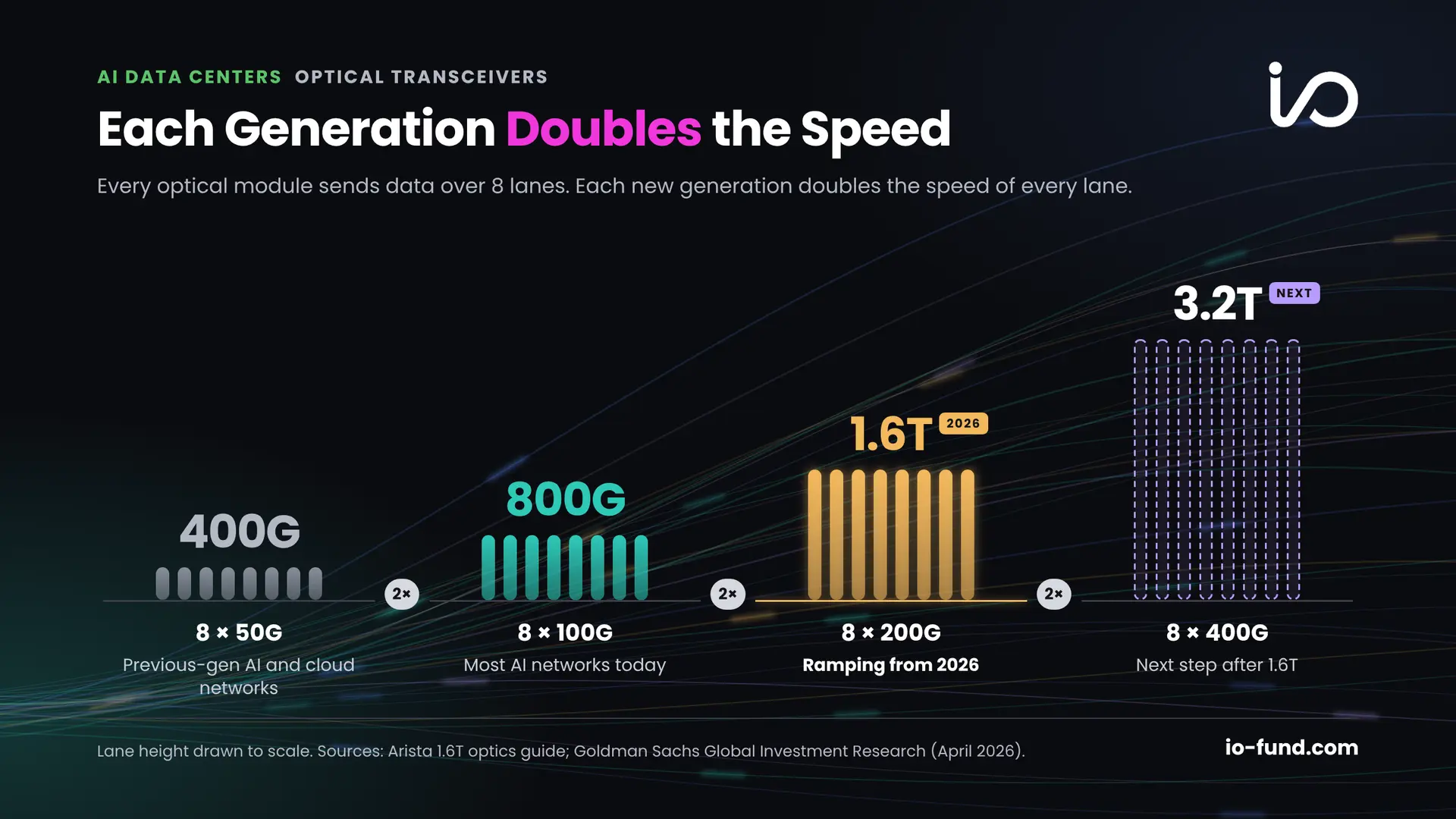
The numbers mentioned on a transceiver represent its speed in data per second. An 800G module can move 800 gigabits of data per second while a 1.6T module can transfer 1.6 terabits per second. Each generation of optical transceiver doubles its speed by doubling how fast each of its eight internal lanes runs, so a 400G supports a speed of 50G per lane, which goes up to 100G and 200G per lane respectively for 800G and 1.6T transceivers, as per Arista’s 1.6T optics guide.
Each new generation of optical transceivers doubles per-lane bandwidth while maintaining eight lanes, enabling total speeds to increase from 400G to 800G, 1.6T, and eventually 3.2T. The transition reflects the growing networking demands of AI data centers and large-scale GPU clusters.
TrendForce estimates that 800G and faster modules could rise to over 60% of global transceiver shipments in 2026, up from 19.5% in 2024. However, their costs vary widely, with an 800G module built with EML lasers selling for around $430 against $1000 for a 1.6T version as per Goldman Sachs’ estimates.
How Big Is the AI Optics Market?
The AI optical transceiver market was valued at around $16.5 billion in 2025 and is expected to grow by more than 57% to $26 billion in 2026, as per TrendForce’s estimates. Wider estimates of the optical transceiver market beyond AI estimate the sector to be worth $23.4 billion in 2025 and grow to $112.3 billion by 2031, according to Yole Group.
One way to read the market size of optical transceivers is to consider it as a percentage of AI spending. As per estimates by LightCounting, optics account for 2.7% of the five largest cloud companies’ capital spending in 2025, and this figure could rise to 4.1% by 2031. It forecasts that optics could account for a growing share of cloud capital spending.
Get Our Free Weekly Stock Newsletter
Get weekly stock insights, market analysis, and technology updates straight to your inbox.
Weekly stock insights
Market analysis
Technology updates
Is There a Bottleneck in Optical Transceiver Supply?
Lasers account for the tightest part of the optical transceiver supply chain. Both TrendForce and Yole Group have highlighted laser capacity as the main constraint.
According to Goldman Sachs, one of the reasons for the bottleneck is constrained export of indium phosphide by China, an essential material used in manufacturing both laser types, EML and continuous-wave. Moreover, building and qualifying new laser capacity is a time-consuming process. It estimates light-source supply tightening to extend through 2027 and expects it to become more balanced only by H2 2028.
Optical transceivers’ supply chain is also split by geography. Seven of the top 10 modules are located in China as per LightCounting’s 2026 ranking, while US and Western companies lead in lasers, DSPs and silicon photonics.
Who Makes Optical Transceivers? Leading AI Optics Suppliers
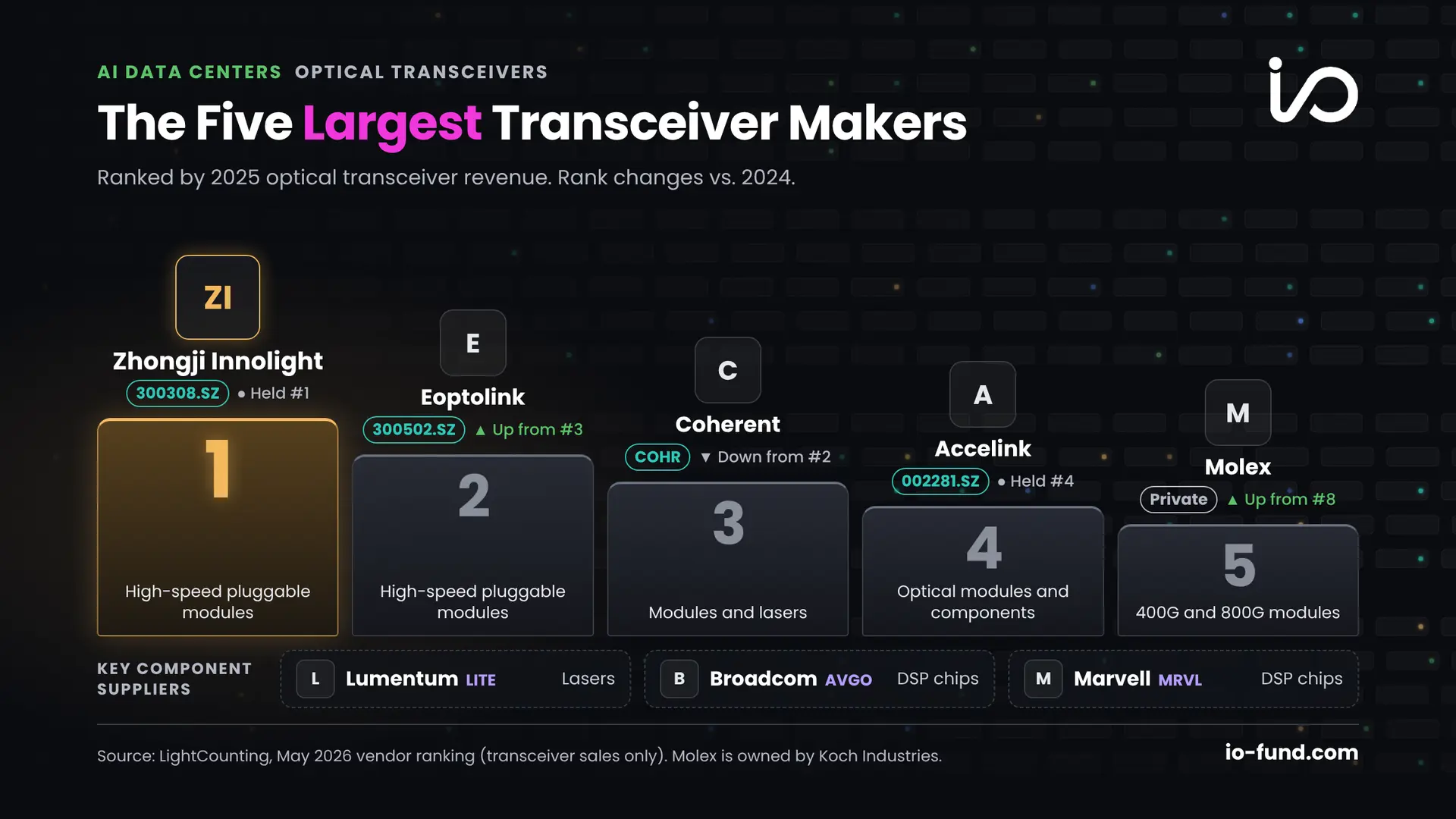
According to LightCounting’s May 2026 vendor ranking, the top five optical transceiver suppliers based on 2025 revenue were Zhongji Innolight, Eoptolink, Coherent, Accelink and Molex, which is privately owned by Koch Industries. In 2025, Eoptolink overtook Coherent to become the world’s second-largest optical transceiver supplier.
In 2025, Innolight’s revenue rose 61% to $5.3 billion after registering a 114% rise to $3.3 billion in 2024. Eoptolink registered a faster growth, with its revenue climbing 189% to $3.5 billion in 2025, following a 175% growth to $1.2 billion in 2024. Innolight supplies all of the largest US cloud companies while Eoptolink is a key supplier of 400G and 800G optics to Amazon and has qualified with Nvidia.
LightCounting’s 2025 ranking shows Zhongji Innolight retaining the top position in optical transceivers, while Eoptolink overtook Coherent to become the second-largest supplier. The chart also highlights key component providers, including Lumentum for lasers and Broadcom and Marvell for DSP chips.
Since this ranking considers only transceiver sales, Coherent and Lumentum rank lower than their total revenue suggests, with Lumentum ranking ninth in the list. In addition to optical transceivers, both companies also sell lasers and other components. Key component suppliers behind the module makers include Lumentum and Coherent for lasers, and Broadcom and Marvell for DSP chips.
What’s Next for AI Optics: 3.2T, Silicon Photonics and Co-packaged Optics
Goldman Sachs anticipates optical transceivers to reach faster speeds through 2028, with the shift from 800G to 1.6T underway in 2026, followed by 3.2T and faster modules rolling out in 2027 to 2028.
In silicon photonics, a significant portion of the optical circuitry is built onto a silicon chip, cutting the number of separate parts and lasers in each module. As per Goldman Sachs, silicon photonics could rise from 6% of optical modules in Q1 2024 to around 45% by Q4 2028. According to its estimates, a 1.6T silicon photonics module sells for around 20% less than an EML-based one.
Co-packaged optics moves the optics from the front panel and right next to the switch chip, shortening the electrical path and saving power. Nvidia claims in its technical blog that its CPO switches are around 3.5x more power-efficient than pluggable designs. Goldman estimates that CPO could reach 25% to 29% of scale-out connections in Nvidia’s next platforms, which still leaves most links on pluggable transceivers. Learn more about Nvidia’s optical strategy in our previously published analysis.
For investors, the next key milestones will be the launch of 3.2T transceivers after 2026 and the first volume of co-packaged optics in AI networks, expected around 2027 and 2028.
The shift to 3.2T, co-packaged optics and the laser shortage will keep reshaping this market. Beth Kindig’s free weekly AI stock analysis covers AI hardware, software and the supply chain, and more than 40,000 investors read it every Friday.
What is the difference between an optical transceiver and co-packaged optics?
An optical transceiver is a separate module that plugs into the front of a switch and can be swapped out. Co-packaged optics builds the optical parts into the same package as the switch chip. CPO consumes lesser power but is harder to service, as a failure can affect the entire switch.
Is an optical transceiver the same as a fiber optic cable?
No, a fiber optic cable carries the light while an optical transceiver at each end of this cable creates it from electrical signals and converts the light back into electrical signals. Some products, known as active optical cables, can combine both into one unit, featuring permanently attached optical transceivers.
Which stocks could benefit from AI optical transceiver demand?
Companies with exposure to AI optical transceivers include module makers such as Zhongji Innolight, Eoptolink, Coherent and Applied Optoelectronics, and component suppliers such as Lumentum, Broadcom and Marvell. However, note that exposure to AI optics does not by itself make a stock a good investment.
What is linear pluggable optics (LPO)?
Linear pluggable optics remove the DSP chips from the optical transceiver and let the switch itself handle signal processing. LPO can lower power and cost but makes links harder to set up across different vendors, according to Juniper Networks. Nokia previously reported Oracle and Meta presenting results from 800G LPO deployments at the 2026 OCP Global Summit.
How long will the optical transceiver shortage last?
Goldman Sachs estimates that laser supply could remain tight through 2027, before potentially becoming more balanced in H2 2028, as new capacity from suppliers such as Lumentum and Coherent comes online. The timing remains uncertain as previous forecast anticipating a sooner end to the shortages have not been held.
Do optical transceivers use a lot of power?
Each module consumes a limited amount of power, but the totals add up. According to Arista, a fully featured 1.6T optical transceiver draws up to 28 W, and a large AI cluster can include hundreds of thousands of such transceivers. This is why the industry is focusing on developing lower-power designs, such as LPO and co-packaged optics.
Please note: The I/O Fund conducts research and draws conclusions for the company’s portfolio. We then share that information with our readers and offer real-time trade notifications. This is not a guarantee of a stock’s performance and it is not financial advice. Please consult your personal financial advisor before buying any stock in the companies mentioned in this analysis.
Aiswarya Gopan, AI and Semiconductor Investment Writer at I/O Fund, contributed to this analysis.
The I/O Fund Editorial Team writes educational guides that explain investing concepts, market terms, and the technology behind today's markets. All content is researched from trusted sources, fact-checked, and reviewed by an I/O Fund analyst before it is published. This content is for educational purposes only and is not investment advice or a stock recommendation.