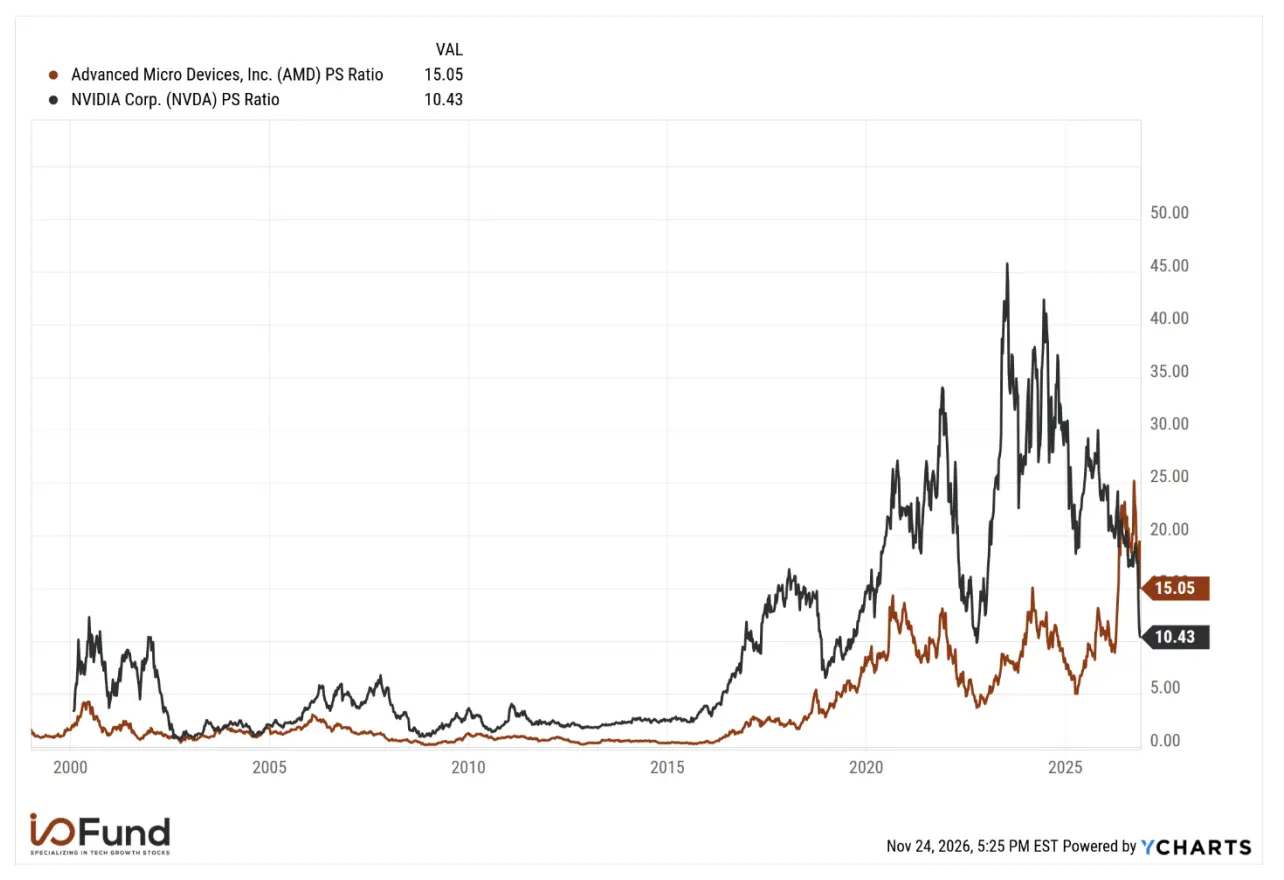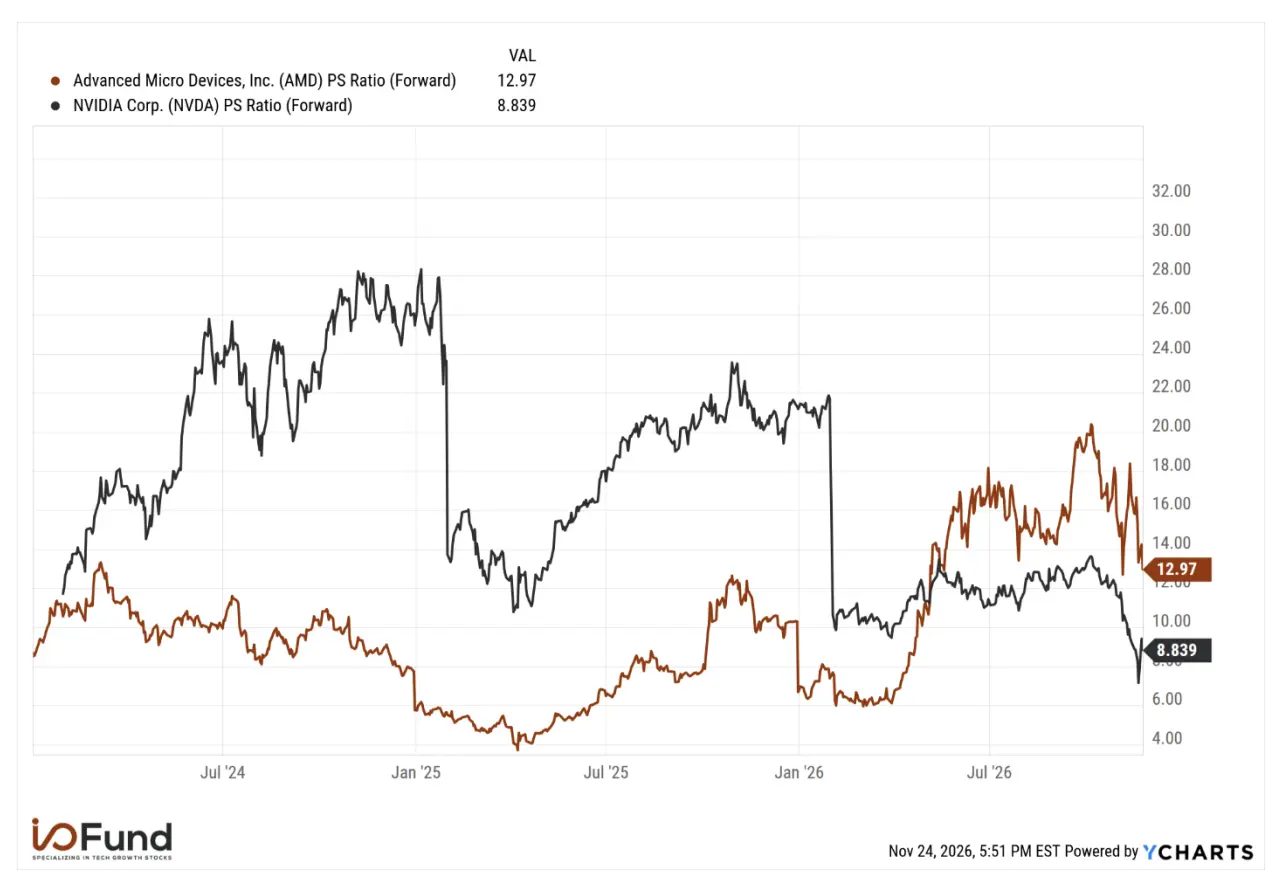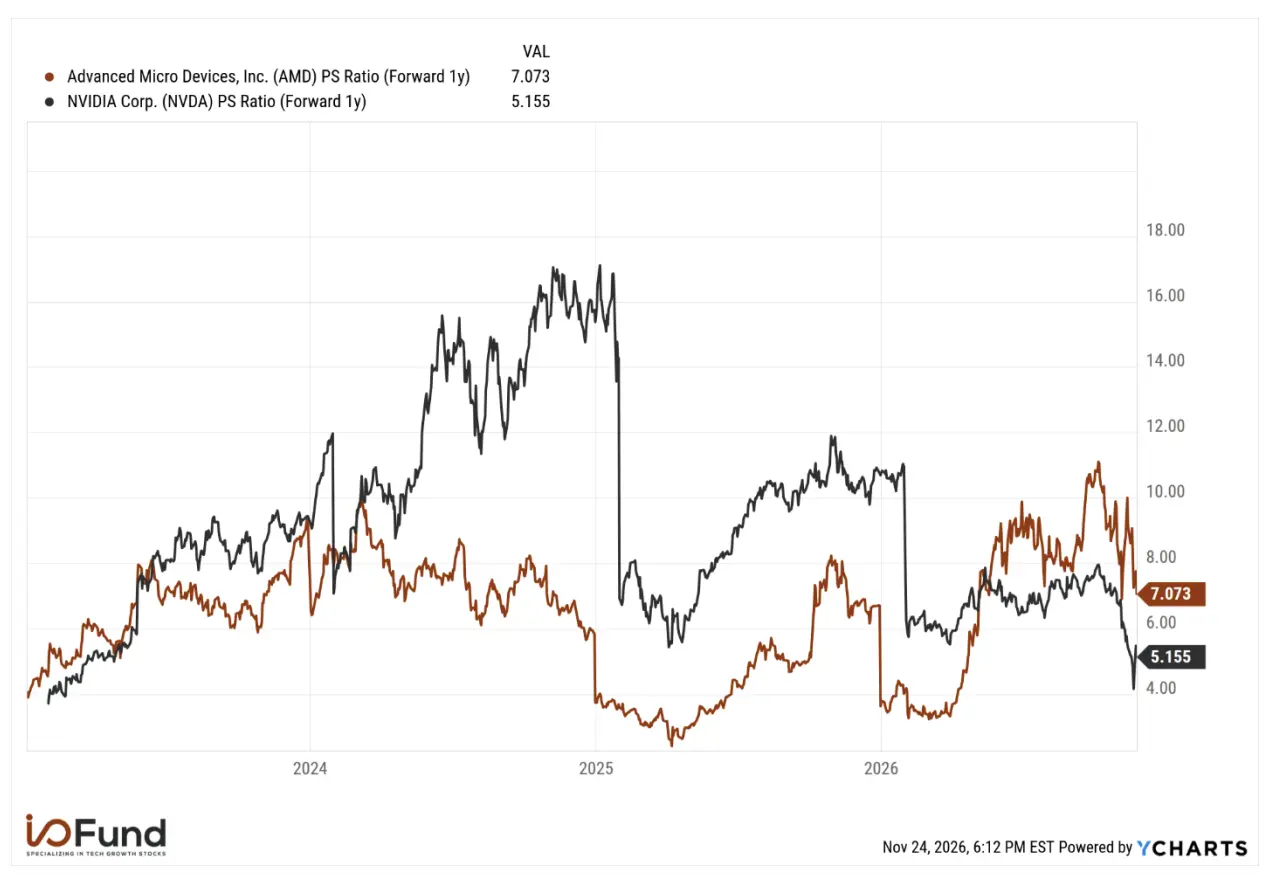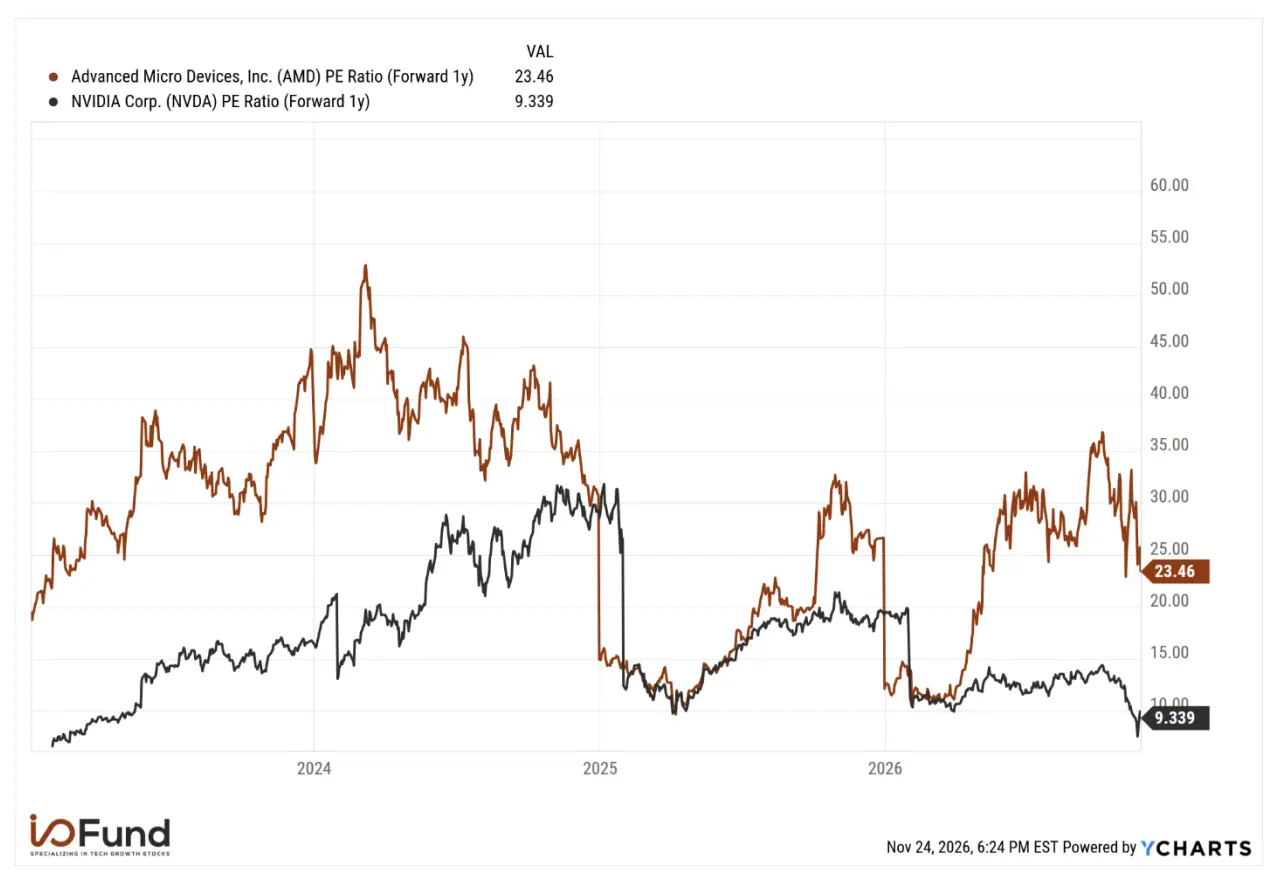


Over two years ago, I predicted AMD’s stock could outperform Nvidia’s stock returns by 2030, based on the thesis that the AI market was transitioning from the compute-heavy training stage to the inference stage. As you likely know by now, with inference comes more focus on unit economics.
This wasn’t well-known when I first stated AMD could surpass Nvidia, yet the challenger is up 131% compared to the incumbent stock up only 11%. At the time, AMD was trading at $163 compared to Nvidia at $128 (split-adjusted), yet has more than doubled while Nvidia has plateaued.
Recently, Wall Street is more focused on analyst downgrades, even as AMD and Nvidia prepare for their most important product ramps in years. The timing is particularly interesting when you consider automated traffic has recently surpassed human traffic and could eventually grow to 10X, 100X or even 1000X human traffic.
While the competition between these two companies has been spoken about for years, it is finally coming to a head next quarter. Not only will AMD directly take on Nvidia for the first time on rack-scale GPUs, but Nvidia is preparing to answer AMD on rack-scale CPU systems. These are not minor upgrades, but rather entirely new platforms preparing to ramp in volume.
I foresee AMD leading on performance-per-dollar, while Nvidia takes inference a step further by combining its GPUs with specialized Groq 3 chips built for ultra-fast token generation.
Strangely enough, reminders around AMD’s killer roadmap and Nvidia’s killer roadmap are few and far between right now. Instead, ill-timed analyst downgrades are absorbing the headlines. Rather than getting caught up in the noise, you can count on the I/O Fund to focus on the opportunities hiding in plain sight.
Below, we look at how AMD is setting up for what could be its strongest year yet, alongside Nvidia’s unusually low valuation. Given that both companies are positioned to lead in AI for the next decade or longer, there may be no better time to revisit these two stocks than after the recent selloff.
AMD’s Killer Product Roadmap Targets More Inference Tokens per Dollar
AMD claims that Helios can deliver “up to 30% more inference tokens per dollar than the competition.” This could make Helios more attractive to hyperscalers, enterprises or neoclouds focused on maximizing margins on millions or billions of inference requests.
To help illustrate this, Nvidia could theoretically generate more tokens from the same amount of power, while AMD could generate more tokens per dollar if the cost of the Helios system is lower.
One area that’s helping drive this tokens-per-dollar advantage for AMD is memory, helping drive throughput higher. As discussed in our previous write-up “AMD Stock Crosses $1 Trillion – and the Market Still Underestimates the Dark Horse,” Helios offers roughly 50% more total memory capacity compared to Nvidia’s Vera Rubin rack architecture, at approximately 31 TB of HBM4 across 72 GPUs compared to 20.7 TB for the Vera Rubin NVL72.
According to AMD, its testing showed that Helios delivered up to 21,333 tokens per second per GPU on DeepSeek R1, which was up to 30% higher throughput than Nvidia’s Vera Rubin. However, if AMD can deliver around 10-15% more throughput, it would need to cost approximately 11.5-15.4% less per hour to deliver 30% more tokens per dollar.
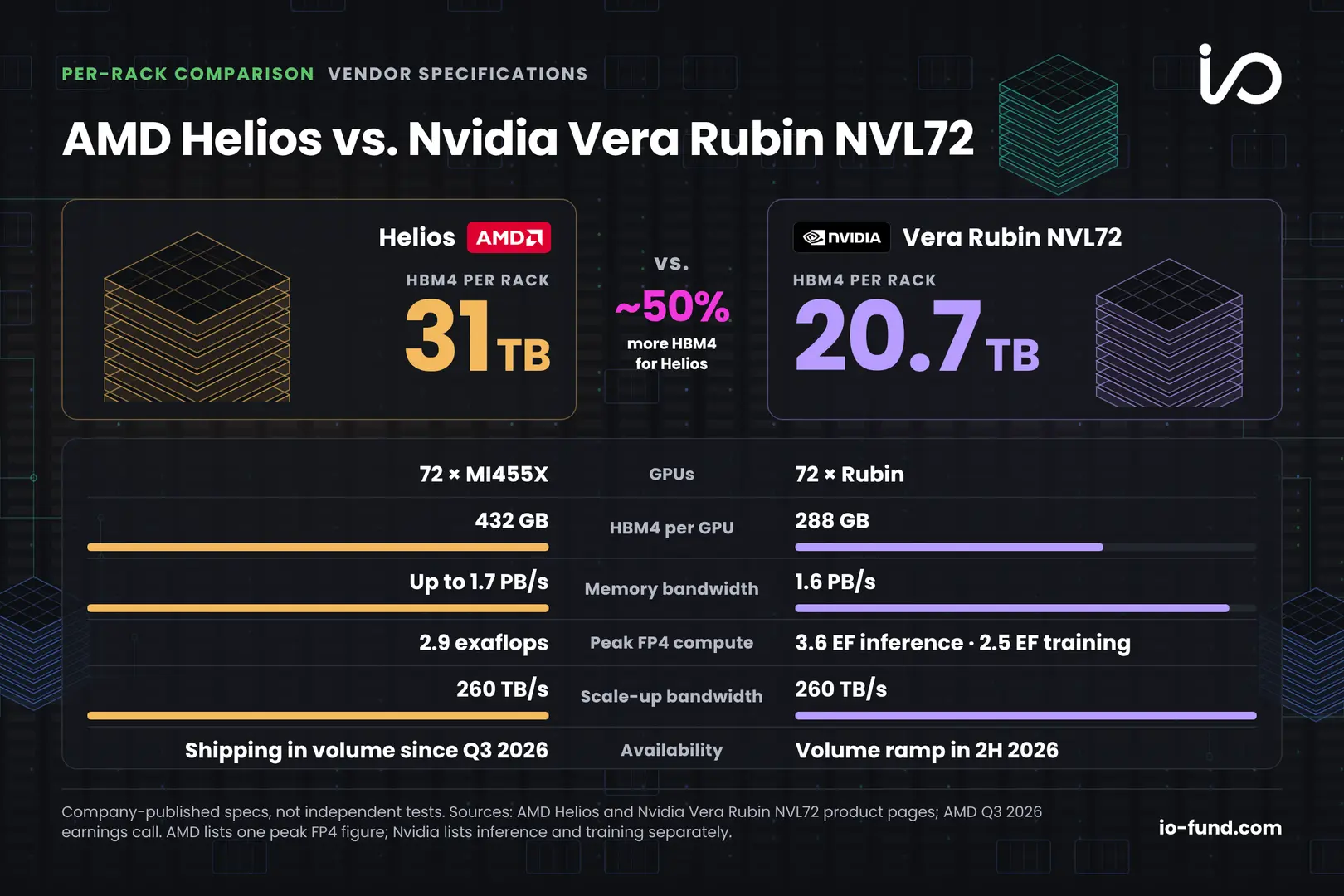
However, HBM capacity is not the only determining factor for inference performance. While it appears to be lending AMD a hand in terms of performance-per-dollar via higher throughput, AMD is still competing against Nvidia’s tightly-codesigned Rubin platform architected specifically for maximizing token throughput.
AMD is also optimizing its CPU roadmap for agentic applications, with an edge in CPU core density with Venice offering among the highest CPU core and thread counts across leading chips. This CPU core density is increasingly important in handling higher volumes of concurrent orchestration tasks, as well as supporting greater amounts of agent sandboxes.
Both CPUs and GPUs will be central to AMD’s growth story in 2027, with server CPU revenue now expected to more than double, and GPUs expected to significantly more than double.
Nvidia’s Killer Product Roadmap Targets More Tokens per Watt
Nvidia is focusing on maximizing how many tokens can be generated in a fixed power envelope, or tokens per watt. This comes in response to the steep power bottleneck that the AI buildout faces, as customers cannot secure infinite power.
Year after year (and generation after generation), Nvidia has proven that it can consistently deliver massive efficiency gains on inference throughput and token processing speed. For example, the GB200 NVL72 boosted per-GPU throughput by up to 30X versus the HGX H100 platform, while the GB300 NVL72 boasts up to a 50x increase in token output, via a 10X increase in tokens per second per user and a 5X increase in throughput per MW.
Now, Nvidia says its new Vera Rubin NVL72 systems can deliver up to 10X more throughput per megawatt, rapidly compounding performance gains from its Hopper generation in just three years. However, with Rubin, Nvidia is also introducing specialized new platforms such as its Groq 3 LPX racks to continue driving substantial throughput gains.
With Vera Rubin and Groq 3 LPX, Nvidia can assign different parts of inference to the hardware best optimized for each task, positioning the new Groq 3 LPX racks as a ‘token accelerator’ working alongside NVL72 racks to drive a 35X increase in throughput (tokens per second) per MW.
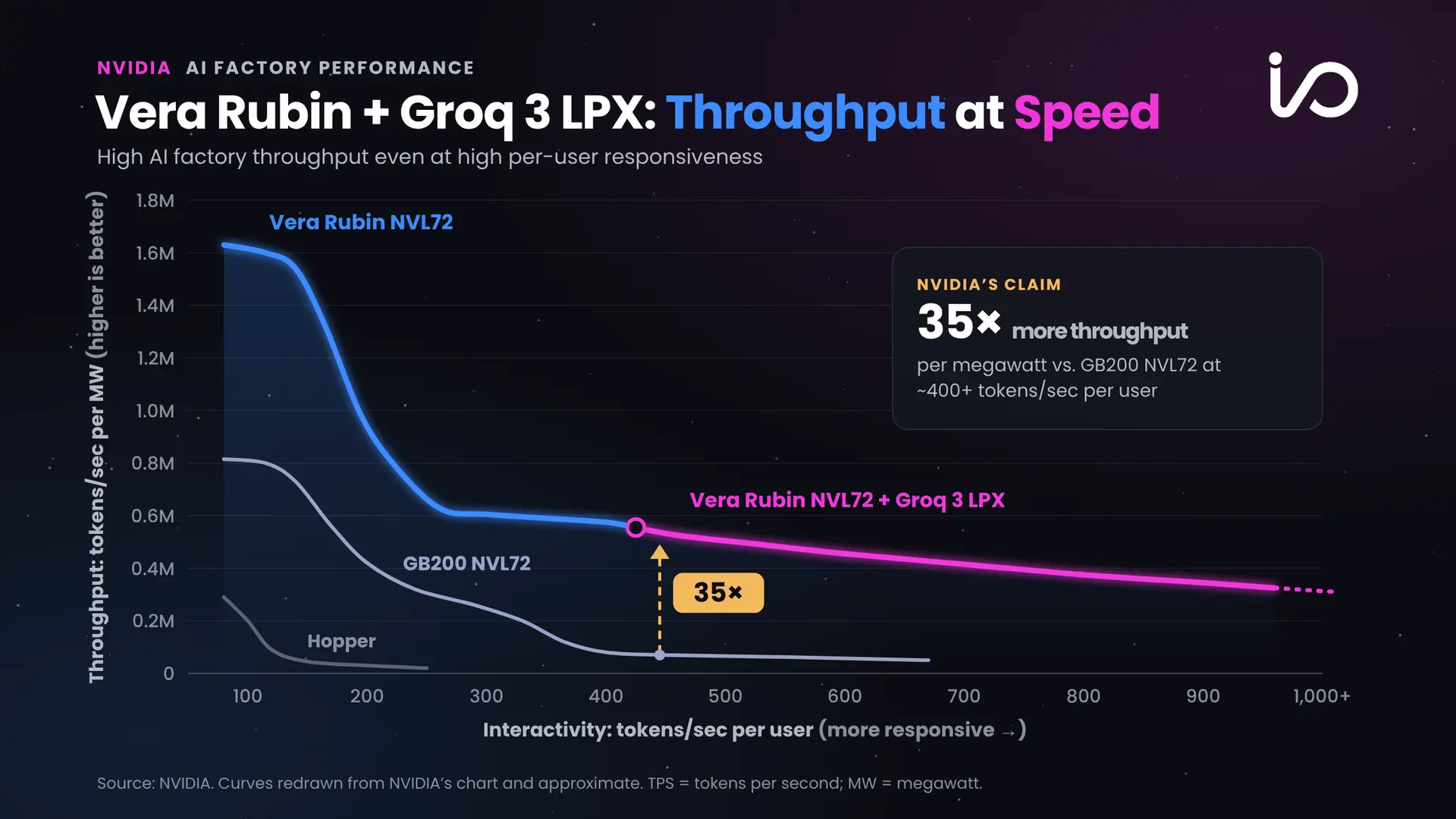
As we detailed in “Why Nvidia’s Next AI Battle Is About Tokens per Watt,” increasing tokens per watt is key to hyperscalers growing inference revenue despite power constraints, while also expanding inference margins. This performance per watt strength is evident in its pricing power, with revenue per GW rising from $18 billion with Hopper to $25 billion with Blackwell, and now to $40 billion with Rubin.
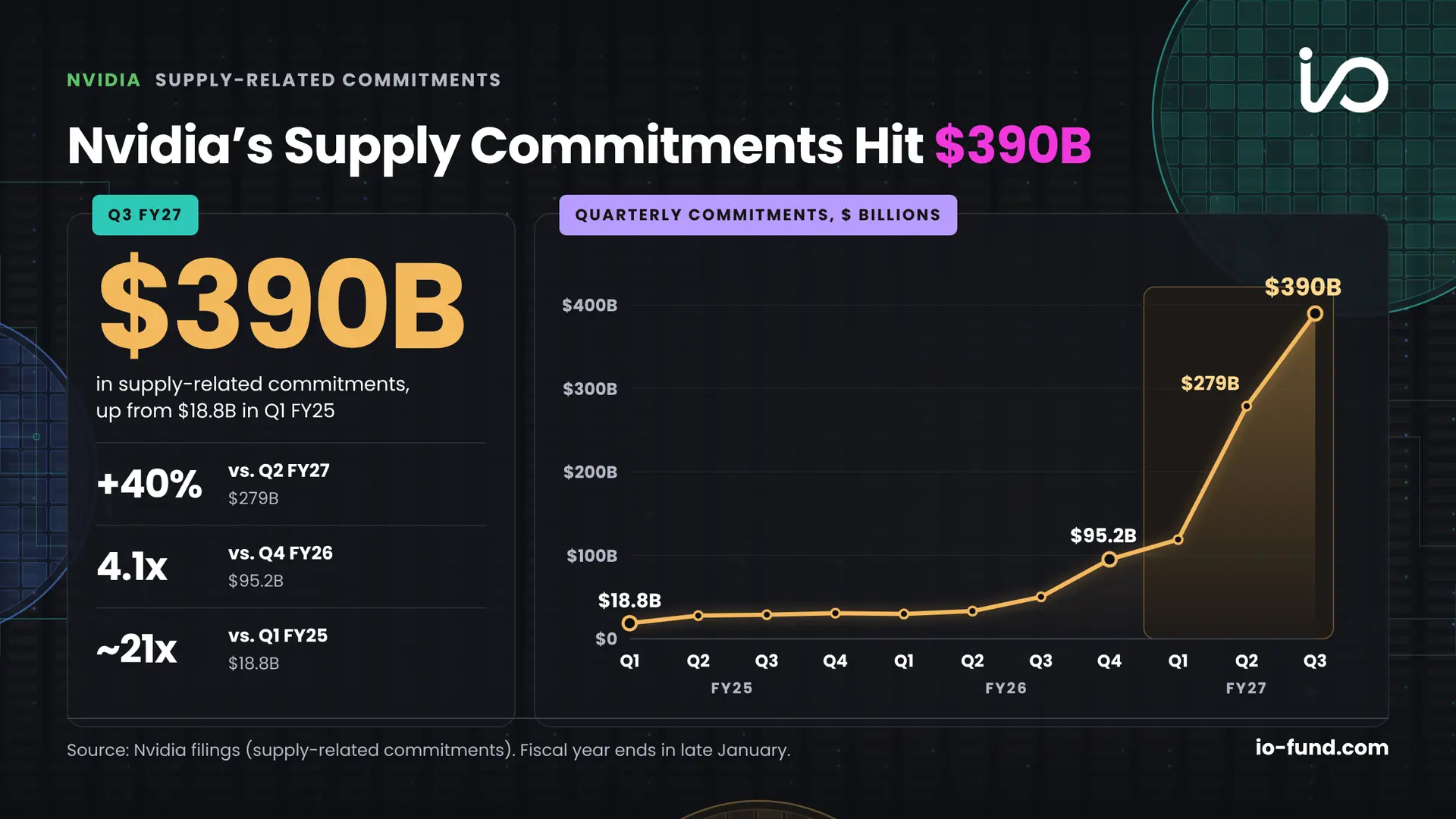
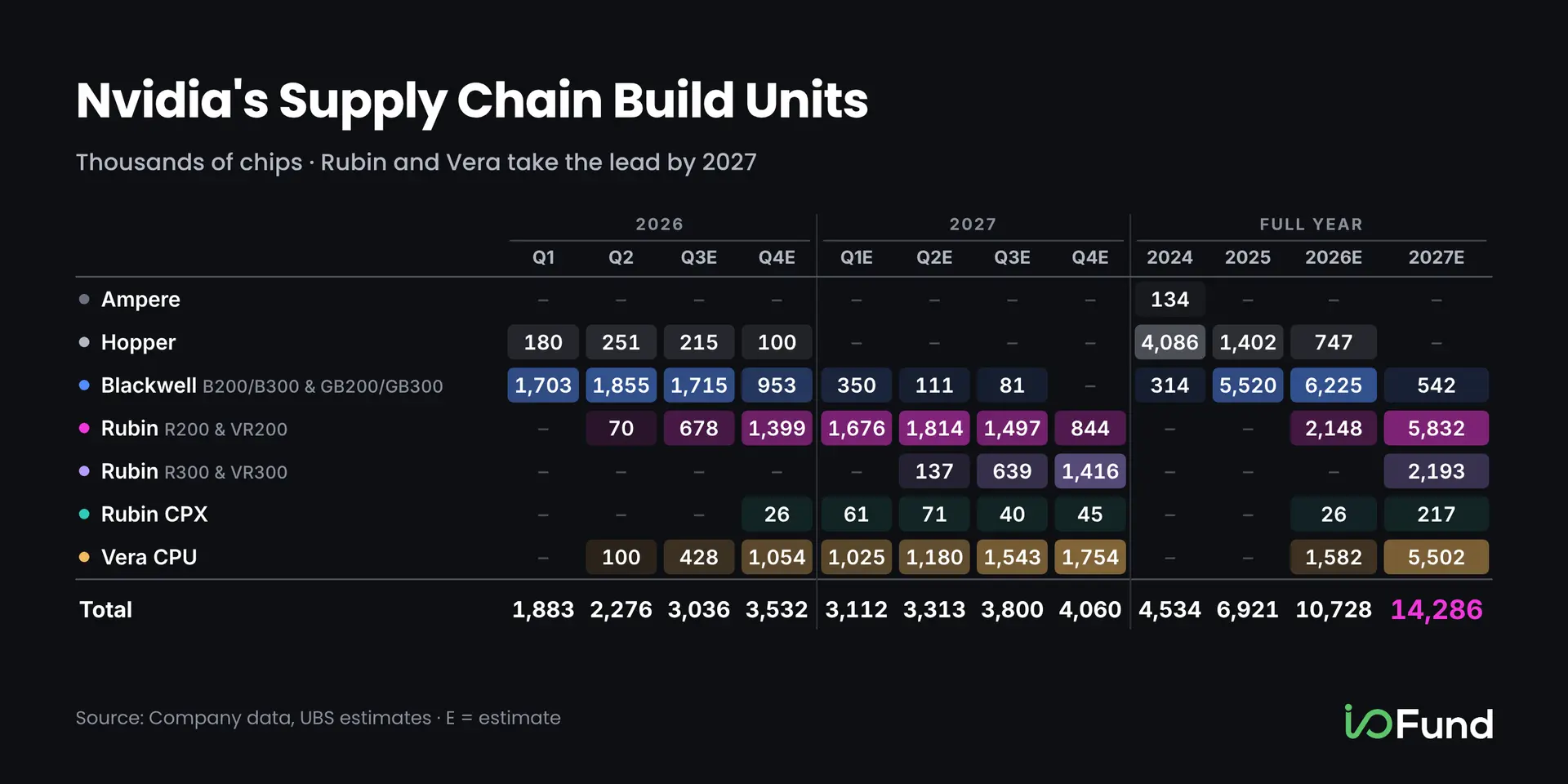
What’s allowing Nvidia to ramp several new rack-scale platforms in volume – from Vera Rubin GPUs reaching $20 billion in revenue in its first quarter shipping (nearly 2X Blackwell’s first quarter), Vera CPUs and Groq LPX racks, among others – is its scale.
AMD’s GPU Roadmap is Closing the Inference Performance Gap with Nvidia
AMD is quietly setting the stage for significant performance gains with each of its upcoming GPU generations, after Helios goes into head-to-head competition with Nvidia in the 72-GPU scale-up domain. We have said since June 2025 that Helios will help close the gap with Nvidia, and recent data from EpochAI’s Inference Performance Index suggests Helios could outperform Rubin on inference capacity per chip.
According to EpochAI, the Inference Performance Index focuses on “how many requests each chip can serve at once across a range of required output speeds,” with version 1 testing agentic workloads across four models. The IPI uses Nvidia’s GB300 as the reference benchmark for modeling.
As seen in the chart below, AMD’s MI355X GPUs delivered roughly half of the inference capacity of the GB300 at 0.55, comparable with Nvidia’s B300 chips at 0.54.
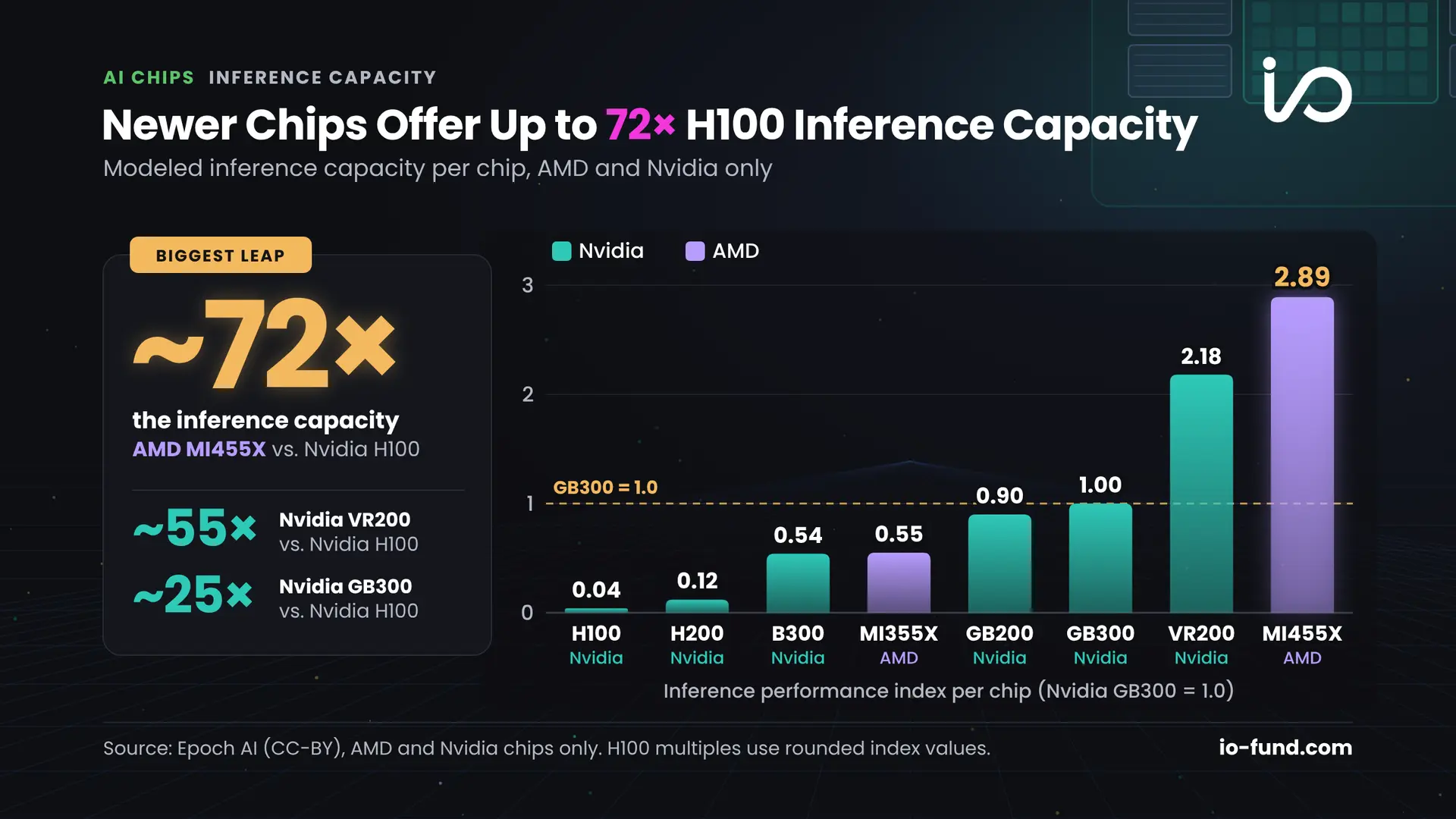
However, the transition to the MI455X and leap to rack-scale has driven a substantial increase in inference capacity per chip. EpochAI’s testing shows the MI455X delivering 2.89X the inference capacity per chip as the GB300. This also outperforms Nvidia’s Vera Rubin generation, delivering just 2.18X the performance as the GB300.
This substantial increase in performance within one generation underscores the strength of AMD’s product roadmap. For example, AMD claimed in January this year that the MI500 series, expected to debut in 2027, would deliver a 1,000X increase in performance from the MI300X series released in 2023. The MI600 series is expected to follow in 2028, and will likely deliver another step-function increase in performance as it competes against Nvidia’s Feynman generation.
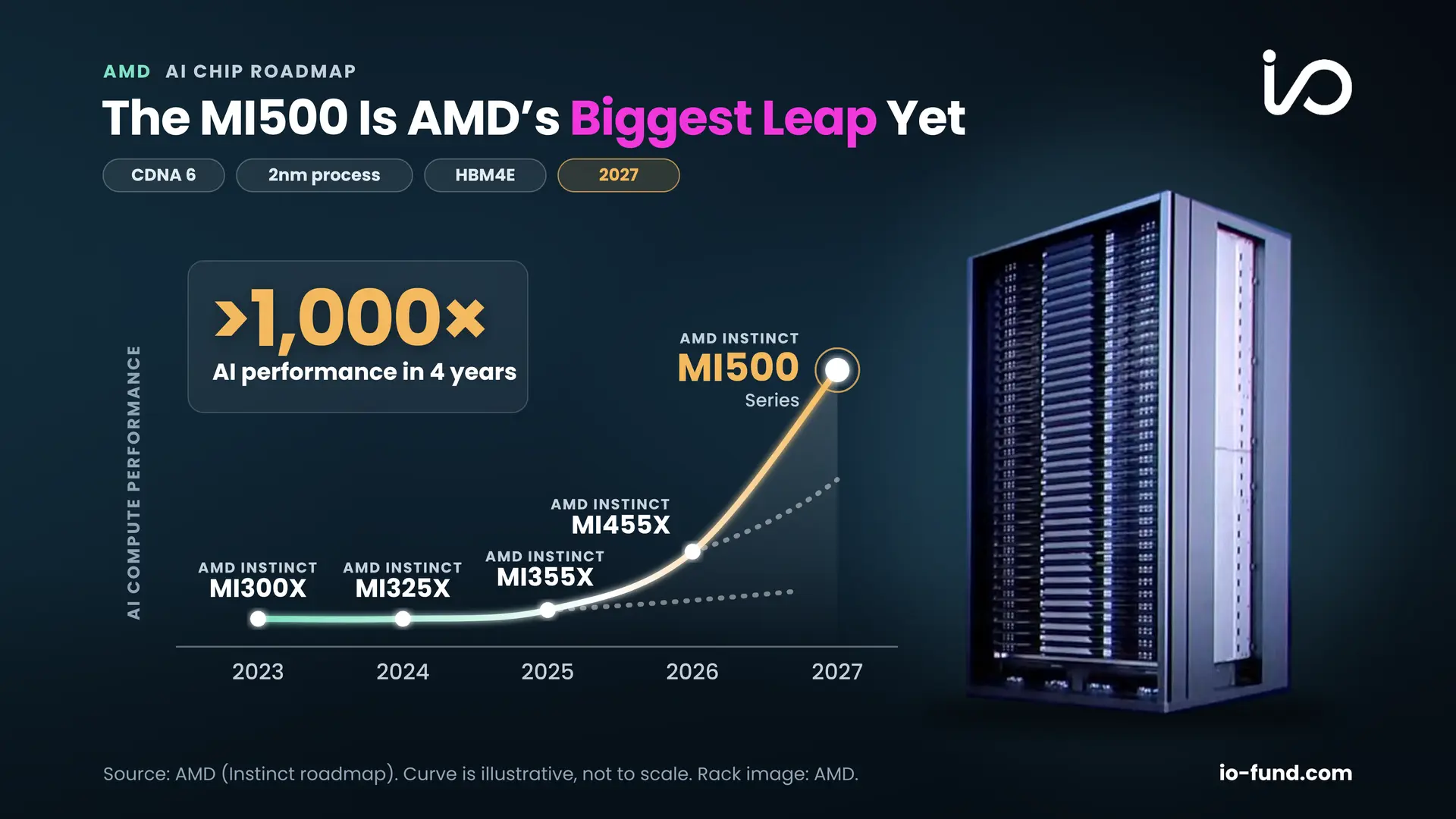
Although exact specs of the two generations are unknown, AMD could be lining up to deliver a more performant system ahead of Rubin Ultra’s volume production in H2 2027.
With the MI455X’s 50% increase in HBM capacity and inference performance advantage, the playbook is set for AMD to offer a rack-scale platform with stronger dollar economics, which could appeal to a broader base of enterprise and neocloud customers.
The I/O Fund is on a buying spree. For investors who want to know exactly what we’re buying, including real-time trade alerts, weekly webinars and our Top 20 AI Stocks list, we’re offering $250 off our flagship Advanced Market Signals membership during our Black Friday sale, one of our deepest discounts of the year. ➝ Get $250 Off Now.
AMD Venice vs Nvidia Vera: The Battle for Agentic AI CPUs
Agentic AI is another area where AMD and Nvidia will now be competing against each other head-to-head, this time in standalone CPU racks. These new rack platforms are specifically designed to handle the high-concurrency environment required for multi-agent systems, by packing a much higher density of CPU cores versus current GPU rack-scale platforms.
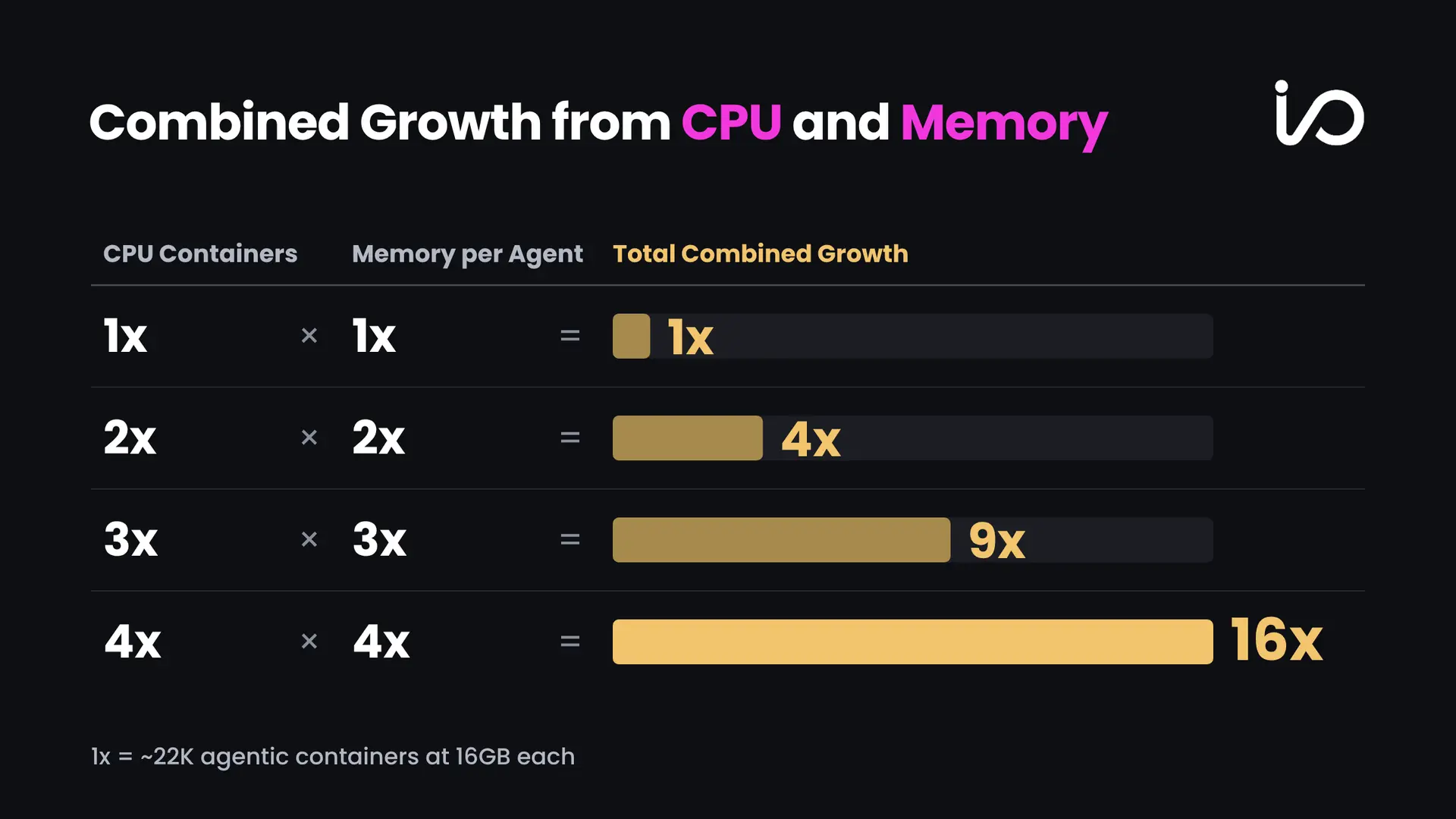
For example, Nvidia’s Vera CPU racks feature 256 CPUs, which are capable of supporting more than 22,500 concurrent agent sandboxes. This is approximately 7X what can theoretically be supported within an NVL72 rack’s 3,168 CPU cores. Nvidia is also taking design a step further, deploying a new agentic AI architecture combining Vera Rubin GPUs handling inference, with Vera CPUs executing agents and BlueField-4 DPUs for security.
AMD’s new Helion racks, unveiled last month, offer up to 32,768 Venice CPU cores in its CPU-only hyperscale-oriented configuration, while an enterprise-oriented configuration can scale to include up to 16 MI350P GPUs. In the CPU-only configuration, Helion offers roughly ~45% more cores than Nvidia’s Vera racks, which in theory could support up to 45% more concurrent sandboxes.
Although rack-scale CPU platforms are relatively new introductions for both companies, Nvidia is establishing itself as a formidable force in the space. Management had stated in FQ1 that they had visibility to $20 billion in standalone CPU revenue this year, which would be equivalent to nearly 40% of AMD’s annual revenue this year. Nvidia also has a high-profile list of early adopters for Vera CPUs, spanning AWS, OCI, Meta, OpenAI, SpaceX and CoreWeave.
Both Nvidia and AMD do see a similar growth trajectory emerging in calendar 2027, with the two projecting server CPU revenue to more than double next year.
With the broader server CPU TAM expected to rise about 50% per year to $220 billion by 2030, Nvidia and AMD both appear to have their sights set on taking more market share next year.
MEXT Gives AMD Another Angle to Challenge Nvidia in Agentic AI CPUs
Although AMD claims Venice can offer up to 3.3X the rack-level performance within a 100kW power budget versus Nvidia’s Vera CPU, its new MEXT software could strengthen its agentic positioning by reducing DRAM requirements and extending memory capacity.
MEXT is an AI-powered predictive memory software that leverages high-capacity, lower-cost flash to support and extend DRAM. MEXT works by predicting which pieces of data stored in flash are likely to be requested by AI applications soon, and then quickly moving them back to DRAM before they are requested.