Why Frontier Labs, Not SaaS Vendors, Could Win Enterprise AI
I/O Fund Team·OCT 16, 2026·8 min read
On this page
In our previous analysis on SaaS economics, we examined how agentic AI converts traditional fixed enterprise software subscriptions into variable compute expenses, eating away at the 80% gross margins that SaaS vendors have historically enjoyed. However, the financial pressure on application gross margins is only a symptom of a far larger structural power shift within the technology ecosystem.
Enterprise AI value is migrating in two distinct directions. Frontier R&D labs who own foundational AI models earn inference revenue with every action an agent takes, regardless of which application’s front-end interface the end user interacts with. On the other hand, open interoperability protocols are decoupling enterprise data from single-application “Systems of Record,” reducing legacy software tools to background databases queried by autonomous agents.
The $100 Billion Cross-System Workflow Problem in Enterprise Software
For over two decades, enterprise software moats were built around controlling a primary “System of Record.” Salesforce gained dominance in customer data storage, Workday was the tool of choice for managing employee and financial records, and ServiceNow controlled IT operational workflows. The high complexity and costs involved in replacing a core system of record enabled vendors to lock in customers and extract predictable, high-margin subscription fees.
However, real-world enterprise processes rarely take place inside a single application. Requests like resolving customer disputes, approving vendor contract, or processing employees’ onboarding requests requires pulling data and executing actions across CRM, ERP, billing, and support ticketing platforms simultaneously. Employees had no choice but to move between these isolated software tools to coordinate workflows manually.
Bain & Company estimates that this cross-system coordination effort represents a $100 billion addressable opportunity in the U.S. alone, and $200 billion globally, over 90% of which remains uncaptured.
How AI Agents Use Open Standards to Work Across Enterprise Applications
Autonomous AI agents are now able to perform this cross-system coordination work, enabled by open standards. Anthropic developed and open-sourced the Model Context Protocol (MCP), often described as a “USB port for AI.” MCP enables frontier AI models to connect to disparate software applications and retrieve data without the need for custom, one-off integrations. MCP had over 97 million monthly SDK downloads as of December 2025, when Anthropic donated it to the Linux Foundation. Concurrently, Google’s Agent-to-Agent (A2A) protocol, which enables multi-vendor agent interoperability, is backed by more than 150 organizations.
This open interoperability directly threatens legacy SaaS moats. If an AI agent can retrieve customer data from Salesforce, invoices from an ERP, and tickets from ServiceNow to execute tasks from a unified interface, employees no longer need to log in to individual application UIs. As a result, traditional applications risk becoming background databases that agents query, making them easier to replace and far harder to monetize through per-seat licensing.
If AI agents can pull data from Salesforce, ServiceNow and your ERP through one interface, the per-seat model that built enterprise software starts to break.Sign up for our free weekly newsletterto see which software stocks are exposed as value shifts away from legacy SaaS, and where we see it moving next.
SaaS Vendors Are Raising Agent Access Fees to Defend Their Moats
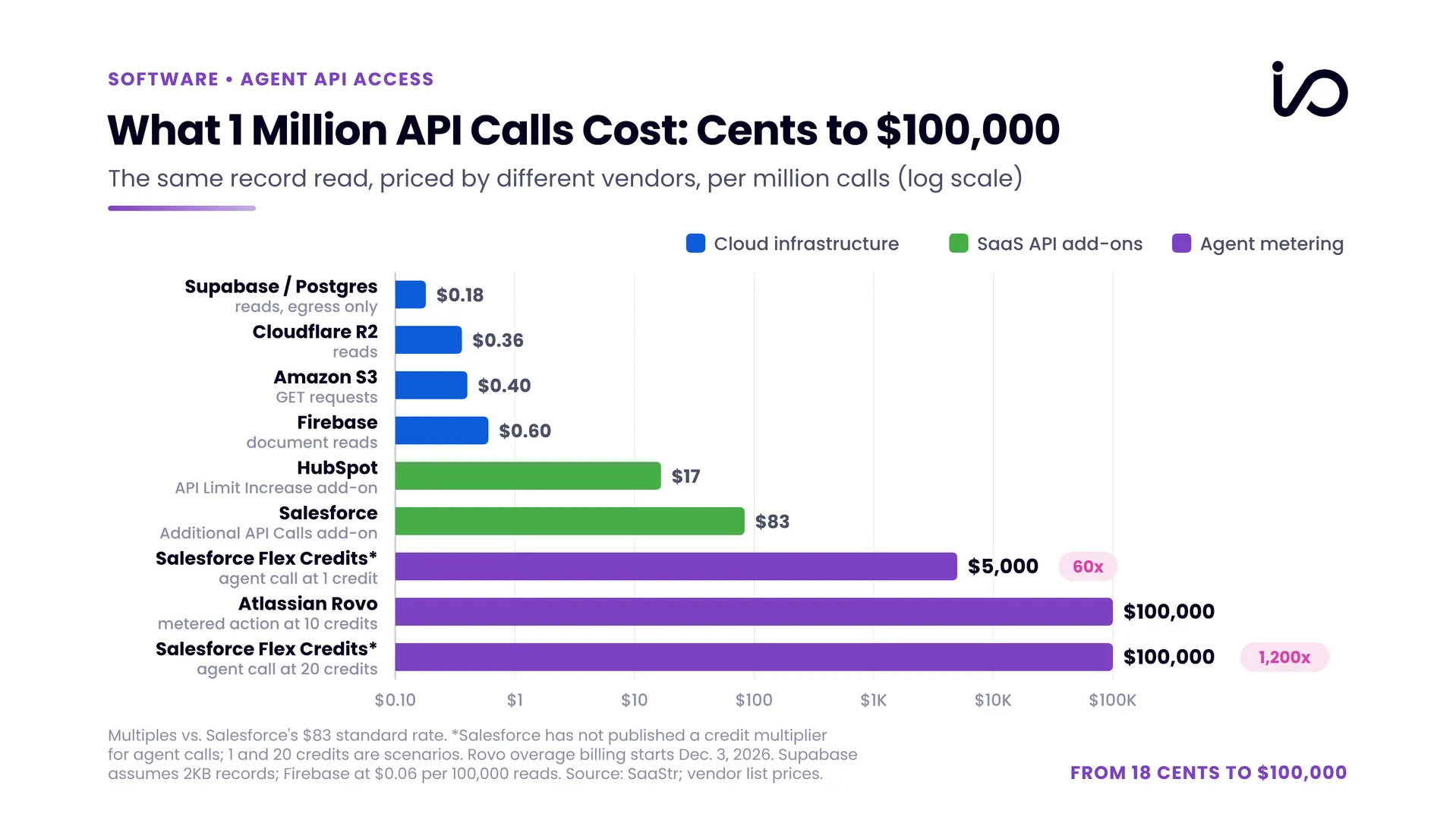
To counter this strategy, some SaaS vendors are charging higher fees for agent access. SaaStr reports that Salesforce introduced agent metering fees ranging from $5,000 to $100,000 per million calls, a 60x to 1,200x markup over its standard API rate of around $83 per million calls.
As show in the chart below, there is quite a wide range for API pricing at different vendors. Salesforce and Atlassian sit at the extreme with Flex Credits and Rovo at that $100,000 level, while HubSpot and Cloudflare are significantly cheaper at $17 and $0.36, respectively. The difference stems from the agent’s interface and actions agents are taking – HubSpot’s pricing reflects usage of internal agents, while Salesforce reflects the maximum rate for third-party agent calls.
Comparison of list prices for one million API calls across cloud infrastructure, SaaS API add-ons, and agent metering products. Examples range from $0.18 for Supabase/Postgres reads and $83 for Salesforce API calls to $5,000-$100,000 for selected agent metering offerings.
However, attempting to hold enterprise data hostage carries substantial risk. High API toll costs could push customers to move their data into neutral data warehouses like Snowflake or Databricks, letting agents query data directly without hitting legacy application tollbooths.
Do Frontier R&D Labs Hold the Upper Hand?
Get Our Free Weekly Stock Newsletter
Get weekly stock insights, market analysis, and technology updates straight to your inbox.
Weekly stock insights
Market analysis
Technology updates
Amid this structural shift, frontier R&D labs hold the primary advantage because they collect inference revenue regardless of which application interface the agent runs in. A SaaS vendor reselling Claude or GPT pays an API fee that includes the lab’s profit margin, while the lab pays only for raw compute. As a result, Menlo Ventures estimates that Anthropic captured 40% of enterprise LLM API spending in 2025.
Anthropic’s confidential draft prospectus, reviewed by Reuters, illustrates the speed at which operating leverage is building at the model layer. In 2025, Anthropic’s annual revenue reached nearly $4.6 billion, a 12-fold increase YoY. Crucially, its compute efficiency expanded rapidly. In 2024, Anthropic spent $2.4 billion on compute to generate $0.39 billion in revenue, with compute costs coming in around 6x revenue. In 2025, compute costs surged to $7.3 billion against $4.6 billion in revenue, bringing down this ratio to 1.6x.
Recognizing that building competing foundational models is financially unviable, major software platforms are surrendering the model layer and converting into distribution channels for frontier labs. Salesforce made Claude the default reasoning engine inside Slack and AgentForce, and Microsoft Copilot Cowork is built directly on the technology behind Anthropic’s Claude Cowork. Additionally, Anthropic has launched Claude Marketplace with over 2,000 connectors across Salesforce, Atlassian, Google, and Snowflake, allowing enterprise buyers to purchase software directly from committed Anthropic spend.
Labs are executing a deliberate strategy of rapid price deflation in a bid to further accelerate AI adoption. At the same time, list prices for Opus-tier frontier models fell 73% in a single year, from $15/$75 per million tokens down to $4/$20 for Claude Opus 5.5, while OpenAI’s GPT-5.6 Sol fell 60% to 67% from $5/$30 to $2/$10. This rapid price deflation creates a classic Jevons Paradox, where driving down per-token inference costs unlocks exponentially higher usage volume across millions of automated enterprise workflows.
Why Frontier Labs Still Face Significant Structural Risks
The business model of frontier AI labs comes with significant financial risks. Anthropic’s prospectus discloses $518 billion in long-term cloud and computing infrastructure commitments. Anthropic also cautions that many of its largest clients aren’t yet locked into long-term contracts and could cut or halt spending. In a market where frontier model prices are falling fast, there is little room for error.
Smaller enterprise software companies have it even harder. Without Salesforce’s or Microsoft’s distribution, or Big Tech’s compute budget, most will be caught between rising inference bills and labs moving up the stack. Specialists are likely an exception here. Sierra reached $150 million in ARR and a valuation above $15 billion by focusing on customer-service agents. However, companies like Sierra run on lab models, so their growth also flows back to the frontier labs in the form of inference revenue.
Who Wins the Enterprise AI Stack?
Agentic AI is transforming enterprise software by separating the software interface where work is viewed from the underlying intelligence and data layers where work is executed. As open protocols like MCP shake up legacy software through autonomous access, SaaS vendors are losing their ability to hold customer data hostage. Value is moving up the stack to frontier R&D labs that generate inference revenue across every enterprise workflow, and down to neutral cloud data warehouses that provide the raw cross-system context.
The ultimate winners of the enterprise AI adoption race may not be the legacy SaaS vendors of the past decade but the foundational models offering AI agents and neutral data orchestrators that can solve the problem of cross-system execution.
The I/O Fund has built a strong track record in lesser-known AI winners, including an energy stock up more than 1,300% since our initial entry last year, an optical networking stock up 325%, and two of our largest AI positions up 183% and 130% year to date.
We publish more than 100 paywalled articles each year on AI stocks, supported by an actively managed portfolio and real-time trade alerts.
Please note: The I/O Fund conducts research and draws conclusions for the company’s portfolio. We then share that information with our readers and offer real-time trade notifications. This is not a guarantee of a stock’s performance and it is not financial advice. Please consult your personal financial advisor before buying any stock in the companies mentioned in this analysis.
Aiswarya Gopan, AI and Semiconductor Investment Writer at I/O Fund, contributed to this analysis.