
Nvidia’s pace of growth in the Data Center segment has been nothing short of remarkable. Data Center revenue reached $89 billion in Q2 FY27, up nearly 9x over the last three years. Meanwhile, Nvidia’s total revenue is expected to surpass the $100 billion milestone next quarter.
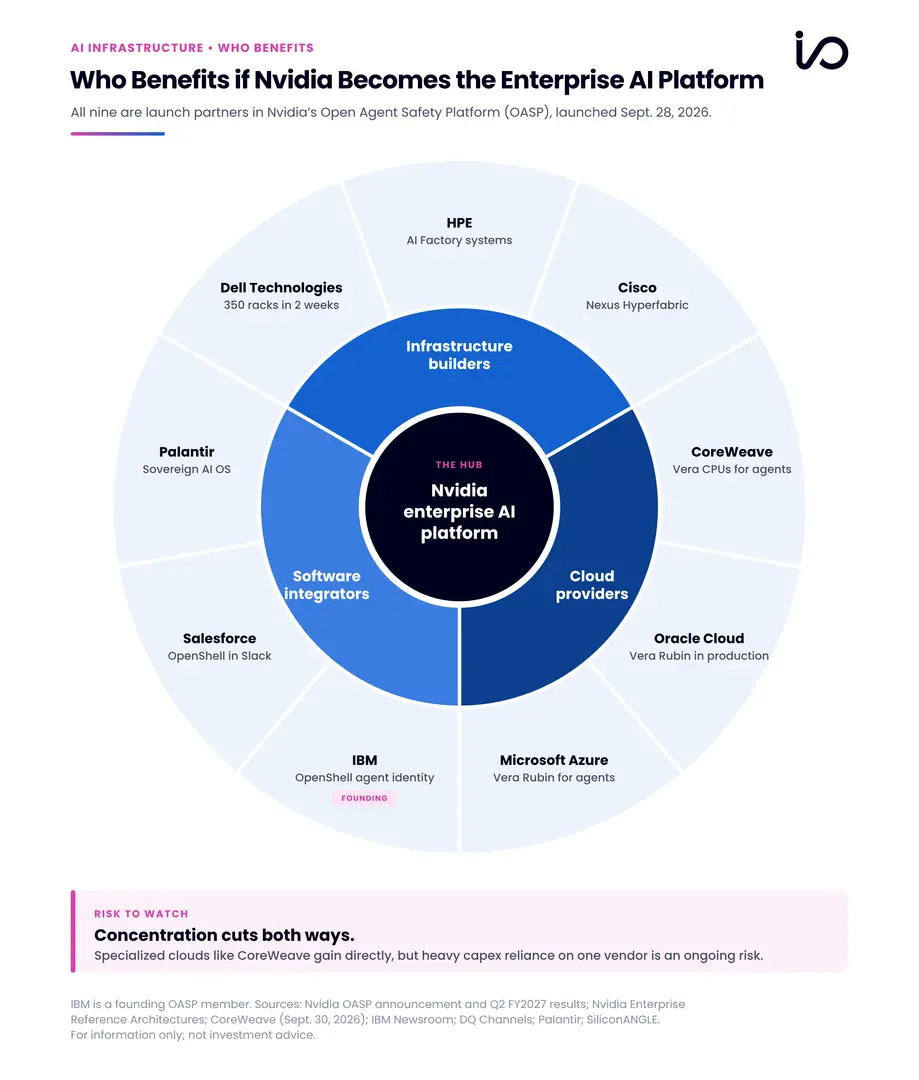
Despite these strong numbers, calling Nvidia a semiconductor company no longer captures what it is building. Nvidia is now moving towards building an agentic-focused enterprise AI stack, with the recent launch of its Open Agent Safety Platform on September 28. In partnership with over 100 ecosystem companies, including Anthropic, Microsoft, and Salesforce, this high-profile launch was for a software and infrastructure security stack designed to govern autonomous AI agents, and not for the release of a next-generation chip conventionally associated with the company.
Long-term investors should look out for whether Nvidia’s enterprise AI strategy establishes a foundational operating system that could shape how next-generation computing evolves.
Nvidia’s Enterprise AI Stack, From GPUs to AI Agents
Nvidia’s footprint in data centers has evolved from standalone accelerator cards into a tightly co-designed architecture of GPUs, CPUs, and DPUs, tied together by its own Spectrum-X Ethernet networking fabrics and enterprise software runtime layers. Each layer now features dedicated products and measurable performance metrics tailored for agentic AI workloads across these integrated hardware and software tiers.
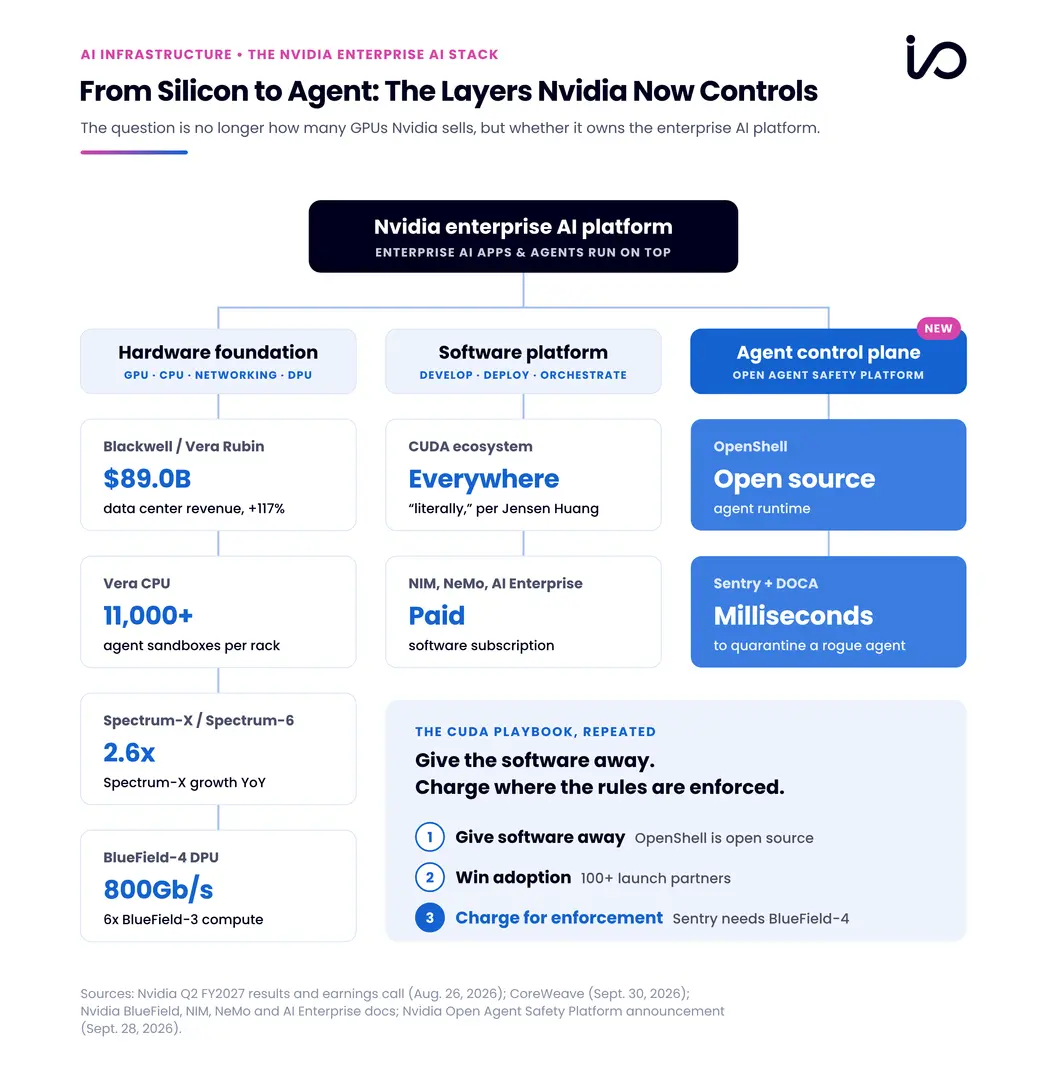
Software turns Nvidia’s hardware stack into a platform, going beyond its CUDA ecosystem with its newer NIM and NeMo offerings. NIM and NeMo help enterprises deploy models and manage agents in production. These tools come bundled in Nvidia AI Enterprise subscriptions along with long-term support versions and FedRAMP High-ready components, with lifecycle commitments similar to enterprise operating systems. Nvidia packages the full stack into Enterprise Reference Architectures that AI server partners then build on.
Few, if any, other technology provider directly competes with Nvidia as an end-to-end, pre-validated software stack spanning silicon, networking, microservice runtimes, and security enforcement. The newest layer, agent security, may be the one that ties it all together.
The Agentic Control Plane: Nvidia’s New Layer of AI Infrastructure
Speaking at Salesforce’s Dreamforce in mid-September 2026, Nvidia CEO Jensen Huang stressed the need to consider AI agent reliability and safety as fundamental infrastructure and engineering problems. With autonomous AI agents increasingly modifying databases, executing code, and making financial transactions with minimal direct oversight, application-level guardrails and prompt filters are no longer sufficient for safety.
Nvidia’s Open Agent Safety Platform leverages a dual-layer architecture to address the operational safety challenges of autonomous AI agents, comprised of OpenShell and Sentry. OpenShell is Nvidia’s open-source CPU runtime layer that runs AI agents in a secure environment, managing what files, networks and processes each agent can access. Sentry serves as an out-of-band security “watchdog” running on BlueField-4 DPUs to continuously track agent behavior. Sentry operates physically outside the agent’s execution environment, so a compromised agent cannot alter or bypass its controls, enabling Sentry to quarantine rogue agents within milliseconds.
At Dell’s AI Leadership Symposium, executives revealed that runtime governance is emerging as critical infrastructure, while high API token costs drive agentic workloads back to on-premises. Additionally, over 3,200 respondents surveyed as part of Nvidia’s State of AI Report 2026 indicated active AI use in 64% of their organizations, while 44% are deploying or evaluating autonomous AI agents, and 86% are raising their AI budgets. In December 2025, Gartner estimated that 33% of enterprise software applications will incorporate agentic AI by 2028. This broader trend of increasing agentic AI adoption puts greater emphasis on having a secure control plane monitoring agent behavior, such as what Nvidia is aiming to offer.
Leading enterprise software vendors have also started integrating agent safety infrastructure into their core workflows. Salesforce connected Nvidia’s OpenShell directly into Slack to manage agent permission approvals and maintain audit trails. IBM integrated its Agent Identity framework with OpenShell and HashiCorp Vault, in addition to integrating IBM Storage on BlueField-4 and enabling Red Hat OpenShift support. Rob Thomas, SVP, IBM Software and Chief Commercial Officer, observed, “How do you let an agent act on your behalf without giving up control? And how do you prove what it did?”
Cloud Security Alliance (CSA) mapped the architecture to its Agentic Trust Framework, calling this layer the “agentic control plane.”
How Nvidia Is Applying the CUDA Playbook to AI Agents
It’s been two decades since Nvidia released CUDA for free, which enabled Nvidia to build an entrenched software ecosystem that helped drive massive demand for its GPUs over time.
With the Open Agent Safety Platform, Nvidia is now executing a similar playbook, this time for autonomous AI agents. OpenShell is open-source and compatible with both Arm and Intel CPU architectures, easing the process of enterprise adoption. Even as it open-sources OpenShell and keeps its runtime software free, real-time out-of-band hardware enforcement via Sentry needs Nvidia’s BlueField-4 DPUs, and the company’s reference design builds the platform directly into Vera Rubin systems. In addition, production deployment microservices via NIM are also monetized through Nvidia’s paid AI Enterprise software suite subscription.
At least one of Nvidia’s enterprise software partners has already started explicitly calling this architecture an AI operating system. On March 12, 2026, Nvidia along with Palantir introduced the Sovereign AI OS Reference Architecture, combining Blackwell Ultra GPUs, Spectrum-X networking, CUDA-X, and Nvidia AI Enterprise. Palantir’s chief architect termed the offering “a fully integrated AI operating system optimized for Nvidia accelerated compute.”