Blogs -The Future of AI Stocks? TSMC Commentary Suggests AI Megatrend

The Future of AI Stocks? TSMC Commentary Suggests AI Megatrend


January 29, 2026

author

Beth Kindig

Lead Tech Analyst

TSMC is one of the least sensational management teams in the AI stocks space, yet management explicitly called AI a multi-year “megatrend” in their most recent earnings call, with demand now being pulled not just by chip designers, but directly by hyperscale cloud providers seeking to lock in capacity.  

Management stated: 

“Our customers’ customers, who are mainly the cloud service providers, are also providing strong signals and reaching out directly to request the capacity to support their business. Thus, our conviction in the multiyear AI megatrend remains strong, and we believe the demand for semiconductor will continue to be very fundamental.” 

When the world’s most advanced foundry says hyperscalers are coming to them directly for capacity, it signals that AI demand remains foundational. Perhaps most importantly, TSM is not a “flip the switch" business model to where demand can be turned on and turned off quickly. Wafer capacity must be planned years in advance, which makes these signals particularly meaningful. 

TSMC already sits beneath tens of trillions of dollars in market capitalization, with customers including Apple, Nvidia, Broadcom, Amazon, AMD, and Google. While each is pursuing AI through a different mix of merchant GPUs, custom silicon, and software, they all converge at the same point: TSMC’s advanced manufacturing. As the roadmap progresses to N2 and A16, customer dependence on TSMC’s leading-edge capacity increases. 

The company reported record Q4 revenue of $33.73 billion, up 25.5% year over year and 1.9% sequentially, exceeding the midpoint of guidance by 2.8%. But the more important takeaway was not the quarter, rather it is the visibility that TSMC provides. 

Below, we break down how this multi-year AI megatrend translates into durable visibility for TSMC, expands pricing power for advanced nodes, and a longer runway for earnings growth on arguably one of the strongest AI stocks on the bottom-line in the space. 

TSMC Raises AI Accelerator Forecast to mid to high 50% CAGR: Evidence of a Multiyear Megatrend  

TSMC stands out as the most reliable barometer for tracking AI demand trends. During the Q4 earnings call, management raised the forecast for revenue growth for AI accelerators to a mid- to high 50% CAGR over the 5-year period from 2024 to 2029, up from the mid-40% CAGR provided during the Q4 2024 earnings call. This conveys strongly that AI demand is expanding.  

Similarly, the company’s long-term revenue growth forecast was raised to 25% CAGR in U.S. dollar terms for the 5-year period starting from 2024 from the earlier 20% CAGR provided during the Q4 2024 earnings call. Management expects AI accelerators to drive the largest share of incremental revenue growth, while overall growth will continue to be supported by smartphones, high-performance computing (HPC), IoT, and automotive over the next several years.

mid

AI accelerator revenue accounted for a high-teens percentage of total revenue in 2025, up from the mid-teens in 2024. As manufacturing complexity continues to rise, engagement lead times for advanced chips have extended to at least two to three years and thereby providing better long-term visibility.  

The company’s capex in 2025 grew by 37.4% YoY to $40.9 billion. Management expects 2026 capex in the range of $52 billion to $56 billion, implying a YoY growth of 32% at the midpoint. Notably, 70–80% of 2026 spending will be allocated to advanced process technologies (7nm and below), signaling management’s confidence in sustained, long-term demand driven by AI. TSMC takes two to three years to build a new fab with the increase in 2026 capex spending suggesting strong structural growth for the years 2028 and 2029. 

Responding to an analyst’s question on whether the industry is in an AI bubble, Chairman and CEO C.C. Wei gave a grounded answer. “Okay. Gokul, you essentially try to ask us, say, whether the AI demand is real or not. I'm also very nervous about it. You bet because we have to invest about USD 52 billion to USD 56 billion for the CapEx, right? If we didn't do it carefully, and that would be big disaster to TSMC for sure.” Management mentioned that they spent $101 billion in capex in the last three years and they expect capex to be significantly higher in the next three years.
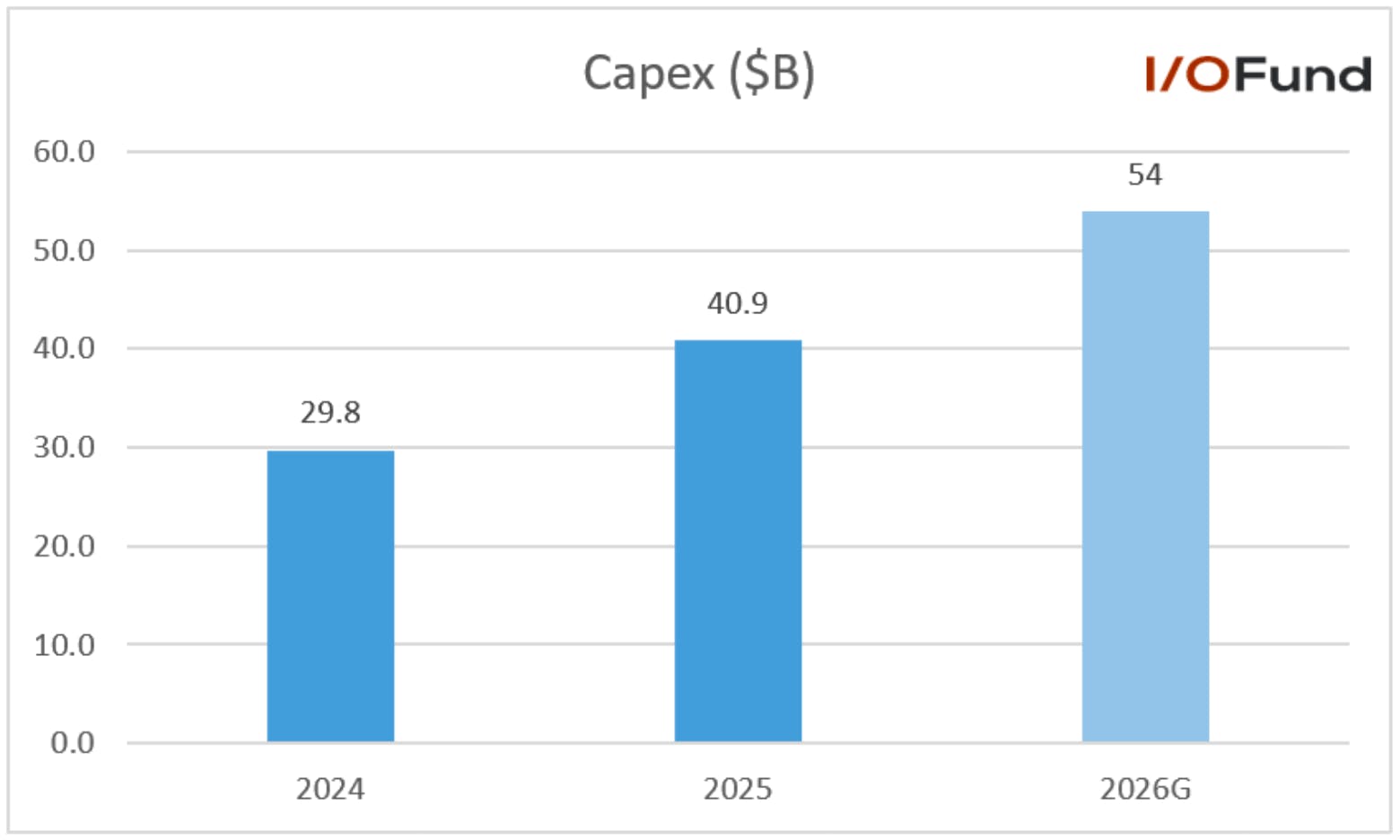
Chart showing TSMC’s capital expenditure expected to rise 32% year over year to $54 billion in 2026, indicating strong AI‑related semiconductor demand.

TSMC’s capex is expected to grow 32% YoY to $54 billion in 2026, suggesting strong AI-demand in the next few years.  

Source: Company IR 

Advanced Nodes: Why TSMC’s Semiconductor Moat is Widening 

While 2nm defines the next phase of the roadmap, 3nm remains the node supporting most AI deployments today. 

The company’s advanced 3nm node offers roughly 15% better performance than 5nm at equal power and transistor density, with die sizes estimated to be ~42% smaller. TSMC also states the 3nm process can reduce power consumption by up to 30%, underscoring power efficiency as a key competitive advantage. 

This efficiency helps deepen TSMC’s moat. While Samsung introduced 3nm chips in 2022, it has lagged TSMC on yield and power efficiency by an estimated 10%–20%. This advantage is reflected in pricing power, with TSMC charging roughly 25% more for 3nm versus 5nm, as customers are willing to pay a premium to avoid Samsung. 

TSMC offers multiple 3nm variants, including N3E, N3P, and N3X, allowing customers to tailor designs across consumer and AI workloads. N3E serves as the baseline IP platform, delivering approximately 18% higher performance and 34% lower power versus N5. N3P provides incremental performance and efficiency gains, while N3X is optimized for high-performance computing at the expense of higher leakage. 

The company entered volume production of its most advanced node, N2, in 4Q 2025, marking a transition from FinFET to gate-all-around (GAA) transistor architecture. By wrapping the gate around all sides of the channel, GAA improves electrostatic control and reduces leakage versus FinFET designs. 

N2 introduces NanoFlex technology, enabling designers to mix cell types and optimize for performance or power by adjusting nanosheet dimensions. According to management on the Q2 2025 earnings call, N2 delivers 10%–15% speed improvement at the same power or 20%–30% power reduction at the same speed, along with more than 15% chip density gains versus N3E. 

TSMC expects strong demand from both smartphones and AI HPC applications, with a rapid ramp in 2026. The company also introduced N2P, an enhanced version of N2, with volume production scheduled for the second half of 2026. Additionally, A16, featuring super-power rail (SPR) technology for complex HPC designs, is also on track for volume production in the second half of 2026. 

As chips migrate to advanced nodes—such as Nvidia’s Rubin moving to 3nm and AMD building GPUs and CPUs on 2nm—TSMC stands to benefit from rising pricing power, as these nodes command significant wafer premiums in exchange for material performance and power efficiency gains. 

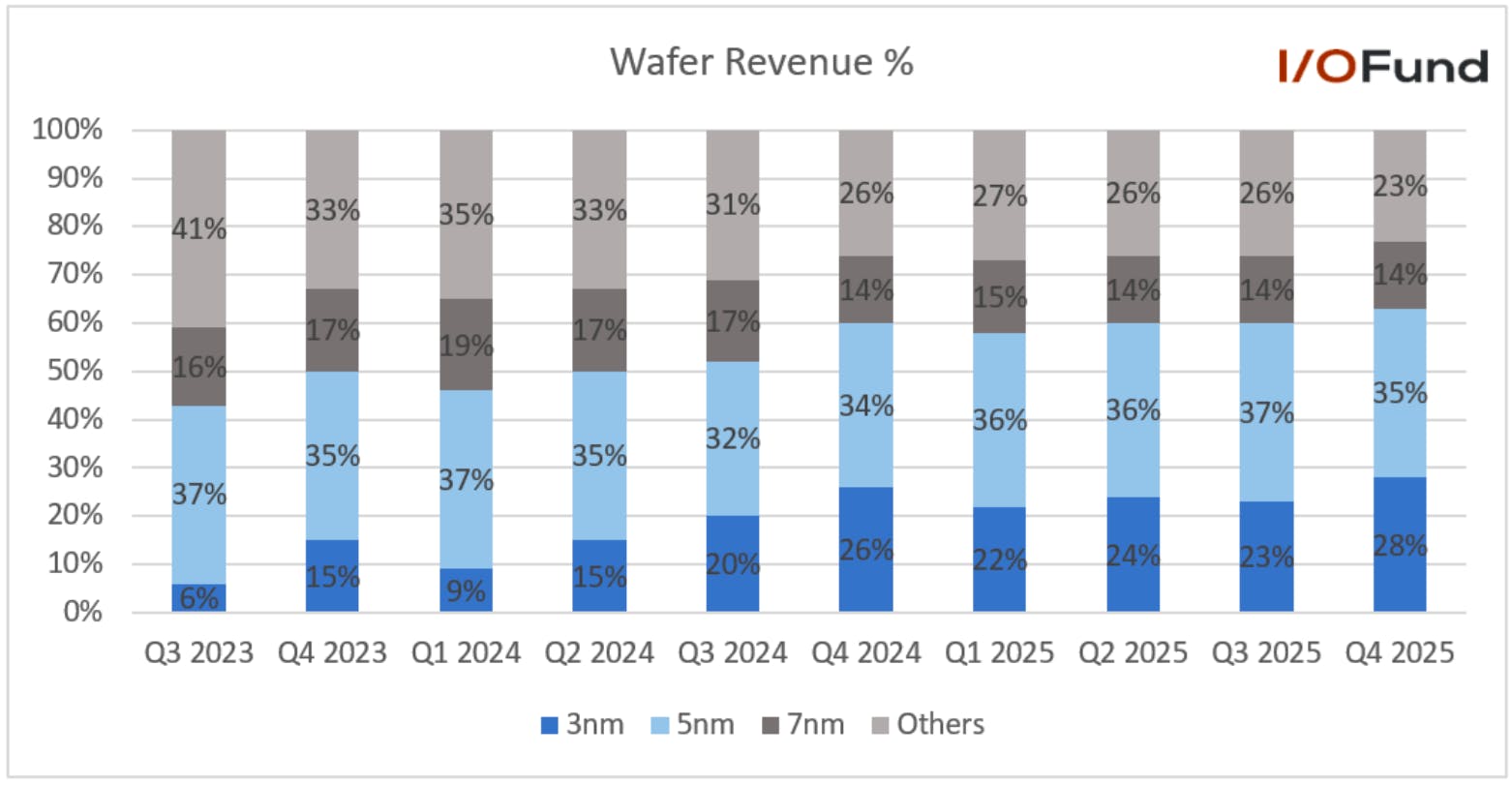
In Q4 2025, advanced nodes below 7nm accounted for 77% of wafer revenue, up from 74% in Q3. 3nm rose to 28% of wafer revenue, while 5nm accounted for 35%, compared with 23% and 37%, respectively, in the prior quarter. 

Visual showing TSMC’s 3nm revenue increasing from 22% of wafer revenue in Q1 2025 to 28% in Q4 2025, highlighting the company’s transition toward high‑performance AI chips.

TSMC 3nm revenue has ramped up from 22% of wafer revenue in Q1 2025 to 28% in Q4 2025, signaling transition toward high-performance AI. 

Source: Company IR 

TSMC Stock: $122B Record Revenue on Surging AI Chip Demand 

TSMC reported record Q4 revenue of $33.73 billion, up 25.5% year over year and 1.9% quarter over quarter, beating the midpoint of guidance by 2.8%. As expected, the upside was driven primarily by strong AI-related demand. Revenue growth is expected to accelerate next quarter, with management guiding Q1 revenue of $34.6 billion to $35.8 billion, implying 37.9% year-over-year growth and 4.4% sequential growth. 

For the full year, 2025 revenue grew 35.9% year over year to a record $122.42 billion. Looking ahead, management guided 2026 revenue growth to be close to 30% year over year in U.S. dollars. 

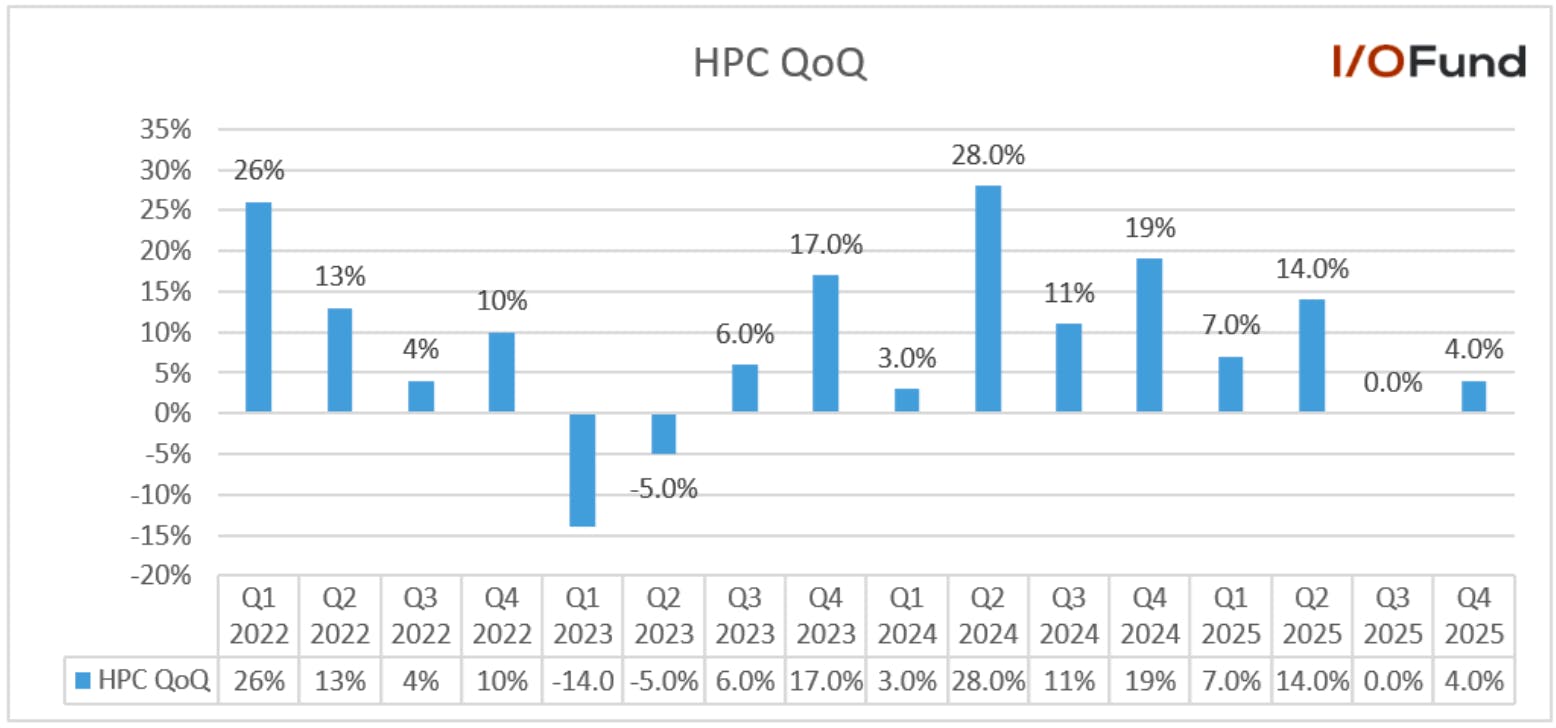
HPC revenue continued to expand, rising 4% quarter over quarter in NT dollars and accounting for 55% of total revenue in Q4. For FY25, HPC revenue in NT dollars increased 48% year over year and represented 58% of total revenue.  The sequential deceleration in HPC revenue from Q3 appears consistent with a platform transition, as Nvidia prepares to shift from Blackwell—built on TSMC’s customized 5nm N4P process—to the upcoming Rubin architecture, which relies on TSMC’s customized 3nm N3P node. 

With Rubin chips expected to enter mass production in the second half of 2026, we will look for HPC revenue growth to reaccelerate in the coming quarters. Management also highlighted a strong ramp for N2 in 2026, reinforcing sustained AI-driven demand. 

As shown in the chart below, TSMC experienced a similar slowdown in HPC growth during the second half of 2022 and the first half of 2023 amid the transition to Nvidia’s Hopper architecture. Nvidia began mass production of Grace Hopper chips in May 2023, after which HPC revenue growth resumed.

Graphic showing TSMC’s High‑Performance Computing (HPC) revenue rising 4% quarter‑over‑quarter in Q4 2025 after flat sequential growth in Q3 2025.

TSMC High-performance Computing (HPC) revenue grew by 4% QoQ in Q4 2025, up from flat sequentially in Q3 2025 

Source: Company IR 

TSMC Q4 Results: GAAP EPS grew by 40% 

TSMC’s ability to generate exceptionally strong profits showcases that the company is one of the best-managed companies in the world. Despite the rising inflation, tariff concerns, technological advancement, trade wars, overseas fab expansion, and geopolitical tensions, TSMC has overcome these challenges by continuing to generate superior profits. Margins continue to expand due to cost controls, higher capacity utilization rates, economies of scale, and better price negotiation with customers and suppliers.   

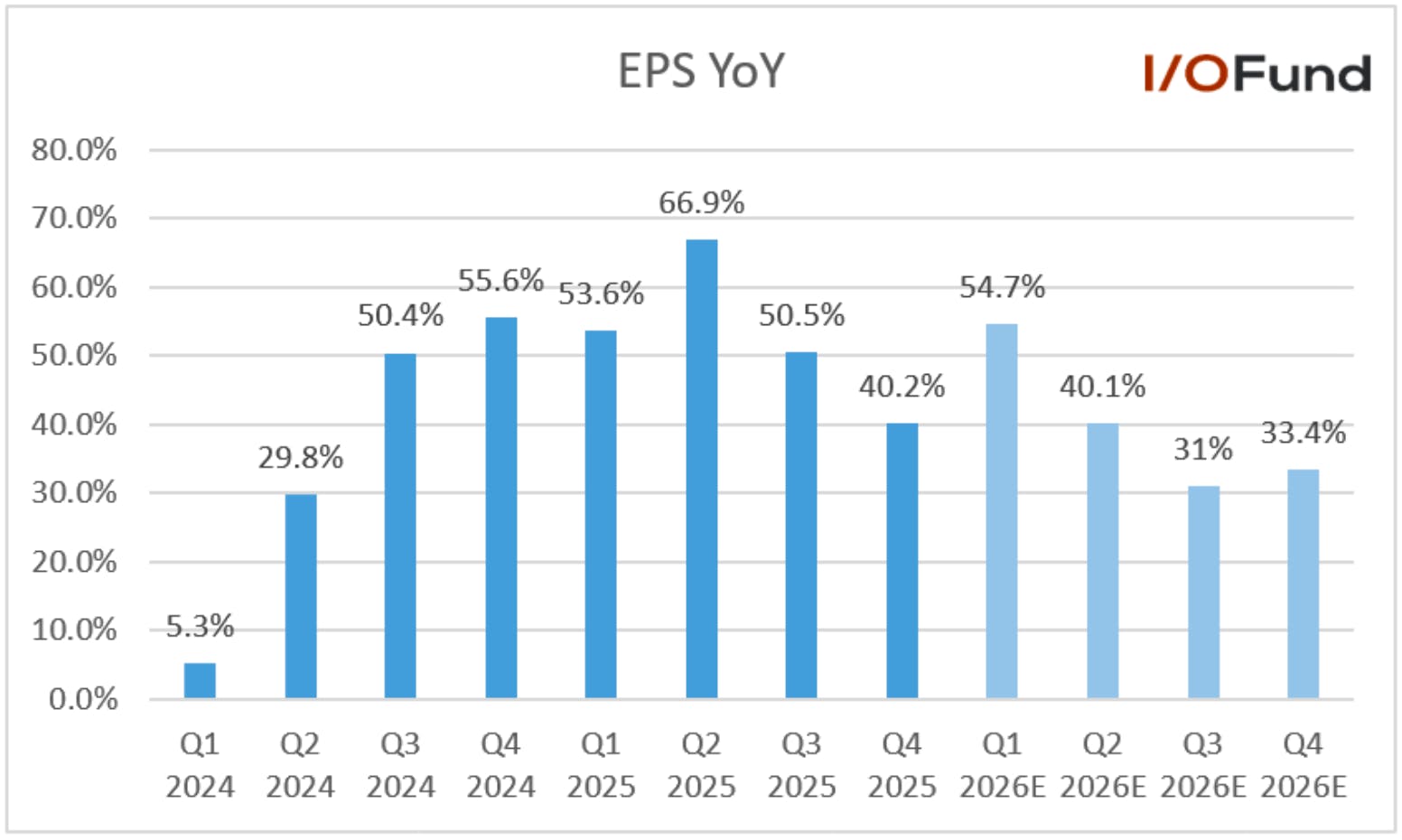
TSMC’s Q4 GAAP EPS grew by 40.2% YoY, beating estimates by 5.2%. That strength is expected to continue into 2026. Earnings are projected to grow roughly 55% year over year in Q1, followed by another strong step-up in Q2 with 40.1% growth. After delivering more than 50% EPS growth in 2025, consensus estimates call for earnings to rise by more than 20% annually in both 2026 and 2027, pointing to a sustained growth profile rather than a one-year spike.

Graphic showing TSMC’s Q4 2025 earnings per share rising 40.2% year over year to $3.14, exceeding expectations by 5.2% and reflecting strong demand for AI and high‑performance computing chips.

TSM’s Q4 2025 EPS grew by 40.2% YoY to $3.14, beating estimates by 5.2%. These results highlight the company’s dominant position in the AI chip supply chain and growing demand for high-performance computing (HPC). 

Source: Company IR/YCharts 

In Q4, TSMC generated $23.4 billion in operating cash flow, up 21.9% year over year, with an operating cash flow margin of 69.4%, down modestly from 71.4% in the prior-year period. 

Free cash flow increased 48.8% year over year to $11.9 billion, with margins expanding nicely to 35.2% up from 29.8% last year. Notably, capital expenditures grew just 2.5% year over year to $11.5 billion in the quarter, supporting strong free cash flow conversion. Management has indicated this moderation is temporary, as noted above, capex is expected to accelerate meaningfully in the coming years as advanced-node demand ramps. 

Conclusion 

When the world’s most advanced foundry raises its long-term AI growth forecasts, commits more than $50 billion annually to capacity, and openly states that hyperscalers are coming directly to secure wafers years in advance, it provides a level of visibility that few companies in the AI ecosystem can match. TSMC’s willingness to materially expand capex through 2026, knowing that fabs take years to come online, signals confidence that extends well beyond the next product cycle and into the latter half of the decade. 

We’ll expand on how this visibility feeds into the I/O Fund's broader AI positioning—and where we see the next phase of opportunity—in our Q1 2026 Top 15 AI Stocks report. This 50+ page report totalling over 20,000 words identifies many lesser-known AI stocks leading the charge in the three critical pillars of the AI Megatrend: AI networking, AI energy and AI inference. Sign up now to receive this report.

Royston Roche and Damien Robbins, Equity Analysts at I/O Fund contributed to this analysis.

Please note: The I/O Fund conducts research and draws conclusions for the Fund’s positions. We then share that information with our readers. This is not a guarantee of a stock’s performance. Please consult your personal financial advisor before buying any stock in the companies mentioned in this analysis.

Recommended Reading:

head bg

More To Explore

Newsletter

TSMC semiconductor manufacturing facility (fab) with the company logo on the building.

The Future of AI Stocks? TSMC Commentary Suggests AI Megatrend

TSMC is one of the least sensational management teams in the AI stocks space, yet management explicitly called AI a multi-year “megatrend” in their most recent earnings call, with demand now being pul

January 29, 2026
2026 Big Tech AI strategy comparison: Apple, Amazon, Google, Meta, and Microsoft transitioning to AI infrastructure monetization.

The $530 Billion AI Question: Which Big Tech Stock is Winning?

Big Tech is expected to invest $530 billion for building AI infrastructure in 2026, while the path to near-term monetization remains a question mark. As investor scrutiny around capital expenditure in

January 22, 2026
A futuristic city designed like a glowing circuit board, with the Palantir logo at the center.

Palantir Stock 2026 Forecast: Is Its High Valuation Sustainable?

Palantir’s stock has defied gravity, delivering steady performance that no other AI software stock has come close to matching (yet). For investors, the Palantir thesis is two-fold: the company must co

January 15, 2026
A high-impact graphic titled "Top 10 Tech Stocks of 2025" featuring a grid of futuristic technology icons including microchips, digital circuits, and AI data nodes.

Top 10 Tech Stocks of 2025: How the AI Trade Defied the Skeptics

The stock market in 2025 was a high-stakes tug-of-war between geopolitical tensions and the AI trade. Headlines were dominated by the DeepSeek fears, trade wars, tariffs, and persistent whispers of th

January 08, 2026
I/O Fund analyst team with a graphic promoting “The Best of I/O Fund’s Free Newsletter in 2025,” showing an upward chart and market-themed background.

Nvidia & Beyond: I/O Fund’s Best Free AI Stock Research in 2025  

We describe our newsletter as “free,” however the resources required to produce the research behind our weekly analysis are substantial. Delivering early, actionable insights consistently—and making t

December 31, 2025
A Fox Business live interview features Beth Kindig, Lead Tech Analyst at I/O Fund, discussing NVIDIA.

AI Stocks & Nvidia: I/O Fund’s 2025 Tech Media Highlights

As we close out a defining year for tech, we’re proud to share a few media moments where our theses met the mainstream. We are grateful that our readers trust us to cut through the noise - and we want

December 23, 2025
Meta logo glowing on a futuristic microchip with neon circuitry and rising stock chart, symbolizing AI growth and monetization.

The AI Revenue Leader Nobody Is Talking About—Second Only to Nvidia Stock

Meta’s stock sits at the center of the AI spending debate, as Big Tech continues to shock markets with outsized AI-driven capital expenditures. What is being overlooked is that Meta’s stock is already

December 18, 2025
Nvidia, Broadcom (AVGO), and AMD AI Accelerator Chips Comparison

Broadcom Stock: The Silent Winner in the AI Monetization Supercycle

The AI accelerator market will inevitably widen beyond Nvidia’s GPUs - the keyword is widen. More players will sell more AI systems as the market expands, and that growth supports both the clear leade

December 11, 2025
A large digital wave with Nvidia’s green accents, made of binary code and GPU textures, rising with an upward market graph.

Nvidia Stock and the AI Monetization Supercycle No One Is Pricing In

Two weeks ago, Nvidia blew the doors off with an earnings report that defies the company’s mega-cap scale. The long-awaited Blackwell and Blackwell Ultra architectures are shipping in volume, leading

December 04, 2025
Digital image of a glowing Bitcoin coin centered over a candlestick chart, representing price volatility and technical analysis in the crypto market.

I/O Fund Called the Bitcoin Selloff: What Liquidity & DXY Data Predict Next

In August, the I/O Fund warned that Bitcoin was entering a high-risk phase as global liquidity stalled, and sentiment patterns flashed caution. Since then, Bitcoin has fallen more than -35%. In this a

November 28, 2025
newsletter

Sign up for Analysis on
the Best Tech Stocks


Copyright © 2010 - 2026