Palantir Stock 2026 Forecast: Is Its High Valuation Sustainable?
January 15, 2026
Beth Kindig
Lead Tech Analyst
Palantir’s stock has defied gravity, delivering steady performance that no other AI software stock has come close to matching (yet). For investors, the Palantir thesis is two-fold: the company must continue to scale its Commercial segment after posting multiple quarters of over 50% growth, while also sustaining a high valuation. Both matters and the bar is undeniably high.
What separates Palantir, however, is not simply growth, but capability. The differences matter as unlike traditional AI-enabled database or business intelligence competitors, Palantir can operate effectively even when data sets are incomplete or fragmented—situations where most models struggle. In that regard, traditional business intelligence companies require a complete data set, whereas Palantir can handle situations where one isn't available. You can think of the competitive advantage as actionable depth, as Palantir has described it: “the reasoning that goes into decision-making, not just data.”
Palantir’s Artificial Intelligence Platform (AIP) integrates generative AI with operational data and workflows, and, when combined with Palantir’s other platforms, Foundry and Apollo, it provides an AI service mesh that can run hundreds of microservices, scale compute via its Rubix engine, and orchestrate updates through Apollo.
Additionally, Palantir’s knowledge graph, referred to as Ontology, is a distinct advantage. The graph offers better context than a large language model would on its own – or as Palantir states, it’s “the reasoning that goes into decision-making.” Palantir made key upgrades to AIP with the introduction of AI-forward-deployed engineers (FDEs) and the AI Hivemind, and brought Ontology to the edge, enabling deployment on mobile devices.
Palantir Stock leads the AI software pack, delivering one of the best reports across tech in Q3. Revenue accelerated nearly 15 points sequentially to almost 63%, with strong growth in key metrics and a 28-point acceleration in US Commercial revenue to 121% YoY. The Artificial Intelligence Platform (AIP) is driving most of the Commercial growth, as there was a clear revenue inflection when AIP launched in mid-2023.
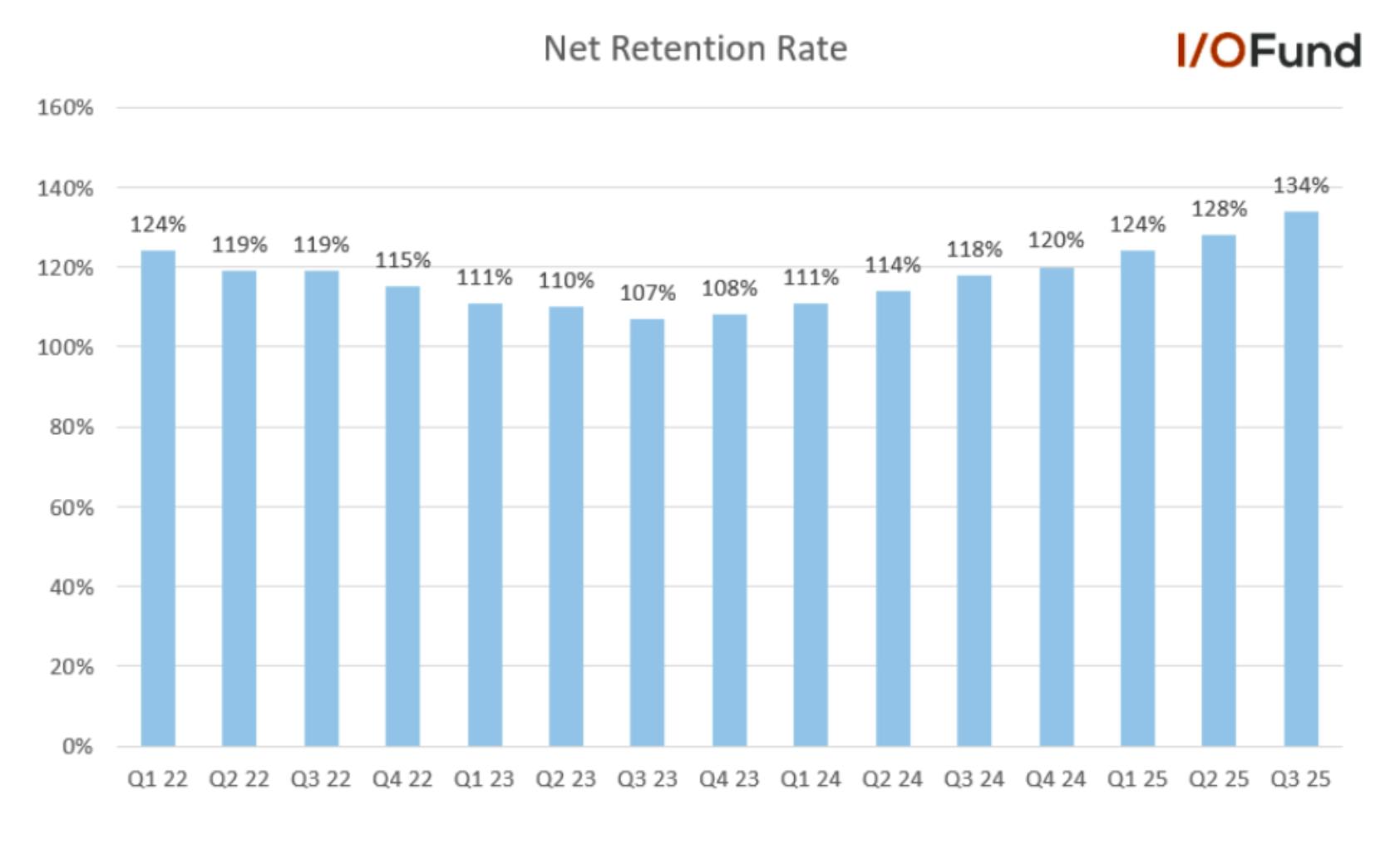
The company reported strong key metrics, with net retention rate (NRR) expanding six points sequentially to 134%. Over the past two years, NRR has risen an impressive 27 points, and Palantir noted that AIP is continuing to drive existing expansions and new customer conversions. On the other hand, Palantir’s forward P/S ratio trades at an outstanding 67.5.
Below, I discuss what you need to know about Palantir, and the hotly debated stock.
New Product Upgrades – AIP FDEs, Hivemind and Edge Ontology
Palantir made a handful of upgrades to its AIP and Ontology in Q3, unveiling AIP forward-deployed engineers (FDEs) in beta, AI Hivemind, and Edge Ontology, all aimed at accelerating AI deployment with its customers.
AI FDEs builds upon Palantir’s take on software engineers, the forward deployed engineer, which sit at the intersection of software, sales, and platform engineers, embedding within customer teams to closely develop and tailor AI software and solutions directly to their needs. Palantir now brings this to AIP, with the AI FDEs being its AIP-native deployment AI agent that “understands how to connect to data sources, how to integrate and transform data, how to create ontologies and functions and build applications.” AI FDEs function in conversational commands, allowing customers to easily turn requests into autonomously executed Foundry operations.
Palantir says the AI FDEs are increasing productivity for customers, noting that at one customer, two of its human FDEs utilized AI FDEs to migrate to a legacy data warehouse in five days, a task which Palantir says would normally have taken up to two years.
mid
AI Hivemind is a new tool within AIP that Palantir says will orchestrate a “swarm of dynamically generated agents to tackle hard problem solving, idea generation refinement and executable proposal generation that is integrated with Ontology and therefore aware of the context of your enterprise.” Palantir says the tool was developed to help government clients solve extremely complex problems with classified data (such as generating intricate mission plans), but it has already been tested by commercial clients to help “identify bottlenecks to their supply chain, proactively developing possible solutions and then leveraging AI FDE to code that up into an actual solution.”
Edge Ontology is Palantir’s new, lightweight Ontology that allows it to run on mobile devices, letting customers build mobile apps or embedded software for hardware such as robots or drones. Edge Ontology is also fully integrated with AIP. While Palantir was very thin on details, it’s likely tied to its existing partnership with Qualcomm, where the two brought Ontology to edge devices powered by Qualcomm’s Dragonwing processors. This partnership focused on the industrial, auto and manufacturing sectors, and remote and offline environments.
Together, the new product upgrades reflect Palantir’s dedication to continuously improve its platform and help customers consistently solve problems daily. Financially, the three new upgrades can help accelerate deployments and adoption of AIP, help secure more (and potentially larger) contracts, and tap into new markets such as IoT at the edge.
Financials
Revenue Accelerates Nearly 15 Points to 63% YoY
Palantir reported $1.18 billion in revenue in Q3, up by an impressive 18% QoQ and beating estimates by 8.4%, driven by unwavering momentum in US Commercial. On a YoY basis, revenue growth accelerated 14.8 points to 62.8% YoY, the largest sequential acceleration to date and marking Palantir’s highest growth rate since going public. Over the last nine quarters, topline growth has accelerated ~50 points, from just 12.7% in Q2 2023, a rare feat to accomplish.
For Q4, Palantir guided revenue up 60.6% YoY to $1.327 to $1.331 billion, well ahead of estimates for 44.2% growth to $1.19 billion. While this does represent a marginal deceleration at face value, this sequential deceleration is in line with trends from previous quarters.
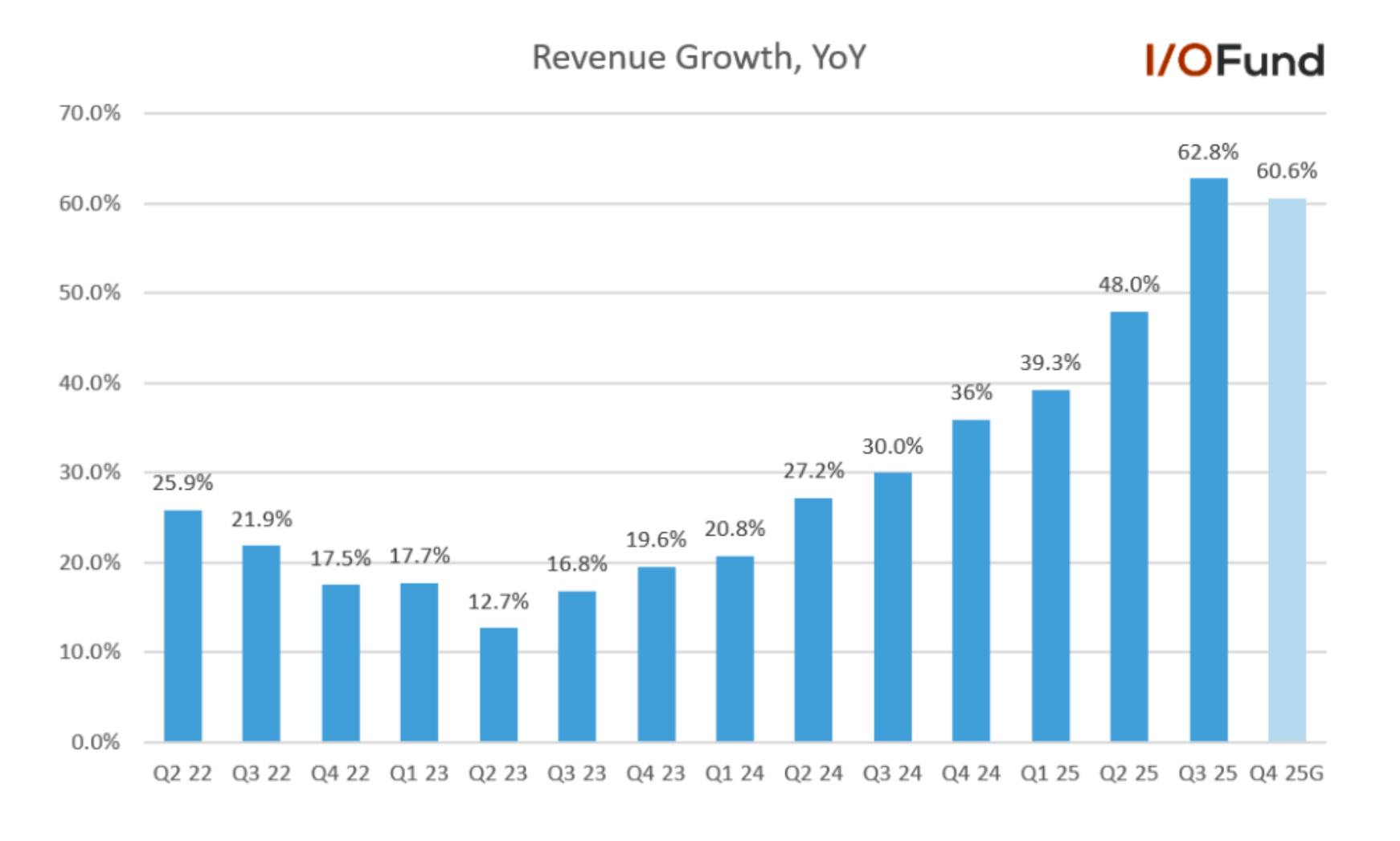
Palantir (PLTR) Revenue YoY Growth: 9-Quarter Acceleration Hits Record 62.8% in Q3 2025, marking the highest growth rate since its IPO. This chart highlights the unprecedented revenue acceleration driven by Palantir’s Artificial Intelligence Platform (AIP).
Source: Company IR
For the full year, Palantir raised its revenue outlook to $4.396 to $4.40 billion, pointing to YoY growth of 53.5% at midpoint, a sharp acceleration from 29% growth in 2024. To put in perspective the strength of this acceleration, Palantir had initially guided for just 30.9% growth to $3.76 billion in revenue back in Q4 2024; growth is now more than 22 points faster.
Impressive 28 Point Acceleration in US Commercial Revenue to 121% YoY
Palantir’s US Commercial segment is generally seen as the primary vector for its AIP-driven growth, with robust momentum only accelerating further in Q3.
US Commercial revenue grew 29% QoQ and 121% YoY to $397 million in Q3, accelerating from 93% YoY growth in Q2. Since the start of the year, US Commercial growth has accelerated 50 points, and since the start of 2024, growth has accelerated 81 points.
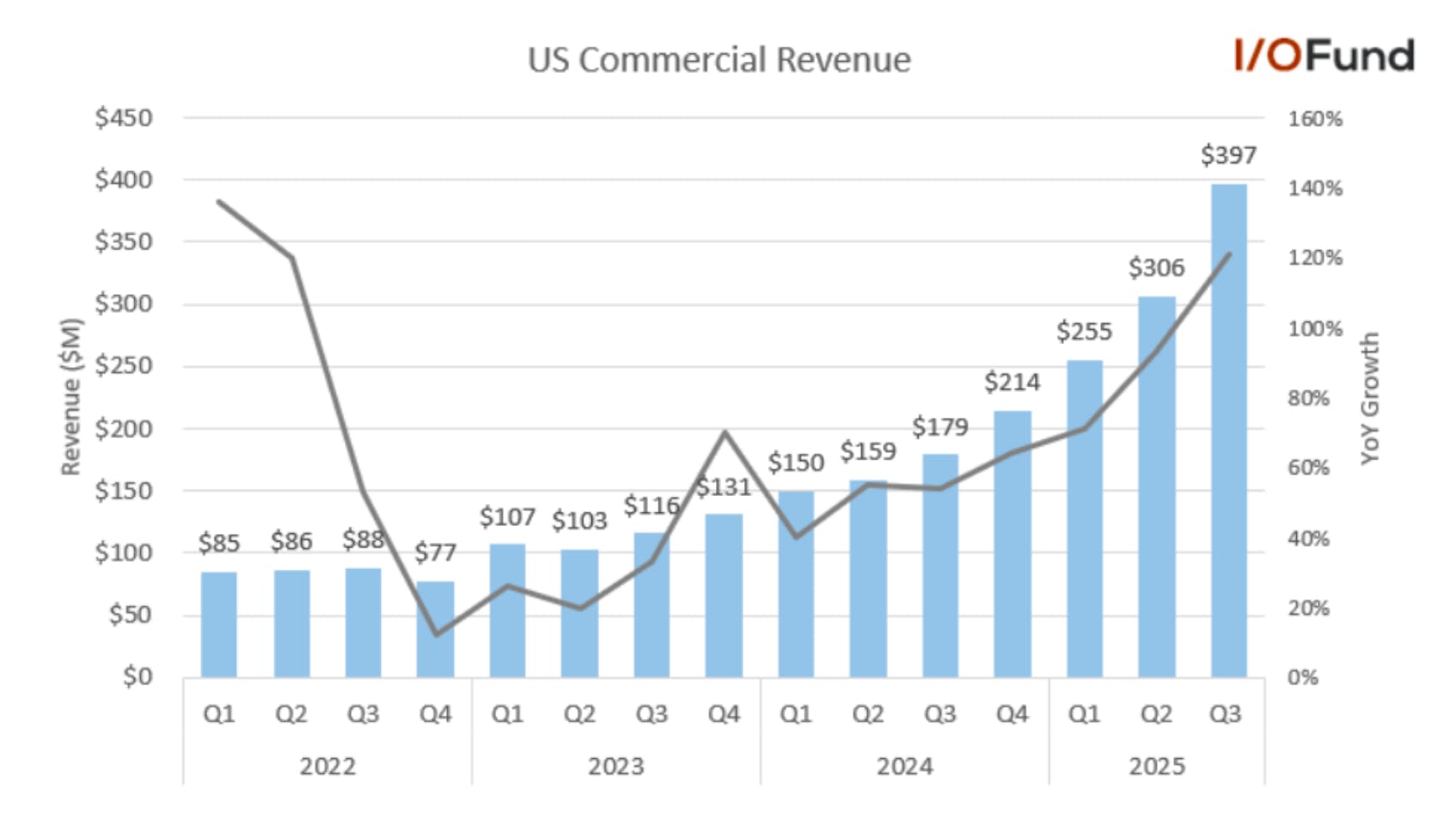
US Commercial Revenue accelerated by 28 percentage points to 121% YoY growth to $397 million.
Source: Company IR
For the full year, Palantir significantly boosted its US Commercial growth outlook to >104% YoY, up from 85% previously. This corresponds to revenue of $1.433 billion, up from $1.302 billion previously.
Key metrics for the segment were very strong: TCV closed (total contract value) surged 342% YoY to a record $1.31 billion, and TTM TCV was $3.8 billion, up 217% YoY. Remaining deal value (RDV) rose 199% YoY and 30% QoQ to $3.63 billion. US Commercial deals closed of >$1 million were up 2X YoY and deals closed of >$5 million were up 5X YoY.
Palantir Key Segments – Government and Commercial Revenue
Q3 also marked the first time Commercial growth outpaced Government segment growth since Q2 2024, fueled by the robust momentum and sharp acceleration in US Commercial as discussed above.
Commercial revenue rose 21.5% QoQ and 73% YoY to $548 million, a 26-point acceleration from 47% YoY growth last quarter. International Commercial revenue was ~$151.7 million in Q3, up ~10% YoY and 5% QoQ.
Government revenue rose 14.5% QoQ and 55% YoY to $633 million, a six-point acceleration from 49% YoY in Q2. Government remained Palantir’s largest segment at ~53.6% of revenue. US government revenue was up 52% YoY and 14% QoQ to $485.9 million, while International Government revenue was ~$146.8 million, up nearly 66% YoY and 16% QoQ.
Other Key Metrics – NRR Expands, Strong Customer Growth
Palantir had a handful of other strong key metrics that support strong revenue growth continuing despite the sharp acceleration the company delivered in Q3.
Palantir’s net retention rate (NRR) expanded six points sequentially to 134%, and over the past two years, NRR has risen an impressive 27 points, with Palantir noting that AIP is continuing to drive existing expansions and new customer conversions. Palantir also continued to emphasize that NRR does not include revenue from new customers acquired over the last twelve months, and accelerating momentum in quarterly deals closed supports more upside to NRR in 2026.
Palantir stock’s Q3 Net Retention Rate accelerated by 600 basis points sequentially to 134% in Q3.
Source: Company IR
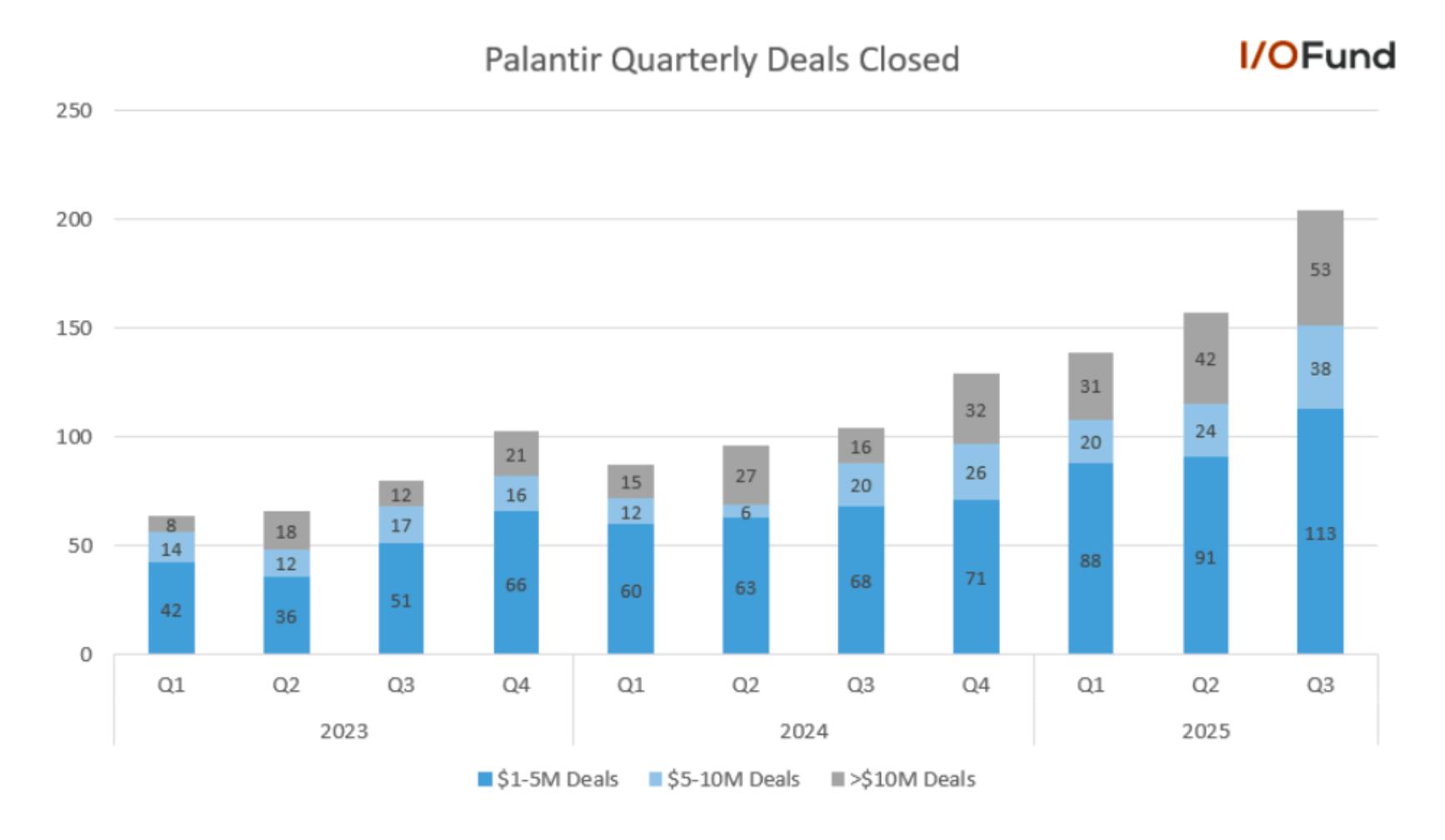
For Palantir’s AIP, which connects frontier models directly to enterprise data streams, this creates a surge in data that Palantir can then contextualize and provide value for decision making for its customers. There is already more evidence below the headline figures that Palantir is benefiting from increasing enterprise AI adoption, such as Palantir’s quarterly deals closed. Palantir closed 201 deals of >$1 million in Q3, up 30% QoQ; this was a sharp acceleration from 13% QoQ growth in Q2. Palantir also signed more deals in all its cohorts (>$1M, >$5M and >$10M) in Q3 than it had in Q2.
To put deal growth in the context of NRR, Palantir has signed 629 >$1M deals over the last twelve months, up more than 61% from 390 in the same period last year – with none of these new deals appearing yet in NRR.
Palantir’s quarterly deals closed accelerated sharply to 30% sequential growth in Q3, up from 13% in Q2.
Source: Company IR
However, there were a few blemishes within key metrics – billings growth decelerated from 53.5% YoY in Q2 to 48.8% YoY in Q3 to $1.23 billion, with QoQ growth also decelerating from 21.8% QoQ to 11.2% QoQ. RPO growth decelerated from 77% YoY and 27% QoQ in Q2 to 66% YoY and 8% QoQ in Q3 at $2.60 billion.
Margins – Q3’s Rule of 40 of 114%, from 94% in Q2
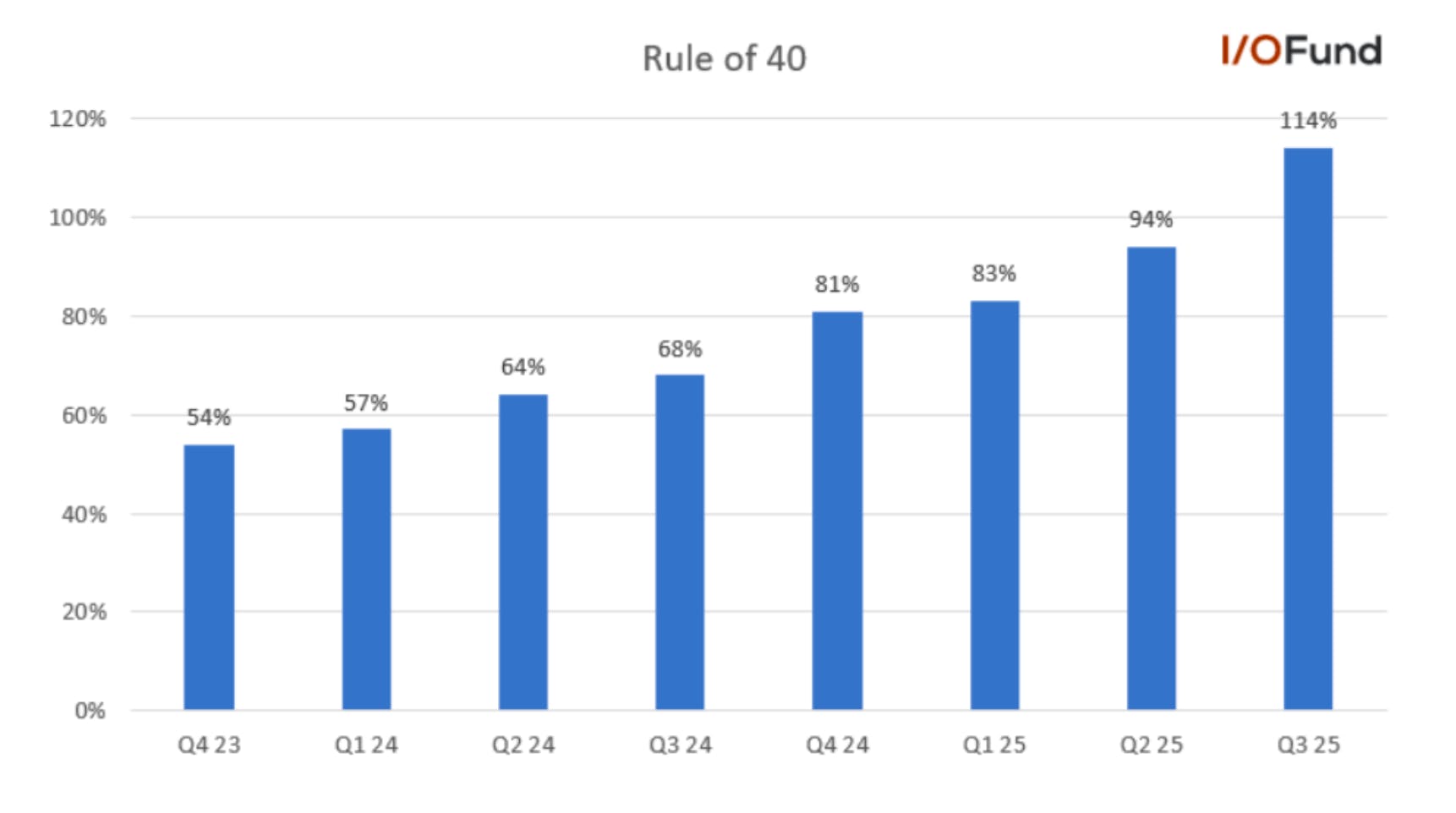
Margins strengthened considerably in the quarter, with adjusted operating margin surpassing 50% with more expansion guided for Q4. Palantir’s Rule of 40 score (revenue growth + adj operating margin) expanded to a wild 114%, up from 94% last quarter and 68% last Q3.
Palantir’s Rule of 40 score accelerated to 114%, from 94% last quarter and 68% in Q3 2024.
Source: Company IR
Gross margin was 82% in Q3, up one point QoQ and two points YoY, while adjusted gross margin was 84%, up two points YoY and QoQ.
GAAP operating margin was 33%, an impressive 6 point QoQ and 17-point YoY expansion. Adjusted operating margin was 51%, breaking past 50% for the first time and up 5 points QoQ and 13 points YoY. For Q4, Palantir guided for adjusted operating margin to be 52%, showcasing its ability to drive strong margin expansion alongside swift revenue acceleration. Full year adjusted operating margin guidance was raised from 46% to 49%.
GAAP net margin was 40%, up 7 points QoQ and 20 points YoY. Adjusted net margin was 45%, up 5 points QoQ and 12 points YoY. Palantir is one of the few, if not only, tech companies to have 40% GAAP net margins with revenue growth accelerating above 60%.
Adjusted EPS grew by 110%
Palantir reported $0.18 in GAAP EPS in the quarter, up 200% YoY, while adjusted EPS was $0.21, beating estimates by 25.5% and rising 110% YoY. Palantir’s adjusted EPS is expected to grow 64.1% YoY to $0.23 in Q4 and 59.4% YoY to $0.21 in Q1 2026.
For FY25, Palantir is expected to earn $0.72 in adjusted EPS, up 76.7% YoY and then 39.5% YoY to $1.01 in FY26.
Strong Balance Sheet
Palantir stock has strong cash flows, though cash flow margins dipped on a YoY and QoQ basis. Q3 operating cash flows grew by 20.9% YoY to $507.7 million for a 43% margin, down from a 54% margin in Q2 and 58% in the year ago quarter.
Adjusted free cash flow grew by 24.3% YoY to $539.9 million for a 46% margin, down from 57% in Q2 and 60% in the year ago quarter. Palantir raised its adjusted free cash flow guidance for the year to $1.9 to $2.1 billion, or a 45.5% margin, up from a 42.8% margin previously.
Cash and marketable securities totaled $6.4 billion and debt remained zero.
Valuation
To many investors on social media, Palantir’s valuation remains a hot topic, with it blowing past norms and reaching the upper echelons of the stratosphere for what is considered ‘typical’ for SaaS stocks. Put it this way -- how often do you see a software company re-accelerate revenue from 13% growth a couple of years to 60% in nine quarters organically and sustainably, while increasing both profitability and cash flows.
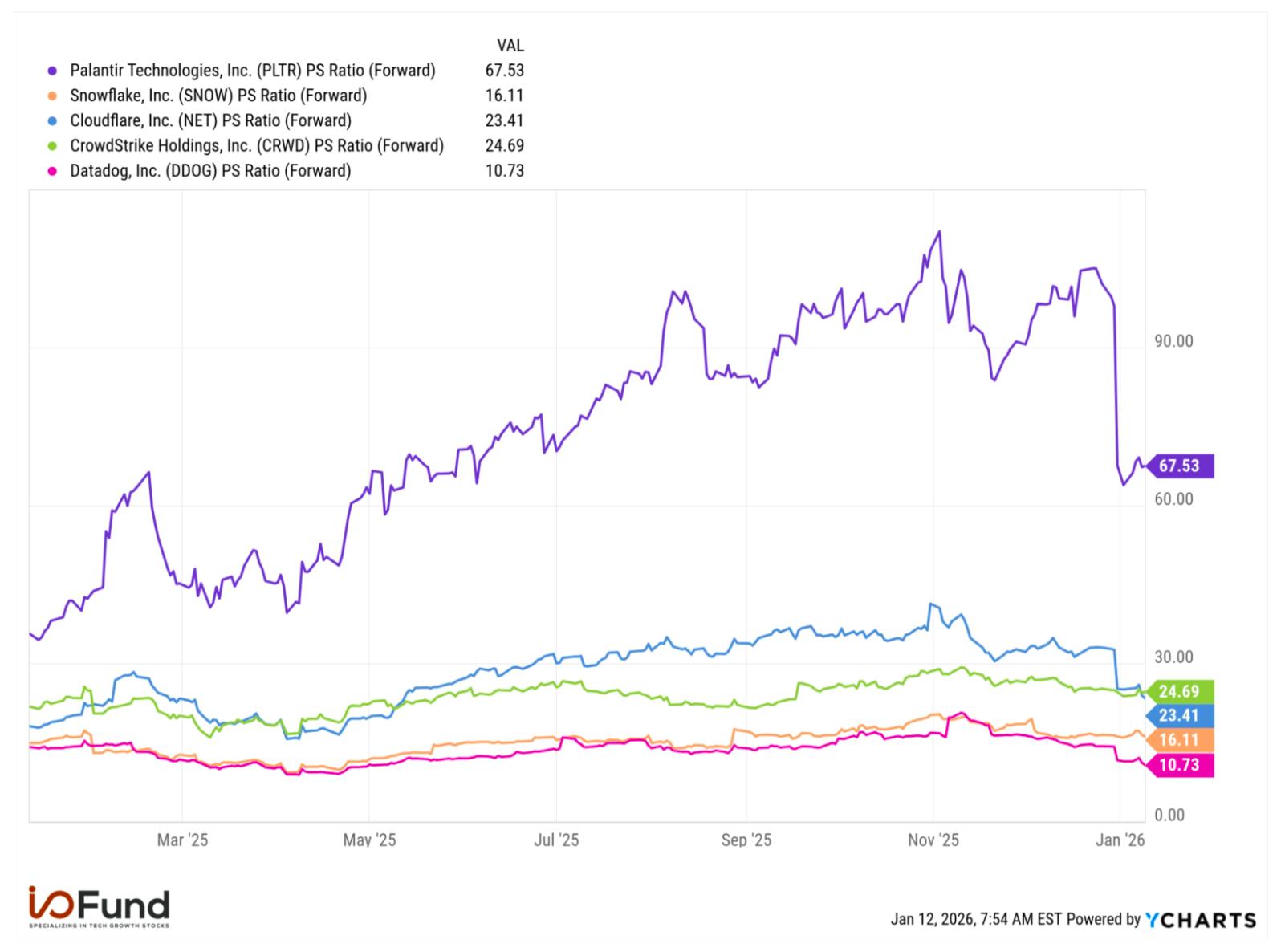
Palantir is now trading at a forward P/S ratio of 67.5, making other best-of-breed cloud stocks like CrowdStrike and Cloudflare cheap at 24.7 and 23.4, respectively. On the bottom-line, it is trading at a forward P/E of 176.5, slightly below Snowflake’s forward P/E ratio of 180.4 and higher than Cloudflare’s and CrowdStrike’s forward P/E ratio of 155.3 and 126.6, respectively.
Source: YCharts
Given Palantir is trading at a forward P/S ratio of 67.5, there are certainly easier stocks to own in 2026. Within AI, specific niches are booming such as AI networking, AI energy and AI memory plays that are trading far lower than Palantir.
Recently, Palantir was upgraded by Citi as it believes that the commercial and government super cycle is coming this year. Analyst Tyler Radke said, “We are upgrading PLTR to Buy/High-Risk from Neutral and raising estimates and our target price to $235.” He further added, “Shares have minted spectacular returns over the last few years as a vicious growth acceleration and equally impressive margin expansion has 'broken' traditional rule-of-40 and valuation frameworks. Despite our 2025/26 revenue numbers up 10%+ since mid-year, the stock is ~flat. Our upgrade is premised on the view that 2026 is poised to be another year of significant positive estimate revisions, with recent CIO + industry conversations suggesting AI budget and use cases are accelerating in the enterprise. We also see significant tailwinds in the Government, driven by accelerating defense budgets and modernization urgency.”
Conclusion
Palantir delivered one of the strongest earnings reports across the tech sector in Q3, with revenue growth of nearly 63% and a strong 28-point acceleration in its AI-driven US Commercial segment. Since the start of 2025, revenue growth has accelerated more than 23 points, with US Commercial revenue accelerating 50 points. Trends in other key metrics such as NRR and quarterly deals closed remain robust, although billings and RPO growth decelerated in the quarter. However, what Palantir has to contend with is an extended valuation, in uncharted territory even by its own measures, and where the market will ultimately price its shares.
Our Premium members received a 15,000 word report outlining the Top 15 AI Stocks for Q4 of 2025 with many stocks seeing higher returns in Q4 than Palantir. Our Premium members will be receiving the Top 15 AI Stocks for Q1 2026 in January plus technical setups for potential entries. Sign up now to find out which AI stocks rank higher than Palantir. Join now.
Royston Roche and Damien Robbins, Equity Analysts at I/O Fund contributed to this analysis.
Please note: The I/O Fund conducts research and draws conclusions for the company’s portfolio. We then share that information with our readers and offer real-time trade notifications. This is not a guarantee of a stock’s performance and it is not financial advice. Please consult your personal financial advisor before buying any stock in the companies mentioned in this analysis. I/O Fund may own stocks pictured in the charts.
Recommended Reading:
More To Explore
Newsletter
Palantir Stock 2026 Forecast: Is Its High Valuation Sustainable?
Palantir’s stock has defied gravity, delivering steady performance that no other AI software stock has come close to matching (yet). For investors, the Palantir thesis is two-fold: the company must co
Top 10 Tech Stocks of 2025: How the AI Trade Defied the Skeptics
The stock market in 2025 was a high-stakes tug-of-war between geopolitical tensions and the AI trade. Headlines were dominated by the DeepSeek fears, trade wars, tariffs, and persistent whispers of th
Nvidia & Beyond: I/O Fund’s Best Free AI Stock Research in 2025
We describe our newsletter as “free,” however the resources required to produce the research behind our weekly analysis are substantial. Delivering early, actionable insights consistently—and making t
AI Stocks & Nvidia: I/O Fund’s 2025 Tech Media Highlights
As we close out a defining year for tech, we’re proud to share a few media moments where our theses met the mainstream. We are grateful that our readers trust us to cut through the noise - and we want
The AI Revenue Leader Nobody Is Talking About—Second Only to Nvidia Stock
Meta’s stock sits at the center of the AI spending debate, as Big Tech continues to shock markets with outsized AI-driven capital expenditures. What is being overlooked is that Meta’s stock is already
Broadcom Stock: The Silent Winner in the AI Monetization Supercycle
The AI accelerator market will inevitably widen beyond Nvidia’s GPUs - the keyword is widen. More players will sell more AI systems as the market expands, and that growth supports both the clear leade
Nvidia Stock and the AI Monetization Supercycle No One Is Pricing In
Two weeks ago, Nvidia blew the doors off with an earnings report that defies the company’s mega-cap scale. The long-awaited Blackwell and Blackwell Ultra architectures are shipping in volume, leading
I/O Fund Called the Bitcoin Selloff: What Liquidity & DXY Data Predict Next
In August, the I/O Fund warned that Bitcoin was entering a high-risk phase as global liquidity stalled, and sentiment patterns flashed caution. Since then, Bitcoin has fallen more than -35%. In this a
Why Nvidia Stock Could Reach a $20 Trillion Market Cap by 2030
The headline that Nvidia could reach a $20 trillion market cap by 2030 will trigger plenty of emotion — it sounds fantastical, full of hype, or like a prediction made far too early in the AI cycle. Ye
Big Tech’s $405B Bet: Why AI Stocks Are Set Up for a Strong 2026
AI accelerators such as GPUs and custom silicon need no introduction. Compute has led the AI boom; a trend so powerful, it is displacing the FAANGs of the last decade with Nvidia firmly the world’s mo