Blogs -The $530 Billion AI Question: Which Big Tech Stock is Winning?

The $530 Billion AI Question: Which Big Tech Stock is Winning?


January 22, 2026

author

Beth Kindig

Lead Tech Analyst

Big Tech is expected to invest $530 billion for building AI infrastructure in 2026, while the path to near-term monetization remains a question mark. As investor scrutiny around capital expenditure intensifies, the key question is no longer who is spending the most on AI, but who is translating that spend into measurable revenue and sustainable margins. 

The market is right to question the shift in role for Big Tech, as these companies have swiftly moved from global demand engines for consumer and enterprise software to now being large consumers themselves of a rather expensive endeavour.  

When asked about Big Tech for the last few years, my answer has been consistent – my firm is heavily positioned in the suppliers. For example, while many are celebrating Google’s stock performance last year, stocks like AMD and Micron effortlessly outperformed the 2025 Big Tech winner – as did dozens of lesser-known suppliers. This is easily visible in the QQQs returning 20.2% last year compared to SMH at 48.7%.  

But I digress, as although Big Tech has paled in stock returns compared to select AI semiconductor stocks, my firm is anticipating an incoming monetization wave driven by inference. The moment that Big Tech and others can effectively monetize their large investments will unfold in the coming years. Big Tech is not muted; it’s just a bit later in the cycle given they’re predominately software companies.  

My firm strives to be early to trends, positioning in cloud in 2019 ahead of Covid, then began rotating out of cloud to position for AI in late 2022 around extreme lows and ahead of Nvidia’s Hopper release. We then added AI energy names to our portfolio ahead of the Street in February – April of 2025 (again) before the broad market and around extreme lows.

On a similar note, I fully expect we will be well-positioned for the moment AI can finally monetize – which brings us back to Big Tech.  

The report below compares Big Tech companies across revenue, AI segment revenue, margins, capex intensity, and balance sheet health, to help assess which companies are best positioned to convert AI investment into durable growth and profits. With infrastructure spending at historic highs, the stakes have never been higher. 

Microsoft ($MSFT): Azure Acceleration Powered by AI  

Microsoft has consistently delivered double-digit revenue growth across all three quarters of 2025, driven by strong demand for cloud and AI.  

  • The company’s Q3 revenue grew by 18.4% YoY to $77.67 billion.  
  • Analysts expect revenue to grow 15.3% YoY to $80.3 billion in Q4, representing more than 300 bps deceleration due to seasonality and the revenue decelerated 370 bps in the same period last year. 

Yet under the hood, Microsoft Azure is witnessing accelerating demand, rising 40% in Q3, driven by better-than-expected growth in the company’s core infrastructure business, primarily from its largest customers and AI-demand. The company’s productivity and business processes segment has also demonstrated steady, balanced growth driven by continued adoption of Microsoft 365.  
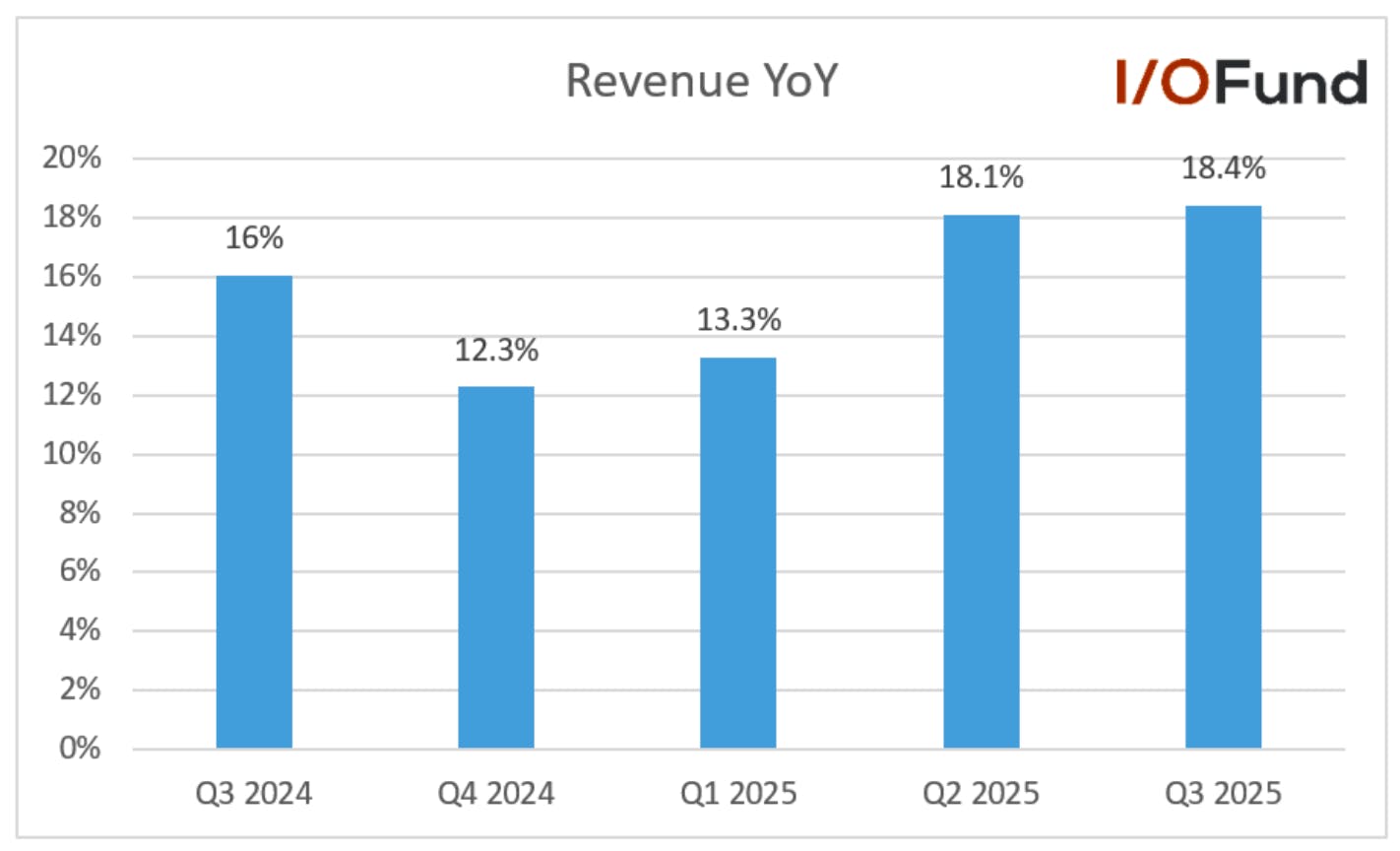
Chart showing Microsoft’s accelerating revenue growth from 13.3% in Q1 to 18.1% in Q2 and 18.4% year‑over‑year in Q3.

Microsoft’s revenue growth has accelerated from 13.3% in Q1 to 18.1% in Q2, and a further acceleration of 30 basis points in Q3 to 18.4% YoY. 

Source: YCharts

The last direct update on AI revenue we got from Microsoft is from fiscal Q2 ending last January 2025, where AI revenue was stated to be $13 billion, growing at a pace of 175% year-over-year. Microsoft did denote in fiscal Q3 that AI services contributed 16 points to Azure’s 35% YoY growth, up from 13 points in the prior quarter.  

Assuming AI drove Azure’s reacceleration from 35% to 39% in the past two quarters, the base case for Microsoft assumes AI contributing approximately 22 points to growth as of the prior quarter, fiscal Q1, or around 56% of its YoY growth in dollars. This could imply AI revenue at 26% of Azure’s total revenue, or around $25 to $26 billion on a nearly $100 billion annual run rate for Azure. Microsoft has also struck a new deal with OpenAI under which it has committed to $250 billion of compute capacity through 2032, and also signed a deal with Anthropic for $30 billion of compute capacity.

The company has consistently delivered strong profits, driven by higher software and cloud services revenue, and operational efficiencies. The company’s Q3 operating margin improved by 400 basis points sequentially and 230 basis points YoY to 48.9%, driven by operating leverage and higher-margin revenue. 
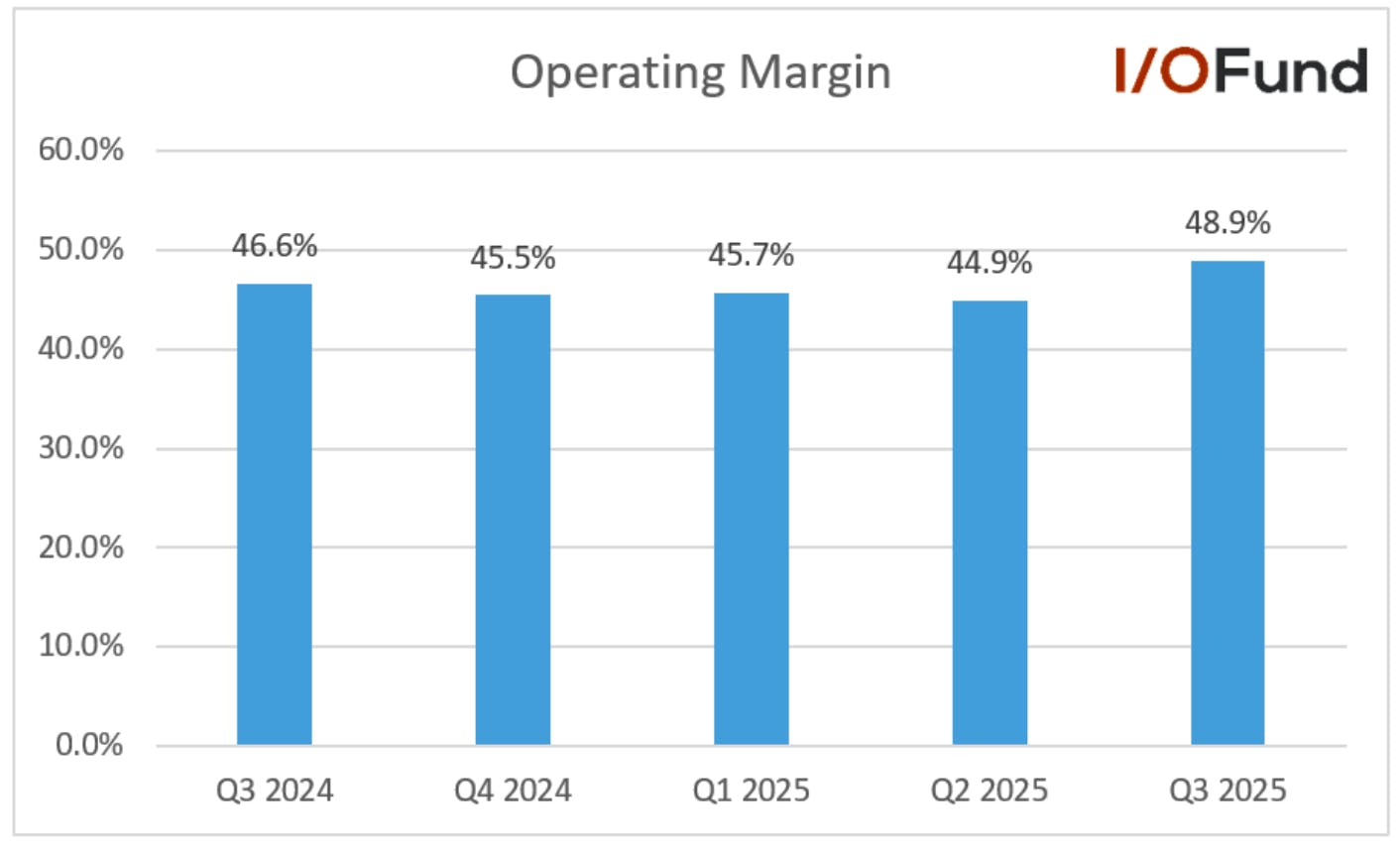
Graphic illustrating Microsoft’s Q3 operating margin increasing both year‑over‑year and sequentially.

Microsoft’s Q3 operating margin has improved YoY and sequentially. 

Source: YCharts

Microsoft’s capex in Q3 was $34.9 billion, an increase of 75% YoY from $20 billion in the year-ago quarter. The company’s strong capex growth was primarily driven by increasing demand for its Cloud and AI offerings. With strong accelerating demand, Microsoft is increasing its spending on GPUs and CPUs. Therefore, total spending is expected to increase sequentially in the next quarter. The company maintains a strong balance sheet with a net cash position of $58.8 billion. 

Takeaway: Given Microsoft’s large capex spending, the market is likely to be unconvinced in the near-term the AI contribution to Azure is happening quickly enough. If our math is correct, AI’s contribution is 1/3 of this fiscal year’s capex and we are years deep now – meaning its much lower in terms of contribution to cumulative AI capex. 

Keep in mind, Microsoft has publicly stated they will absorb grid costs for their AI infrastructure to avoid passing it off to consumers – which is ethically the right thing to do – yet this increases total capex cost per GW. Recently, Microsoft President Brad Smith stated: “We will pay utility rates that are high enough to cover our electricity costs in part by collaborating with utilities on plans to add the electricity supply that we will need.” It’s likely other Big Tech companies will follow suit. 

Google ($GOOGL): Record 83% Capex Surge to Scale Search and Google Cloud Momentum 

Google’s Q3 revenue grew by 16.2% YoY to $102.35 billion. Analysts expect Q4 revenue to grow 15.4% YoY to $111.3 billion. The company is witnessing momentum across its business segments with Google Cloud being a standout, with accelerating revenue growth from 28% in Q1 to 32% in Q2, and further accelerating to 34% YoY growth to $15.2 billion. This has been primarily driven by Google Cloud Platform, Generative AI Solutions, and AI Infrastructure.  

The Cloud business continues its trajectory of accelerated growth, with AI-driven revenue emerging as a key catalyst. Cloud backlog increased 46% QoQ to $155 billion, underscoring strong demand visibility and sustained momentum across enterprise deployments. Most importantly, over 70% of existing Google Cloud customers use the company’s AI products.
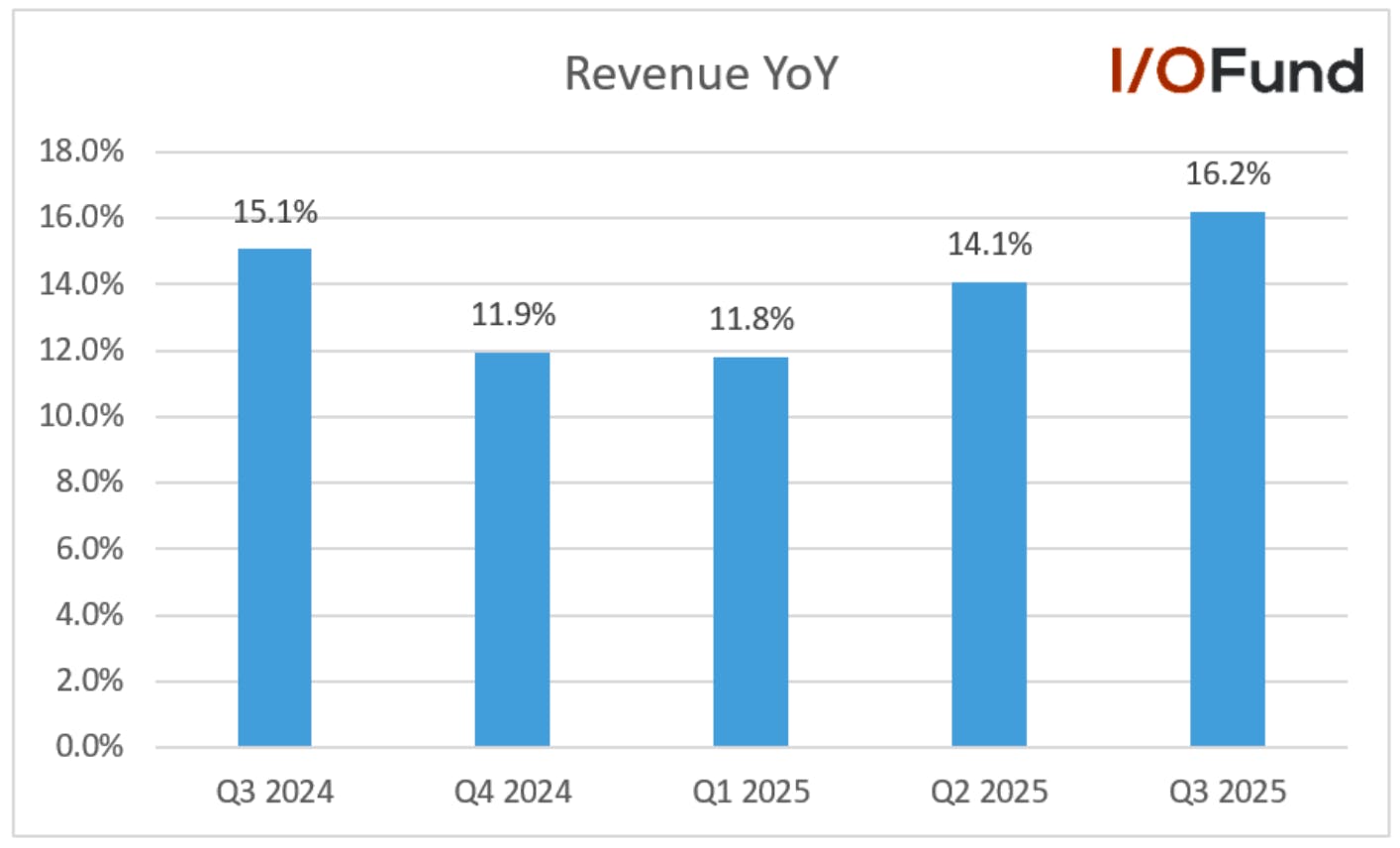
Chart showing Google's accelerating revenue growth from 11.8% in Q1 to 14.1% in Q2 and rising another 210 basis points to 16.2% year‑over‑year in Q3.

Google’s revenue growth has accelerated from 11.8% in Q1 to 14.1% in Q2, and a further 210 basis points acceleration in Q3 to 16.2% YoY.

Source: YCharts

Google said that its enterprise AI products in GCP are generating ‘billions’ in quarterly revenue but provided no specific breakout beyond that, and also did not provide an update on Search. However, assuming a similar split as Microsoft for AI contribution in the latest quarter, such as ~17 points or half of growth, this would project quarterly AI revenue to be ~$1.9 billion, or nearly $8 billion annualized, less than one-third of Microsoft’s current run rate. Google signed a deal with Anthropic in October said to be worth tens of billions, giving the Claude parent access to up to one million TPUs, bringing more than 1GW of capacity online in 2026.

mid

AI’s contribution to Search revenue could be larger, assuming that the acceleration from 10% YoY in Q1 to 15% YoY in Q3 is entirely driven by AI and AI Overviews, or 5 points. Search growth was ~12-13% in the second half of 2024 after the launch of AI Overviews and assuming ~2 point contribution from AI by Q4, this would roughly estimate AI’s contribution to Search at $800 million. As of Q3, under that 5 point assumption, AI’s contribution would be estimated at roughly $2.3-2.4 billion, or closing in on a $10 billion annual run rate.

Google’s Q3 operating margin improved 180 basis points YoY and 160 basis points QoQ to 34.1%, driven by operational efficiencies. Google’s high-margin advertising business remains the core profit engine, delivering durable and resilient earnings growth.
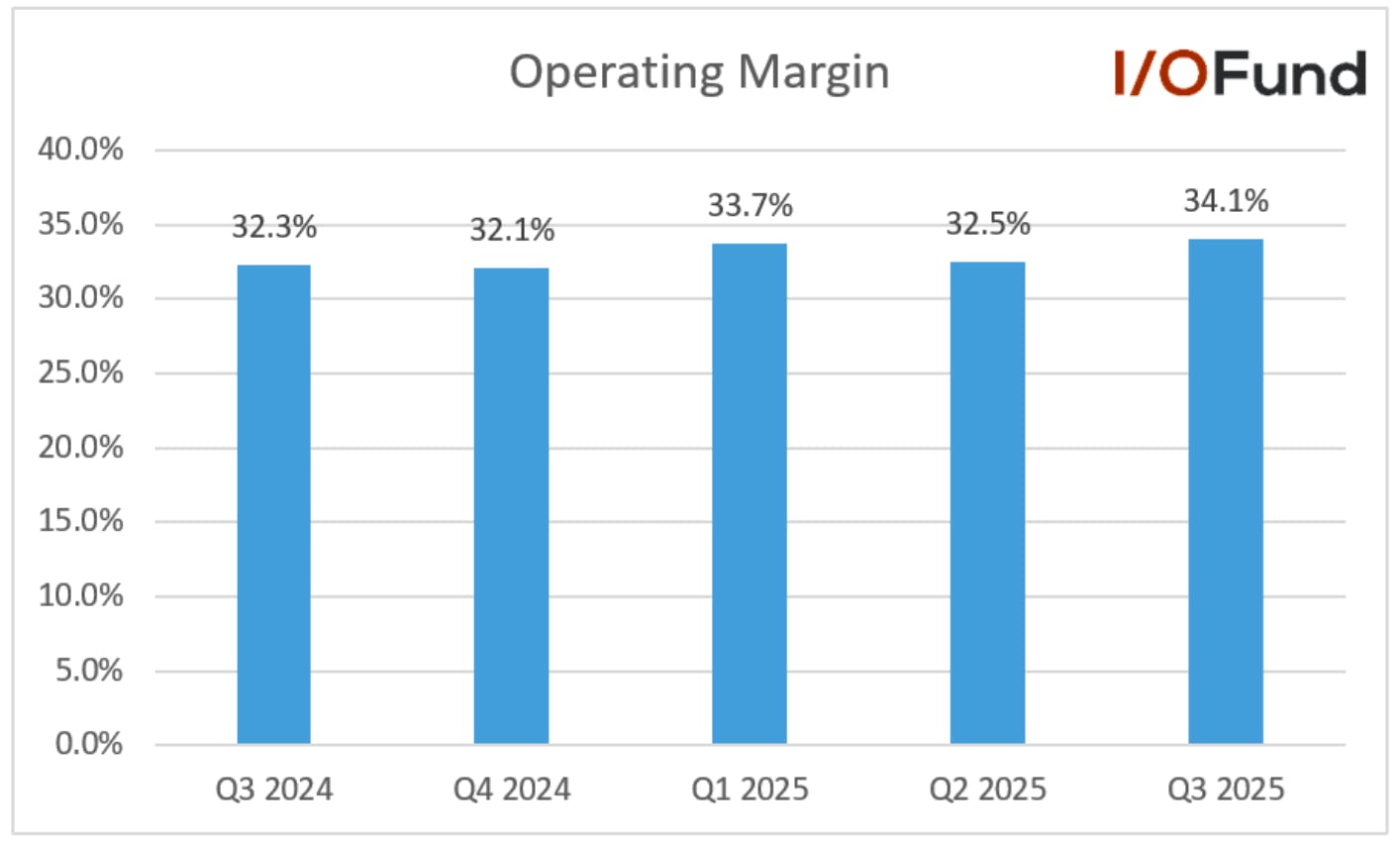
Graphic highlighting Google's Q3 operating margin improvement compared to both the prior year and the previous quarter.

Google's Q3 operating margin has improved YoY and sequentially. 

Source: YCharts

Google reported the fastest capex growth among Big Tech in Q3. The company’s capex grew by 83% YoY to $23.95 billion. Sequentially, it grew by 7% from $22.4 billion in the previous quarter. Management stated in the Q3 earnings call that they are witnessing positive returns on AI investments. “I would say it's not just early signs because we're seeing returns, obviously, in the Cloud business. You've heard us talk about the fact that we already are generating billions of dollars from AI in the quarter.”  

Looking ahead, the company expects to invest aggressively due to strong demand from cloud customers and growth opportunities across the company. Management expects 2025 capex to be in the range of $91 billion to $93 billion, up from the previous estimate of $85 billion. It represents YoY growth of 75% at the midpoint. Capex is expected to increase further in 2026, which supports our view that AI stocks will benefit. Google’s balance sheet remains robust, with a net cash balance of $76.9 billion, the highest among Big Tech companies.

Takeaway: 

Google reported the strongest returns last year across Big Tech, likely due to a combination of Google Cloud accelerating alongside an easier monetization with Search given advertising can see an immediate impact from automation. The company repeatedly emphasizes that integrating AI into Search improves advertiser outcomes for more effective campaigns, therefore, investors should keep an eye on the Search inflection as much (if not more so) than Google Cloud. 

In April 2025, Google introduced Ironwood v7, its first TPU designed specifically for inference. Another impetus for 2025’s strong performance is using its own silicon to drive inference at a lower cost curve, which will result in improved unit economics for Search and GCP. We discussed in detail the Google TPU Ironwood v7 rollout in our recent report to our free newsletter subscribers.

Amazon ($AMZN): AWS Reported the Fastest Growth since Q4 2022 

Amazon has the second slowest revenue growth among the Big Tech companies. The company’s Q3 revenue grew by 13.4% YoY to $180.17 billion. Revenue is expected to grow by 12.4% YoY to $211.14 billion in Q4. Q3 AWS revenue grew by 20.2% YoY to $33 billion, accelerating by 270 basis points from 17.5% growth in Q2. The company reported the fastest AWS growth since Q4 2022, driven by strong demand in AI and core infrastructure.   
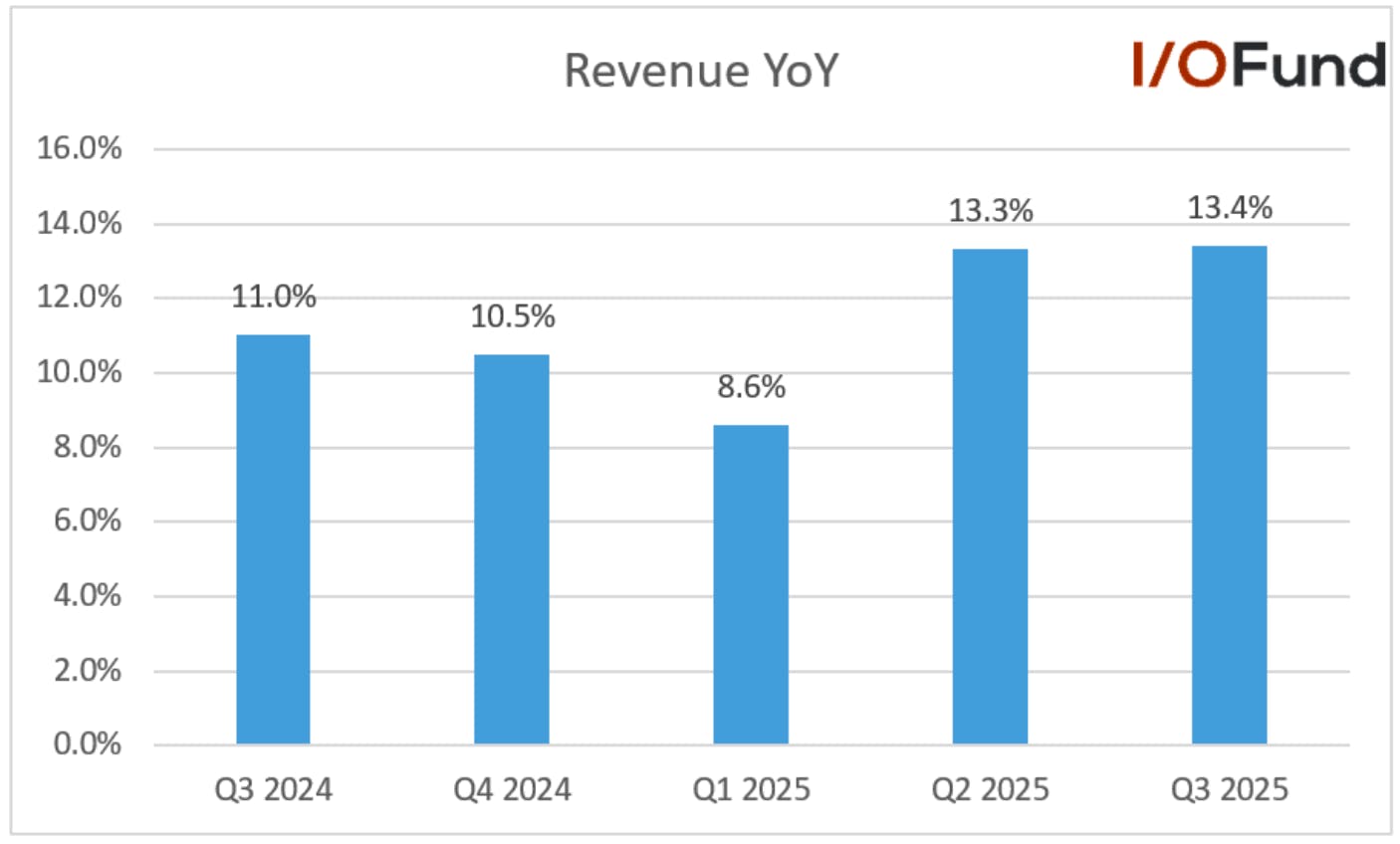
Chart showing Amazon’s accelerating revenue growth from 8.6% in Q1 to 13.3% in Q2 and rising further to 13.4% year‑over‑year in Q3.

Amazon’s revenue growth has accelerated from 8.6% in Q1 to 13.3% in Q2, then in Q3 to 13.4% YoY.  

Source: YCharts

Amazon has provided a few hints on its AI revenue, saying in Q2 that AI was a “fast-growing triple-digit year-over-year percentage multibillion-dollar business” and in Q3 that its Trainium chips had grown 150% QoQ and were a multi-billion dollar business. Again, assuming AI contributed roughly half or slightly above half of AWS’ 20% YoY growth, or 10 to 12 points, this would project AI revenue to be ~$2.8-3.3 billion, or more than $10-12 billion annualized. This would represent 8-10% of AWS’ TTM revenue.  Amazon also signed a $38 billion, multi-year deal with OpenAI in November to give the AI firm immediate access to Nvidia GPUs on AWS.

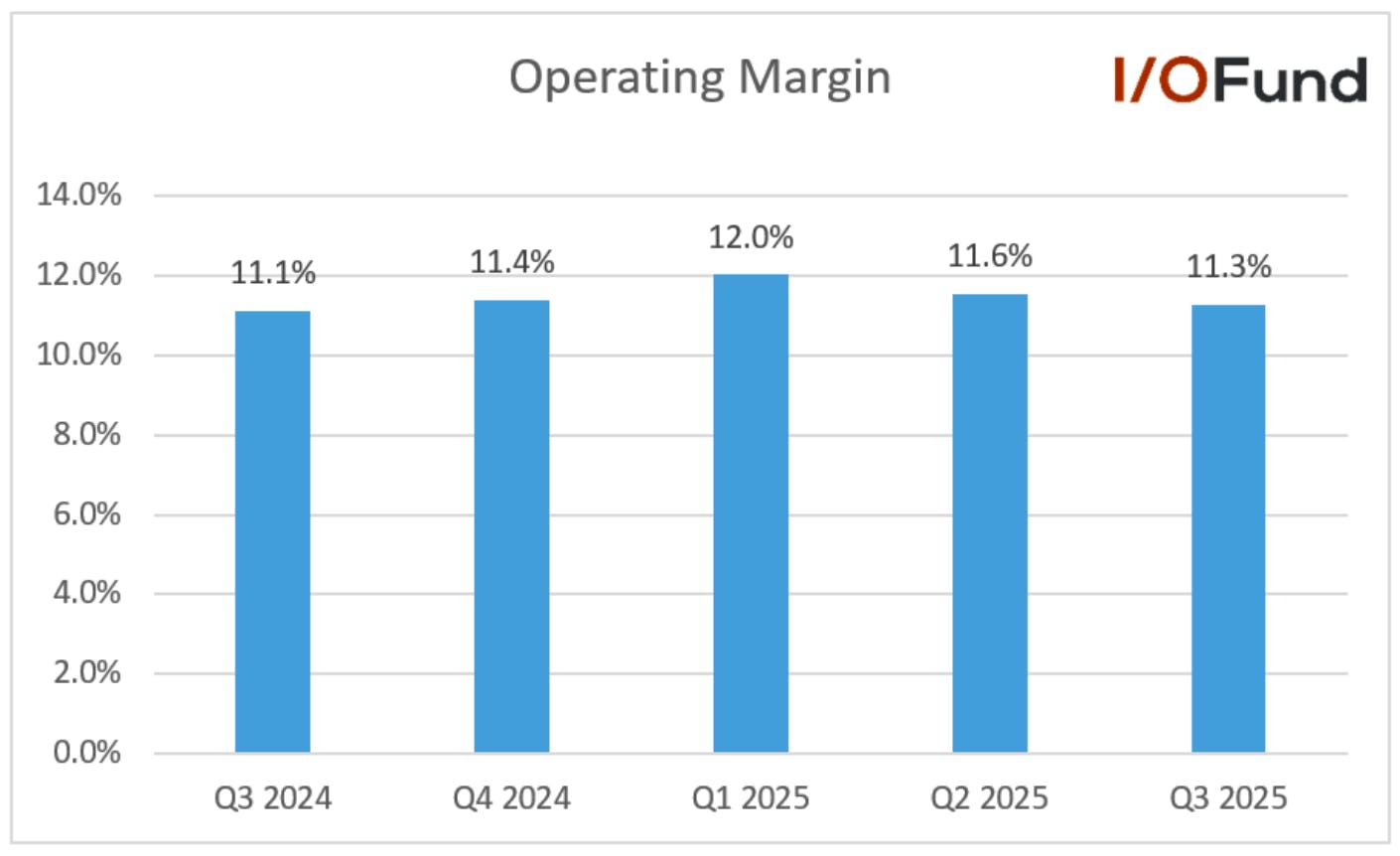
Amazon has the weakest margins among Big Tech companies, as the majority of its revenue is generated by its lower-margin e-commerce business. In Q3, operating margin improved modestly by 20 basis points YoY but declined 30 basis points sequentially to 11.3%.

Graphic showing Amazon’s Q3 operating margin with a marginal year‑over‑year improvement but a sequential decline compared to the previous quarter.

Amazon’s Q3 operating margin has improved marginally YoY and down sequentially. 

Amazon is the biggest spender among the Big Tech companies. Amazon’s capex in Q3 rose 55% YoY to $35.1 billion, with the company raising the 2025 capex guidance to $125 billion, up 51% YoY. The company’s CEO, Andy Jassy, said in the Q3 earnings call, “You're going to see us continue to be very aggressive investing in capacity because we see the demand. As fast as we're adding capacity right now, we're monetizing it.” The company has a net cash position of $43.5 billion.  

Takeaway:  

AWS enjoyed an early mover advantage to cloud infrastructure-as-a-service (IaaS) yet that advantage could be in jeopardy in the AI era. These concerns were alleviated somewhat in the last earnings report as AWS revenue reported 20% YoY growth for $33 billion in Q3, marking the fastest growth since Q4 2022. Amazon also struck a seven-year cloud computing deal with OpenAI, signaling renewed momentum. 

Similar to Google, AWS is building out its custom Trainium chip and expanded its AI-focused programs, including accelerators for startups and new cloud services that help enterprises adopt generative AI. The custom chips offer 4X performance and efficiency gains for better price-performance compared to GPUs. This helps to lower AWS’ compute costs and will lead to better margins given the more competitive pricing for training and inference at scale. 

Meta ($META): The $60B Advantage+ Engine 

Meta has the fastest growth among the Big Tech companies and is an early AI beneficiary. The company is benefiting from AI-driven recommendation models that are improving advertiser ROI and increasing time spent across its family of apps, supporting stronger advertising revenue growth. The company’s Q3 advertising revenue grew by 25.6% YoY to $50.1 billion, accelerating more than nine points since Q1 and marking the fastest growth in six quarters. 

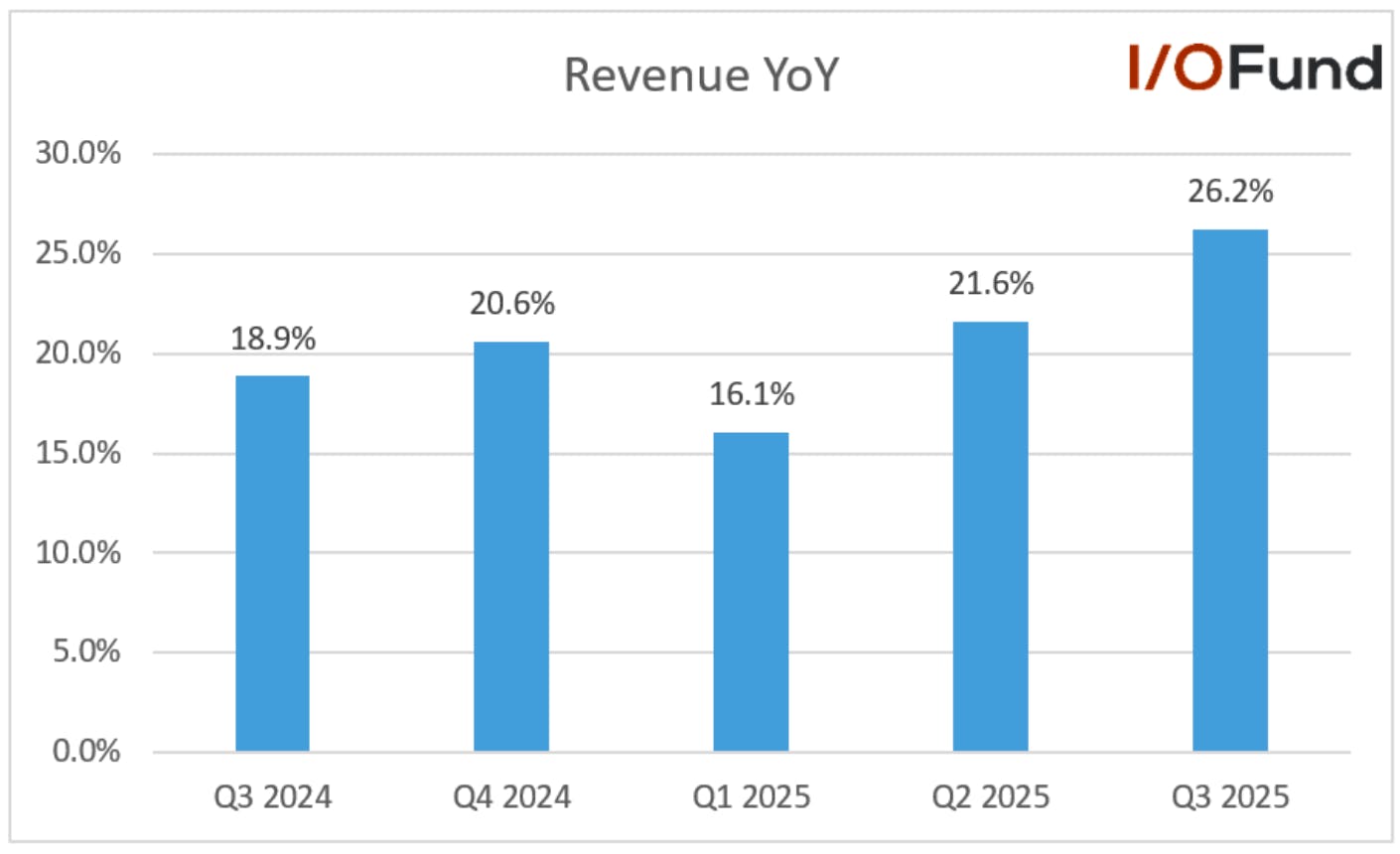
Chart showing Meta’s accelerating revenue growth from 16.1% in Q1 to 21.6% in Q2 and reaching 26.2% year‑over‑year in Q3.

Meta’s revenue growth has accelerated from 16.1% in Q1 to 21.6% in Q2, and to 26.2% YoY in Q3.  

Source: YCharts

In terms of AI-driven revenue, Meta’s Advantage+ is outpacing OpenAI by 3X and is also offering the strongest AI revenue among the FAAMGs – in Q3, the company revealed that its end-to-end AI-powered ads platform Advantage+ has reached a $60 billion annual run rate, just 3.5 years after its launch. We recently covered this in more detail in our free newsletter, The AI Revenue Leader Nobody Is Talking About—Second Only to Nvidia Stock

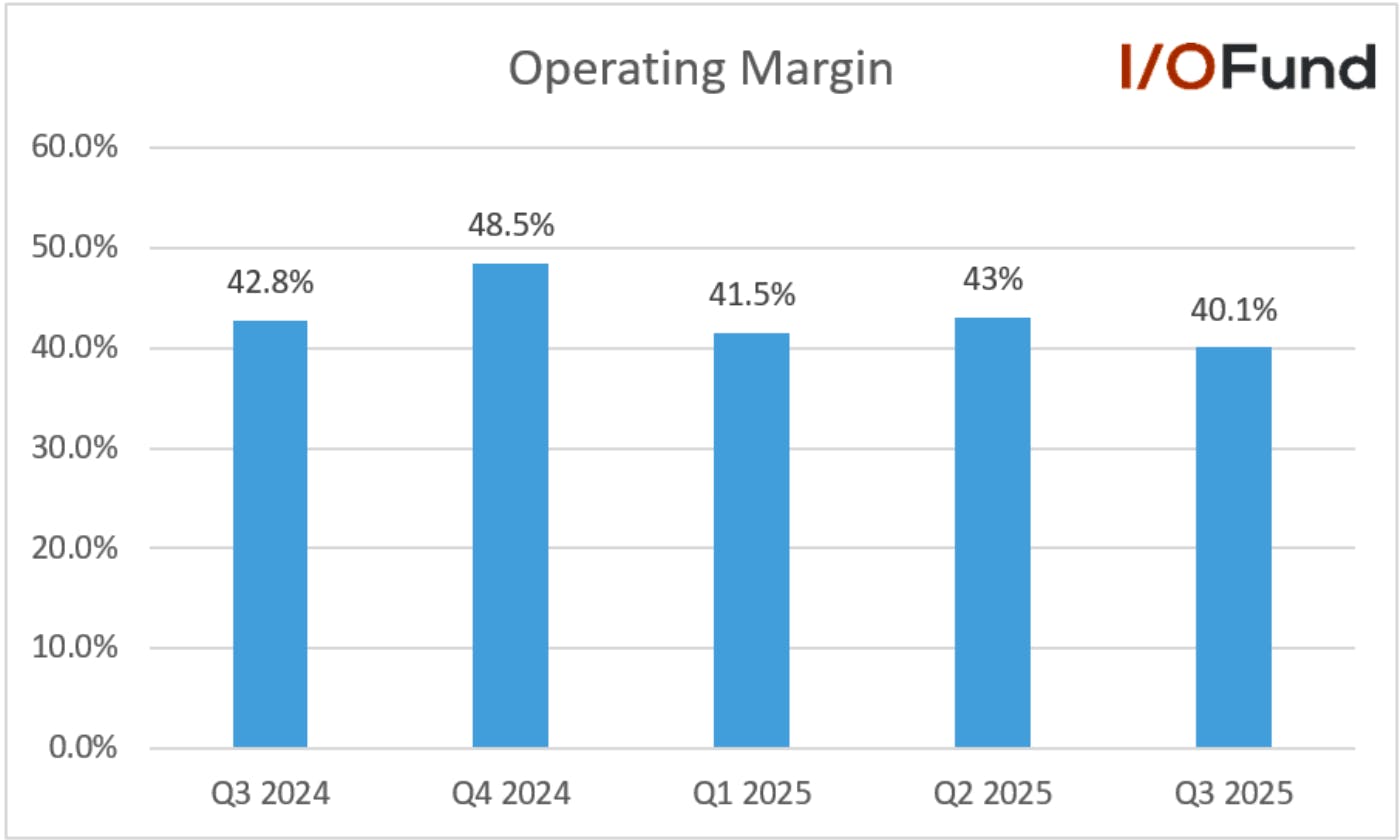
Meta is witnessing a deceleration in margins due to rising expenses supporting its AI infrastructure. Reality Labs also continues to incur losses, recording a $4.43 billion loss from operations in Q3 2025, and its cumulative losses now total $73.04 billion. During Q3 earnings, management mentioned that total expenses “will grow at a significantly faster percentage rate in 2026” driven by infrastructure costs, incremental cloud costs and depreciation, followed by employee compensation. In December, Meta’s CEO, Mark Zuckerberg, said that they plan to cut Metaverse projects by up to 30%, which is positive.

Graphic showing Meta’s Q3 operating margin decreasing both year‑over‑year and compared to the previous quarter.

Meta’s Q3 operating margin was down YoY and sequentially.

Meta’s Q3 capex grew by 111% YoY to $19.4 billion. The strong growth was primarily driven by investments in servers, data centers, and network infrastructure. Management also increased the 2025 capex to a range of $70 billion to $72 billion, up from the prior outlook of $66 billion to $72 billion. It represents a YoY growth of 81% from the prior year. Due to continued investments in AI infrastructure, Meta expects next year’s capex to be significantly higher than in 2025, particularly as their compute needs are higher than their expectations. Management stated in the earnings call, “As we have begun to plan for next year, it's become clear that our compute needs have continued to expand meaningfully, including versus our own expectations last quarter. We are still working through our capacity plans for next year, but we expect to invest aggressively to meet these needs, both by building our own infrastructure and contracting with third-party cloud providers.” 

Meta has the weakest balance sheet among the Big Tech companies with a net cash position of $15.7 billion. Meta has also entered a joint venture with Blue Owl Capital to fund its development of the Hyperion data center in Louisiana. Thereby, helping it to keep about $27 billion in debt off-balance sheet, where it would sit in a special-purpose vehicle tied to Blue Owl. While this approach may improve reported leverage and financial ratios, it carries inherent risks.  

Takeaway: 

Which company has the world’s most valuable data? While some will argue it’s a tie between Google, Meta, Microsoft and Amazon – I believe the contextual richness of social media data puts Meta at a slight advantage. In addition, Advantage+ is the second largest AI revenue segment on the market today; a stat this is materially underreported in the media. 

However, the biggest hurdle Meta faces is not visibly seen in the fundamentals but rather the company must convince developers to adopt its large language models, which are underwhelming on benchmarks compared to OpenAI and Anthropic's Claude. From where it stands today, it’s hard to see a path where Meta commercializes Llama. 

Instead, in the near-term, Meta’s opportunity lies in its ability to monetize its own platforms. This approach has proven to be unusually effective, given the revenue we are seeing from Advantage+. Over time, however, Meta will need to bring additional AI-driven applications to market to keep pace with competitors that are beginning to monetize not only infrastructure, but the full software stack built on top of it. 

Apple ($AAPL): Record Services Revenue 

Apple has the slowest revenue growth among Big Tech companies. The company’s Q3 revenue grew by 7.9% YoY to $102.5 billion. Revenue is expected to accelerate to 11.4% YoY to $138.5 billion in Q4. The services revenue achieved a record of $28.8 billion in Q3, growing 15.1% YoY.

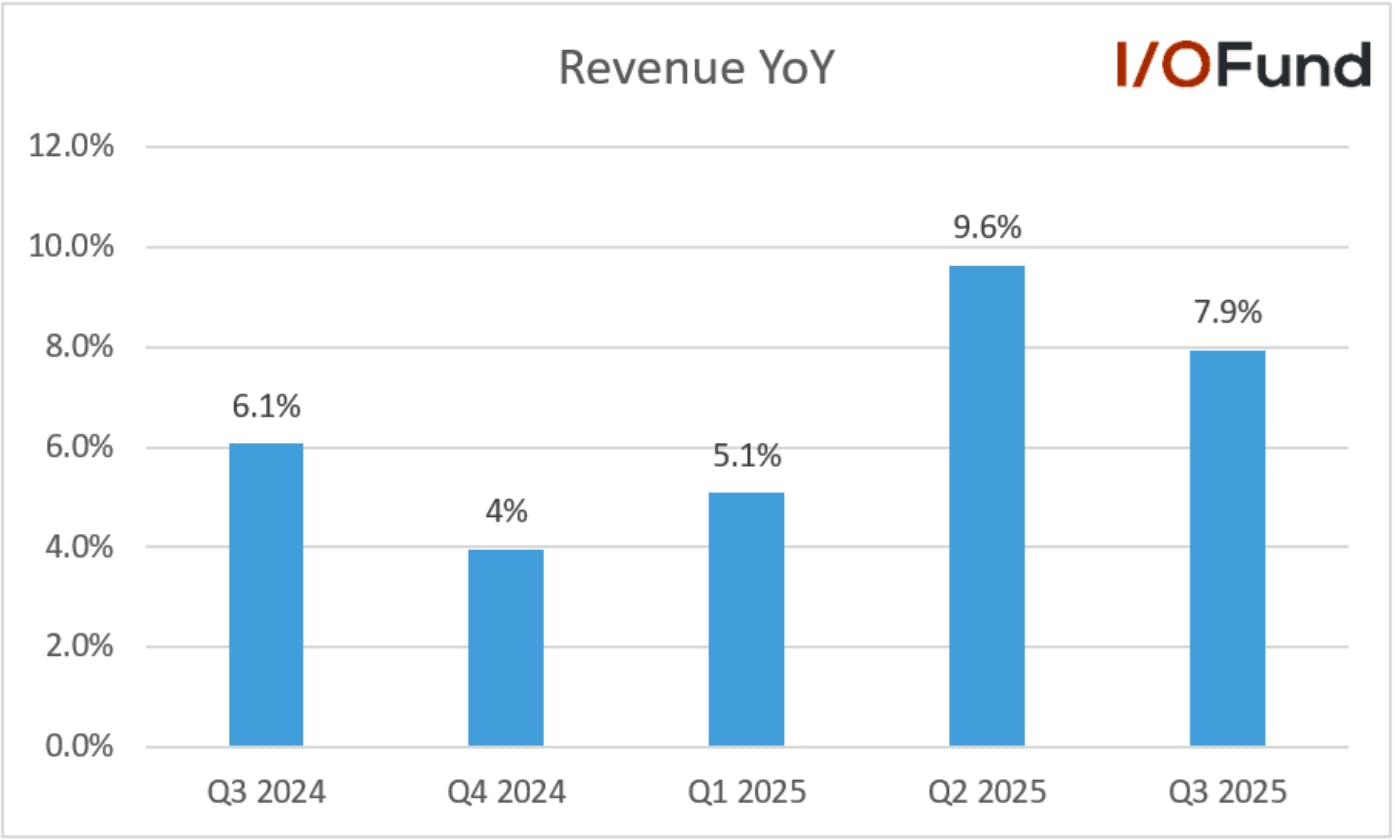
Chart showing Apple’s revenue growth rising from 5.1% in Q1 to 9.6% in Q2 before decelerating to 7.9% year‑over‑year in Q3.

Apple’s revenue growth has accelerated from 5.1% in Q1 to 9.6% in Q2 and decelerated to 7.9% YoY in Q3. 

Source: YCharts

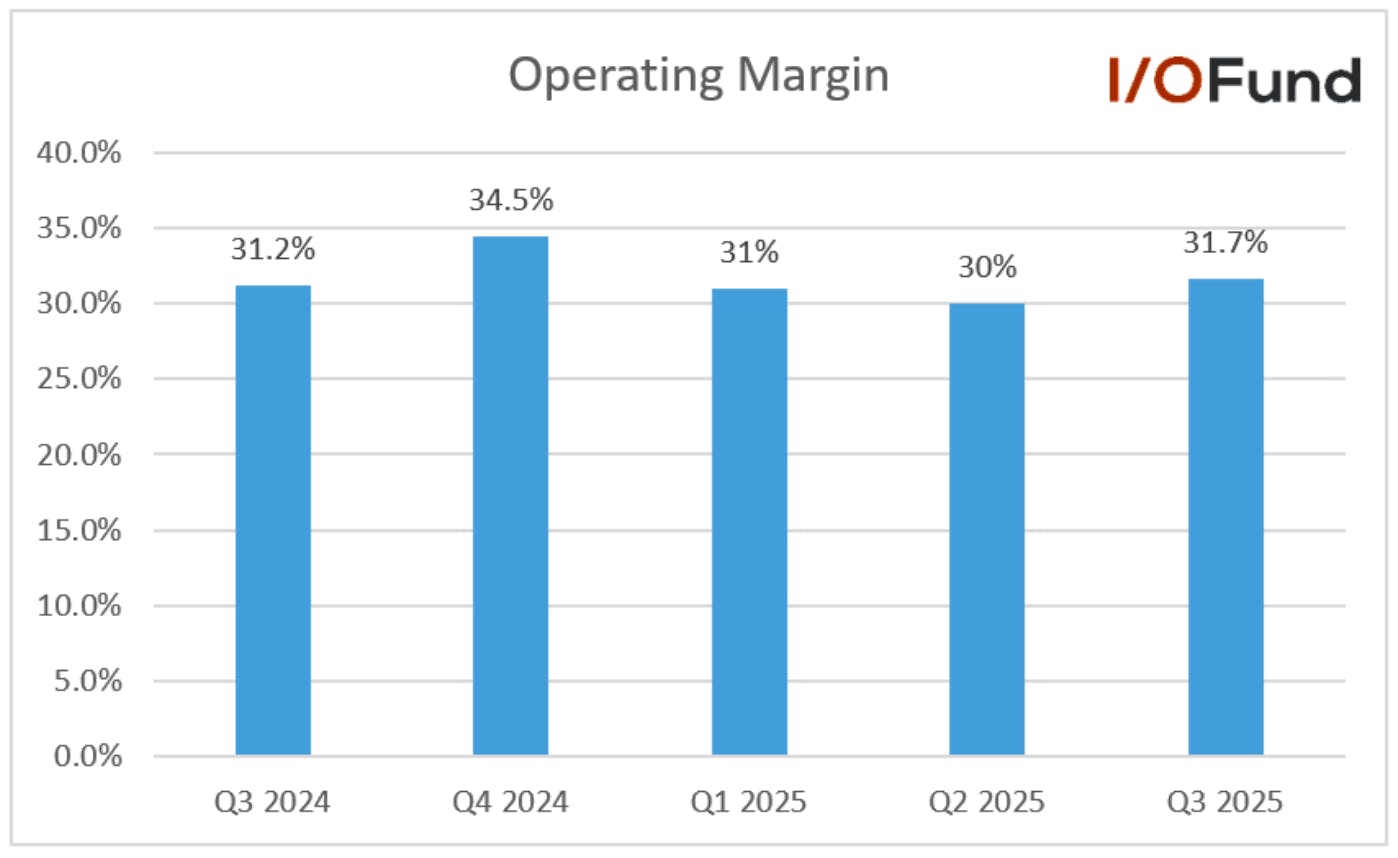
The company’s Q3 operating margin improved 50 basis points YoY and 170 basis points sequentially to 31.7%. The improvement in margins was primarily driven by favorable product mix, cost discipline, and a higher contribution of margin from better-margin services revenue.

Graphic showing Apple’s Q3 operating margin improving both year‑over‑year and compared with the previous quarter.

Apple’s Q3 operating margin was up YoY and sequentially. Source: YCharts 

Takeaway: 

Apple is not an infrastructure player, and thus given we are in the infrastructure phase of AI, one of the world’s most valuable companies is largely sitting this one out. While Apple benefits from exceptional margins, a fortress balance sheet, and strong cash generation, those strengths are not translating into leadership in the current phase of the AI training market. 

Our firm is focused on identifying AI’s biggest winners, and from that perspective, the opportunity cost of owning Apple over companies supplying AI infrastructure, energy, and on the brink of monetizing LLMs is significant. Apple may serve as a defensive allocation, but in my opinion, it does not offer the same asymmetric upside as the companies building—and monetizing—the backbone of the AI economy. 

This may change once more AI applications are in the hands of consumers, but for now, Apple is not part of our AI investment focus. 

Conclusion 

Based on this analysis, Google stands out as having the strongest Big Tech AI positioning today, given its ability to monetize AI directly through Search while simultaneously accelerating Cloud growth. To add to this, Google will see improved unit economics with custom silicon with a path to expand margins despite elevated capex. 

At the same time, we continue to see Big Tech broadly underperform AI hardware suppliers – even Google. For example, while many are celebrating Google’s stock performance last year, stocks like AMD and Micron effortlessly outperformed the 2025 Big Tech winner – as did dozens of lesser-known suppliers. This is easily visible in the QQQs returning 20.2% last year compared to SMH at 48.7%.  

In our view, the most compelling value creation in today’s AI market remains on the supply side, particularly among underappreciated hardware and infrastructure players. Rather than Big Tech, I/O Fund is focused on where AI demand is more broadly flowing, which companies are translating spend into profits, and how to position ahead of the next leadership shift. Viewed through a longer-cycle lens—especially around when monetization becomes meaningful—the expectation that Big Tech will lead as early as the first half of 2026 appears premature relative to other, more attractive areas of the market.

Next Wednesday, I’m dropping my Top 15 List of AI Stocks for Q1 2026 – this quarterly report ranks the companies I believe will define the next year and whose fundamentals are on fire. Notably, Big Tech did not rank high enough to make the list. The 42-page report is for I/O Fund premium members. Sign up now.

Royston Roche and Damien Robbins, Equity Analysts at I/O Fund contributed to this analysis.

Please note: The I/O Fund conducts research and draws conclusions for the Fund’s positions. We then share that information with our readers. This is not a guarantee of a stock’s performance. Please consult your personal financial advisor before buying any stock in the companies mentioned in this analysis.

Recommended Reading:

head bg

More To Explore

Newsletter

2026 Big Tech AI strategy comparison: Apple, Amazon, Google, Meta, and Microsoft transitioning to AI infrastructure monetization.

The $530 Billion AI Question: Which Big Tech Stock is Winning?

Big Tech is expected to invest $530 billion for building AI infrastructure in 2026, while the path to near-term monetization remains a question mark. As investor scrutiny around capital expenditure in

January 22, 2026
A futuristic city designed like a glowing circuit board, with the Palantir logo at the center.

Palantir Stock 2026 Forecast: Is Its High Valuation Sustainable?

Palantir’s stock has defied gravity, delivering steady performance that no other AI software stock has come close to matching (yet). For investors, the Palantir thesis is two-fold: the company must co

January 15, 2026
A high-impact graphic titled "Top 10 Tech Stocks of 2025" featuring a grid of futuristic technology icons including microchips, digital circuits, and AI data nodes.

Top 10 Tech Stocks of 2025: How the AI Trade Defied the Skeptics

The stock market in 2025 was a high-stakes tug-of-war between geopolitical tensions and the AI trade. Headlines were dominated by the DeepSeek fears, trade wars, tariffs, and persistent whispers of th

January 08, 2026
I/O Fund analyst team with a graphic promoting “The Best of I/O Fund’s Free Newsletter in 2025,” showing an upward chart and market-themed background.

Nvidia & Beyond: I/O Fund’s Best Free AI Stock Research in 2025  

We describe our newsletter as “free,” however the resources required to produce the research behind our weekly analysis are substantial. Delivering early, actionable insights consistently—and making t

December 31, 2025
A Fox Business live interview features Beth Kindig, Lead Tech Analyst at I/O Fund, discussing NVIDIA.

AI Stocks & Nvidia: I/O Fund’s 2025 Tech Media Highlights

As we close out a defining year for tech, we’re proud to share a few media moments where our theses met the mainstream. We are grateful that our readers trust us to cut through the noise - and we want

December 23, 2025
Meta logo glowing on a futuristic microchip with neon circuitry and rising stock chart, symbolizing AI growth and monetization.

The AI Revenue Leader Nobody Is Talking About—Second Only to Nvidia Stock

Meta’s stock sits at the center of the AI spending debate, as Big Tech continues to shock markets with outsized AI-driven capital expenditures. What is being overlooked is that Meta’s stock is already

December 18, 2025
Nvidia, Broadcom (AVGO), and AMD AI Accelerator Chips Comparison

Broadcom Stock: The Silent Winner in the AI Monetization Supercycle

The AI accelerator market will inevitably widen beyond Nvidia’s GPUs - the keyword is widen. More players will sell more AI systems as the market expands, and that growth supports both the clear leade

December 11, 2025
A large digital wave with Nvidia’s green accents, made of binary code and GPU textures, rising with an upward market graph.

Nvidia Stock and the AI Monetization Supercycle No One Is Pricing In

Two weeks ago, Nvidia blew the doors off with an earnings report that defies the company’s mega-cap scale. The long-awaited Blackwell and Blackwell Ultra architectures are shipping in volume, leading

December 04, 2025
Digital image of a glowing Bitcoin coin centered over a candlestick chart, representing price volatility and technical analysis in the crypto market.

I/O Fund Called the Bitcoin Selloff: What Liquidity & DXY Data Predict Next

In August, the I/O Fund warned that Bitcoin was entering a high-risk phase as global liquidity stalled, and sentiment patterns flashed caution. Since then, Bitcoin has fallen more than -35%. In this a

November 28, 2025
Illustration of a towering Nvidia GPU dominating over smaller Apple, Microsoft, and Google chip blocks, with stock market charts in the background symbolizing Nvidia’s market cap lead.

Why Nvidia Stock Could Reach a $20 Trillion Market Cap by 2030

The headline that Nvidia could reach a $20 trillion market cap by 2030 will trigger plenty of emotion — it sounds fantastical, full of hype, or like a prediction made far too early in the AI cycle. Ye

November 19, 2025
newsletter

Sign up for Analysis on
the Best Tech Stocks


Copyright © 2010 - 2026