Inside Nvidia’s $4B Optical Strategy—and Why CPO Changes Everything
May 08, 2026
Beth Kindig
Lead Tech Analyst
- Over the coming years, CPO is poised to see a dramatic uptick in demand, as data center operators push to expand the limits of AI.
- CPO provides key benefits over the two networking systems that dominate today: copper and optical transceivers. This includes up to 5x power efficiency versus transceivers and much higher bandwidth.
- Nvidia and Broadcom are huge players in CPO, and firms that gain qualification in their supply chains can be massive beneficiaries
Nvidia’s Rapid Networking Roadmap Is a Key Driver for AI Stocks
Within the AI investment theme, there is nowhere that the supply chain shifts faster than in networking, leading companies to gain content on new platforms or lose incremental share.
The reason is straightforward: much of the market is tied to a single customer, Nvidia; and Nvidia is rolling out new architectural iterations at an unusually fast pace. When it comes to networking, two of the most important architectural advancements are the increase in pod and cluster sizes and the transition to 200G per lane.
Last month, Nvidia made $2 billion equity investments in two separate optical component suppliers: Coherent and Lumentum. Nvidia is securing its supply chain as it ramps its co-packaged optics (CPO) roadmap and writing big checks to do so. These targeted moves signal that CPO, the next major architectural shift in AI networking, is moving from theory to reality.
Below, we break down why this transition is taking place and the key companies involved in the secular trend toward CPO.
Nvidia’s Move to Larger Pods: Scale-Up from NVL72 to NVL576 and Beyond
With Blackwell and Blackwell Ultra, Nvidia was fundamentally focused on solving scale-up problems, where the primary challenge is binding large numbers of GPUs into a single coherent node with a unified memory using ultra-dense, low-latency NVLink fabrics. This led to NVL72, which packed 72 GPUs into one rack, acting as one giant GPU.
However, with Rubin and Rubin Ultra, the company is pushing this concept further. Nvidia will offer Rubin in NVL72, NVL144, and NVL576 configurations, connecting two and eight racks respectively into a single NVLink scale-up domain. With NVL576, an eight-rack pod behaves as a single, massively larger GPU.
Rubin also doubles NVLink scale-up bandwidth versus Blackwell — 3.6 TB/s of bidirectional GPU-to-GPU bandwidth on the sixth-generation NVLink 6 interconnect, with 36 switches per NVL72 rack delivering 260 TB/s of total bandwidth versus Blackwell's 130 TB/s.
As these pods grow in size and require higher bandwidth, copper hits physical limits. Each step up in bandwidth degrades signal integrity faster, shortening the effective length of copper cables. A chart from Marvell illustrates this. At 100G per lane, the speed that now dominates deployments, copper can stretch around 5 meters using range-extending AECs. At 200G, the speed that will be used in Rubin Ultra, the effective length of AECs falls to just 3 meters.
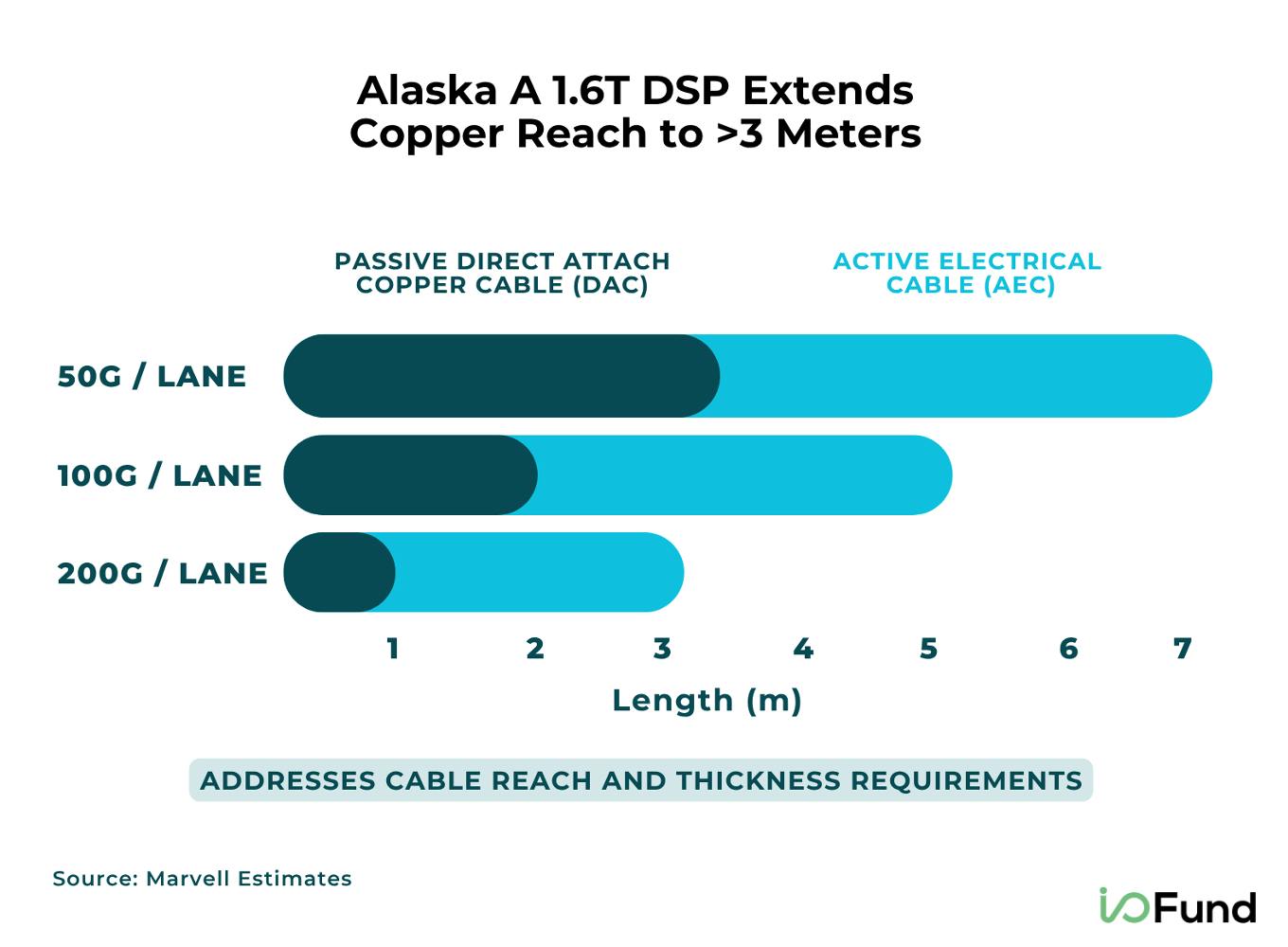
Comparison of passive direct attach copper (DAC) and active electrical cable (AEC) reach at increasing lane speeds. As bandwidth scales from 50G to 200G per lane, copper cable length degrades significantly, with AEC reach falling to roughly 3 meters at 200G. Source: Marvell estimates.
According to Supermicro, one GB300 NVL72 rack is 0.6 meters wide. Rubin Ultra NVL576 will place eight racks side by side, resulting in a width of nearly 5 meters; too long to connect the entire pod at 200G using AECs.
In turn, Nvidia will use CPO for rack-to-rack connections in Rubin Ultra NVL576, although copper will still be used for connections within each rack. This is why Huang said that customers will be able to buy Rubin Ultra in “copper, or copper plus CPO." Copper plus CPO will be used in NVL576, while only copper will be used in smaller configurations. Huang went on to say, “two years from now, at [NVL]1152, it's all CPO because there's a limit to how far it could take copper.”
Co‑Packaged Optics as a Structural Shift for Nvidia's Stock
With pod sizes and bandwidth only increasing, the transition from copper to optics in scale-up is structural, not cyclical. CPO is positioned as the eventual endpoint of that transition.
Notably, companies in the supply chain are moving to reflect this. Credo recently acquired DustPhotonics to diversify away from AECs, the product the company has built its name on. Through this deal, Credo adds silicon photonics to its portfolio, with the company expecting to generate $500 million in optical revenue in FY2027. For reference, Credo reported its Q3 FY2026 results in March. This will aid the company in bridging the gap between AEC content and optics content.
Marvell acquired Celestial AI as it looks to offer CPO solutions. During its Q4 FY2026 results in March, Marvell projected its CPO revenue reaching a $500 million annualized run rate in Q4 FY2028 before doubling to $1 billion by Q4 FY2029. Nvidia and Marvell also recently announced a strategic partnership, connecting Marvell to Nvidia’s AI factory ecosystem through NVLink Fusion. Customers can easily pair Marvell products, including custom XPUs, certain scale-up networking, and silicon photonics, with Nvidia’s rack-scale AI compute and other components using NVLink. Additionally, Nvidia has invested $2 billion in Marvell.
Scale-Out CPO: Boosting Performance and Efficiency Versus Transceivers
Scale-out networking poses a different challenge for CPO adoption, as companies look to connect larger pods into massive clusters with 1 million AI accelerators. Copper has already been largely phased out of scale-out, as distances are far too long. This has led to optical transceivers becoming a key solution.
Optical transceivers take electrical signals sent through copper traces in ASIC switches and convert them into optical signals. These signals then flow through fiber optic cables, which can stretch kilometers at high bandwidths without losing integrity.
However, using optical transceivers also comes with significant drawbacks. Most notably, they consume much more power than copper and are more expensive. This is the trade-off that data center operators are increasingly having to accept in exchange for longer cable lengths and/or higher bandwidth.
mid
CPO offers something closer to a best-of-both-worlds solution, allowing for both long cable lengths as well as better power efficiency, higher bandwidth, and lower latency compared to transceivers. CPO provides better power efficiency by drastically shortening the distance signals flow through copper before conversion to light.
In most cases, CPO eliminates the need for power-hungry DSPs, which clean up the degraded electrical signal before sending them to transceivers. This comes as CPO embeds optical engines in the same package as the switch. A visual from Nvidia illustrates this difference clearly. The orange line (copper) is much shorter in the CPO diagram, and the DSP is gone, allowing the electrical signal loss to be significantly lower.
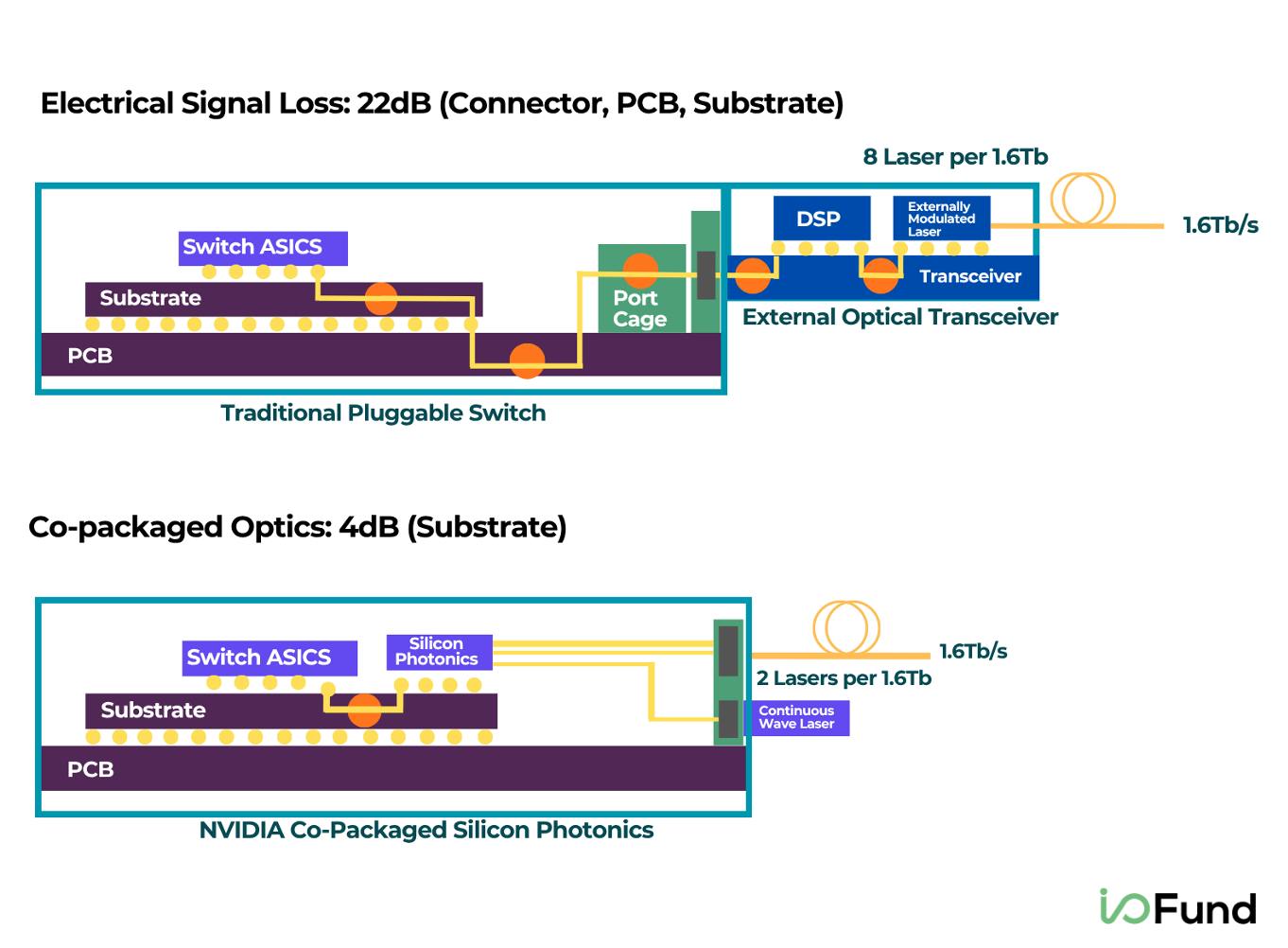
Comparison of a traditional pluggable switch architecture and Nvidia’s co‑packaged silicon photonics design. In pluggable systems, electrical signals travel across the PCB, connectors, and port cage before reaching an external transceiver, resulting in roughly 22 dB of signal loss and requiring DSPs and multiple lasers. Co‑packaged optics integrate silicon photonics alongside the switch ASIC, shortening the electrical path to the substrate, reducing loss to about 4 dB, and improving power efficiency at 1.6 Tb/s. Source: Nvidia
CPO also offers higher bandwidth and lower latency versus pluggables. As inference workloads rise, largely driven by agentic AI, improving these variables is key. Automating workflows in enterprise environments means higher data rate requirements compared to the use of chatbots.
LLM developers will compete on how fast their models can execute tasks, making latency reduction paramount. Reducing latency is particularly relevant going forward, as many expect inference to overtake training as the dominant AI workload over the coming years.
McKinsey projects that by 2030, inference will account for 93 GW of data center demand, versus 62 GW for training. It sees inference demand rising by a CAGR of 35% through 2030, significantly faster than training’s 22% CAGR.
In summary, as AI workloads continue expanding, power efficiency, bandwidth, and latency improvements are vital to increasing performance while limiting costs. CPO is a key solution that allows for these advancements.
CPO Adoption: Gated by Low-Cost Copper and Reliability Concerns Near Term
Despite these benefits, CPO faces constraints that limit its adoption today. Copper and optical transceivers are generally sufficient at today’s bandwidth levels and cost less than CPO upfront. With hyperscalers already spending hundreds of billions on AI infrastructure annually, staying on lower-cost solutions makes more sense for now. In line with this, Broadcom CEO Hock Tan said that the industry will “try to scale up within a rack in copper as long as possible.” Echoing this, Jensen Huang said, "We should scale with copper [as far as] we can, as long as we can."
CPO reliability is another hurdle that developers are tackling. Theoretically, CPO should be more reliable than pluggables, as it consolidates many otherwise separate parts, creating fewer points of failure. However, because CPO has not been deployed at scale, there is a lack of real-world evidence to support this idea.
This is key, as when a CPO chip fails, servicing costs are much higher. Pluggable transceivers can be easily swapped out when they fail, but this is not possible when optical engines are embedded in the switch package. CPO servicing requires removing the full switch to have a complex repair performed or replacing it entirely.
To accelerate adoption, CPO providers must demonstrate strong reliability of the technology. On this front, Broadcom recently made a significant step forward. In a study conducted with Meta, the company showed a 5X improvement in serviceable failures compared to pluggables. The study also found no unserviceable CPO failures after 15 million hours of device testing. This provides solid initial evidence of CPO reliability.
Still, these tests were performed in a lab environment, not in actual data centers. This underscores the need for more CPO reliability testing in real-world environments before adoption hits an inflection point. The industry has an opportunity to generate this data through early CPO deployments in 2026 and 2027, setting the stage for increased adoption thereafter.
Nvidia and Broadcom Are Leading the Push Into CPO Networking
Nvidia and Broadcom are the two market leaders in CPO, as both are leaders in switching ASICs. Nvidia has the largest networking business in the world, with revenue hitting $11 billion. Meanwhile, one-third of Broadcom’s $10.7 billion in total AI revenue, or approximately $3.6 billion, came from networking last quarter.
Broadcom has been developing CPO since 2021 and is now shipping its third-generation scale-out product, the Tomahawk 6 – Davisson switch, which delivers 3.5x better power efficiency than pluggables. Broadcom is currently developing its fourth-generation CPO product, which will double the per-channel bandwidth compared to Davisson.
Meanwhile, Nvidia will use CPO for scale-up NVL576 approximately a year from now. For scale-out networking, Nvidia has its Spectrum-X Ethernet Photonics switch, which it says will deliver 10X greater network resiliency with CPO, bringing 1.6T silicon photonics (SiPho) optical engines directly onto the switch.
Maximum bandwidth doubled to 102.4Tb/s per ASIC, matching Broadcom’s Davisson, though Nvidia is also offering the industry’s first four-ASIC design, delivering 409.6Tb/s bandwidth. Notably, Spectrum-X Ethernet switches drive up to 5X better power efficiency with a lower cost versus pluggable transceivers.
CPO adoption should bring substantial benefits to Nvidia and Broadcom. However, companies that gain qualification within Nvidia and Broadcom’s CPO supply chains are poised to be among the biggest winners from this networking shift. I/O Fund specializes in identifying these types of lesser-known networking players.
Subscribe to Advanced Market Signals to receive I/O Fund’s best thinking on the stocks with massive potential as the shift to CPO progresses, including real-time trade alerts for every entry and exit, portfolio access, and weekly live webinar access. Sign up here
Optical and CPO Stocks: Coherent, Lumentum, and Corning
Coherent, Lumentum, and Corning are optical and CPO beneficiaries to be aware of. All three are benefiting from scale-out transceiver adoption today and are positioned to benefit from CPO gradually replacing copper in scale-up over the coming years. Below, we break down what each company supplies, their opportunity ahead, and how the market is valuing them today.
What Each Company Supplies in the CPO and Optical Ecosystem
Coherent and Lumentum: Lasers, Silicon Photonics, and Nvidia’s CPO Supply Chain
Coherent and Lumentum make pluggable optical transceivers and high-powered lasers, critical components within transceivers. While CPO will replace transceivers in certain instances, it also drives higher content for the SiPho-laser ecosystem and CPO photonics components, as SiPho will serve as the backbone for the CPO switches. This extends beyond the photonics ICs to include CW lasers and ultra-high-power (UHP) lasers for external light source (ELS) modules.
Coherent and Lumentum expect to be leading suppliers of these components within Nvidia's CPO rollout. Nvidia has rubber-stamped its supply chain relationship with both firms, investing $2 billion in each to fund manufacturing capacity expansions.
Corning’s Role in CPO
Corning plays a different role in the ecosystem as one of the top fiber optic cable makers. CPO adoption will translate into much more fiber optic cable usage in data centers. According to Marvell, this increase will be very significant. They say CPO will enable "tens of thousands of fiber per rack, no longer just a few thousand." Marvell believes the increase in fiber usage will be so large that the industry must create new innovations to manage it.
Optical Demand Is Inflecting Across AI Data Centers
Demand is already inflecting for these companies. Lumentum's revenue rose by over 65% YOY to $665.5 million in its latest quarter, and adjusted operating margin expanded by 1,730 basis points. Lumentum expects growth to accelerate to around 90% YOY next quarter and an approximately 500 basis point sequential operating margin expansion.
Coherent saw revenues rise by 34% YOY in its data center and communications segment last quarter, driven by growth in 800G and 1.6TB transceivers. The company's data center book-to-bill ratio exceeded 4X, showing how dramatically demand is outstripping supply.
Meanwhile, Corning's Enterprise business, which captures sales inside data centers, grew 61% YOY in 2025 to $3 billion, with the hyperscale data center portion growing significantly faster.
Optical and CPO Market Outlook Through 2030
The market ahead of these firms is substantial. Corning has made very strong statements around its opportunity to benefit from scale-up CPO adoption. The firm believes that its scale-up CPO opportunity is at least 2-3X larger than its Enterprise business, implying an incremental opportunity of $6 billion to $9 billion. Management believes it could be even larger as it spends more time with partners in the ecosystem. Compared to Corning's 2025 core sales of $16.41 billion, this incremental market is very significant.
Coherent estimates that its serviceable addressable market (SAM) in CPO will be more than $15 billion by 2030. This compares to Coherent's LTM revenue of $6.29 billion. Notably, SAM estimates represent just the portion of the total addressable market (TAM) that a company believes it can realistically serve.
Related to this, Lumentum estimates that its current optical AI TAM is $18 billion today. It sees this figure increasing by more than 5X to over $90 billion in 2030. These forecasts help illustrate the huge opportunity that exists for smaller players in the optical and CPO market.
CPO Shipments Are Set to Gain Share
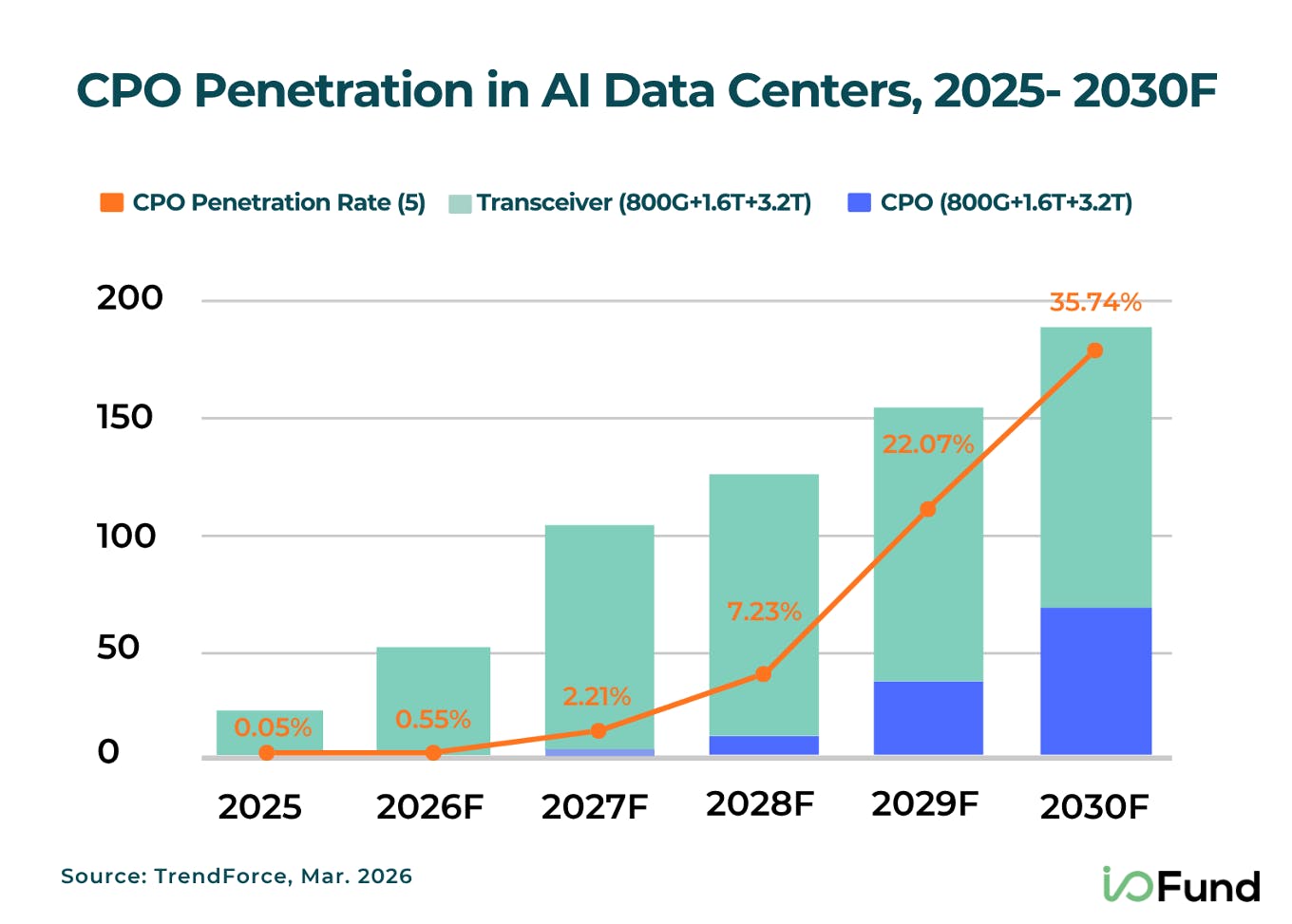
Importantly for Coherent and Lumentum, TrendForce estimates that both transceiver and CPO shipments will rise greatly over the coming years, although CPO will increasingly take share. Forecasts show optical transceiver shipments continuing to rise from around 50 million in 2026 to nearly 200 million by 2030. Simultaneously, CPO shipments exceed 50 million by 2030, and increase their penetration rate within optical networking from less than 1% to more than 35%.
TrendForce forecast for CPO penetration in AI data centers from 2025 through 2030. Total optical shipments continue to rise, while co‑packaged optics scale rapidly from negligible adoption in 2025 to more than 35% penetration by 2030. The data highlights a structural shift toward CPO as data center bandwidth and power efficiency requirements increase. Source: TrendForce, March 2026.
Valuation
How Much CPO Upside Is Already Priced Into Networking Stocks
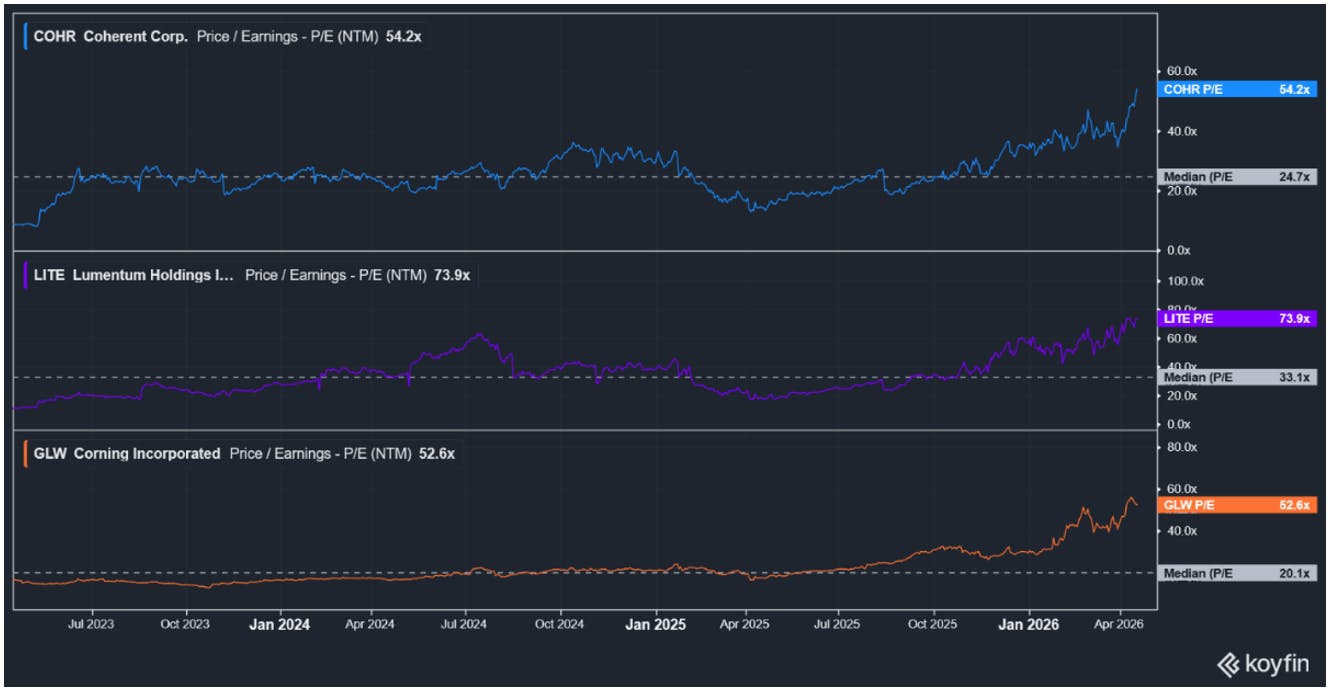
The market has already moved to reflect much of the optical and CPO prospects for these stocks. All three are trading at or very close to their all-time high forward P/E ratios, with these multiples being 2.2-2.6X higher than their median levels over the past three years. Since the end of June 2025, Lumentum has delivered a return of 950%, while returns exceed 280% and 210% at Coherent and Corning, respectively.
Chart showing the current and three-year median forward P/E ratios of Coherent, Lumentum, and Corning. Coherent’s forward P/E is 54.2x versus a median of 24.7x, Lumentum’s forward P/E is 73.9x versus a median of 33.1x, and Corning’s forward P/E is 52.4x versus a median of 20.1x. Source: Koyfin
Conclusion
CPO Is a Multi‑Year Structural Tailwind for AI Infrastructure
The AI networking stack is moving secularly towards optics and away from copper. Nvidia's pod-scaling roadmap clearly demonstrates this. From NVL72 in Blackwell today to NVL576 with Rubin Ultra, NVL1152 with Feynman, and potentially beyond, the physical limits of copper cannot be engineered around. With CPO emerging as the preferred optical form factor, adoption will continue to increase.
How quickly the transition moves is up for debate. Broadcom and Nvidia management teams have both said that copper will be used for scale-up as long as possible, and TrendForce estimates that CPO penetration will remain in the low single digits through 2027 before inflecting. Reliability validation in real-world deployments over the next 12-24 months will be a key factor in determining the pace, while there are bridge solutions, such as NPO and LPO.
Regardless, the supply chain is already shifting. Component makers and switch vendors are positioning for a networking stack that looks considerably different from today's. For investors, the CPO transition is a clear multi-year theme in AI infrastructure, with implications that extend well beyond the handful of names the market is focused on.
My updated Q2 Top 15 AI Stocks report was just released. The report runs over 70 pages and identifies the 15 stocks I believe will lead the AI market this quarter. The report is built on the same investment discipline that identified massive winners like Bloom Energy and Lumentum early in their AI cycle.
Since our inception in May 2020, the I/O Fund has delivered a cumulative return of 326% — outperforming the Nasdaq-100 by 152 percentage points. Subscribers receive the Top 15 AI Stocks report, real-time trade alerts, full portfolio access, and weekly one-hour webinars. Sign up now.
Please note: The I/O Fund conducts research and draws conclusions for the company’s portfolio. We then share that information with our readers and offer real-time trade notifications. This is not a guarantee of a stock’s performance and it is not financial advice. Please consult your personal financial advisor before buying any stock in the companies mentioned in this analysis. Beth Kindig and the I/O Fund own shares in NVDA at the time of writing and may own stocks pictured in the charts.
Recommended Reading:
More To Explore
Newsletter
Inside Nvidia’s $4B Optical Strategy—and Why CPO Changes Everything
Within the AI investment theme, there is nowhere that the supply chain shifts faster than in networking, leading companies to gain content on new platforms or lose incremental share. The reason is str
Is Nvidia Stock a Buy? Why Semiconductor Strength May Signal a Market Top
In this report, we take a deeper look at the technical scenarios, which suggests that Nvidia’s latest high is shaping up to be a potential bull trap. That view is corroborated by the broader semicondu
Nvidia’s $20 Trillion Thesis Is Intact. My 2026 Allocation Isn't
The thesis on Nvidia's hardware moat has played out exceptionally well, but that also highlights one of the biggest risks investors face, which is becoming emotionally attached to a winning stock. Whi
Bitcoin 2026 Price Prediction: Why the Dollar, Global Liquidity and Volume Signal More Downside Ahead
In our last Bitcoin analysis, "Bitcoin After the Cycle Peak: What Comes Next and How We're Positioning", we argued that Bitcoin was closer to a cycle low than most believed, even if one final drop rem
2026 Stock Market Outlook: Cycle Convergence & What's Next
In our last broad market update, the S&P 500 was trading near 6,850, grinding through its fifth consecutive month of going nowhere. I drew a clear line in the sand at the 6,780 level. This was where t
Arm Stock Could Win as Agentic AI Shifts the Bottleneck to CPUs
Arm unveiled an AGI CPU to address one of AI’s biggest bottlenecks, which is orchestration. During the chatbot craze of 2023-2025, GPUs did most of the heavy lifting while CPUs had become an afterthou
Nvidia Stock Prediction: The Path to a $20 Trillion Market Cap is Strengthening
The $20 trillion market cap will not come from GPU unit growth alone, though unit growth remains very important. Rather, the value proposition will increasingly focus on economic output. This marks a
Nvidia Stock to See New Growth Catalyst; 35X Faster AI with Groq 3 LPX
At GTC this week, Jensen Huang stated the revenue opportunity for Nvidia’s artificial intelligence chips may reach at least $1 trillion through 2027, up from a previous target of $500 billion. While t
Palantir Stock is Out of Favor, but is the Growth Engine Still Intact?
Palantir stock sold off 38% from November to February and is down about 10% year-to-date. Even so, it has held up better than many software peers given the software sector has taken it on the chin lat
“Tech Bubble” Warnings Cost Investors a 550% Nasdaq-100 Run
Investors have been hearing “tech bubble” warnings for more than a decade — but instead of collapsing, the Nasdaq‑100 has gained 550%. If we look back ten years ago to 2015, headlines such as “Sell ev